Paid AI research jobs from home are becoming one of the more interesting paths inside remote AI work because they sit between writing, fact-checking, analysis, and model evaluation. They are not the same as traditional academic research, and they are not the same as basic data entry. In many cases, this kind of work asks a remote worker to read a prompt, review information, compare answers, judge the quality of evidence, and explain which result is more accurate, useful, or trustworthy.
The phrase "AI research job" can be confusing for job seekers. Some listings use it to describe web research. Some use it for AI model training. Some use it for expert review, prompt evaluation, chatbot response review, RLHF, data annotation, or AI rater work. The important question is not whether the listing uses the perfect title — it is whether the task actually requires research judgment.
What Counts as Real AI Research Work?
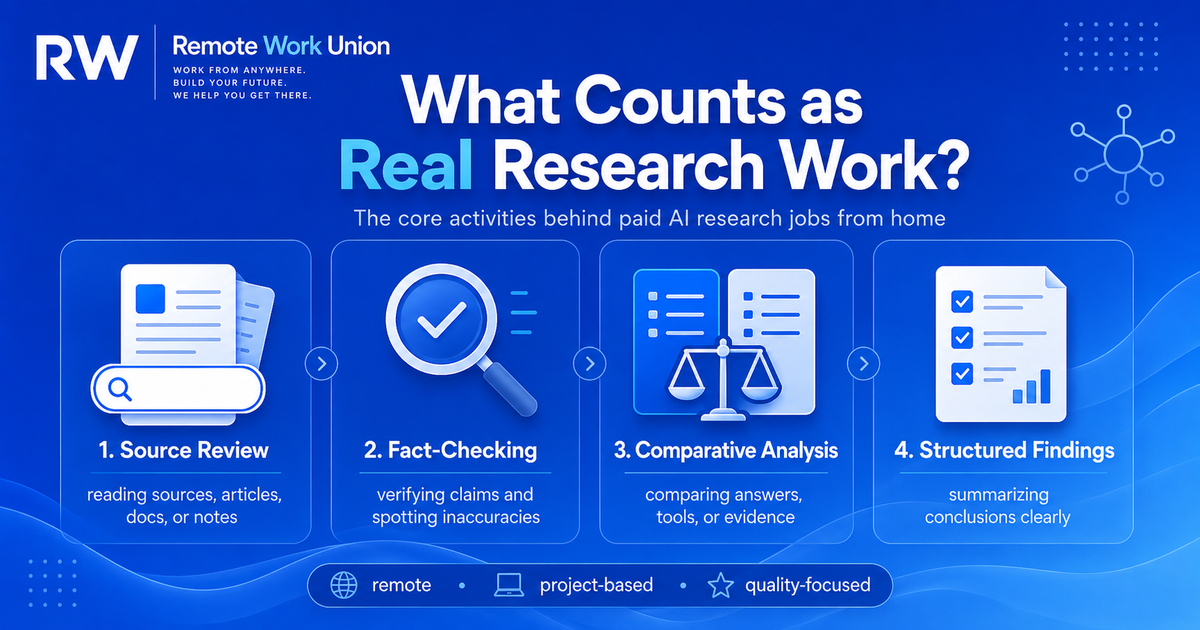
Real AI research work does not have to mean publishing papers, running lab experiments, or building machine learning models from scratch. In the remote AI work market, it usually means practical research that helps a company improve the quality of AI systems, datasets, prompts, outputs, or evaluation standards.
A task counts as research-oriented when it requires more than clicking labels. It should involve reading, checking, comparing, interpreting, or explaining. You may be asked to determine whether an AI answer is factually grounded, whether a source supports a claim, whether two responses disagree in a meaningful way, or whether a model handled a user request with enough context and precision. Common examples include source review, fact-checking, evidence comparison, answer ranking, prompt testing, claim verification, and rubric-based judgment.
Where Paid AI Research Jobs Fit Inside Remote AI Work
Paid AI research jobs from home overlap with several other job categories — which is why a good search strategy should include related phrases instead of relying on one exact job title. Relevant listings may appear under remote AI training jobs, AI model evaluation jobs, AI rater jobs, AI response reviewer jobs, prompt evaluation jobs, chatbot evaluation jobs, human feedback jobs, RLHF jobs, data annotation jobs, search quality evaluation, and expert review jobs from home.
Because the names vary, the best way to identify a strong opportunity is to read the task description. Look for verbs like evaluate, compare, verify, research, review, fact-check, explain, cite, rank, write feedback, create rubrics, assess quality, or analyze responses. Those verbs usually signal that the work involves judgment.
Examples of Research Tasks You Might Do From Home
A paid AI research project can take many forms. One task might ask you to compare two AI answers and decide which one better follows the prompt. Another might ask you to check whether a response contains unsupported claims. Another might ask you to research a niche topic, summarize the key facts, and identify where an answer should be more cautious.
Some tasks are generalist-friendly — evaluating whether an AI assistant answered a travel, shopping, career, or productivity question clearly. Other tasks require subject expertise. A legal researcher might review contract language. A finance worker might assess market explanations. A nurse or medical writer might review health-related answers for appropriate caution. A bilingual worker might evaluate translation quality or cultural context.
What a Paid AI Research Task Usually Looks Like
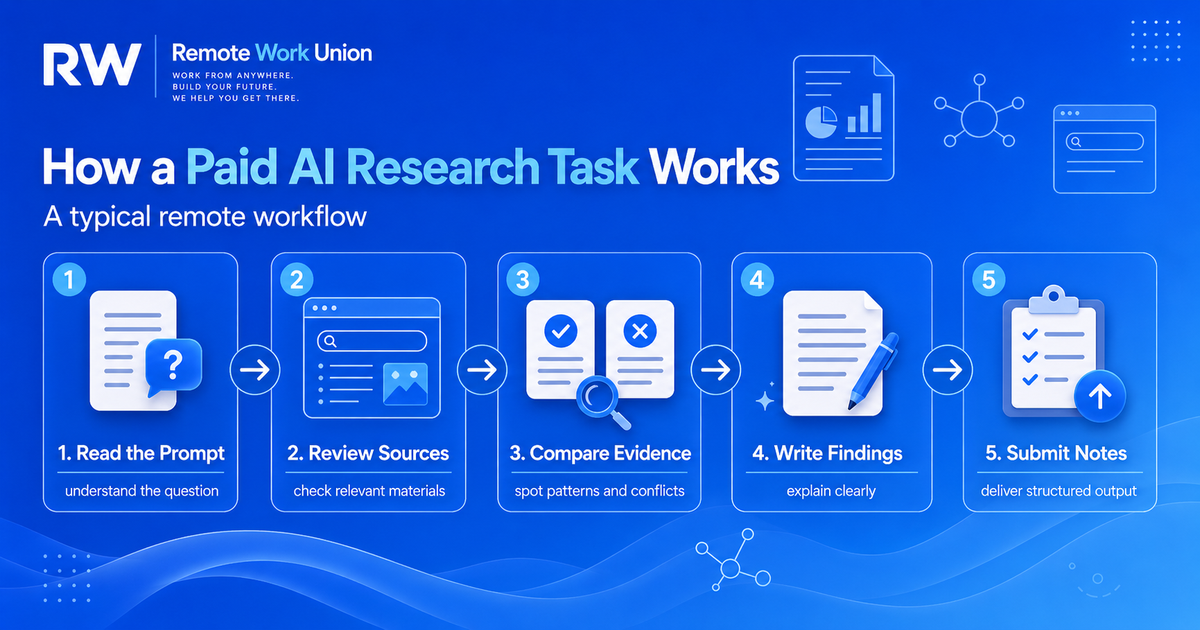
A typical task starts with a prompt. You read the user request carefully and identify what the model is supposed to do. Then you review the AI output, the provided sources, or the instructions for the task. In many projects, you compare two or more responses against a rubric. The rubric may ask about accuracy, completeness, instruction following, tone, safety, reasoning, formatting, or usefulness.
Next, you check evidence. That could mean reviewing attached documents, looking at search results inside a controlled interface, comparing facts against supplied references, or using your domain knowledge. After that, you write findings. Strong notes are specific — instead of "Response A is better," a good reviewer writes that Response A uses the provided source correctly, explains the key limitation, avoids unsupported claims, and gives the user a clearer next step.
How Research Work Differs From Data Entry and Basic Annotation
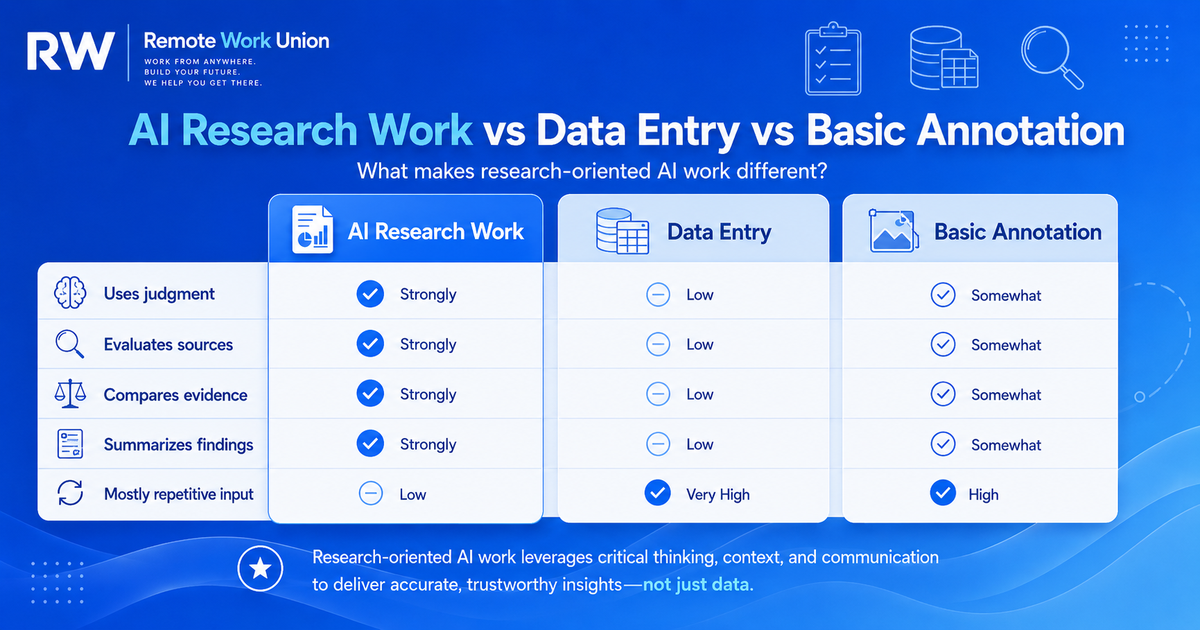
Data entry is usually about moving information from one place to another with accuracy and consistency. Basic annotation is usually about labeling examples according to a set of instructions. Both can be legitimate remote jobs, but they are not always research work. AI research work is different because it asks for interpretation — the worker may need to decide whether a source is relevant, whether an answer is misleading, whether a response missed an important caveat, or whether two answers are similar on the surface but different in quality.
Skills That Matter for Remote AI Research Jobs
The most valuable skill is clear judgment. Platforms need people who can look at messy information and make a defensible decision. Strong reading comprehension also matters — many tasks are instruction-heavy, and a small detail in the prompt or rubric can change the correct answer. Writing skill matters too: you do not need to write like a novelist, but you do need to write concise, specific explanations.
Other useful skills include fact-checking, source evaluation, search literacy, domain expertise, data labeling discipline, rubric interpretation, attention to detail, and comfort using AI tools such as ChatGPT, Claude, Gemini, and Copilot. These tools are not the job by themselves — the job is knowing how to evaluate their outputs.
Remote Work Union connects you to legitimate paid AI research and evaluation roles. Apply for free.
Find Roles Hiring Now →Who These Jobs Are Best For
Paid AI research jobs from home can fit writers, editors, teachers, tutors, researchers, analysts, lawyers, paralegals, healthcare professionals, finance professionals, students, bilingual workers, and generalists who are good at reading and explaining. The best fit is someone who likes detail-oriented thinking. If you enjoy comparing options, spotting mistakes, checking claims, or explaining why one answer is better than another, this category may be more natural than phone support or basic data entry.
People with specialized knowledge may have an advantage when applying for expert review projects. A domain expert can evaluate answers that a generalist should not confidently judge — which is why remote AI platforms often separate generalist projects from legal, medical, coding, finance, math, science, language, or writing projects.
How to Search for Paid AI Research Jobs From Home
Use a wide keyword set. Search for paid AI research jobs from home, remote AI research jobs, AI model evaluation jobs, AI training jobs, AI response reviewer jobs, prompt evaluation jobs, AI rater jobs, RLHF jobs, human feedback jobs in AI, data annotation jobs from home, search quality evaluator, and expert review jobs from home. Also search around platform names such as Mercor, Handshake AI, micro1, Surge AI, Stellar AI, Outlier, DataAnnotation, and Remotasks.
When using job boards, add terms that describe the actual task: fact-checking, research, evaluation, annotation, rubric, chatbot, LLM, AI responses, prompt, quality, and reviewer. Read each listing carefully — strong listings usually explain the task type, skill requirement, expected time commitment, pay structure, and application process.
How to Position Yourself When Applying
Do not apply as if the job is only about loving AI. Apply as someone who can produce reliable judgment. Your application should highlight research, writing, analysis, quality review, editing, subject expertise, annotation, rubric-following, fact-checking, or prompt evaluation experience. A simple positioning statement: "I have experience reviewing written material for accuracy, comparing alternatives against criteria, and writing clear notes explaining quality issues." That is more relevant than saying you use AI every day.
Red Flags to Avoid
A real remote AI research job should not require you to pay an upfront fee to apply. Be cautious with listings that promise guaranteed income, require crypto payments, ask you to move conversations to suspicious messaging channels, or provide no company information. Also be cautious with roles that ask you to fabricate sources, produce spam, impersonate users, or scrape private information. Real research work improves quality and trust — it should not require dishonest behavior.
Frequently Asked Questions
What counts as real paid AI research work from home?
Real AI research work involves judgment: reviewing sources, checking claims, comparing evidence, evaluating AI responses, and writing clear findings. Tasks that require more than clicking labels — such as fact-checking, comparative analysis, rubric-based judgment, and structured note writing — qualify as research-oriented work.
Who is best suited for paid AI research jobs from home?
Writers, editors, teachers, tutors, researchers, analysts, lawyers, paralegals, healthcare professionals, finance professionals, students, bilingual workers, and generalists who are good at reading and explaining. People with specialized knowledge may have an advantage on expert review projects.
How do I search for paid AI research jobs from home?
Search for paid AI research jobs from home, remote AI research jobs, AI model evaluation jobs, AI training jobs, AI response reviewer jobs, prompt evaluation jobs, AI rater jobs, RLHF jobs, human feedback jobs in AI, data annotation jobs from home, search quality evaluator, and expert review jobs from home.