Remote AI research jobs sit in an interesting middle ground. They are not always classic software engineering roles, but they are also not generic low-skill microtasks. In many cases, these jobs involve structured research, careful review, comparison, reasoning, writing, and quality judgment. That makes them appealing for remote workers who are strong with information and analysis, even if they are not full-time machine learning engineers.
As AI companies grow, so does the amount of human work needed around the models. Systems have to be tested. Outputs have to be checked. Responses have to be compared. Domain knowledge has to be applied. Research assistants, evaluators, reviewers, and subject-matter experts all play a role. The result is a growing category of remote AI jobs that reward people who can think clearly and work carefully.
What Remote AI Research Jobs Usually Involve
The phrase "AI research job" can mean different things depending on the employer. In one company, it may describe work that supports formal research teams. In another, it may involve AI evaluation, testing, or structured data analysis. In another, it may look more like expert review or model-improvement work. The common thread is that the job involves helping AI systems become more accurate, more useful, or more reliable.
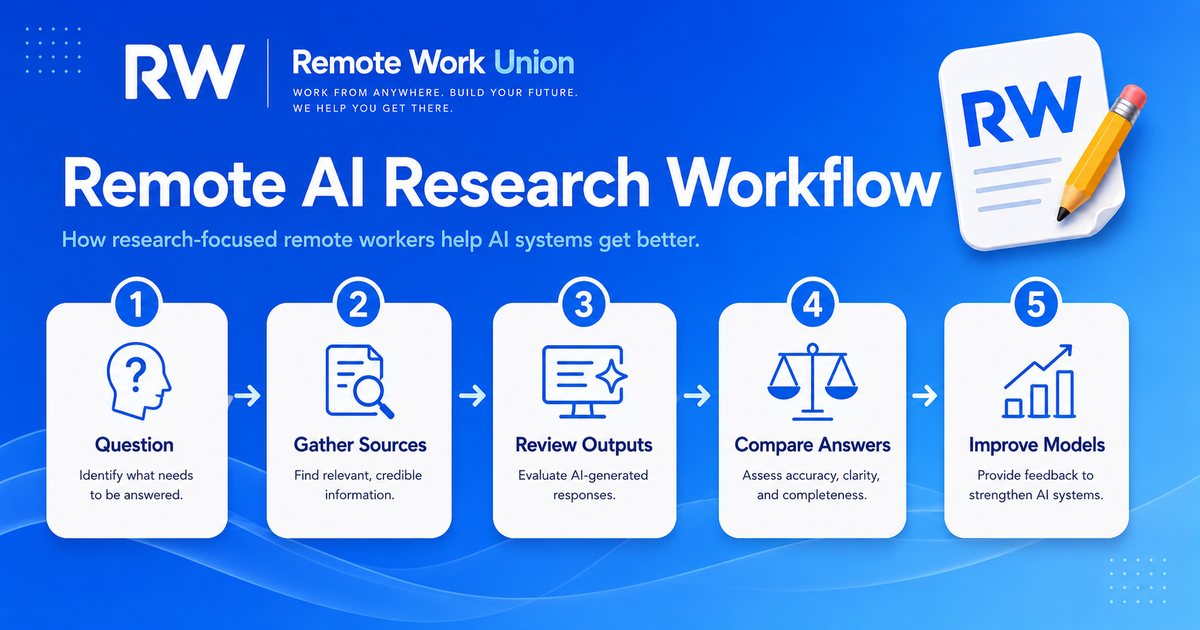
Typical tasks may include gathering sources, checking whether generated answers are correct, comparing multiple model responses, identifying gaps in reasoning, ranking outputs, reviewing factual claims, or applying domain expertise to assess quality. Some roles focus more on language. Others focus more on logic, technical content, or research workflows. Either way, the human contribution is usually about judgment.
How These Jobs Differ from Generic AI Training Tasks
Remote AI research jobs often overlap with AI training work, but they tend to feel more structured and research-oriented. Generic AI training might focus on labeling, rewriting, or evaluating short outputs. Research-focused roles are more likely to require deeper reading, more careful comparison, longer-form review, or more nuanced subject knowledge.
That distinction matters because it affects both who is a fit and how you should position yourself. If the role emphasizes research support, review quality, and analytical reasoning, you want your application to highlight those skills rather than treating the opportunity like a generic task platform.
Who Is a Good Fit
Strong candidates for remote AI research work often come from writing, education, law, finance, policy, marketing, science, engineering, operations, or analytical business roles. The background itself matters less than the type of thinking it trained you to do. If you are used to reading carefully, assessing quality, summarizing information, comparing alternatives, or explaining complex ideas, you may already have relevant skill.
People who do well in this category usually combine attention to detail with comfort around ambiguity. AI outputs are not always clearly right or clearly wrong. Sometimes the work is about weighing which answer is better, more complete, more consistent, or more aligned with instructions. That means mature judgment has real value.
What Employers and Platforms Want to See
Most employers hiring for remote AI research jobs want signs that you can communicate clearly, follow instructions, and work consistently with information. They may test written judgment, domain knowledge, or review ability. Some will care about prior research experience. Others will care more about transferable signal such as analytical writing, editing, review, auditing, teaching, policy work, or technical reasoning.
That is why a generic resume is a weak approach. A stronger application makes the connection obvious. If you have reviewed reports, analyzed documents, evaluated content, built research memos, checked accuracy, or managed structured information, those examples should be visible. The goal is to sound like someone who can help improve quality, not just someone who wants a remote job.
Where to Find Legitimate Remote AI Research Jobs
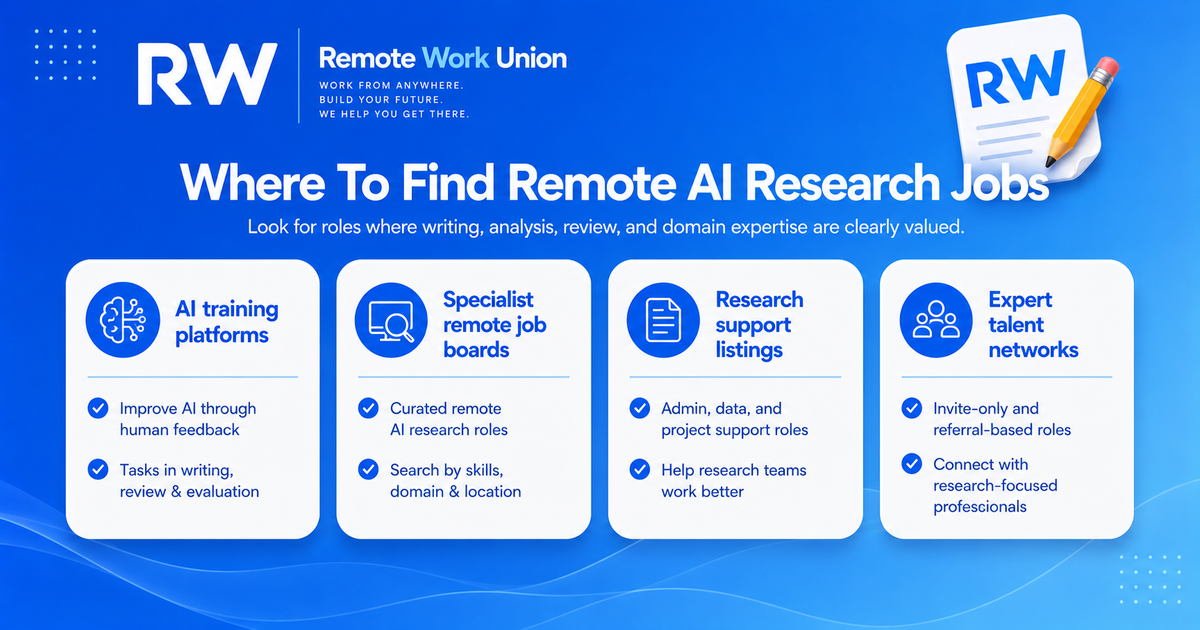
Legitimate roles tend to show up in a few different places. Some appear on AI training platforms or remote evaluation marketplaces. Others appear on specialist remote job boards, research support listings, or expert talent networks. You may also find them through startups building AI products, companies running evaluation projects, or firms hiring contractors for domain-based review work.
When you search, focus on listings that clearly describe the task type. Terms like AI evaluation, research support, response review, model assessment, expert reviewer, domain evaluator, or content quality reviewer can all signal relevant work. Roles that mention writing quality, analytical comparison, source-based review, or model improvement can also be promising.
How to Tell Whether a Role Is Worth Pursuing
A good remote AI research role should have enough detail for you to understand what the work actually is. It should tell you whether the focus is writing, review, technical evaluation, sourcing, annotation, expert feedback, or something similar. The stronger opportunities usually have at least some screening, because quality matters. They also tend to describe expectations more clearly.
Be more cautious with roles that feel vague, overhyped, or disconnected from real work output. If the listing makes huge claims but does not explain the tasks, the workflow, or the standards, that is usually a bad sign. Serious remote work tends to be clearer than that.
How to Position Yourself When Applying
A good positioning formula is background plus research strength plus task fit. For example, someone with a legal background might position themselves as strong at language precision, policy analysis, and nuanced review. Someone from finance might emphasize structured reasoning, numerical accuracy, and decision analysis. A writer might highlight editing, source synthesis, and communication clarity. A teacher might point to explanation quality and evaluation skill.
This kind of framing makes your application more useful to a hiring team. Instead of saying you are interested in AI, you show how your prior experience translates into stronger research support and model evaluation.
Why This Category Is Growing
AI systems create more value when they are trained and evaluated by capable people. That means demand is not only for engineers building the models. There is also demand for people who can stress-test outputs, improve quality, apply expertise, and keep information standards high. In practice, that opens the door for more remote knowledge workers to participate in the AI economy.
That does not mean every listing is amazing. It does mean the category is worth understanding, because it gives skilled remote workers a better lane than many of the older low-ceiling online jobs.
Key insight: Search by task language, not just job title. Terms like "research support," "response reviewer," and "domain evaluator" surface better opportunities than a generic search for "AI jobs."
Conclusion
Remote AI research jobs are best understood as research and evaluation work around AI systems. They reward careful reading, clear writing, structured thinking, and quality judgment. If you know how to position your experience and search in the right places, this can be one of the more promising areas of remote work to explore.