Expert review jobs from home are remote roles where professionals use specialized knowledge to evaluate written answers, AI responses, research summaries, documents, workflows, or structured tasks. Instead of starting from scratch in a new career, the worker brings judgment from a field they already know. That is why these jobs can be a strong fit for lawyers, paralegals, medical writers, nurses, teachers, finance professionals, researchers, technical operators, and experienced generalists who can explain why something is right or wrong.
The rise of AI training jobs, AI model evaluation jobs, prompt evaluation jobs, and human feedback jobs in AI has created more demand for people who can review information carefully. Many systems can generate a fast answer. Fewer systems can consistently judge whether the answer is accurate, complete, safe, useful, and aligned with a detailed rubric. That is where expert reviewers matter.
What Are Expert Review Jobs From Home?
Expert review jobs are knowledge-based remote jobs where the main task is evaluation. You may be asked to compare two answers, review an AI-generated explanation, check whether a document follows instructions, verify that a response uses correct reasoning, or score a piece of work against a rubric. The job is not only to say whether something is good — the job is to explain what is accurate, what is missing, what is misleading, and what should be improved.
In traditional work, expert review may appear in legal document review, medical content review, financial analysis, academic assessment, quality assurance, research editing, or technical documentation. In AI-related work, the same skill set often appears under labels like AI evaluator, AI response reviewer, chatbot reviewer, prompt evaluator, data annotator, AI trainer, human feedback specialist, or domain expert reviewer. The common thread is judgment — these jobs reward people who can read carefully, follow written standards, and make consistent decisions without needing constant supervision.
Why Expert Review Work Exists
Remote expert review work exists because accuracy is not the same thing as fluency. A polished answer can still be wrong. A confident explanation can still miss the point. A helpful-looking summary can still omit the most important caveat. Companies that build AI tools, search systems, education products, legal tools, healthcare workflows, and business software need reviewers who can identify those problems before users rely on the output.
For AI model training and evaluation jobs, human reviewers help turn broad feedback into useful model improvement. They may identify factual errors, compare the quality of two responses, judge whether a prompt was followed, check whether a source supports a claim, or explain why one answer is more useful than another. This feedback can help improve future system behavior, but it also requires a reviewer who understands the task well enough to be precise.
What Expert Reviewers Actually Do
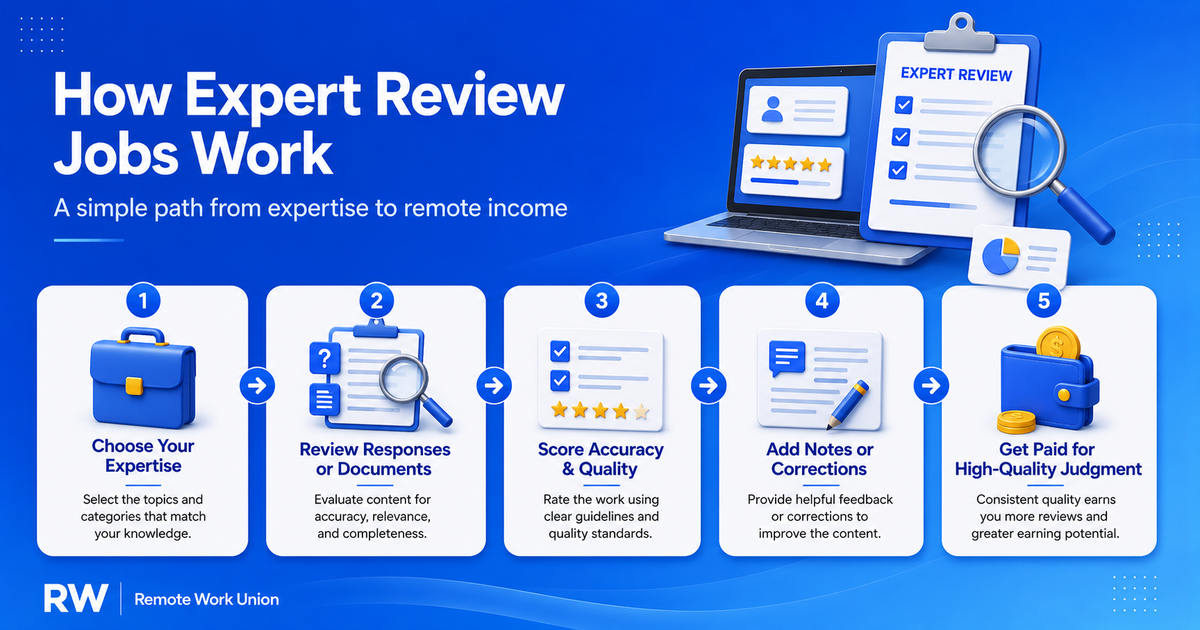
The daily work can vary by platform, company, and subject area, but most expert review jobs involve a repeatable evaluation process. You read instructions, inspect the task, apply the rubric, make a decision, and leave clear feedback. Strong reviewers do not rely on instinct alone — they learn the standard and apply it consistently.
A remote expert reviewer might compare two AI answers and decide which one is more accurate, review a finance explanation for flawed assumptions, check a healthcare article for unsupported claims, evaluate a legal summary for missing context, review an education answer for grade-level appropriateness, or inspect a research summary for source quality. The work is usually less about volume for its own sake and more about dependable quality. If your notes are specific, structured, and tied to the rubric, you become easier to trust with more difficult work.
Best Professional Backgrounds for Expert Review Jobs
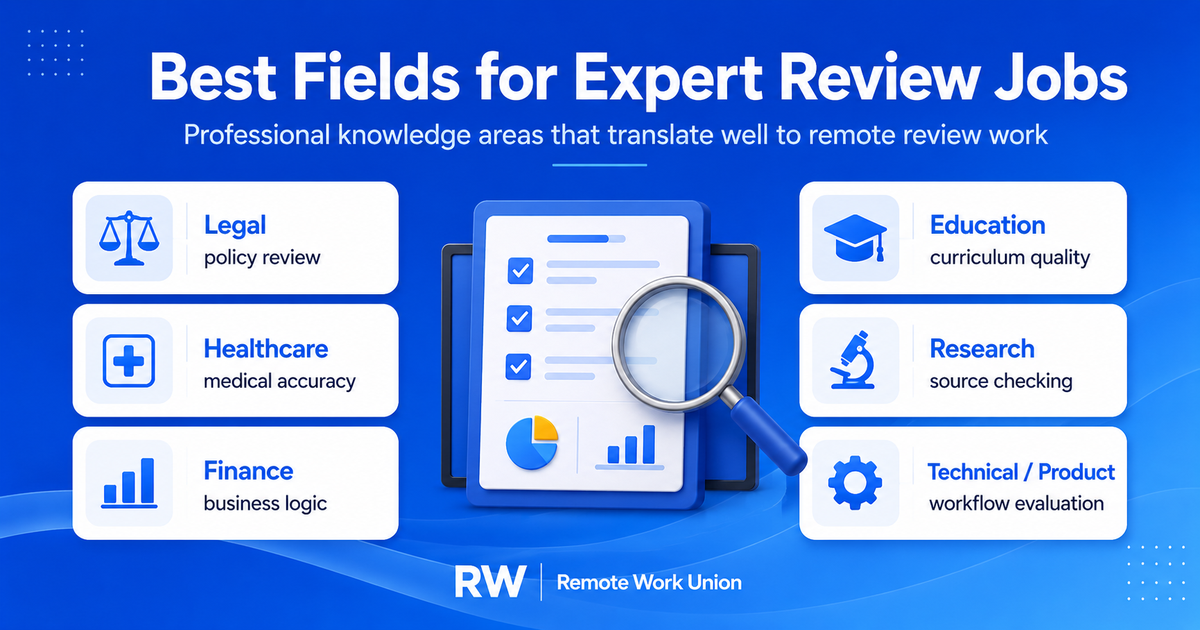
Legal professionals can be useful for tasks involving policy interpretation, contract language, legal reasoning, citation quality, privacy, compliance, and risk.
Healthcare professionals can be useful for medical accuracy review, patient education content, health writing, clinical terminology, and safety-sensitive explanations. Nurses, medical writers, public health professionals, pharmacists, therapists, and healthcare administrators may bring practical judgment that general reviewers lack.
Finance and accounting professionals can review business logic, calculations, investment explanations, spreadsheet reasoning, accounting concepts, and financial literacy content.
Teachers, tutors, and education experts can review learning content, grade-level clarity, instructional quality, assessment design, and feedback quality.
Researchers, analysts, and writers can review source quality, evidence, summaries, citations, factual claims, and argument structure.
Technical, product, and operations professionals can review workflows, software explanations, coding-adjacent tasks, documentation, user instructions, and product logic.
Skills That Help You Succeed
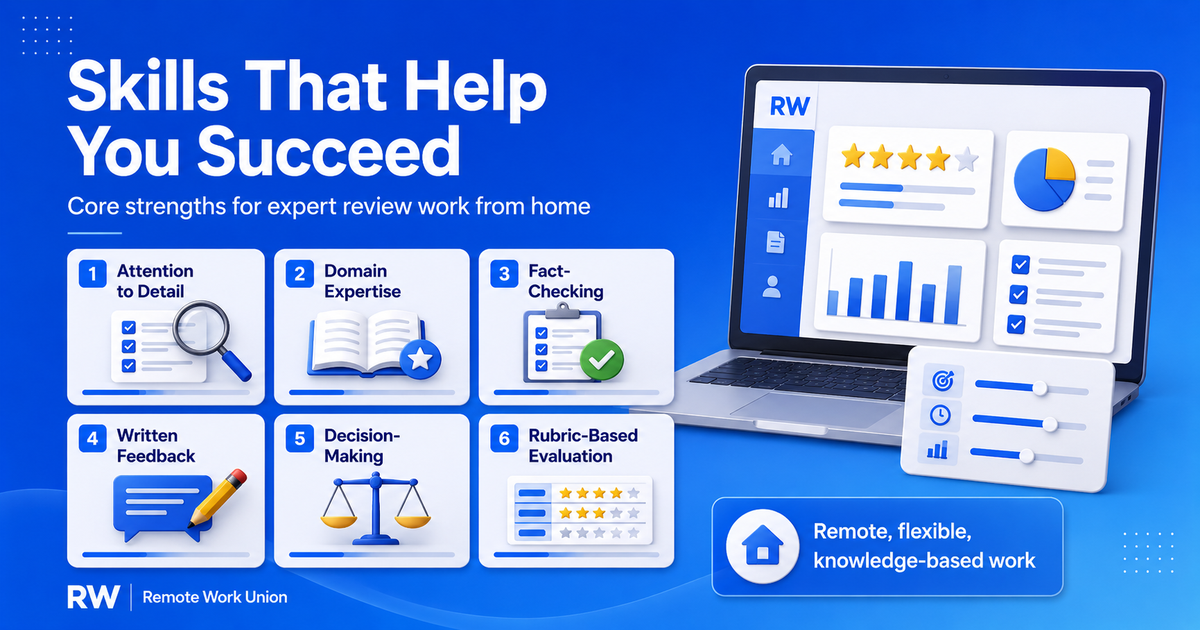
Attention to detail is the foundation. Expert review jobs often turn on small differences — one response may be mostly correct but miss a key instruction, another may sound impressive but invent a fact.
Domain expertise matters because these jobs are not only language tasks. A general writer may notice awkward phrasing, but a domain expert can notice that the conclusion is unsupported or the finance assumption is unrealistic.
Fact-checking is central — the best reviewers know when a claim needs verification and when a source is weak.
Written feedback separates useful reviewers from average reviewers. A rating without a reason is less valuable than a short explanation that identifies the exact issue.
Rubric-based evaluation is the ability to follow criteria even when your personal preference differs. In expert review work, the rubric usually matters more than your taste.
Remote Work Union connects you to legitimate expert review and domain specialist AI roles. Apply for free.
Find Roles Hiring Now →How Expert Review Jobs Compare to Data Annotation Jobs
Data annotation jobs from home are often associated with labeling, categorizing, tagging, rating, or preparing information so a system can learn from it. Expert review jobs usually sit on the higher-judgment end of that spectrum. A basic data annotation task might ask whether an image contains a certain object or whether a sentence belongs in a category. An expert review task might ask whether a legal explanation is complete, whether a model answer correctly handles a financial scenario, or whether a response follows a specialized rubric.
When searching job boards, you may not see the phrase "expert review jobs from home" every time. You may find the right work under keywords like AI data annotation jobs, AI evaluator, AI model trainer, AI response reviewer, domain expert, subject matter expert, prompt evaluator, research reviewer, or human feedback specialist.
How to Position Yourself When Applying
The strongest applications are specific. Do not only write that you are detail-oriented — show the type of detail you can review. A healthcare applicant might mention medical terminology, patient education, risk-sensitive wording, and source quality. A finance applicant might mention analysis, business logic, assumptions, spreadsheets, and explaining complex topics clearly. A teacher might mention rubric design, student feedback, curriculum review, and grade-level clarity.
Useful resume phrases include: rubric-based evaluation, written feedback, quality review, fact-checking, source verification, annotation, AI response evaluation, prompt evaluation, document review, content accuracy, domain review, and comparative judgment. If an application includes a sample task, treat it like the real job — read the instructions twice, use concise reasoning, and explain your decision with evidence.
Search Terms to Find Expert Review Jobs From Home
Use a mix of broad and specific search terms. Start with expert review jobs from home, remote expert reviewer, AI evaluator jobs, AI model evaluation jobs, AI response reviewer jobs, prompt evaluation jobs, human feedback jobs, RLHF jobs, data annotation jobs from home, remote AI training jobs, and domain expert AI jobs. Then search by background: legal AI reviewer, remote legal review jobs, medical AI reviewer, healthcare content reviewer, finance AI reviewer, business analyst AI evaluation, education AI evaluator, or research fact-checking remote.
How to Avoid Low-Quality Opportunities
Expert review jobs are legitimate as a category, but not every listing is worth your time. Be careful with roles that promise easy money without explaining the work, ask for upfront payment, avoid describing the company or platform, or use vague language about instant income. Look for clear task descriptions — a strong listing should tell you what kind of content you will review, what expertise is required, whether work is contract or employee-based, and what standards reviewers must follow.
Common Mistakes New Reviewers Make
One common mistake is reviewing too quickly — speed matters, but quality comes first. Another is writing feedback that is too vague: comments like "good answer" or "bad response" do not help a team understand what happened. A third mistake is confusing personal preference with quality. A fourth mistake is ignoring uncertainty — in expert review, it is acceptable to say that a claim cannot be verified from the provided information. It is better to flag uncertainty than to pretend a claim is proven.
Frequently Asked Questions
What are expert review jobs from home?
Expert review jobs are knowledge-based remote jobs where the main task is evaluation. You may be asked to compare two answers, review an AI-generated explanation, check whether a document follows instructions, verify that a response uses correct reasoning, or score a piece of work against a rubric. The job rewards people who can read carefully, follow written standards, and make consistent decisions.
Which professional backgrounds fit expert review work best?
Legal professionals, healthcare professionals, finance and accounting professionals, teachers and education experts, researchers, analysts, writers, and technical or product professionals. Each can contribute domain-specific judgment that generalists cannot safely provide.
How do expert review jobs compare to data annotation jobs?
Data annotation jobs often involve simple labeling, categorizing, or tagging. Expert review jobs usually sit on the higher-judgment end — they may ask whether a legal explanation is complete, whether a model answer handles a financial scenario correctly, or whether a response follows a specialized rubric.
What search terms should I use to find expert review jobs from home?
Search for expert review jobs from home, remote expert reviewer, AI evaluator jobs, AI model evaluation jobs, AI response reviewer jobs, prompt evaluation jobs, human feedback jobs, RLHF jobs, data annotation jobs from home, and domain expert AI jobs. Then search by specialty: legal AI reviewer, medical AI reviewer, finance AI evaluator, education AI trainer.