Ready to apply for AI training and remote work roles? Apply through Remote Work Union.
Find Roles Hiring Now →Remote AI jobs can pay $100+/hr, but the work is not the same as ordinary data entry, basic data annotation, or casual chatbot testing. The highest rates usually appear when an AI company, AI lab, or model evaluation platform needs a human expert to judge something that the model cannot reliably judge by itself: marketing and brand judgment, sales and customer insight, business strategy, financial analysis, legal reasoning, medical accuracy, code quality, mathematical proof, advanced writing, safety, research quality, or other domain-specific judgment.
That is the key distinction. Many remote AI jobs are accessible to smart generalists. Far fewer are true $100+/hr jobs. The higher-paying roles are usually contract-based, project-based, selective, and tied to scarce expertise. They are more like expert consulting than basic online work.
This guide breaks down which remote AI jobs can realistically reach $100+/hr, what separates those roles from lower-paying AI data annotation jobs, and how to position yourself for them without sounding like every other applicant searching for work from home AI jobs.
The Short Answer: $100+/hr AI Jobs Are Usually Expert Evaluation Jobs
The remote AI jobs most likely to reach $100+/hr are expert model evaluation jobs. These roles may use terms such as AI trainer, AI evaluator, model evaluator, RLHF specialist, AI data trainer, domain expert, prompt evaluator, response reviewer, coding evaluator, red team evaluator, or AI research contractor.
The wording changes by platform, but the core job is similar: you review AI-generated outputs and decide whether they are accurate, useful, safe, well-reasoned, and aligned with the instructions. Sometimes you compare two model answers. Sometimes you write the ideal answer. Sometimes you create difficult prompts designed to expose weak reasoning. Sometimes you build a rubric or label edge cases for a model training project.
A basic task might ask whether an answer is helpful. A $100+/hr task might ask whether a model gave legally dangerous advice, mishandled a clinical detail, wrote insecure code, fabricated a financial claim, or failed a graduate-level math problem. That difference is why expertise matters.
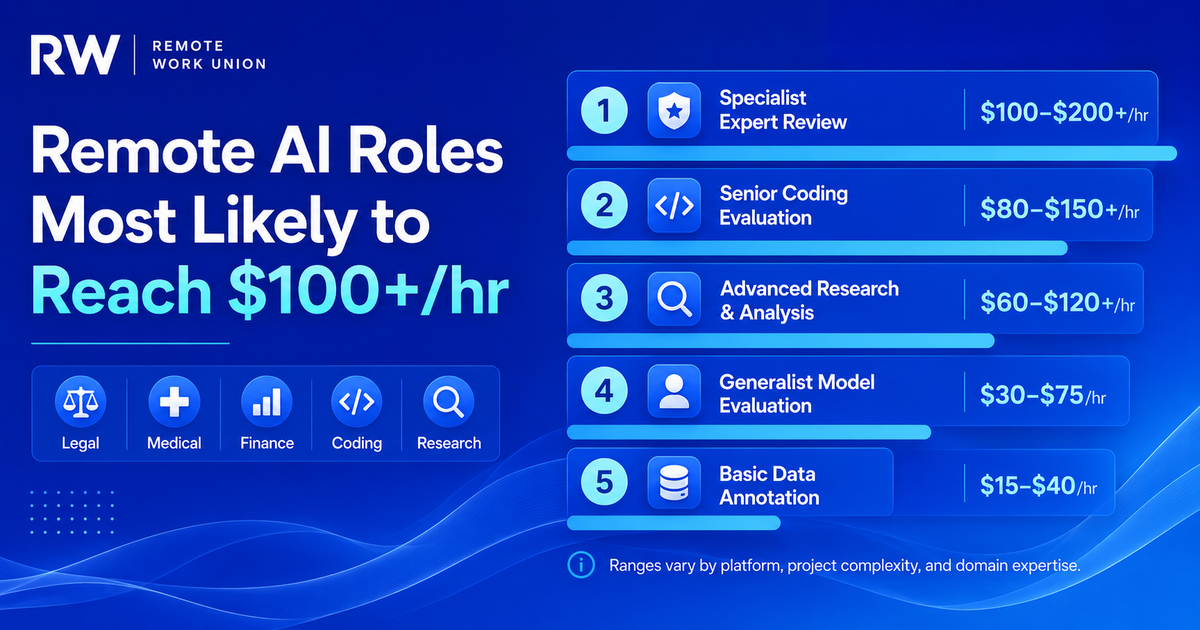
Remote AI Job Categories That Can Reach $100+/hr
| Role category | Why it can pay more | Best-fit applicant signals |
|---|---|---|
| Legal AI evaluation | Legal hallucinations and bad reasoning are costly. | Legal research, JD, paralegal, contracts, compliance, policy |
| Coding evaluator | AI code must be correct, secure, and maintainable. | GitHub, shipped code, code review, CS, software roles |
| Medical review | Clinical content needs accuracy and safety. | Nursing, medicine, pharmacy, public health, medical writing |
| Finance/accounting | Financial reasoning errors can be subtle. | Excel, accounting, valuation, FP&A, audit, market research |
| Marketing, sales & business | On-brand, persuasive, real-world judgment is hard to fake. | Marketing, sales, social media, copywriting, customer success, operations |
| STEM expert | Advanced problems require full-chain reasoning. | Graduate study, research, teaching, engineering, statistics |
| AI safety/red team | Models need stress testing and failure analysis. | Risk, policy, cybersecurity, trust and safety, structured writing |
Legal AI Model Evaluation
Legal AI evaluation is one of the strongest categories for high hourly rates because mistakes are expensive. AI systems used for legal research, contract review, compliance, litigation support, policy interpretation, and document analysis need reviewers who understand legal reasoning and can spot subtle errors.
Strong candidates may include lawyers, law graduates, paralegals, legal researchers, compliance professionals, contract managers, and policy analysts. The work can include checking whether an AI response misstates a rule, invents a citation, applies the wrong jurisdiction, misses a condition, or overstates confidence.
Keywords to use in a resume or application include legal research, contract review, regulatory analysis, compliance, case law, citation checking, document review, risk analysis, policy interpretation, legal writing, and AI model evaluation.
Coding and Software Engineering AI Evaluation
Coding evaluators can also reach premium rates because AI coding tools are now central to software development. The job is not just asking ChatGPT to write a function. Higher-level coding evaluation means reviewing whether model-generated code is correct, efficient, secure, maintainable, and aligned with the prompt.
Projects may involve Python, JavaScript, TypeScript, SQL, Java, C++, React, backend systems, data structures, algorithms, debugging, unit tests, code review, documentation, or software architecture. Strong candidates can explain why a solution works, why it fails, and how it should be improved.
A $100+/hr coding project usually wants evidence of real engineering judgment. A portfolio, GitHub, shipped products, technical writing, prior software roles, or strong assessment performance can matter more than simply listing programming languages.
Medical, Healthcare, and Clinical Content Review
Medical AI work can pay more because quality and safety matter. AI companies need reviewers who understand anatomy, pharmacology, clinical workflows, medical writing, patient education, insurance, public health, nursing, medical coding, and healthcare policy.
The work may involve checking whether an AI answer is medically accurate, appropriately cautious, clear for patients, or safe under the prompt constraints. These roles are especially sensitive because a confident but wrong model answer can be worse than no answer at all.
Strong candidates may include physicians, nurses, pharmacists, medical writers, healthcare administrators, public health professionals, clinical researchers, therapists, medical coders, and people with advanced biomedical education.
Finance, Accounting, Economics, and Business Analysis
Finance and business AI evaluation can also command strong rates. AI models are increasingly used to summarize markets, explain accounting rules, review business cases, classify transactions, analyze spreadsheets, create valuation assumptions, and produce financial explanations.
High-value projects need reviewers who can catch subtle errors in reasoning, assumptions, formulas, definitions, and risk language. A model may sound polished while using the wrong accounting treatment, mixing up cash flow and profit, misreading a balance sheet, or giving an unsupported investment claim.
Useful keywords include financial analysis, accounting, FP&A, valuation, Excel modeling, corporate finance, investment research, economics, business analysis, market research, audit, tax, risk management, and model evaluation.
Marketing, Sales, Communications, and Business Operations Evaluation
You do not need a law degree or a medical license to reach the higher tiers. AI models now write ad copy, sales emails, brand messaging, social media posts, product descriptions, customer replies, and business plans — and companies need people who actually do that work to judge whether the output is accurate, on-brand, persuasive, and usable in the real world. This is real expertise, and it is hard for a generalist to fake.
A marketing strategist can tell whether positioning and messaging are sound. A salesperson can tell whether an outreach email would actually get a reply. A social media manager can judge tone, hooks, and platform fit. A customer support or success lead can spot a response that would frustrate a real customer. Someone with a business operations background can evaluate process, prioritization, and practical decision-making. These judgments are valuable precisely because they come from doing the work — not from a credential.
Useful keywords include marketing strategy, copywriting, brand, content marketing, SEO, social media, sales, business development, customer success, customer support, account management, operations, project management, and communications.
Math, Science, Engineering, and Graduate-Level STEM Evaluation
STEM evaluation roles can reach high rates when the tasks require more than surface-level checking. Advanced math, physics, chemistry, biology, electrical engineering, mechanical engineering, statistics, data science, and machine learning tasks often need reviewers who can verify the entire chain of reasoning.
The model may produce a final answer that looks plausible but fails in the derivation. A good evaluator can identify the exact step where the model went wrong. Candidates with graduate degrees, research experience, teaching experience, lab experience, technical writing experience, or deep professional experience can be strong fits.
AI Safety, Red Teaming, and Adversarial Evaluation
AI safety and red teaming projects ask reviewers to find model failures before real users do. This can include testing whether an AI system follows safety policies, refuses appropriately, avoids harmful instructions, handles sensitive topics, resists prompt injection, and stays accurate under pressure.
These projects may appeal to people with backgrounds in cybersecurity, trust and safety, policy, psychology, moderation, risk, law, compliance, technical writing, or research. The work requires precision: creating realistic test prompts, identifying failure modes, documenting the issue clearly, and explaining why the failure matters.
Expert Writing, Editing, and Research Evaluation
Not every $100+/hr remote AI job requires coding. Some high-value AI training work depends on exceptional writing judgment. AI companies still need humans who can evaluate tone, structure, accuracy, argument quality, originality, style, source quality, and whether a response actually satisfies a complicated prompt.
This can fit professional writers, editors, journalists, researchers, technical writers, academics, curriculum designers, and strong generalists with proof of analytical ability. The best writing evaluators do not just say an answer is better. They explain why it is more accurate, more useful, better structured, more faithful to the prompt, or safer for the user.
What Does Not Usually Pay $100+/hr?
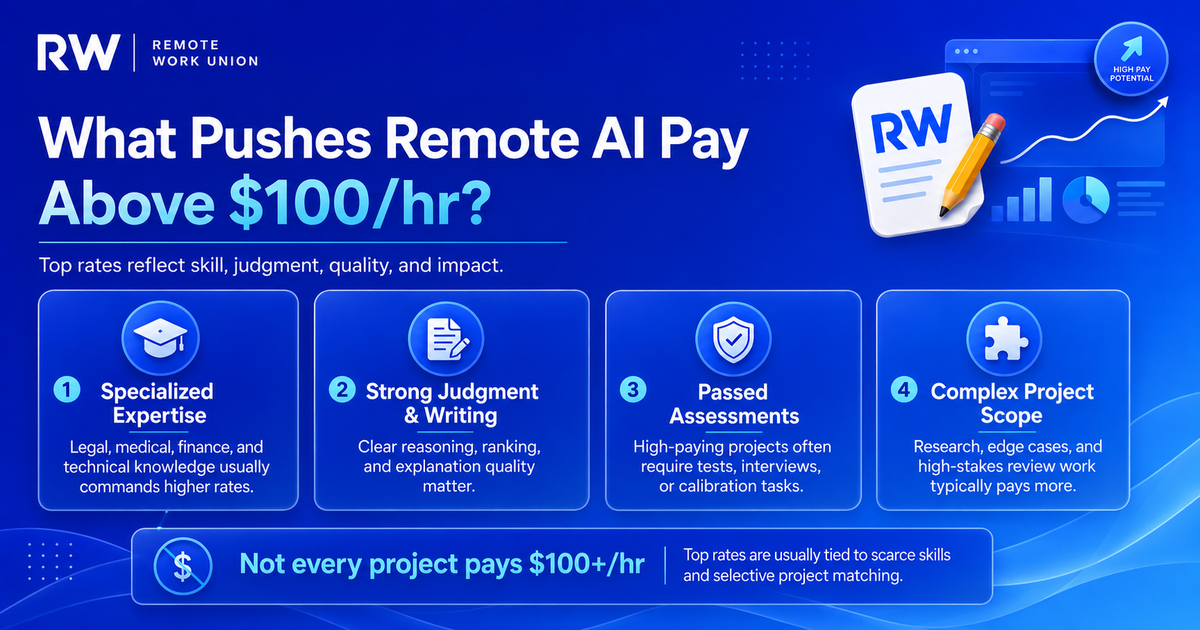
Basic AI data annotation usually does not pay $100+/hr. Simple labeling, image tagging, short response ranking, transcription cleanup, basic chatbot review, and beginner-friendly writing tasks are useful work, but they are usually not the top of the pay ladder.
That does not mean those jobs are bad. They can be a way to enter the field, learn how AI training platforms work, build a track record, and qualify for more specialized projects later. But applicants should not assume every remote AI job is a six-figure-equivalent opportunity.
The lower-paying side of the market tends to reward availability and consistency. The higher-paying side rewards judgment, credentials, scarce expertise, and task quality.
How to Position Yourself for $100+/hr AI Jobs
Start by choosing a high-value lane. Do not apply as a generic AI enthusiast if you have a sharper angle. Apply as a finance analyst who can evaluate AI-generated financial reasoning. Apply as a nurse who can review patient education content. Apply as a lawyer who can catch legal hallucinations. Apply as a software engineer who can review code quality.
Your resume should make the expertise obvious in the first few lines. Use a short professional summary that names your domain, your strongest work skills, and the type of AI evaluation work you are targeting. Then show proof: credentials, projects, publications, licenses, portfolio work, technical tools, writing samples, or measurable professional experience.
What the Assessment Is Really Testing
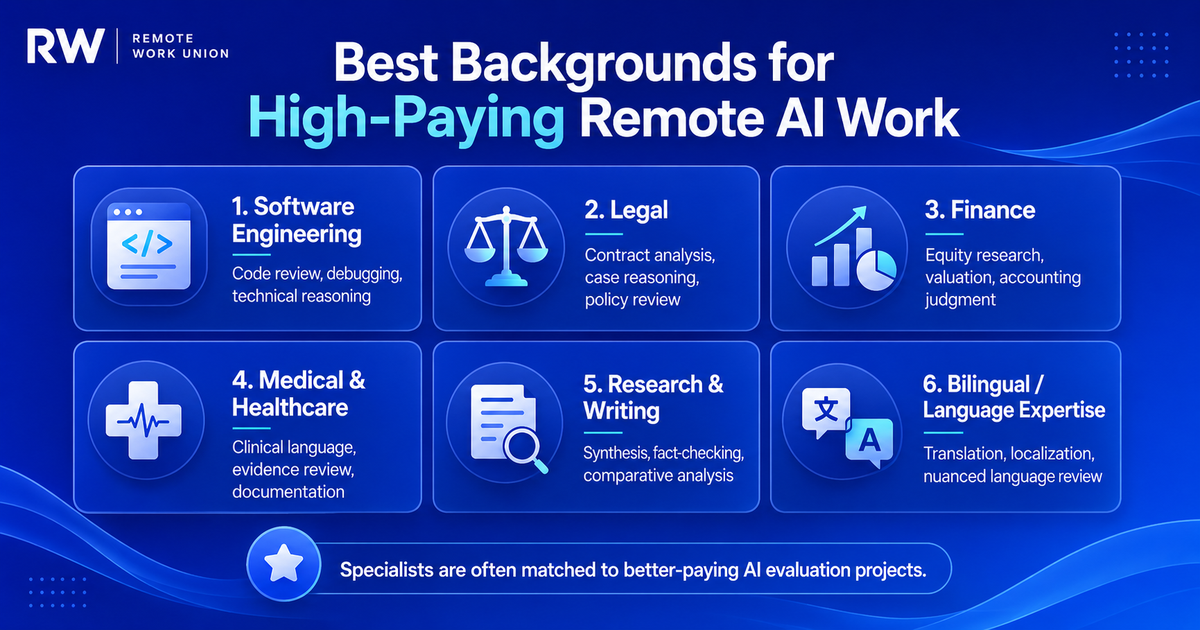
Most high-paying remote AI roles require an assessment. The assessment is not only testing whether you know the subject. It is testing whether you can follow instructions, explain your reasoning, write clearly, notice edge cases, avoid overclaiming, and produce work that can be trusted without heavy editing.
The fastest way to fail is to rush. Many applicants treat assessments like casual online forms. Better applicants treat them like paid work. They read every instruction, answer exactly what is asked, show their reasoning, and avoid filler.
If the task asks you to compare two AI answers, do not just pick the one that sounds smoother. Check factual accuracy, instruction following, completeness, safety, tone, logic, and whether the answer makes unsupported claims. Then explain your decision in clean, specific language.
How to Avoid Fake $100/hr AI Job Claims
Because remote AI work is popular, inflated claims are common. Be careful with listings that promise guaranteed $100+/hr work with no assessment, no expertise requirement, no identity verification, and no clear description of the company or task.
Before applying, look for clear information about the role, rate, contractor status, payment method, project expectations, required skills, and onboarding process. Be careful with anyone asking you to pay a fee to access work. Also remember that high hourly rates do not always mean full-time hours. A project may pay well but offer limited task volume.
Your real monthly income depends on rate, available hours, task flow, approval rate, and how consistently you qualify for projects.
The Best Candidate Profile for $100+/hr Remote AI Work
The strongest profile combines three things: a valuable domain, excellent written judgment, and reliable task execution.
A valuable domain gives the platform a reason to pay more. Excellent written judgment shows you can turn expertise into useful feedback. Reliable execution shows you can follow rubrics, meet deadlines, and produce work that does not create extra review burden.
That combination is rare. Many experts are not clear writers. Many writers do not have specialized knowledge. Many remote workers want flexibility but do not want demanding assessments. If you can combine expertise, clarity, and consistency, you are much closer to the part of the market where $100+/hr AI jobs exist.
Final Take
Remote AI jobs that pay $100+/hr are real, but they are not the normal beginner tier of AI data annotation. They are usually expert model evaluation, coding review, legal review, medical review, finance analysis, STEM reasoning, research, safety testing, or high-end writing evaluation roles.
The path is not to apply for every remote job with AI in the title. The path is to identify your highest-value expertise, present it clearly, pass the assessments carefully, and build a track record on the platforms that match experts with AI training work.