If you have typed "remote jobs near me" into a search bar, you already know the results can feel off. You wanted flexible work you could do from home — and you got a mix of warehouse roles, part-time retail shifts, hybrid office jobs, and a handful of remote positions that turn out to require you to live in a specific state, city, or time zone.
That is not a search engine failure. It is a vocabulary problem. "Remote jobs near me" is a phrase built around physical proximity, and job boards take that seriously. The result is a search optimized for location when many job seekers are actually looking for the opposite: work that has nothing to do with where they live.
This guide explains the real difference between location-dependent remote jobs and work-from-anywhere roles, why AI training and evaluation jobs are often genuinely location-independent, and how to replace "near me" searches with smarter terms that surface the right opportunities.
Why "Remote Jobs Near Me" Is a Confusing Search
The phrase "remote jobs near me" creates an immediate contradiction. Remote work, by definition, does not require a physical location. But "near me" asks a search engine to prioritize geography. The result is a compromise that serves neither goal well: you get remote listings filtered by your area, many of which carry location restrictions you were trying to avoid in the first place.
There is also a structural problem. Job boards categorize postings as remote because the employer allows employees to work off-site. But "remote" on a job board does not mean "anywhere in the world." It often means "remote within a specific state," "remote with US residency required," "remote but EST-timezone preferred," or "remote for the first six months, then subject to change." These distinctions are real, and the "near me" search does not help you find them or avoid them.
The better approach is to understand what you actually want — fully location-independent work — and then search for it using language that matches that requirement.
What "Remote Jobs Near Me" Usually Returns vs What People Actually Want
When you search "remote jobs near me," most job boards surface a blend of four types of results:
- Hybrid office jobs labeled as remote: These require in-person attendance at least some of the time. They are remote in name but not in practice.
- State-restricted remote jobs: Real work-from-home roles, but limited to specific states due to tax registration, payroll compliance, or labor law. If you live in the wrong state, you cannot be hired.
- Local service jobs in a remote-friendly format: Phone-based customer service, local healthcare administration, or regional administrative roles that are technically off-site but tied to a specific geography.
- Genuinely remote jobs that happen to be near you: Occasionally, you will find a listing that is both near you and actually location-independent — but this is often coincidence, not the result of a smart search strategy.
What most job seekers actually want when they type "remote jobs near me" is something different: work they can do from a computer, on their own schedule, without commuting — regardless of where they happen to live. That is a work-from-anywhere job, not a "near me" job.
The Real Difference: Location-Limited Remote vs Work-From-Anywhere
Location-limited remote jobs are real remote jobs with geographic restrictions attached. The employee does not go into an office, but they must be within a certain area, time zone, or country. These restrictions exist for legitimate reasons: state tax registration, employment law compliance, benefits administration, team meeting overlap, or client proximity.
Work-from-anywhere jobs have no meaningful geographic restriction. You can be in any state, any country, or any time zone and still perform the same work at the same quality. The employer either does not track your location or has structured the role so location is irrelevant.
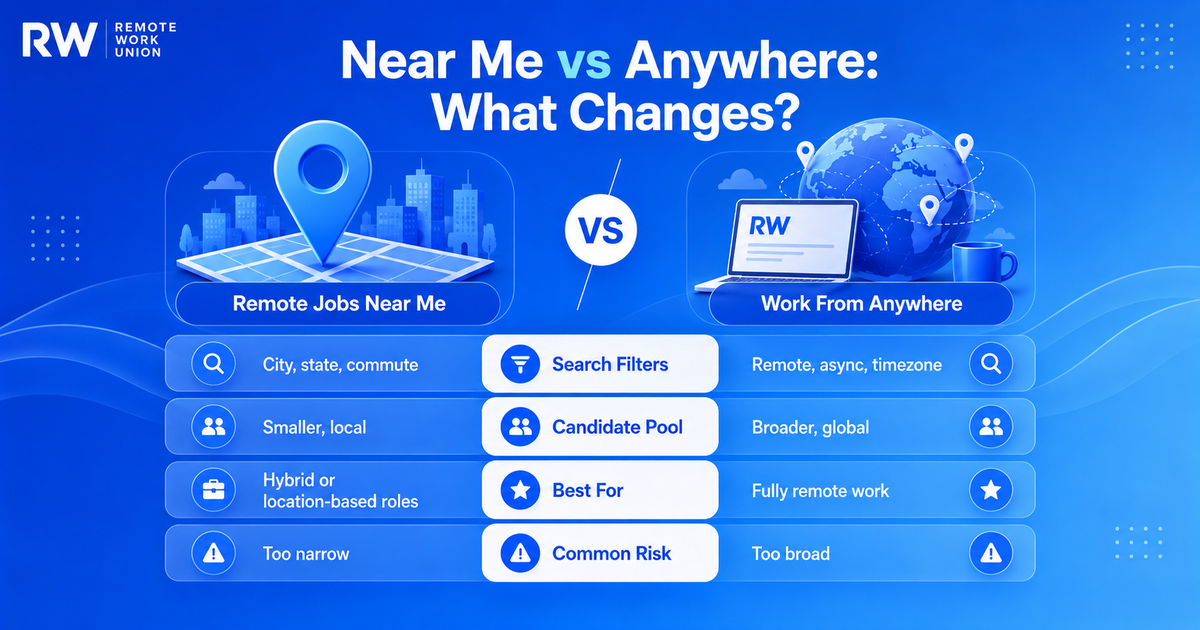
The difference matters in practice. If you move to a different state, a location-limited remote job may require you to notify HR, may require the employer to register in your new state, and could theoretically affect your employment. A work-from-anywhere job is unaffected. If you want to spend a few months in another country, a location-limited job may prohibit it. A work-from-anywhere job typically does not care.
For remote workers who value true flexibility, work-from-anywhere roles are the goal — not just "remote."
Why AI Training and Evaluation Jobs Are Often Truly Location-Independent
AI data annotation, model evaluation, prompt evaluation, RLHF work, human feedback jobs, and AI response review roles are among the most genuinely location-independent types of online work available today. Here is why:
- The work is entirely digital and asynchronous: You log into a platform, review tasks, submit your work, and get paid. There is no in-person component and usually no required meeting time.
- The output is the same regardless of where you produce it: A well-written evaluation of two AI responses has the same quality whether it was written in Austin, Berlin, or Manila. Location does not affect the deliverable.
- Platforms are built to handle global contractors: Major AI training platforms were designed from the start to work with contractors across many countries. Their payment systems, onboarding flows, and task distribution are built for geographic diversity.
- The skills required are universal: Clear writing, careful reading, domain knowledge, attention to detail, and judgment are not location-specific skills. They transfer everywhere.
This does not mean every AI training job is available in every country. Some platforms restrict by country due to payment processing, legal compliance, or data handling rules. But the restriction is at the platform level, not the work level. The work itself has no geographic dependency.
Remote Work Union connects you to legitimate work-from-anywhere AI training and evaluation roles. Find location-independent positions hiring now.
Find Roles Hiring Now →How to Search Smarter: Replace "Near Me" With Role-Specific AI Work Terms
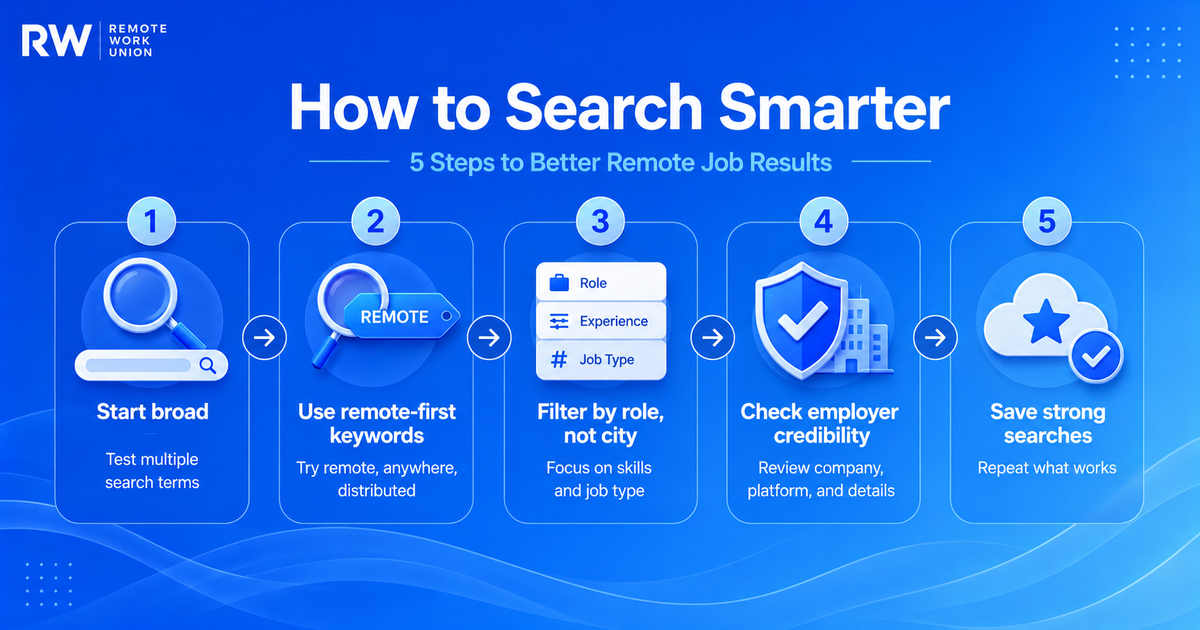
The core fix is simple: stop searching by location and start searching by task. Instead of "remote jobs near me," describe the specific type of work you want to do. This change has two benefits: it surfaces more relevant results, and it filters out location-dependent listings that would not work for you anyway.
If you want AI evaluation work, search for the specific task: AI evaluator, AI rater, model evaluation, chatbot response review, RLHF, human feedback, prompt evaluation. If you want data annotation work, search for data annotation, data labeling, text annotation, image labeling, content quality analysis. If you want research-based AI work, search for AI research assistant, search quality rater, fact-checking remote, source verification jobs.
You can add "remote" or "work from home" to these searches, but leave out "near me" entirely. You can also add "worldwide" or "no location restriction" if the platform supports those filters. The goal is to describe the work, not the geography.
Search Terms That Surface Work-From-Anywhere AI Roles
Below are specific search terms that tend to return genuinely location-independent AI work, organized by task type. Use these on job boards, AI platform job listings, LinkedIn, Indeed, Google Jobs, and specialized remote work sites.
For AI evaluation and rating work:
- AI evaluator jobs remote
- AI rater jobs work from home
- AI response reviewer jobs
- LLM evaluator remote
- chatbot testing jobs remote
- model evaluation jobs from home
For data annotation and labeling work:
- data annotation jobs from home
- AI data annotation jobs remote
- data labeling jobs work from anywhere
- text annotation jobs remote
- image labeling jobs online
- content quality analyst remote
For RLHF and human feedback work:
- RLHF jobs remote
- human feedback jobs AI
- reinforcement learning from human feedback jobs
- AI preference labeling jobs
- AI training data jobs from home
For prompt and research work:
- prompt evaluation jobs remote
- prompt engineer jobs work from anywhere
- AI fact checker jobs remote
- search quality rater jobs
- AI research assistant remote
Common Mismatches to Avoid
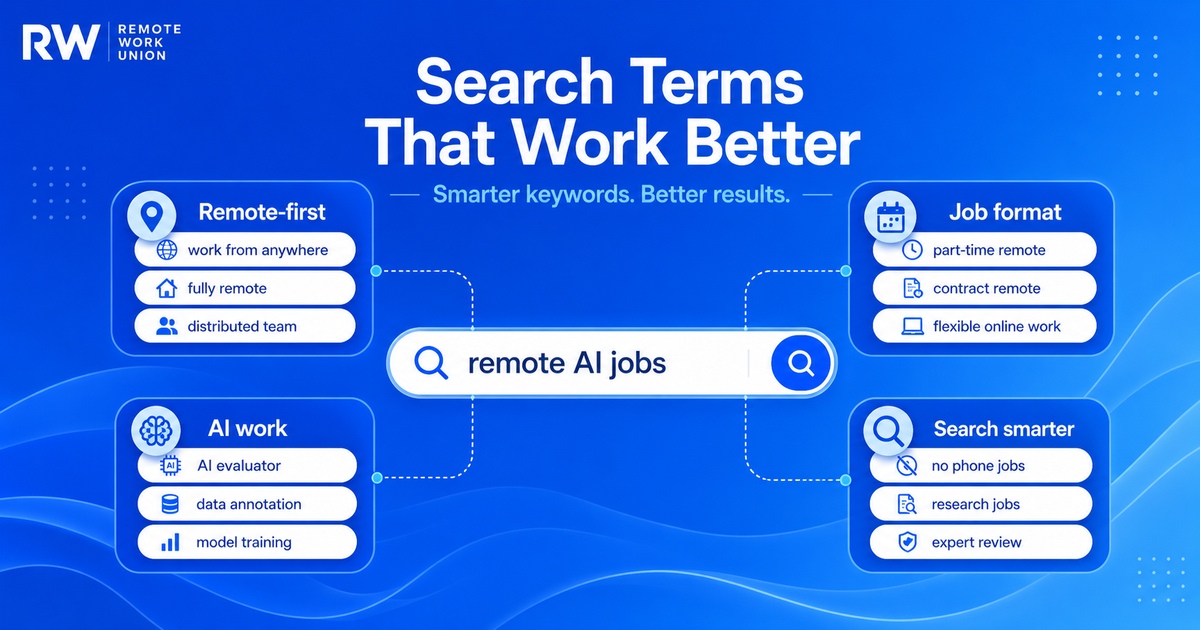
Even when you search by task rather than location, some listings will carry hidden restrictions. These are the most common mismatches that job seekers discover only after investing time in an application:
Timezone requirements: Some AI platforms and companies require contractors to work during specific business hours, usually EST or PST. This is more common for customer-facing roles or real-time evaluation projects. Look for phrases like "must be available during US business hours" or "EST overlap required."
US-only roles: Many staffing companies, some AI platforms, and most government-adjacent AI roles require US residency or citizenship. This is common for roles involving sensitive data or government contractors. Look for "US residents only," "must have US work authorization," or "US citizens preferred."
State tax restrictions: Even within the US, some employers cannot hire in states like California, New York, or others with complex employment law. They may list the role as remote but include a list of eligible states. Always check whether your state is on that list.
Country payment restrictions: Some AI platforms can pay contractors in certain countries but not others, due to banking infrastructure or legal compliance. The work itself may be available globally, but the payment mechanism may limit who can actually get paid. Check the platform's supported countries list before investing significant time in the application process.
Misuse of "remote" as a marketing term: Some postings use "remote" to mean "remote from headquarters" while still expecting you to work at a regional office or co-working space. Read the full description carefully before applying.
How to Filter for True Location Independence
Most major job boards do not have a single "work from anywhere" filter, but you can combine filters and keywords to narrow your results effectively.
On LinkedIn, use the "Remote" work type filter, then add keywords like "worldwide," "no location restriction," or "work from anywhere" to your search query. This combination often surfaces better results than either filter alone.
On Indeed, apply the "Remote" location filter and look for job descriptions that explicitly state "open to candidates worldwide" or "no state restrictions." Read the full posting before applying.
On specialized remote job boards such as We Work Remotely, Remote.co, and FlexJobs, look for a "Worldwide" location tag or filter. These boards tend to be more precise about distinguishing between US-only remote and truly global positions.
On AI-specific platforms, go directly to the platform's eligibility page or FAQ. Most major AI training and evaluation platforms list supported countries explicitly. Checking this before applying saves time and avoids disappointment late in the process.
When reading any job description, search for these phrases manually: "must reside in," "eligible states," "US residents only," "UTC offset required," and "not available in all regions." If the description does not include any location language at all, that is often a good sign — but it is worth confirming in the application or with the recruiter.
A Practical Checklist Before Applying
Before investing time in any remote AI application, run through this checklist to confirm the role is actually what you are looking for:
- Is the work task-based and digital? No in-person component, no physical deliverable, no local client requirement.
- Does the description mention location restrictions? Check for state, country, timezone, or citizenship requirements.
- Is the platform available in your country? Check the platform's eligibility page or FAQ before applying.
- Is the pay structure transparent? Per task, hourly, per project, or fixed rate — the method should be clear before you apply.
- Is there a real screening process? Legitimate AI work usually includes an application, assessment, or qualification test. A complete absence of screening can be a red flag.
- Does the listing describe the actual work? A good listing explains what you will review, how quality is measured, and what the expected output is. Vague listings that only promise income are worth skipping.
- Are there any upfront costs or payment requests? Real remote AI jobs do not require you to pay to access work. Any listing that asks for payment before work begins should be avoided.
Tip: The most reliable way to find genuinely location-independent AI work is to go directly to platform websites rather than relying on job board aggregators. Many AI training platforms list open projects and eligibility information on their own sites, which gives you more accurate information than a job board repost.
Final Takeaway
Searching for "remote jobs near me" is a reasonable starting point, but it is not the right search for finding truly location-independent work. The phrase invites job boards to filter by geography, which is exactly the opposite of what most flexible remote workers want.
The better approach is to search by task: AI evaluator, data annotation, RLHF, human feedback, prompt evaluation, model review. These terms describe work that is inherently digital, asynchronous, and location-independent. They surface listings that a "near me" search would miss entirely.
AI training and evaluation jobs are among the most genuinely flexible categories of online work available today. They do not require an office, a specific time zone, or a particular state. They require attention, accuracy, judgment, and a reliable internet connection. If that describes what you are looking for, the search terms in this guide are a much better starting point than anything with "near me" attached.
Frequently Asked Questions
What is the difference between a remote job and a work-from-anywhere job?
A remote job means you do not go into an office, but it may still restrict where you live or work due to state tax rules, time zone requirements, payroll compliance, or client proximity. A work-from-anywhere job has no meaningful location restriction — you can do the work from any state, country, or time zone without affecting your employment status. AI training and evaluation jobs are often in the second category because the work is asynchronous and digital, with no physical dependency.
Why does searching "remote jobs near me" return location-restricted results?
Job boards use your location to surface roles that are remote-eligible but limited to your area. Many employers post remote jobs with state restrictions for tax, legal, or payroll reasons. The "near me" modifier also prompts the algorithm to prioritize local employers, which can filter out truly global opportunities. Replacing "near me" with task-specific terms like "AI evaluator remote worldwide" or "data annotation jobs from home no location restriction" often surfaces better options.
Are AI training and evaluation jobs truly location-independent?
Many are, yes. AI data annotation, model evaluation, prompt evaluation, response review, RLHF, and human feedback work is typically asynchronous, task-based, and performed entirely online. There is no physical office, no local client, and no in-person requirement. Some platforms do restrict by country for payment or compliance reasons, but the work itself has no geographic dependency. This makes AI training roles among the most genuinely location-independent online jobs available.
What search terms work better than "remote jobs near me" for finding AI work?
More effective search terms include: AI evaluator jobs, AI rater jobs remote, data annotation jobs from home, prompt evaluation jobs, RLHF jobs, human feedback jobs, AI response reviewer, remote AI training jobs, work from anywhere AI jobs, and AI model trainer remote. These terms describe the actual task and are more likely to surface listings that do not carry location restrictions.
What are common hidden location restrictions in remote job listings?
The most common hidden restrictions are: US-only roles, state-specific restrictions, timezone requirements, and country payment restrictions. Always read the full job description for phrases like "must reside in," "US residents only," "EST/PST overlap required," or "not available in all countries."
Can I filter job boards to find work-from-anywhere roles only?
Some job boards let you filter for "worldwide," "no location restriction," or "work from anywhere." On LinkedIn or Indeed, use the remote filter and add a keyword like "worldwide" or "location independent." On specialized remote job boards, look for a "worldwide" location tag. For AI platforms, check the eligibility page directly — they often list supported countries.