Remote part-time jobs from home are easier to search for when you stop using only broad phrases like "online work" or "work from home jobs." Those phrases can surface everything from customer support to low-quality data entry listings. Flexible AI work usually sits behind more specific language: AI evaluator, AI rater, AI response reviewer, data annotation, prompt evaluator, search quality evaluator, human feedback, RLHF, AI content editor, AI research assistant, and subject matter expert review.
The goal is not to find one magic job board. The goal is to build better searches. Flexible AI work can appear on remote job boards, contractor platforms, AI training platforms, staffing sites, university job portals, company career pages, and referral-based communities. Some roles are listed as part-time jobs. Others are contract projects, freelance assignments, hourly tasks, expert review projects, or flexible remote work.
This guide gives remote job seekers a practical search system for part-time AI work from home, especially for people who can write clearly, follow instructions, evaluate responses, fact-check information, compare answers, label data, research topics, or apply domain expertise.
Why Broad Remote Job Searches Miss Flexible AI Work
Many people search for "remote part-time jobs," scan the first page of results, and assume there are no serious opportunities. The problem is usually the search language. Remote AI roles often do not use the exact phrase "part-time job." A platform may call the work a project, task queue, contributor role, expert assignment, evaluator position, rater project, or independent contractor opportunity.
That matters because AI training work is often organized differently from a normal hourly job. A traditional part-time job may expect scheduled shifts, phone availability, a manager, and a fixed weekly calendar. A flexible AI role may ask you to pass a qualification test, join a project, complete tasks when they are available, and get paid for approved work. The listing may still be remote and part-time in practice, even if the title never says "remote part-time job."
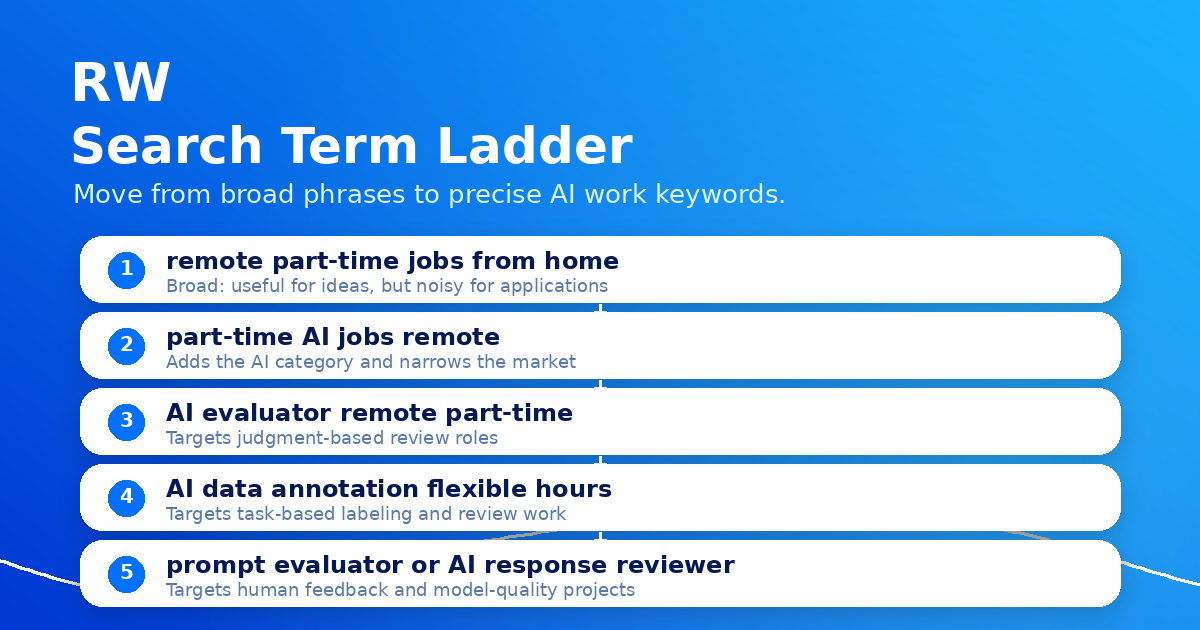
This is why job seekers should search by role type, task type, and schedule style. "AI response reviewer remote" is usually more targeted than "easy online jobs." "Data annotation flexible hours" is usually more useful than "work online and get paid." "Prompt evaluator contract" is usually more relevant than "part-time computer jobs."
The Best Core Search Terms for Remote Part-Time AI Jobs
Start with these core phrases. They are broad enough to capture multiple platforms but specific enough to avoid the worst generic work-from-home results.
- remote part-time AI jobs
- part-time AI jobs from home
- AI evaluator remote part-time
- AI rater jobs remote
- AI response reviewer jobs
- prompt evaluator jobs
- prompt evaluation jobs remote
- AI model evaluation jobs
- AI training jobs from home
- data annotation jobs from home
- AI data annotation remote
- human feedback AI jobs
- RLHF jobs remote
- chatbot evaluator jobs
- search quality evaluator AI
- AI content editor remote
- AI fact checker remote
- AI research assistant remote
- subject matter expert AI training
- freelance AI trainer
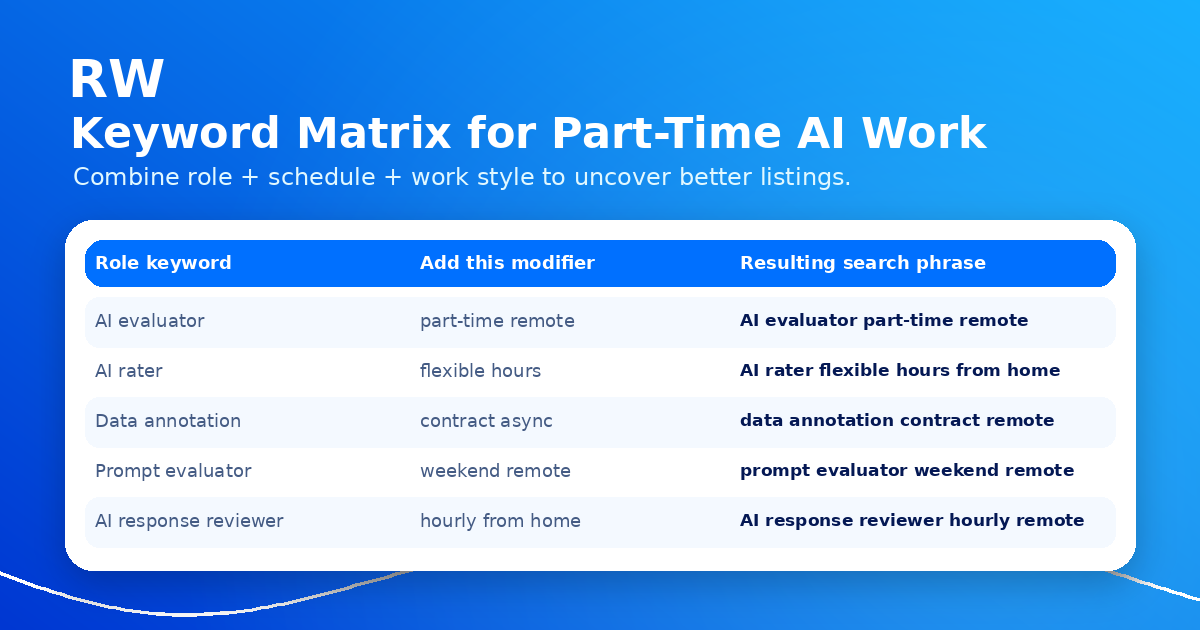
Use the search terms in combinations instead of one at a time. For example, search "AI evaluator remote flexible hours," then "AI response reviewer contract," then "data annotation part-time from home." Small changes can surface completely different listings.
Search Terms by Skill Level
Not every flexible AI role is designed for the same type of applicant. A beginner with strong writing skills should search differently from a lawyer, nurse, coder, finance analyst, teacher, bilingual speaker, or researcher. Better search terms help you avoid applying to roles that do not fit your background.
For generalists, use phrases like "AI evaluator," "AI rater," "AI response reviewer," "data annotation," "prompt evaluator," and "AI content review." These roles usually emphasize clear writing, accuracy, instruction following, and judgment.
For writers and editors, search for "AI writing evaluator," "AI content editor," "AI response editor," "AI writing assessment," "AI prompt reviewer," and "AI answer quality reviewer." These roles are especially relevant for people who can explain why one answer is clearer, more helpful, more accurate, or more natural than another.
For researchers, search for "AI research evaluator," "AI fact checking jobs remote," "AI research assistant remote," "source evaluation AI," and "AI answer verification." These searches can surface projects where the work is less about speed and more about careful reading.
For specialists, combine your domain with AI terms. A nurse might search "healthcare AI evaluator remote" or "medical AI training jobs." A lawyer might search "legal AI evaluator" or "legal AI response reviewer." A finance professional might search "finance AI training" or "accounting AI evaluator." A teacher might search "education AI evaluator" or "tutor AI training jobs." A coder might search "coding AI evaluator," "code review AI trainer," or "programming AI model evaluation."
Search Terms by Schedule and Flexibility
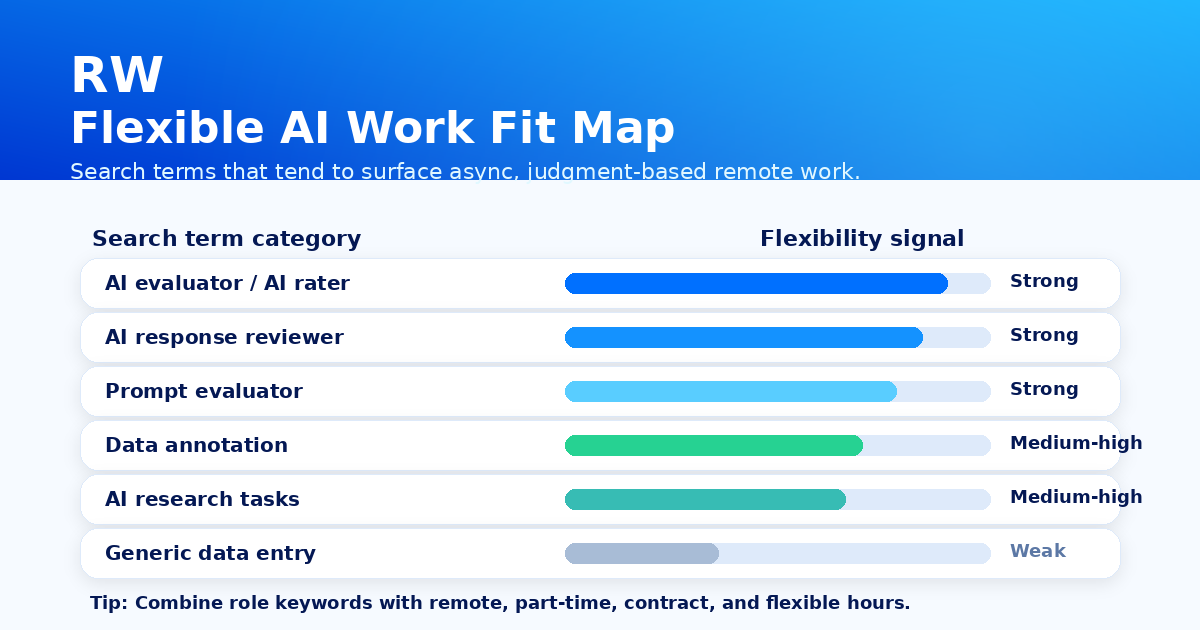
The word "part-time" is useful, but it is not the only schedule keyword. Flexible AI roles may use different language depending on the platform. Add schedule modifiers to every search.
Useful schedule modifiers include "part-time," "flexible hours," "set your own hours," "contract," "freelance," "project-based," "asynchronous," "remote," "work from home," "weekend," "evening," "hourly," "task-based," and "short-term project."
Examples of effective schedule-modified searches:
- AI evaluator flexible hours
- AI rater part-time remote
- AI data annotation contract remote
- prompt evaluator weekend remote
- AI response reviewer hourly
- human feedback AI freelance
- RLHF contractor remote
- AI research tasks flexible schedule
- chatbot evaluator part-time from home
- search quality evaluator flexible hours
When a listing says "flexible," read the details carefully. Flexible can mean you choose tasks when available, but it can also mean inconsistent work volume. A good search strategy should help you find opportunities, but the application still needs careful review.
Remote Work Union connects you to legitimate remote AI training and evaluation roles across multiple platforms. Apply for free.
Find Roles Hiring Now →Search Terms by Company and AI Ecosystem
Major AI companies are valuable keywords because many job seekers use them to understand the market. Search terms can include OpenAI, Anthropic, Google, Meta, Microsoft, Apple, Amazon, xAI, Perplexity, Scale AI, Surge AI, DataAnnotation, Outlier, Mercor, Handshake AI, micro1, Turing, Appen, Telus International AI, RWS, Invisible Technologies, Remotasks, and similar AI training or evaluation ecosystems.
Use company names carefully. A role may support models, datasets, or AI products connected to a major company without being listed directly by that company. Many AI training and evaluation roles appear through vendors, contractors, staffing partners, or specialized platforms. That means "OpenAI evaluator jobs" may not only produce direct OpenAI career listings — it may also surface related contractor roles and evaluation opportunities.
Useful ecosystem searches include:
- OpenAI AI evaluator remote
- Anthropic AI training jobs
- Google AI rater jobs remote
- Meta AI data annotation jobs
- Scale AI data annotation jobs
- DataAnnotation AI trainer part-time
- Outlier AI evaluator jobs
- Mercor AI jobs remote
- Handshake AI fellowship remote
- Appen remote evaluation jobs
The point is not to assume every result is a perfect match. The point is to find the language employers and platforms use, then repeat the searches that produce legitimate listings.
How to Separate Flexible AI Work From Low-Quality Fast-Money Claims
A real remote part-time AI opportunity usually explains the task, qualification process, payment structure, expectations, and required skills. It may require a test. It may ask for a writing sample, resume, professional background, language ability, or subject expertise. It should not promise effortless income with no screening.
Be careful with listings that rely on vague claims like "make money online instantly," "no skills needed," "guaranteed AI income," or "get paid today for ChatGPT." Flexible does not mean frictionless. Good AI evaluation work often requires patience, accuracy, and the ability to justify decisions.
Tip: A stronger listing usually includes clear language such as "evaluate AI-generated responses," "rate chatbot answers," "compare model outputs," "annotate data," "review prompts," "fact-check responses," "write ideal answers," "classify content," "label examples," "assess helpfulness," "judge accuracy," or "provide human feedback." Those terms are more meaningful than generic promises.
A Simple Search Workflow for Part-Time AI Jobs From Home
Use a repeatable workflow instead of randomly browsing job boards.
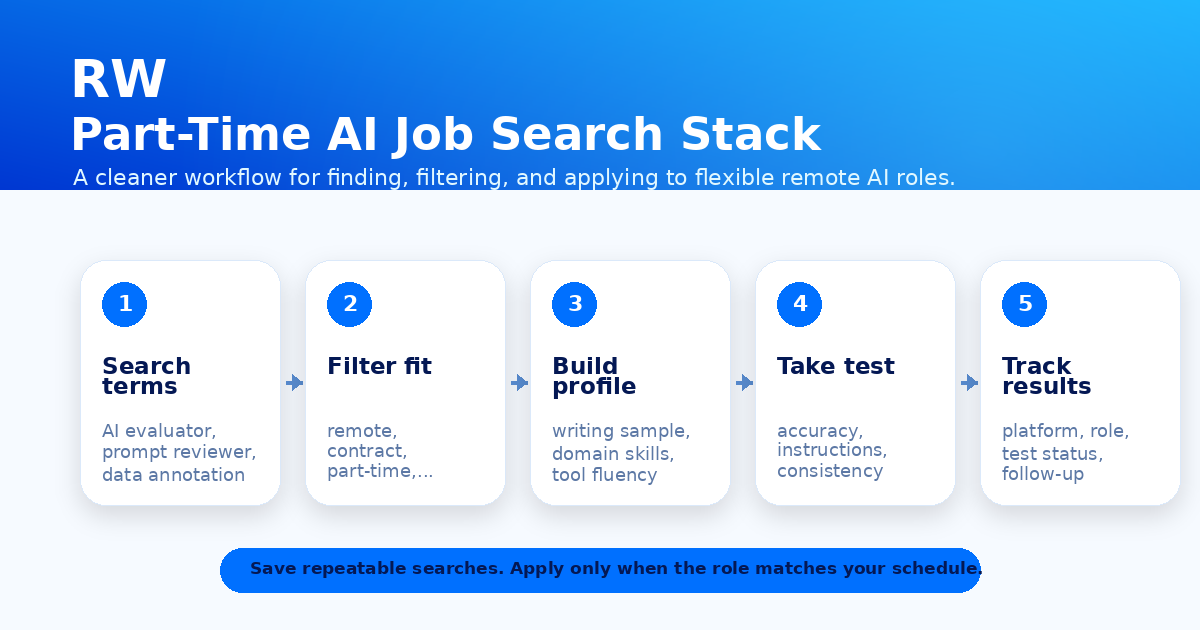
Step one: Create a search bank. Save 20 to 40 search phrases that combine role keywords, schedule modifiers, and skill terms. For example: "AI evaluator part-time remote," "prompt evaluator flexible hours," "finance AI reviewer contract," and "data annotation work from home."
Step two: Search across multiple sources. Use general search engines, LinkedIn, remote job boards, AI training platforms, staffing sites, freelance marketplaces, and company career pages. Different sources index different language.
Step three: Filter for the work style. Look for remote, contract, part-time, flexible hours, async work, task-based work, or project-based work. Skip roles that require phone shifts, full-time availability, onsite training, or strict schedules if flexibility is your priority.
Step four: Inspect the task description. The best listings usually tell you what you will evaluate, label, write, research, compare, or review. If the job description is vague, treat it as lower priority.
Step five: Track applications. Keep a spreadsheet with the platform, role title, search term used, application link, test status, pay notes, schedule notes, and follow-up date. Over time, this shows which search terms actually work for you.
Keyword Combinations That Work Especially Well
The best searches usually combine four ingredients: role, schedule, location, and task.
- AI evaluator + part-time + remote + response quality
- AI rater + flexible hours + work from home + chatbot
- data annotation + contract + remote + language
- prompt evaluator + freelance + remote + writing
- AI research assistant + part-time + remote + fact checking
- AI model evaluation + contractor + from home + accuracy
- human feedback + remote + flexible + RLHF
- AI content editor + hourly + remote + review
- subject matter expert + AI training + remote + expert review
- coding evaluator + AI model + remote + code review
For search engines, put exact phrases in quotes when needed. Try "AI response reviewer" or "prompt evaluator" in quotes, then combine the phrase with remote, part-time, contract, or flexible hours. For job boards, avoid overly long searches. Start with the role term, then use filters for remote, part-time, contract, or freelance.
Best Search Terms for Beginners
Beginners should not only search for "entry level." Many AI training roles do not use that phrase. Instead, search for tasks that match beginner-friendly strengths: writing clearly, checking facts, following instructions, reviewing outputs, labeling examples, and comparing answers.
Beginner-friendly searches include:
- AI evaluator no coding
- AI training jobs no coding
- AI rater remote
- AI response reviewer remote
- chatbot evaluator jobs
- data annotation jobs from home
- prompt evaluator jobs
- AI content review remote
- AI fact checking remote
- AI writing evaluator remote
- search quality rater remote
A beginner should also build a simple profile that highlights relevant skills: writing, editing, research, Microsoft Excel, Google Sheets, attention to detail, prompt writing, ChatGPT, Claude, Gemini, Perplexity, fact-checking, academic research, customer communication, tutoring, operations, or subject expertise.
Best Search Terms for Professionals With Domain Expertise
Professionals should search more narrowly because specialized AI evaluation work may pay more attention to credentials, work history, or domain knowledge. Add your field to the search.
- legal AI evaluator remote
- paralegal AI training jobs
- healthcare AI evaluator remote
- medical AI writer reviewer
- nurse AI training jobs remote
- finance AI evaluator remote
- accounting AI model evaluation
- business analyst AI training jobs
- teacher AI evaluator remote
- education AI content reviewer
- coding AI evaluator remote
- software engineering AI trainer
- bilingual AI evaluator remote
- Spanish AI rater remote
- language model evaluator bilingual
Specialists should not hide their expertise behind a generic resume. AI training platforms often need people who can evaluate answers in a specific field. A finance analyst, teacher, nurse, paralegal, coder, or bilingual worker should make that expertise easy to see.
Where to Use These Searches
Use these keywords in more than one place. Search engines are useful for discovery, but job boards and platform directories may show roles that a normal search misses.
Good places to test searches include LinkedIn, Google search, remote job boards, AI training platform pages, company career pages, staffing agencies, freelance marketplaces, university job boards, and referral communities. Search terms also work inside social platforms, but those results need extra caution because low-quality fast-money claims are common.
When searching on LinkedIn, try shorter terms like "AI evaluator," "AI rater," "prompt evaluator," "data annotation," "AI trainer," and "AI response reviewer," then use filters for remote, part-time, contract, or freelance. On general search engines, use longer searches like "AI evaluator part-time remote flexible hours" or "subject matter expert AI training remote contract."
How to Know If a Part-Time AI Role Fits Your Schedule
A listing can say remote and still be a poor fit. Before applying, check the schedule language. Look for whether the work is asynchronous, whether there are required meetings, whether there are minimum weekly hours, whether tasks are available consistently, whether the role is employee or contractor, and whether the company expects a fixed time zone.
The best fit for flexible part-time work usually includes a clear remote setup, a task-based workflow, written instructions, a qualification process, and enough autonomy to work outside normal office hours. If the role requires live phone support, sales calls, strict shifts, or full-time availability, it may not match the type of flexible AI work this guide is focused on.
A Practical Search Bank to Copy
Copy this search bank and adjust it for your own background:
- remote part-time AI jobs
- part-time AI jobs from home
- AI evaluator remote flexible hours
- AI response reviewer part-time
- prompt evaluator remote contract
- AI rater jobs from home
- AI training jobs no coding
- data annotation jobs remote flexible hours
- AI model evaluation contractor
- human feedback AI jobs remote
- RLHF jobs part-time
- chatbot evaluator remote
- AI fact checker remote part-time
- AI research assistant remote flexible
- AI content editor remote contract
- search quality evaluator AI remote
- subject matter expert AI training remote
- legal AI evaluator remote
- healthcare AI evaluator remote
- finance AI training jobs
- teacher AI evaluator remote
- coding AI evaluator remote
- bilingual AI evaluator remote
- Spanish AI rater remote
- AI writing evaluator work from home
Run the same searches every week, but track which phrases produce real listings. Your best search terms will depend on your background, location, field, and schedule needs.
Final Thoughts
Remote part-time jobs from home are not all the same. Some are traditional jobs with fixed schedules. Some are freelance gigs. Some are low-quality listings that promise quick money. The flexible AI work category is different because the strongest roles often revolve around judgment, writing, research, domain expertise, data labeling, prompt review, and human feedback.
Better search terms help you find that category faster. Search for AI evaluator, AI rater, prompt evaluator, AI response reviewer, AI model evaluation, data annotation, human feedback, RLHF, AI content editor, search quality evaluator, AI fact checker, and subject matter expert AI training. Then combine those terms with part-time, remote, work from home, contract, flexible hours, freelance, async, and project-based.
The more precise your searches become, the less time you waste on generic remote listings. Flexible AI work is easier to find when your keywords match the way platforms actually describe the work.
Frequently Asked Questions
Why don't broad searches like "remote part-time jobs" surface AI evaluation work?
Remote AI roles often do not use the exact phrase "part-time job." A platform may call the work a project, task queue, contributor role, expert assignment, evaluator position, rater project, or independent contractor opportunity. Because AI training work is organized differently from a traditional hourly job — often task-based and asynchronous — broad searches miss these roles. Specific terms like "AI response reviewer remote" or "data annotation flexible hours" produce far more relevant results than generic phrases like "work from home jobs."
What are the best search terms for remote part-time AI jobs?
Start with core phrases like: remote part-time AI jobs, AI evaluator remote part-time, AI rater jobs remote, prompt evaluator jobs, AI response reviewer jobs, data annotation jobs from home, human feedback AI jobs, RLHF jobs remote, chatbot evaluator jobs, and AI model evaluation jobs. Use these in combinations rather than one at a time — for example, "AI evaluator remote flexible hours" or "prompt evaluator contract work from home." Small changes can surface completely different listings.
How do I find flexible AI work if I have domain expertise in law, medicine, or finance?
Combine your domain with AI training terms. A lawyer can search "legal AI evaluator remote" or "paralegal AI training jobs." A nurse or medical professional can search "healthcare AI evaluator remote" or "medical AI training jobs." A finance professional can search "finance AI training" or "accounting AI model evaluation." Specialists should make their expertise visible rather than hiding it behind a generic resume — AI training platforms often need people who can evaluate answers in a specific field.
How do I tell if a remote part-time AI listing is legitimate?
A real remote part-time AI opportunity usually explains the task, qualification process, payment structure, expectations, and required skills. It may require a test or writing sample. It should not promise effortless income with no screening. Look for clear language like "evaluate AI-generated responses," "rate chatbot answers," "compare model outputs," "annotate data," "review prompts," or "provide human feedback." Skip listings that make vague income claims, require upfront payment, or ask you to move to an off-platform app immediately.
Where should I use AI job search terms beyond LinkedIn?
Test your best search terms across multiple sources: general search engines like Google, LinkedIn, remote job boards, AI training platform pages directly, company career pages, staffing agencies, freelance marketplaces, and university job portals. On search engines, try longer phrases like "AI evaluator part-time remote flexible hours." On job boards, use shorter role terms and then filter by remote, part-time, or contract. Different sources index different language, so rotating sources often surfaces opportunities that any single platform misses.