Searches like "AI training jobs near me" feel practical. They sound specific, local, and ready to apply. The problem is that AI training work does not always behave like restaurant, retail, warehouse, or office hiring. Many AI training projects are distributed, contract-based, skill-matched, and managed through online platforms. That means a location-first search can miss the exact roles that a strong remote applicant should be finding.
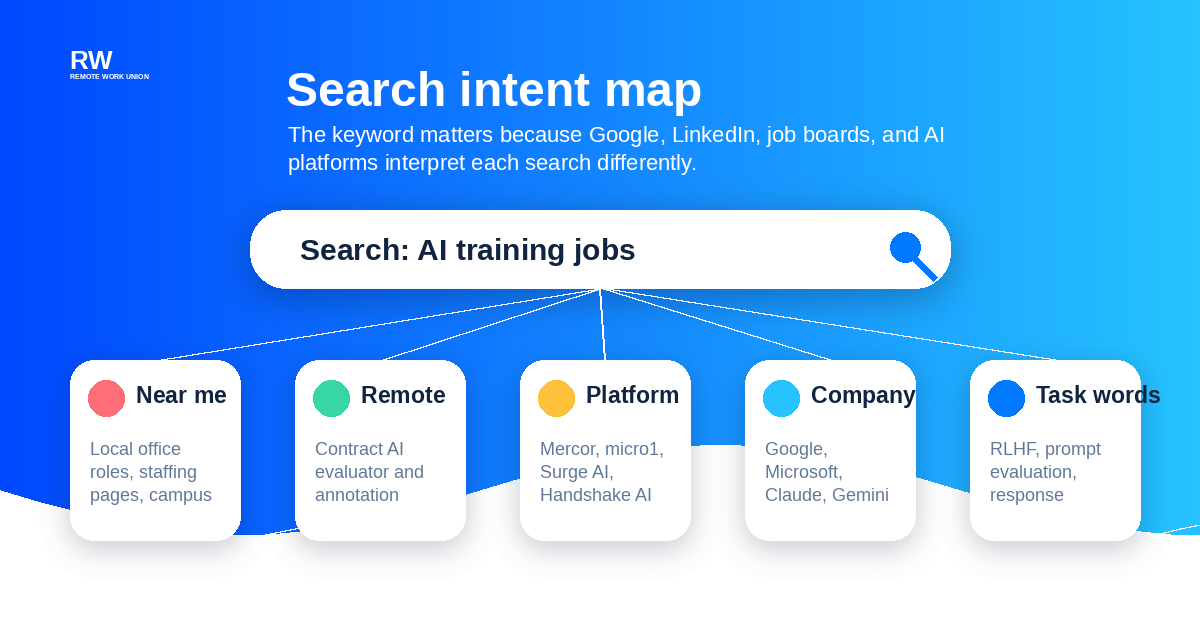
A better search strategy starts by understanding what the search engine thinks you want. "AI training jobs near me" tells Google, LinkedIn, Indeed, and local job boards to prioritize geography. "Remote AI training jobs" tells them to prioritize work format. "AI evaluator jobs," "data annotation jobs from home," "AI model trainer jobs," "prompt evaluation jobs," and "RLHF jobs" tell them to prioritize the actual task. The best results usually come from combining all three: role, task, and work format.
What People Usually Mean by AI Training Jobs
AI training jobs is a broad search phrase. Some people use it to mean teaching artificial intelligence as an instructor. Others mean machine learning engineering. Most remote job seekers mean human feedback work: reviewing AI answers, comparing model outputs, labeling data, judging accuracy, checking tone, rewriting weak responses, or applying rubrics to improve model behavior. Those roles may appear under several titles: AI evaluator, AI rater, AI model trainer, data annotator, LLM evaluator, prompt evaluator, AI response reviewer, search quality rater, human feedback specialist, content quality analyst, and RLHF contributor.
That is why a single search phrase rarely captures the whole market. A person searching for "AI training jobs near me" may be a strong fit for remote data annotation, but the search may show local IT training, bootcamps, classroom instructors, or general AI courses instead of actual paid evaluation work.
Why "AI Training Jobs Near Me" Often Gives Noisy Results
Near me is a powerful local-intent signal. It works well when the job must happen in a fixed place. AI training is different because the work can often be completed from a laptop inside a secure task platform, without a local office. When you attach "near me" to AI training, the search engine may over-prioritize geography and under-prioritize the job type. That can produce several kinds of noise: local staffing agencies with generic AI keywords, classroom AI training programs, bootcamps, in-person corporate training jobs, machine learning engineer roles that require advanced coding, and job-board pages that mention AI but do not involve human feedback work.
Why Remote AI Training Job Searches Usually Work Better
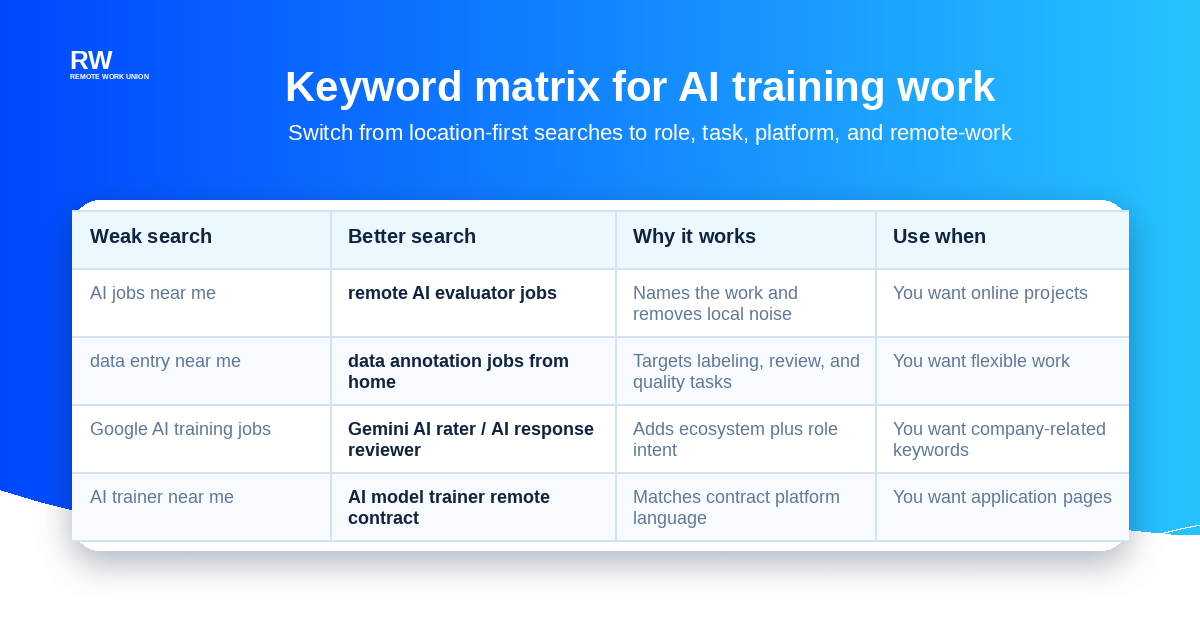
Remote AI training jobs is closer to the way many human feedback projects are actually staffed. Platforms and companies often need distributed workers with specific domain knowledge, language ability, writing skill, or coding ability. A remote-first search also catches synonyms that "near me" may miss — remote AI evaluator jobs, AI model trainer jobs from home, online data annotation jobs, work from home AI rater jobs, and LLM evaluation contract work all point toward similar opportunity types.
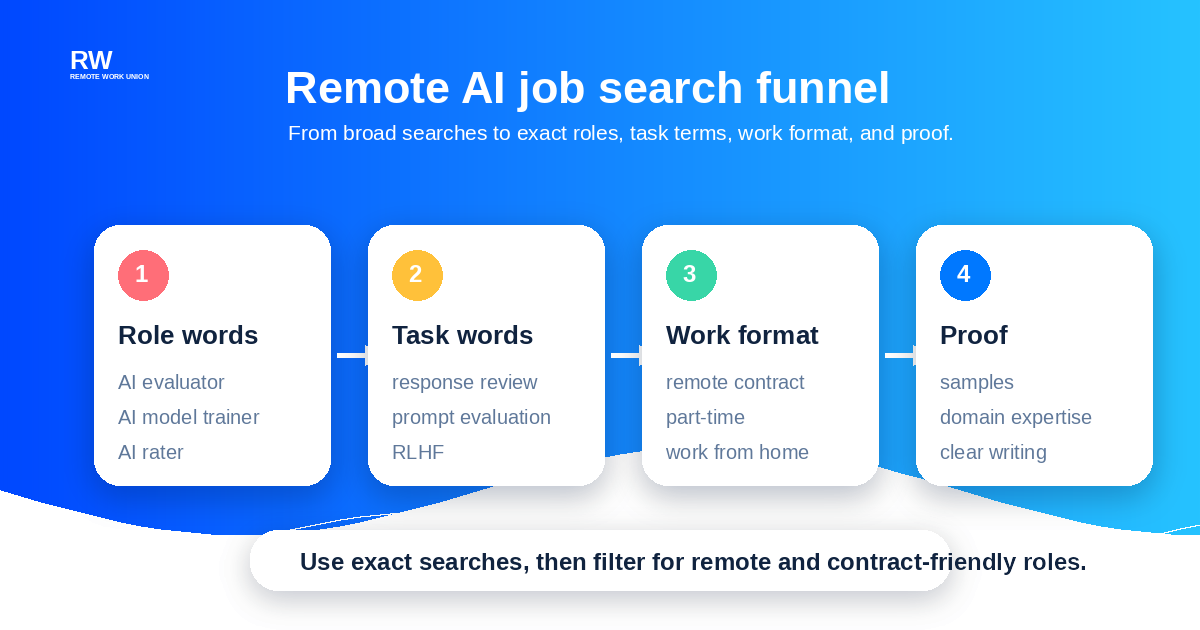
The strongest remote searches usually include a role word and a task word. "Remote AI evaluator jobs" is better than "AI jobs." "Data annotation jobs from home" is better than "data entry jobs." "Prompt evaluation jobs" is better than "prompt jobs." The more accurately the search names the work, the better the results.
When Near Me Searches Still Make Sense
There are cases where "AI training jobs near me" is worth running: local searches can surface hybrid jobs, office-based data quality teams, academic research support roles, local AI startups, enterprise AI adoption teams, or contract roles that restrict applicants by region. Use "near me" when you are willing to commute, want a full-time job with benefits, want to network in your local technology market, or are targeting a city with many startups and research institutions.
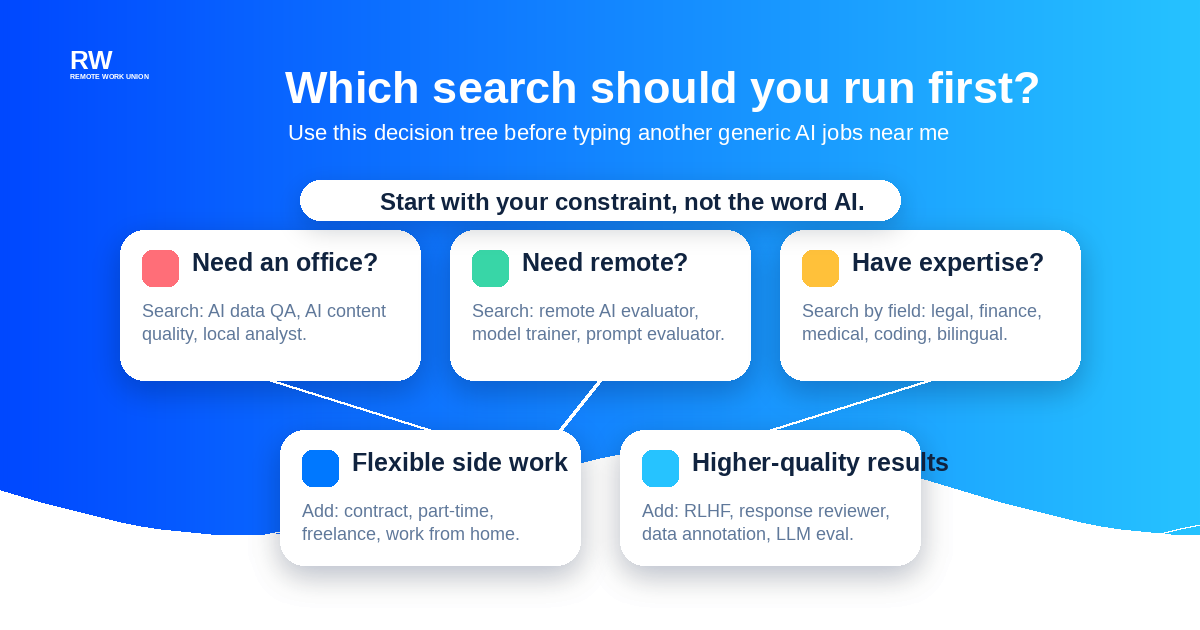
For best results, do not search only "AI training jobs near me." Pair the local term with specific job titles: "AI content quality analyst near me," "machine learning data QA jobs near me," "AI evaluator jobs Austin," or "search quality rater jobs near me." This keeps the local signal without losing the task signal.
The Keyword Combinations That Actually Work
Build keyword stacks — start with the role, add the work format, then add a task or platform term. Good role-based searches: remote AI evaluator jobs, AI model trainer jobs, AI rater jobs, AI response reviewer jobs, prompt evaluator jobs, LLM evaluator jobs, data annotation jobs from home, remote data labeling jobs, search quality rater jobs, and human feedback AI jobs. Good task-based searches: RLHF jobs, prompt evaluation work, chatbot response review jobs, AI answer evaluation jobs, AI fact-checking jobs, AI rubric grading jobs, and model output comparison jobs.
Good platform or ecosystem searches: Mercor AI jobs, Surge AI jobs, micro1 AI jobs, Handshake AI roles, Google AI training jobs, Microsoft AI training jobs, Claude AI training jobs, Gemini AI training jobs, OpenAI evaluation jobs, Anthropic reviewer jobs, Meta AI data annotation jobs, Perplexity AI evaluator jobs, and xAI Grok evaluation jobs. These searches do not guarantee direct openings at those companies — they help you find pages, projects, contractors, discussions, and job listings connected to the broader ecosystem.
Remote Work Union connects you to legitimate remote AI training and evaluation roles. Apply for free.
Find Roles Hiring Now →How to Search Job Boards Without Wasting Time
Job boards reward precise filters. On LinkedIn, Indeed, Wellfound, FlexJobs, Remote OK, company career pages, and freelance platforms, start with exact title searches. Use quotation marks when a phrase is essential: "AI evaluator," "AI rater," "data annotation," "prompt evaluation," "LLM evaluator," "model trainer," and "response reviewer." Then filter for remote, contract, part-time, freelance, or work from home. A practical search loop: search one exact role, open only relevant listings, save the company names, search each company directly, check whether they use contractor projects or full-time roles, then apply with examples that match the task.
How to Read a Listing for Legitimacy
Real roles usually explain the task type, required skills, application steps, work arrangement, pay structure or pay range where available, evaluation process, and contractor status. A strong listing will describe work such as comparing two AI answers, grading factual accuracy, writing better completions, following rubrics, identifying hallucinations, labeling examples, or reviewing domain-specific responses. Be cautious with vague pages that repeat keywords without explaining the work, and especially cautious of listings that use names of major AI companies only to redirect into unrelated courses, paid communities, or lead-generation pages.
How to Choose Between Local and Remote Applications
Choose "near me" searches when you want stability, office structure, local networking, full-time employee benefits, or a role inside a local company. Choose remote AI training searches when you want flexibility, project-based work, specialized evaluation tasks, or the ability to apply across platforms and companies outside your city. The best approach for many job seekers is not either-or — run local searches once or twice per week, run remote searches more often. Keep a spreadsheet of role titles, platform names, application dates, required tests, and follow-up steps.
Application Materials That Match AI Training Work
Search terms get you to the opening. Application materials get you through the screen. For remote AI training jobs, your resume should emphasize judgment, writing clarity, research, rubric-following, factual accuracy, annotation, A/B comparison, option selection, editing, domain expertise, and consistency. If you have used ChatGPT, Claude, Gemini, Copilot, Grok, Perplexity, or other AI tools in serious workflows, mention the relevant skill without overstating it. A stronger application says: "I can follow instructions, compare alternatives, explain why one answer is better, identify factual problems, and maintain quality across repetitive tasks."
A Simple Search Plan for This Week
Day 1: Search remote AI evaluator jobs, AI model trainer jobs, and data annotation jobs from home. Save every company or platform that looks legitimate.
Day 2: Search prompt evaluation jobs, AI response reviewer jobs, RLHF jobs, LLM evaluator jobs, and AI rater jobs. Add platform names and exact titles to your tracking list.
Day 3: Search by company and ecosystem terms: Mercor AI jobs, Surge AI jobs, micro1 AI jobs, Handshake AI, Google AI training jobs, Microsoft AI training jobs, Claude AI training jobs, and Gemini AI training jobs. Separate direct career pages from commentary or third-party posts.
Day 4: Run one local pass — search AI training jobs near me, AI evaluator jobs near me, and search quality analyst jobs near me. Keep only listings that match your actual work preferences.
Day 5: Apply to the best matches with customized language. Use the exact role title from the listing, mention the task type, and give proof of writing, research, coding, language, or subject-matter skill. Quality matters more than volume.
Frequently Asked Questions
Why do "AI training jobs near me" searches often give bad results?
Near me is a powerful local-intent signal that works for location-dependent jobs. AI training is different because the work can often be completed from a laptop without a local office. When you attach "near me" to AI training, the search may over-prioritize geography and under-prioritize the job type, producing noise like local staffing agencies, classroom AI training programs, bootcamps, in-person corporate training jobs, or machine learning engineer roles requiring advanced coding.
When do "AI training jobs near me" searches still make sense?
When you are willing to commute, want a full-time job with benefits, want to network in your local technology market, or are targeting a city with many startups and research institutions. It can also help if you are looking for AI content analyst, machine learning data associate, trust and safety analyst, search quality analyst, or data QA roles that may not use the phrase "AI training" in the title.
What keyword combinations work best for finding real AI training jobs?
Build keyword stacks: role word + work format + task or platform term. Good role-based searches include remote AI evaluator jobs, AI model trainer jobs, AI rater jobs, AI response reviewer jobs, prompt evaluator jobs, LLM evaluator jobs, data annotation jobs from home, search quality rater jobs, and human feedback AI jobs. Good task-based searches include RLHF jobs, prompt evaluation work, chatbot response review jobs, AI answer evaluation jobs, and AI fact-checking jobs.