The best remote work does not pay you just because you are sitting near a laptop. It pays you because you know how to think, review, write, research, compare, explain, and make decisions that a basic checklist cannot handle.
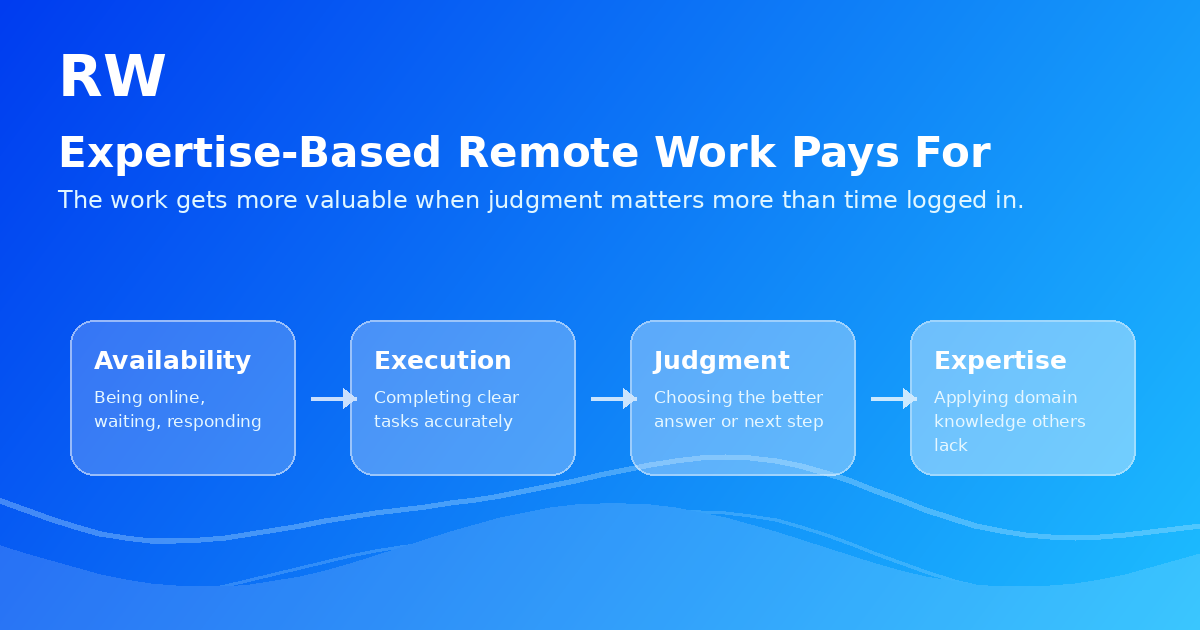
A lot of people search for work from home jobs by looking for anything flexible: remote customer support, data entry, virtual assistant work, surveys, gig apps, transcription, or basic online tasks. Those jobs can be useful starting points, but many of them are built around availability. Expertise-based remote work is different. It pays for what you know and how well you use it.
What Expertise-Based Remote Work Actually Means
Expertise-based remote work is any online job where the quality of your judgment matters more than your ability to stay logged in. It does not always require an advanced degree. It does not always require coding. It does require that you can bring a real skill to a task and apply it consistently.
For example, a legal assistant may be able to review whether an AI response misses an important caveat. A marketer may be able to judge whether a campaign strategy sounds realistic. A customer success professional may know whether a support answer is clear, complete, and safe to send to a frustrated user. A writer may be able to tell when an answer is technically correct but awkward, thin, repetitive, or off-tone. A finance professional may spot when a model confuses revenue, profit, cash flow, and valuation.
Availability-Based Work vs. Expertise-Based Work
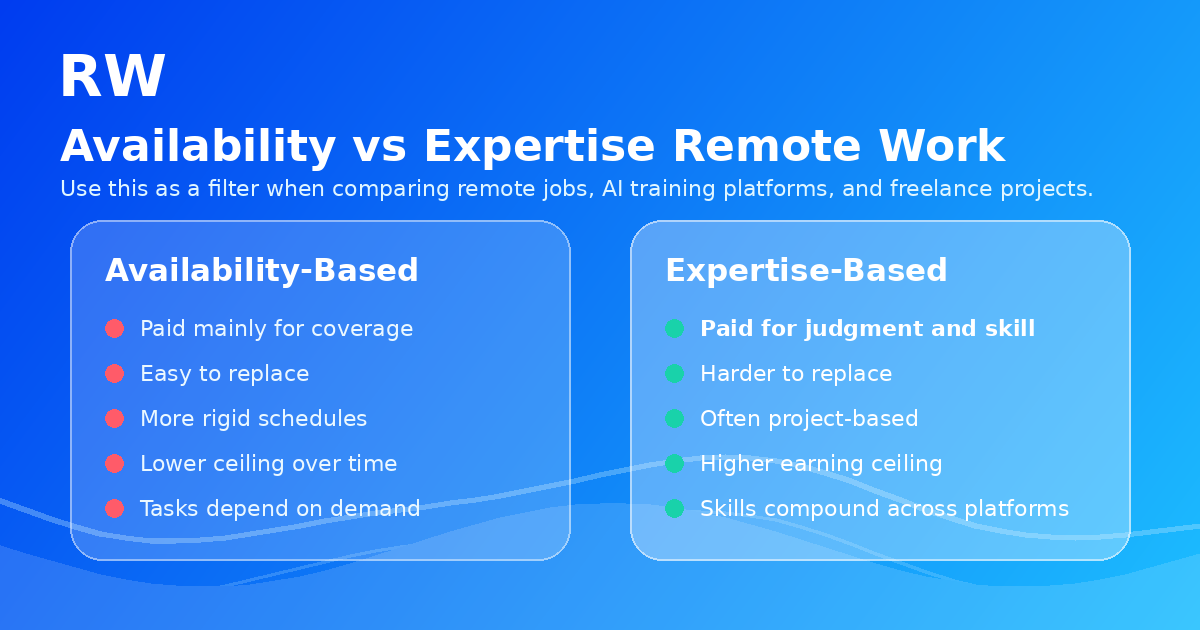
Availability-based remote work usually asks: Can you be online at this time? Can you answer the next ticket? Can you complete the next simple task? Expertise-based remote work asks a different set of questions: Can you evaluate quality? Can you compare two responses and choose the stronger one? Can you explain a mistake? Can you apply real-world experience?
The second category usually has a better long-term ceiling because the work is tied to skill. Availability can be replaced by another available person. Expertise is harder to replace, especially when the work requires industry context, native-level communication, careful reasoning, or a track record of accurate review.
Why AI Training Has Made Expertise More Valuable
Remote AI work is one of the clearest examples of this shift. AI systems are not improved only by engineers writing code. They are also improved by people who review answers, compare outputs, label data, test prompts, identify mistakes, and teach models what a high-quality response looks like.
That work is often described with terms like AI training, AI data annotation, model evaluation, model response rating, AI content review, prompt writing, reinforcement learning feedback, fact-checking, expert review, and human evaluation. Major AI companies and AI products — including OpenAI, Anthropic, Google, Meta, Grok, and other model builders — all compete on answer quality, safety, reasoning, usefulness, and reliability. That creates demand for people who can help evaluate outputs in specific fields. Platforms like micro1, Mercor, Handshake AI, and similar marketplaces are part of the broader ecosystem where remote workers may find projects connected to AI evaluation and expert review.
What Kinds of Expertise Can Translate Into Remote Pay?
Expertise is broader than most people think. It can come from a job, a degree, a portfolio, a hobby, a language skill, a technical background, or years of solving the same type of problem repeatedly.
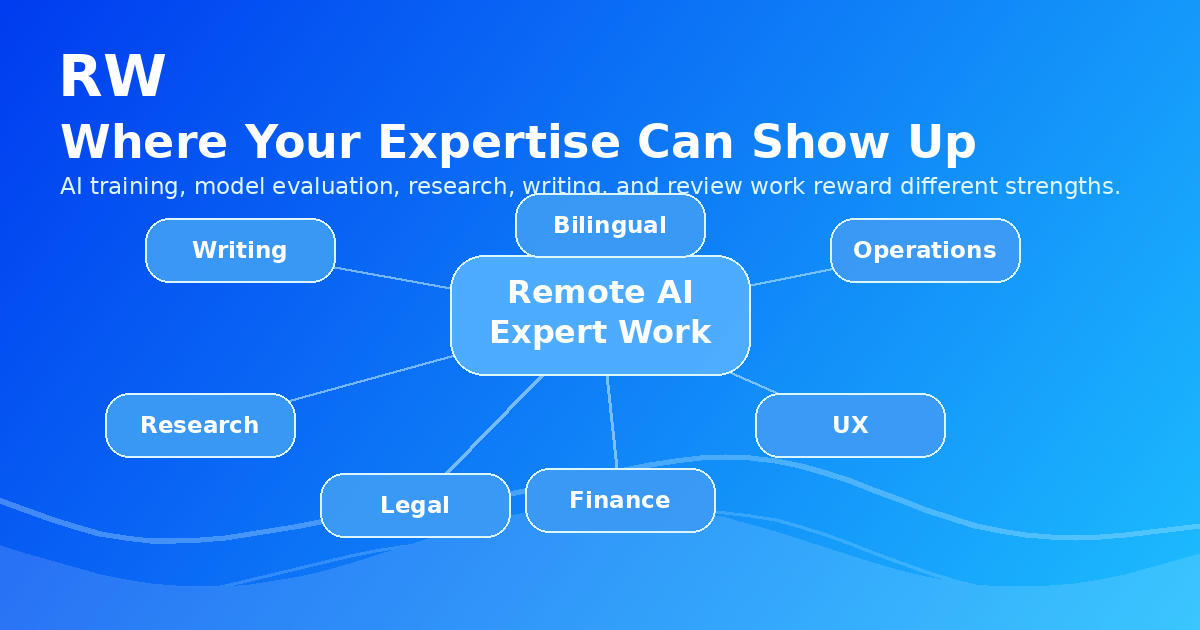
Writing expertise can translate into editing, AI response rewriting, prompt writing, content evaluation, search quality review, and tone assessment. Research expertise can translate into fact-checking, source comparison, evidence review, and answer verification. Legal experience can translate into legal question evaluation, document reasoning, and compliance review. Finance and accounting experience can translate into spreadsheet review, business analysis, and financial explanation tasks.
Marketing, sales, and customer success experience also matter. AI systems need to answer business questions, create campaign ideas, respond to customers, and explain products. People who have actually done those jobs can often tell when an answer is generic, unrealistic, or missing the point. UX researchers, bilingual professionals, and generalists with strong judgment can also qualify for AI training and expert review work.
The Profile Mistake Many Applicants Make
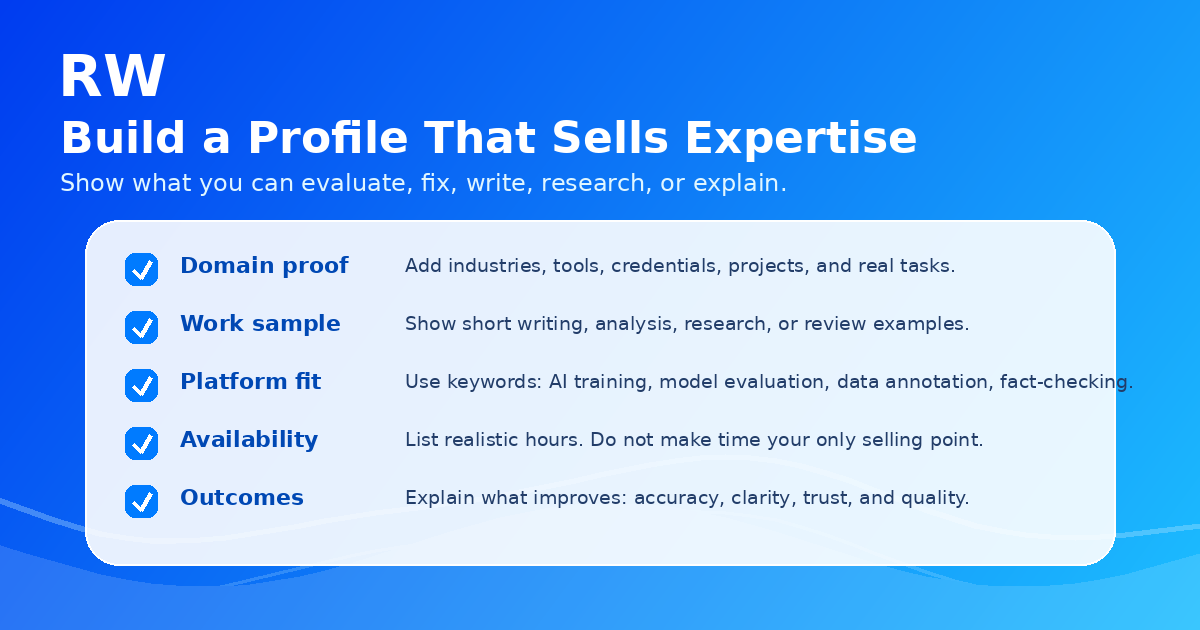
Many applicants describe themselves as available instead of valuable. They say they are hard-working, flexible, reliable, and ready to start immediately. Those traits are fine, but they are not enough for better remote work. A platform or company needs to know what you can do with your time.
A stronger profile does not just say, "I am available 20 hours per week." It says: "I can evaluate marketing strategy, rewrite unclear AI answers, fact-check business claims, review customer support responses, identify weak reasoning, and explain corrections clearly." That is a much stronger signal for AI training platforms trying to match workers to specific projects.
Key insight: For AI training platforms, your profile should make your judgment easy to understand. Use terms such as AI training, model evaluation, response rating, data annotation, prompt writing, fact-checking, subject matter expert, domain expertise, and quality review when they honestly match your background.
How to Position Yourself for Expertise-Based Remote Work
Start by listing the problems you can judge better than a beginner. That is the foundation of your remote work positioning. A former paralegal may be good at spotting missing facts and bad assumptions. A bookkeeper may be good at catching math errors and category mistakes. A social media manager may know when an answer misunderstands the platform, audience, or campaign goal.
Then convert that experience into search-friendly language. Instead of writing only "customer service," write customer support response evaluation, help desk documentation, support QA, escalation analysis, and user communication. Instead of writing only "marketing," write content strategy, ad copy review, SEO writing, brand voice, campaign evaluation, and AI content assessment.
Examples of Work That Pays for Expertise
AI model evaluation is a major category. You may compare two AI responses and decide which one is better, rate helpfulness, accuracy, completeness, tone, safety, formatting, or reasoning, and explain your decision clearly. AI data annotation can also reward expertise — the harder the label is to apply correctly, the more valuable the right reviewer becomes.
Expert writing and rewriting is another category: improving AI-generated answers, creating examples, writing prompts, rewriting weak responses, or judging whether a response sounds natural. Research and fact-checking work rewards people who can verify claims, compare sources, detect hallucinations, and separate confident language from accurate information. Business review work can include evaluating sales messages, marketing plans, financial explanations, operations workflows, or customer support answers.
Ready to find remote AI training and expert review roles that reward your judgment?
See Roles Hiring Now →A Simple Plan to Move From Availability to Expertise
First, identify your strongest knowledge areas. Choose three to five categories where you can judge quality better than a random beginner. These can be industries, tools, languages, job functions, or content types.
Second, rewrite your resume and platform profile around those categories. Lead with skills that match remote AI jobs and expert review work: writing, research, model evaluation, AI training, data annotation, analysis, quality review, fact-checking, communication, and domain expertise.
Third, create one or two proof samples. A sample can be simple: compare two answers and explain which is better, rewrite a weak answer, fact-check a short paragraph, or summarize a complex topic clearly. The sample should prove that you can think, not just that you can type.
Fourth, apply to multiple platforms and roles. Use platforms like micro1, Mercor, Handshake AI, and similar sites as part of a wider search. Fifth, keep track of what gets responses. If writing roles respond more than generalist roles, lean into writing. If finance review gets interest, build more finance examples. Remote work gets easier when your positioning becomes specific.
Frequently Asked Questions
What is expertise-based remote work?
Expertise-based remote work is any online job where the quality of your judgment matters more than your ability to stay logged in. It includes AI training, model evaluation, data annotation, writing review, research, fact-checking, legal analysis, finance review, and other work where your professional background improves the output.
Can I find remote AI training work without a coding background?
Yes. Many AI training and model evaluation jobs do not require coding. Platforms need reviewers who can evaluate writing quality, fact-check claims, compare responses, judge business logic, or assess legal reasoning. Coding helps for technical projects but is not required for most language and judgment work.
What kinds of expertise translate into remote AI training jobs?
Writing, research, legal analysis, finance, accounting, marketing, customer success, operations, UX, bilingual communication, teaching, healthcare, and general analytical skills can all translate. AI companies need human reviewers with real-world expertise to improve model quality across those domains.
How do I build a profile for expertise-based remote work?
List the problems you can judge better than a beginner. Convert that experience into searchable language: AI training, model evaluation, data annotation, prompt writing, fact-checking, content review, domain expertise, subject matter expert. Then add proof — a sample analysis, writing example, or certification — that shows your judgment in action.