When people search for Surge AI jobs, they are usually not looking for a traditional remote customer support role. They are looking for work connected to AI training, data labeling, model evaluation, RLHF, expert review, and the human judgment that helps large language models improve. That distinction matters because the best applicants do not present themselves as generic remote workers. They present themselves as people who can review information carefully, follow detailed guidelines, explain their reasoning, and apply real subject matter knowledge when the task requires it.
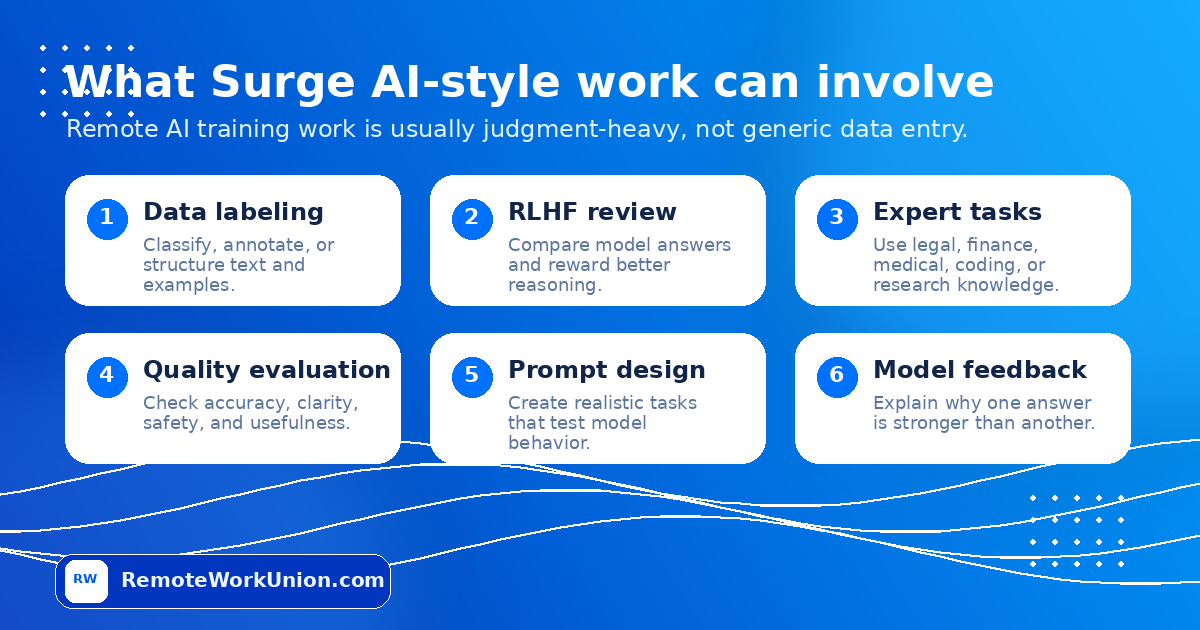
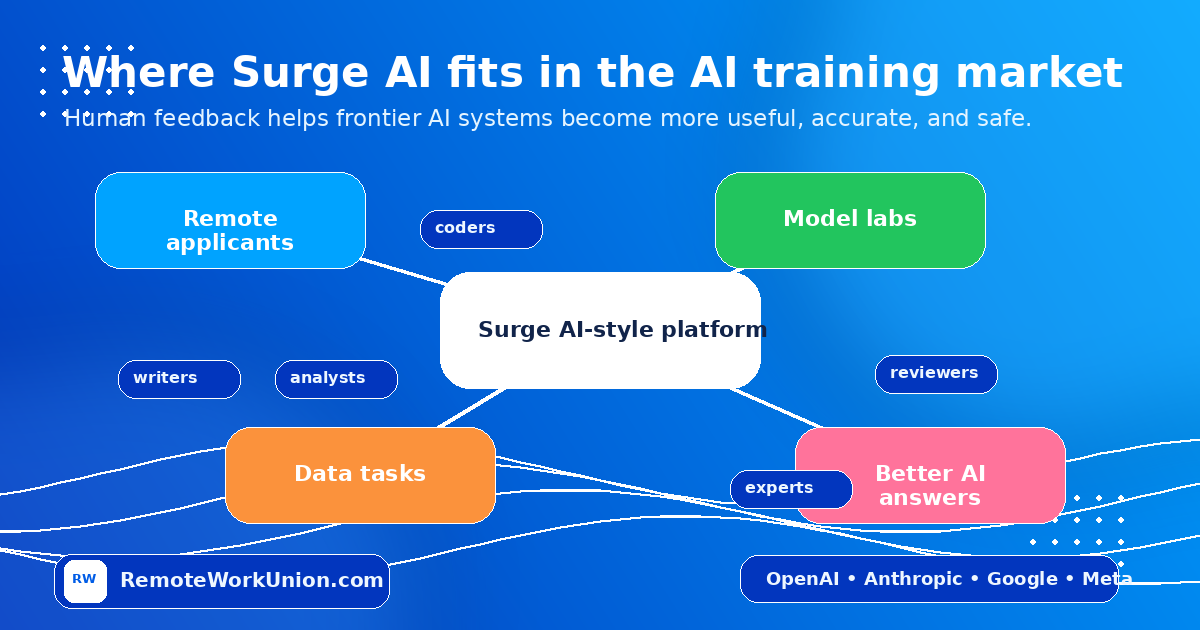
Surge AI is best understood as part of the broader human data and AI evaluation market. Companies building advanced AI systems need high-quality examples, rankings, feedback, annotations, and evaluations. Some of that work looks like writing or editing. Some looks like research. Some looks like fact-checking. Some looks like comparing two chatbot responses and explaining which answer is more helpful, accurate, safe, complete, or aligned with the user request. For higher-level projects, the work may require legal judgment, financial analysis, medical knowledge, software engineering ability, academic research experience, or another specialized background.
This is why a Surge AI application should be treated differently from a low-skill data entry application. A simple resume that says "hard worker" or "fast learner" is usually weaker than a resume that proves you can evaluate complex answers. Remote AI training platforms generally care about evidence: writing samples, domain experience, clear explanations, structured thinking, and the ability to make consistent decisions from a rubric.
What Surge AI Jobs May Include
Surge AI-related roles can sit across several categories. Some public roles may be full-time remote staff positions in research, engineering, operations, data science, growth, programs, account management, or business development. Other opportunities may be contractor-style expert network work, where contributors help evaluate or create training data for advanced AI models. Applicants should read each listing carefully because "Surge AI job" can mean very different things depending on the page, project, and role title.
For remote AI applicants, the most relevant categories are usually AI programs, data operations, human data, expert evaluation, coding evaluation, research support, writing evaluation, and domain-specific review. These roles are adjacent to the kind of work people also search for when they look up AI evaluator jobs, AI model training jobs, remote data annotation jobs, RLHF jobs, AI writing evaluator jobs, prompt response review, search quality rater work, and AI fact-checking jobs.
The common thread is judgment. A remote AI reviewer may be asked to decide whether an answer is accurate, whether a citation supports a claim, whether a model followed instructions, whether a proposed code solution works, whether a legal argument is sound, whether a finance analysis uses reasonable assumptions, or whether a written response is useful to a real user. That is more demanding than clicking labels quickly. The applicant who understands this has a better chance of building a strong profile.
The Best Applicant Profiles Are Specific
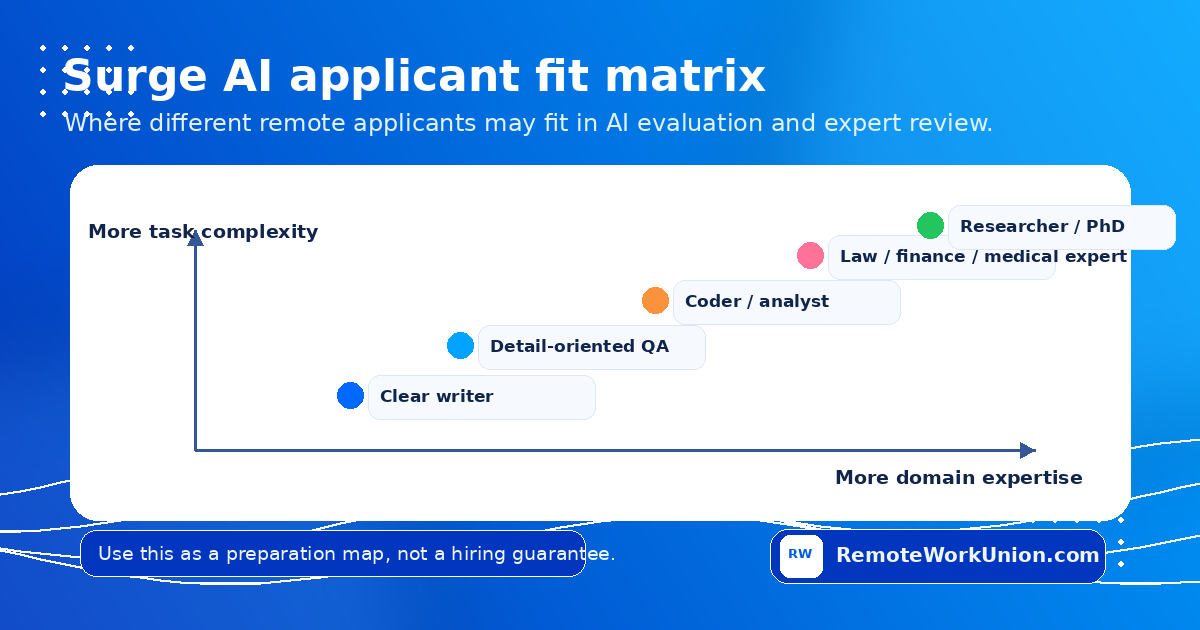
A strong Surge AI applicant does not need to be a professional machine learning engineer for every opportunity. Many AI training jobs are built around human judgment rather than model architecture. However, the applicant does need a clear angle. A vague remote-work profile is easy to ignore. A specific profile is easier to match to projects.
A writer might position themselves around editing, clarity, tone, rubric-based evaluation, and long-form critique. A researcher might emphasize source verification, synthesis, careful reading, and fact-checking. A finance professional might highlight valuation, accounting, Excel, markets, business analysis, and investment reasoning. A software engineer might focus on code review, debugging, technical explanations, Python, JavaScript, SQL, or evaluation of model-generated code. A teacher or tutor might emphasize curriculum, explanations, grading, feedback, and how people learn. A lawyer or legal researcher might emphasize argument structure, precedent, ambiguity, and precise language.
The point is not to stuff a resume with every AI keyword. The point is to make the match obvious. If the role is about model evaluation, show that you can evaluate. If the role is about expert reasoning, show expertise. If the role is about writing feedback, show writing. If the role is about coding evaluation, show technical review ability. Surge AI jobs and similar AI training opportunities reward proof more than broad claims.
What to Prepare Before Applying
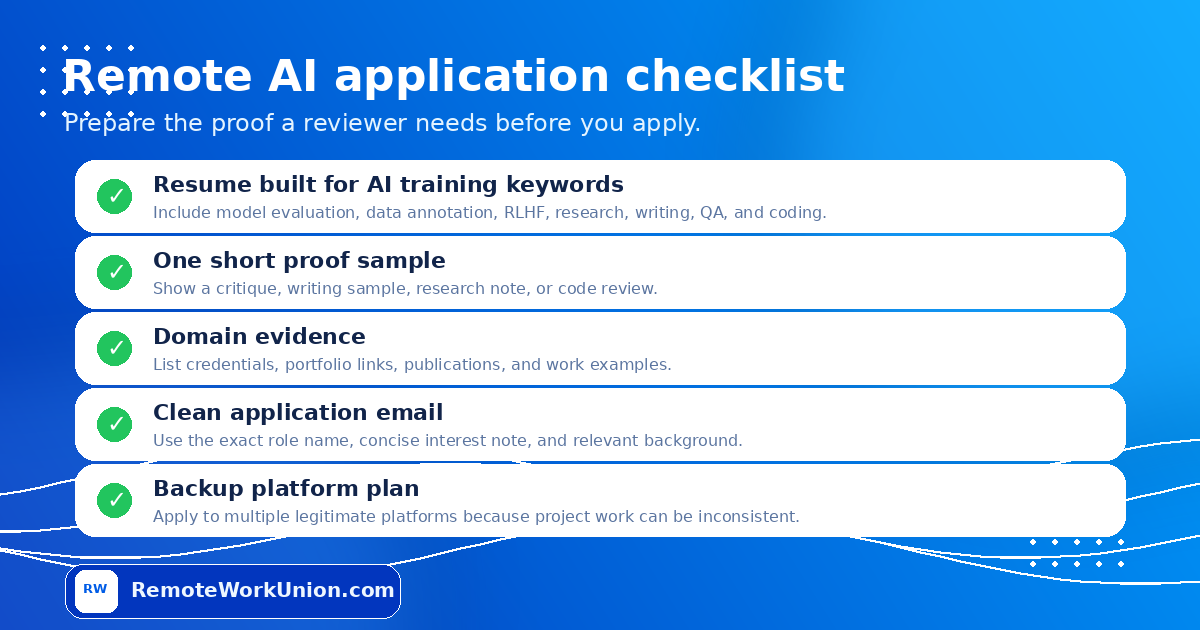
Before applying to Surge AI or any remote AI training platform, prepare the materials that make your judgment visible. Most applicants only think about the resume. Better applicants also prepare a short proof sample, a clean role-specific pitch, and a list of relevant keywords that match the task type.
Your resume should include plain-language terms that match the work: AI training, model evaluation, data annotation, data labeling, RLHF, chatbot response evaluation, prompt response review, fact-checking, research, editing, QA, rubric-based scoring, Python, SQL, Excel, legal analysis, finance analysis, healthcare writing, education, or whichever terms honestly fit your background. Do not overclaim. The goal is to help a reviewer understand where you belong.
A proof sample can be short. For example, you can take two AI-generated answers to the same prompt and explain which is better in five bullet points. You can write a one-page research note with sources. You can show a code review. You can include a portfolio link. You can provide a writing sample with a short note explaining what makes it strong. The best sample depends on your target role, but the principle is the same: prove the skill before someone has to guess.
Tip: Write your application note for the specific role, not for "remote AI work" in general. Mention the role name, explain your fit in one or two sentences, and include one concrete proof point. A specific note consistently outperforms a generic one.
Remote Work Union connects you to legitimate remote AI training and evaluation roles across multiple platforms. Apply for free and find roles hiring now.
Find Roles Hiring Now →How Surge AI Compares With Other Remote AI Platforms
Surge AI sits in the same broad market as other AI training and evaluation platforms, but applicants should not assume every platform works the same way. Mercor may feel more profile-driven and interview-driven for some expert roles. Outlier may feel more task-queue and assessment-driven for some contributors. Handshake AI may position certain opportunities around fellowships or structured evaluation work. micro1, Stellar AI, LinkedIn listings, company career pages, and staffing firms may each present AI training jobs in a different format.
The practical lesson is simple: apply broadly, but tailor specifically. A single generic resume is not enough. The best remote AI applicants build one core resume, then adjust the headline, top skills, examples, and short application note for each platform. Someone applying to Surge AI should make their expertise and judgment easy to understand. Someone applying to Outlier may need to be ready for assessments and task availability. Someone applying to Mercor may need a stronger interview profile and domain-specific positioning. Someone using LinkedIn should filter aggressively for real remote AI evaluation jobs and avoid vague listings that look like scams.
This market can be inconsistent. Projects start and stop. Applicants may pass an assessment and still wait for work. A platform may need one domain this month and a different domain later. That is why the best strategy is not to depend on one application. Treat Surge AI as one target in a wider remote AI job search that includes AI model evaluation, data annotation, expert review, AI safety evaluation, AI writing evaluation, search quality, code evaluation, and research-heavy remote contract work.
Red Flags and Mistakes to Avoid
First, do not assume every online listing using the words "Surge" or "AI" is the same company or a legitimate role. Check the domain, the application instructions, the email address, and whether the opportunity makes sense. Be careful with fake recruiters, payment requests, crypto tasks, training fees, or anyone asking for sensitive personal information before there is a real hiring process.
Second, do not treat AI training work like easy passive income. Many projects require close reading, patience, and consistency. If the guidelines are long, read them. If the task asks for an explanation, write a useful one. If you are comparing two answers, do not choose the longer answer just because it sounds more polished. Look for accuracy, completeness, instruction following, clarity, safety, and actual usefulness.
Third, do not over-specialize your search too early. Surge AI jobs may be a strong target, but the broader opportunity is remote AI work. Search for AI evaluator jobs, remote AI training jobs, data annotation jobs, AI data labeling jobs, AI response evaluator jobs, RLHF jobs, prompt evaluator jobs, AI fact-checking jobs, AI safety evaluation jobs, and expert AI training roles. Many legitimate roles will not use the exact phrase you expected.
Tip: Track every application in a simple spreadsheet: platform, role title, date, resume version, and outcome. Remote AI work is fragmented across many platforms. Organization helps you follow up, adjust your approach, and avoid duplicating work.
A Practical Surge AI Application Strategy
Start with the role category. Is the listing asking for a generalist, an analyst, a writer, a researcher, an engineer, a domain expert, or an operations person? Then rewrite the top third of your resume so it mirrors that category. Use a direct title such as "AI Model Evaluation and Research" or "Finance Analyst for AI Training" or "Technical Reviewer for Coding Evaluation" instead of a generic remote-work headline.
Next, add a short skills bank. Use honest keywords that match your background: model evaluation, prompt response review, rubric scoring, research synthesis, source verification, editing, Python, SQL, Excel, financial modeling, legal research, medical writing, curriculum review, data labeling, AI safety, QA, and written feedback. This helps both human reviewers and applicant tracking systems understand the match.
Then prepare a short application note. Keep it specific. Mention the role name. Explain why your background fits the task. Add one concrete proof point. For example: "I have five years of finance analysis experience and can evaluate model-generated investment memos for assumption quality, valuation logic, and clarity." That is much stronger than "I am interested in remote AI work."
Finally, track your applications. Save the platform, role title, date, application URL, resume version, follow-up date, and outcome. Remote AI work is fragmented. Organization matters because you may apply to Surge AI, Mercor, Outlier, Handshake AI, micro1, Stellar AI, LinkedIn postings, direct company roles, and niche expert networks at the same time.
Bottom Line
Surge AI jobs are worth understanding because they sit near the center of the human feedback market behind modern AI systems. For remote applicants, the opportunity is not only "data labeling." It can include AI response evaluation, expert review, research, writing, coding evaluation, operations, and domain-specific reasoning. The strongest applicants make their judgment visible. They show what they know, how they think, and how they evaluate quality.
Do not apply like a generic remote job seeker. Apply like someone who can help improve AI answers. Build a resume around AI training keywords, prepare a proof sample, target roles that match your background, and keep applying across several legitimate platforms because project-based AI work can change quickly.
Frequently Asked Questions
Is Surge AI a legitimate platform for remote work?
Surge AI is a real company in the human data and AI training space. It works with AI labs on data labeling, model evaluation, RLHF, and expert review. As with any remote platform, applicants should verify each listing directly, use official application pages, and avoid any opportunity that asks for upfront payment or moves to an unrelated messaging app.
What types of work appear in Surge AI jobs?
Surge AI jobs can include AI model evaluation, RLHF work, data labeling, prompt response review, expert reasoning tasks, coding evaluation, writing evaluation, research support, and domain-specific review. Some opportunities are remote contractor roles for contributors; others are full-time staff positions in engineering, data science, operations, or business development.
How do I prepare my application for Surge AI?
Update your resume with honest AI training keywords that match your background: model evaluation, data annotation, research, editing, fact-checking, prompt review, RLHF, or domain expertise in law, finance, healthcare, education, or coding. Prepare a short proof sample showing your judgment. Write a tailored application note that names the role and explains your specific fit with a concrete example.
How does Surge AI compare to Mercor and Outlier?
Surge AI, Mercor, and Outlier are all part of the broader human data and AI training market, but they work differently. Mercor tends to be profile-driven and interview-focused for expert roles. Outlier uses task queues and assessments for contributors. Surge AI combines staff roles and contractor-style expert network work. Applying to multiple platforms is usually the best strategy since project availability varies.
Are Surge AI jobs available worldwide?
Surge AI works with contributors in many countries, but availability can depend on the specific project, language requirements, and regional demand. Some specialized expert review projects may have narrower geographic eligibility. Applicants should check the current listings and application requirements directly to confirm availability in their region.