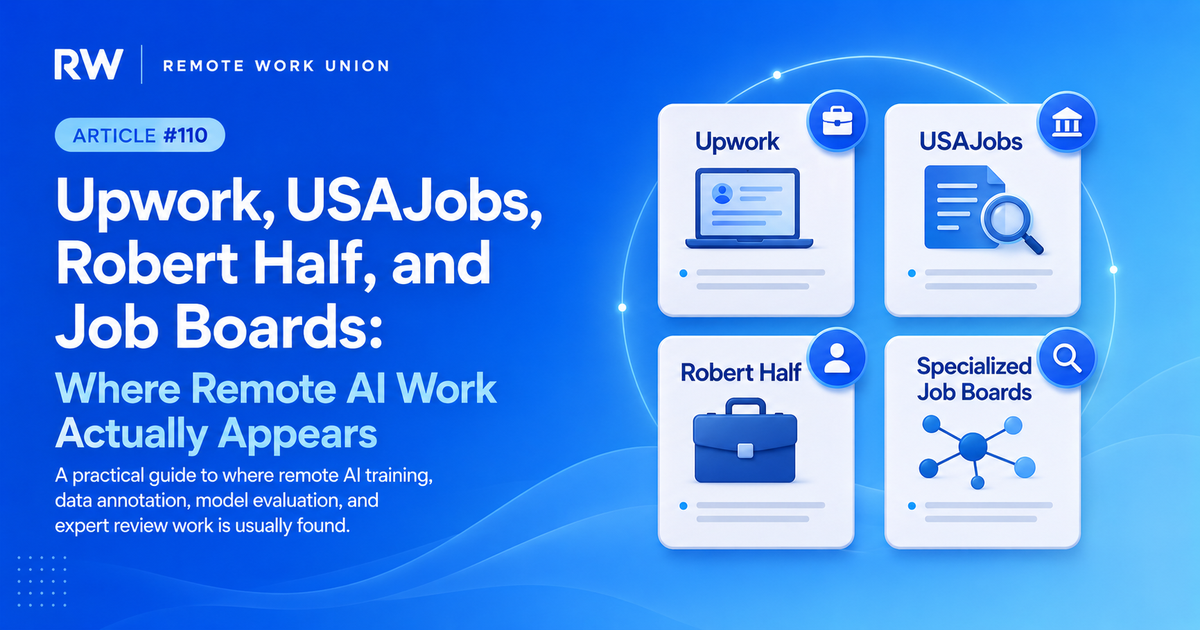
Remote AI work does not appear in only one place. Some projects show up on freelance marketplaces. Some appear inside traditional staffing pipelines. Some are listed on government job portals. Others are posted on specialized AI training platforms, remote job boards, or company career pages with language that does not always say "AI training job" in the title.
That is why a job seeker who only searches one phrase, on one website, usually misses a large part of the market. The same underlying work can be described as AI model evaluation, data annotation, prompt evaluation, content quality review, machine learning feedback, chatbot response rating, AI research support, domain expert review, or human feedback for AI systems. The task may be similar, but the job board language changes by platform.
This guide explains where remote AI work actually appears, how to search each source, and how to decide whether a listing is worth your time. It is written for people looking for work from home AI jobs, AI evaluator jobs, AI rater projects, data annotation jobs, expert review contracts, prompt evaluation work, and other remote jobs connected to modern AI systems from companies and ecosystems such as OpenAI, Anthropic, Google, Meta, Microsoft, Amazon, xAI, NVIDIA, Cohere, and other AI-focused organizations.
The Main Mistake: Searching Too Narrowly
Many applicants search for "AI training jobs" and stop there. That phrase is useful, but it is not enough. A legitimate remote AI role may never use that exact wording. On Upwork, a client may call it "LLM response evaluation" or "prompt testing." On USAJobs, the listing may sit under data science, digital services, research, analytics, language, records, or technology modernization. On Robert Half, the same work might be framed as content operations, business analysis, quality assurance, data review, or AI implementation support. On niche job boards, it might be called model evaluation, annotation, AI tutor work, human feedback, or RLHF.
The better approach is to search by task, not just by title. Remote AI work is often built around a few recurring tasks: judging answers, checking accuracy, labeling information, comparing outputs, improving prompts, reviewing data, writing explanations, testing search results, or applying professional judgment to model responses. Once you understand the task, you can recognize the job across different platforms.
Where Remote AI Work Usually Appears
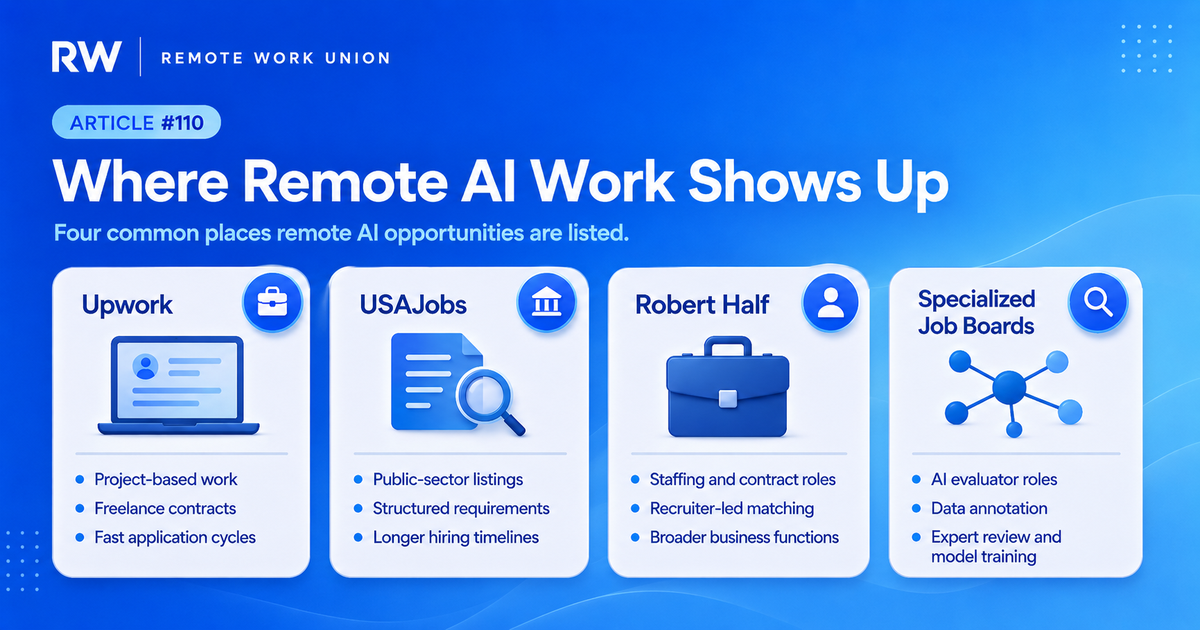
There are four useful categories to understand: freelance marketplaces, public-sector job portals, staffing and recruiting firms, and specialized job boards. Each one can be useful, but each works differently.
| Source | Best For | Typical Search Language | Main Tradeoff |
|---|---|---|---|
| Upwork | Project-based and freelance AI work | AI evaluator, prompt engineer, chatbot testing, data annotation, LLM review | Fast-moving marketplace; quality varies by client |
| USAJobs | Public-sector and government-adjacent AI, data, research, and technology roles | Artificial intelligence, machine learning, data science, digital services, analytics | More structured requirements and slower timelines |
| Robert Half | Staffing, contract, analyst, content, administrative, and technical support roles | AI operations, data analyst, content QA, business analyst, automation, research | May require recruiter matching and broader job titles |
| Specialized job boards | Remote AI training, model evaluation, annotation, expert review, and flexible contract work | AI rater, model trainer, RLHF, human feedback, response reviewer, expert review | Great targeting, but platforms differ in quality and availability |
1. Upwork: Project-Based AI Work and Freelance Contracts
Upwork is one of the most obvious places to search for remote AI work, but it is also one of the easiest places to search poorly. Many useful opportunities are not listed as "remote AI jobs." They are posted as one-off client projects, hourly contracts, content review assignments, prompt testing jobs, AI automation tasks, or data cleanup work.
For a beginner, Upwork can be useful because it lets you test demand quickly. You can create a profile around writing, research, fact-checking, prompt evaluation, AI content editing, data annotation, spreadsheet cleanup, customer support automation, or technical review. You do not need to present yourself as a machine learning engineer unless the work actually requires engineering. Many AI-adjacent projects need judgment, clarity, subject matter knowledge, and consistent execution.
Good Upwork search terms:
- AI evaluator
- AI model evaluation
- LLM evaluation
- Chatbot testing
- Prompt evaluation
- Prompt writing
- AI content editor
- AI fact checker
- Data annotation
- Dataset review
- Search quality rater
- AI research assistant
- LLM response comparison
- RLHF
- Human feedback AI
What to look for on Upwork:
The strongest Upwork listings usually have a clear task, a real deliverable, a defined timeline, and a client who understands what they need reviewed. For example, a good listing might ask you to compare two chatbot responses, identify factual errors, label data, rewrite prompts, create evaluation criteria, or review AI-generated content for accuracy and tone. A weaker listing may promise vague passive income, ask for unpaid training work, or describe the project in buzzwords without giving an actual task.
Upwork also rewards positioning. A generic profile that says "I can do AI work" is less convincing than a profile that says "I help teams evaluate AI-generated answers for accuracy, clarity, safety, and usefulness" or "I review AI outputs for factual consistency, writing quality, and instruction-following." The more specific the service, the easier it is for a client to understand why you fit.
Best fit for Upwork: writers who can judge tone and instruction-following; researchers who can verify claims; domain experts in law, finance, healthcare, education, or coding; operators comfortable with repetitive data review; and freelancers who are comfortable pitching and competing for client work.
2. USAJobs: Government, Research, Data, and Technology Roles
USAJobs is not usually the fastest place to find flexible AI side hustles, but it belongs in the search strategy because public-sector AI work can appear under broader categories. Government agencies, research offices, contractors, and public institutions may need help with data analysis, records modernization, AI policy, cybersecurity, language processing, geospatial data, digital services, research, and technology evaluation.
The important point is that USAJobs listings may not look like the informal remote AI training posts found on AI platforms. The titles can sound more formal: data scientist, program analyst, research analyst, information technology specialist, AI policy analyst, statistician, technical writer, digital services specialist, or machine learning specialist. The work may involve AI systems, but the posting may emphasize security clearance, federal requirements, education, eligibility, documentation, or a structured application process.
Good USAJobs search terms:
- Artificial intelligence
- Machine learning
- Data science
- Data analyst
- Program analyst AI
- Digital services
- Natural language processing
- Automation
- Analytics
- Knowledge management
- Research analyst
- Technical writer
- Human-centered design
- Information technology specialist
- AI governance
How USAJobs differs from AI training platforms: A USAJobs role is less likely to be a quick contract where you rate chatbot answers for a few hours. It is more likely to be a formal role involving public systems, agency operations, policy, compliance, research, analysis, or technical support. That does not make it better or worse; it simply means applicants need a different strategy. Your resume must mirror the qualifications, your experience must be documented clearly, and your application should address the exact requirements in the announcement.
For remote job seekers, the key is to filter carefully. Look for remote eligibility, telework language, location requirements, agency-specific restrictions, security requirements, citizenship requirements, pay scale, and whether the role is full-time, term-limited, contract-adjacent, or permanent.
Best fit for USAJobs: applicants with government, military, public-sector, university, research, policy, data, or technical backgrounds; people who can handle longer applications and formal hiring processes; analysts, researchers, writers, data professionals, cybersecurity candidates, and technical specialists who want AI-adjacent work.
3. Robert Half: Staffing, Recruiter-Led Contracts, and AI-Adjacent Roles
Robert Half is not an AI training platform, but it can still be relevant because many companies introduce AI work through business functions before they create dedicated AI teams. A company may need a content specialist to review AI-generated copy, a business analyst to document automation workflows, an administrative contractor to clean internal data, a QA specialist to test tools, or a data analyst to help evaluate outputs. Those roles may appear through staffing firms before they appear on niche AI boards.
This matters because not every remote AI job is called an AI job. If a business is adopting AI tools, it may post for content operations, customer support automation, knowledge base cleanup, CRM data quality, marketing operations, business intelligence, data governance, project coordination, technical writing, or quality assurance. Some of these roles can become valuable entry points into AI operations, even if the title does not sound futuristic.
Good Robert Half search terms:
- AI operations
- Automation analyst
- Business analyst
- Data analyst
- Content quality analyst
- Content operations
- Technical writer
- Digital marketing analyst
- Quality assurance analyst
- Research analyst
- Data entry specialist AI
- Knowledge base specialist
- CRM data quality
- Process improvement
- Machine learning support
How to use staffing firms well: With a staffing firm, your goal is not only to apply to listings. Your goal is to become easy to match. That means your resume should contain clear keywords, but it should also explain the business result of your work. Instead of writing "used ChatGPT," write "reviewed AI-generated content for accuracy, clarity, and brand consistency" or "created prompt templates to standardize research summaries." Instead of "data entry," write "cleaned, categorized, and quality-checked structured data for internal workflows."
Recruiters often match candidates by title, skills, software, industry, pay range, location, and availability. A candidate who can explain their AI-adjacent experience in normal business language is easier to place than someone who only says they are interested in AI.
Best fit for Robert Half: candidates with business, administrative, content, marketing, finance, accounting, operations, or analyst experience; people who want contract roles but prefer recruiter-led matching; applicants who can translate AI tool experience into business outcomes; and remote workers open to AI-adjacent roles, not only pure AI training jobs.
Remote Work Union helps you find remote AI work across multiple platforms and sources. Browse verified listings from data annotation to expert review.
Find Roles Hiring Now →4. Specialized Job Boards and AI Training Platforms
Specialized job boards are where the language often becomes most direct. This is where applicants are more likely to see terms like AI evaluator, AI trainer, model evaluator, data annotation, prompt evaluator, AI tutor, response reviewer, coding evaluator, language evaluator, search quality rater, expert reviewer, RLHF, and human feedback. These sources can include AI training platforms, remote work boards, niche contractor networks, startup job boards, and company career pages for AI labs or AI infrastructure companies.
This category is broad. It can include platforms that focus on AI training and evaluation work, general remote job boards that list AI roles, startup boards, freelance networks, and the career pages of companies building AI products. Applicants should search both the platform names and the task names. For example, a remote worker might search for "AI model evaluation jobs," "data annotation jobs from home," "AI response reviewer jobs," "prompt evaluation remote," "language evaluator AI," "coding evaluator AI," "expert review AI jobs," or "remote AI research jobs."
Examples of specialized sources to monitor:
- AI training and evaluation platforms such as Mercor, Outlier, Handshake AI, micro1, DataAnnotation, Surge AI, Scale AI, Turing, Invisible Technologies, Remotasks-style task networks, and other contractor marketplaces.
- Remote job boards that publish work from home roles, flexible contracts, and startup jobs.
- Startup job boards where AI companies list operations, evaluation, research, content, support, and data roles.
- Company career pages for major AI and technology companies such as OpenAI, Anthropic, Google, Meta, Microsoft, Amazon, NVIDIA, xAI, Cohere, and AI infrastructure companies.
- Professional communities where domain experts are recruited for evaluation work in law, finance, healthcare, education, coding, science, language, writing, and business.
What makes specialized sources valuable: The advantage of specialized sources is targeting. You are not forcing a general job board to understand what you mean by remote AI work. The listing is more likely to be written for people who want model evaluation, annotation, human feedback, or AI response review. The disadvantage is that availability can change quickly. A platform may have many projects one month and fewer projects later. Some projects are invitation-only. Some require screening tests. Some are only available for specific domains, languages, or locations.
Because of that, the best strategy is to build a pipeline rather than depend on one source. Apply to several credible platforms, keep a strong profile, search job boards weekly, and track which applications actually produce interviews, tests, or paid work.
How to Search Across All Platforms
A good remote AI search routine uses clusters of keywords. You are not trying to find one magic phrase. You are trying to cover the different ways companies describe the same work.
| Keyword Cluster | Search Terms to Try | Best For |
|---|---|---|
| Evaluation | AI evaluator, model evaluator, AI rater, response reviewer, chatbot evaluator, LLM evaluator | Judging AI answers and comparing outputs |
| Annotation | Data annotation, data labeling, dataset review, image annotation, text annotation, data quality review | Structured labeling and cleanup tasks |
| Prompt Work | Prompt evaluator, prompt engineer, prompt writer, prompt testing, AI workflow testing | Improving prompts and testing outputs |
| Research | AI research assistant, fact-checker, search evaluator, web research, source verification | Checking accuracy and supporting answer quality |
| Expert Review | Domain expert AI, legal AI review, finance AI review, medical writing AI, coding evaluator, education expert AI | Specialized review based on professional knowledge |
| Business AI | AI operations, automation analyst, content operations, QA analyst, technical writer, knowledge base specialist | AI-adjacent business roles on staffing and general boards |
How to Tell Whether a Listing Is Worth Applying To
Not every remote AI listing deserves your time. Some are excellent. Some are too vague. Some are legitimate but not a fit. Some are simply regular jobs with AI language added to make them sound current. Before applying, evaluate the listing like a reviewer.
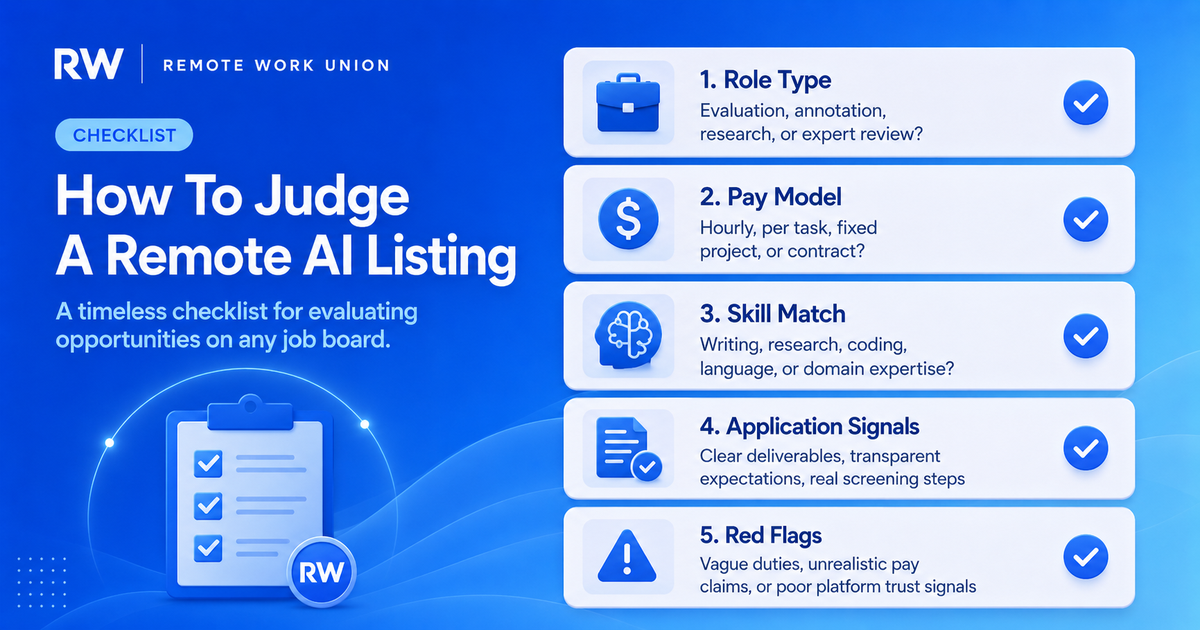
A useful checklist:
- Role type: Is the work evaluation, annotation, research, expert review, writing, coding, operations, or general business support?
- Pay model: Is the listing hourly, per task, fixed project, full-time, part-time, or contractor-based?
- Skill match: Does the role need writing, research, coding, language ability, professional domain expertise, or basic computer skills?
- Application signals: Does the listing explain the task, expected output, screening process, and requirements clearly?
- Trust signals: Does the source have credible company information, reasonable pay language, and a clear application path?
- Red flags: Does the listing promise unrealistic earnings, hide the actual task, require strange payments, or use vague urgency instead of real requirements?
How to Adapt Your Resume and Profile
The same resume should not be used everywhere. You can keep the same career story, but the emphasis should change by source. Upwork needs a service-focused profile. USAJobs needs detailed qualification matching. Robert Half needs recruiter-friendly business language. Specialized AI platforms need task-specific keywords and proof that you can follow instructions carefully.
| Platform | Profile Strategy | What to Emphasize |
|---|---|---|
| Upwork | Service-based positioning | Deliverables, examples, client outcomes, fast communication, specific AI review services |
| USAJobs | Requirements-based application | Exact qualifications, education, experience level, formal duties, tools, measurable responsibilities |
| Robert Half | Recruiter-friendly resume | Business function, software, availability, contract fit, operations and analyst keywords |
| Specialized AI platforms | Task-specific screening fit | Accuracy, writing quality, research skill, domain expertise, coding ability, language fluency, evaluation judgment |
Resume phrases that work better than generic AI language:
- Reviewed AI-generated responses for factual accuracy, clarity, completeness, and instruction-following.
- Compared multiple model outputs and selected the stronger answer using structured quality criteria.
- Annotated text data according to project guidelines and maintained consistency across repeated tasks.
- Created prompt templates to standardize research, writing, and content review workflows.
- Evaluated chatbot answers for usefulness, tone, safety, and relevance to the user request.
- Quality-checked AI-assisted content for grammar, hallucinations, formatting issues, and missing context.
- Applied subject matter expertise to review specialized AI outputs in a professional domain.
A Practical Weekly Search Routine
A remote AI job search should be organized enough to repeat. The goal is not to open a dozen tabs, skim randomly, and hope something appears. The goal is to run a system.
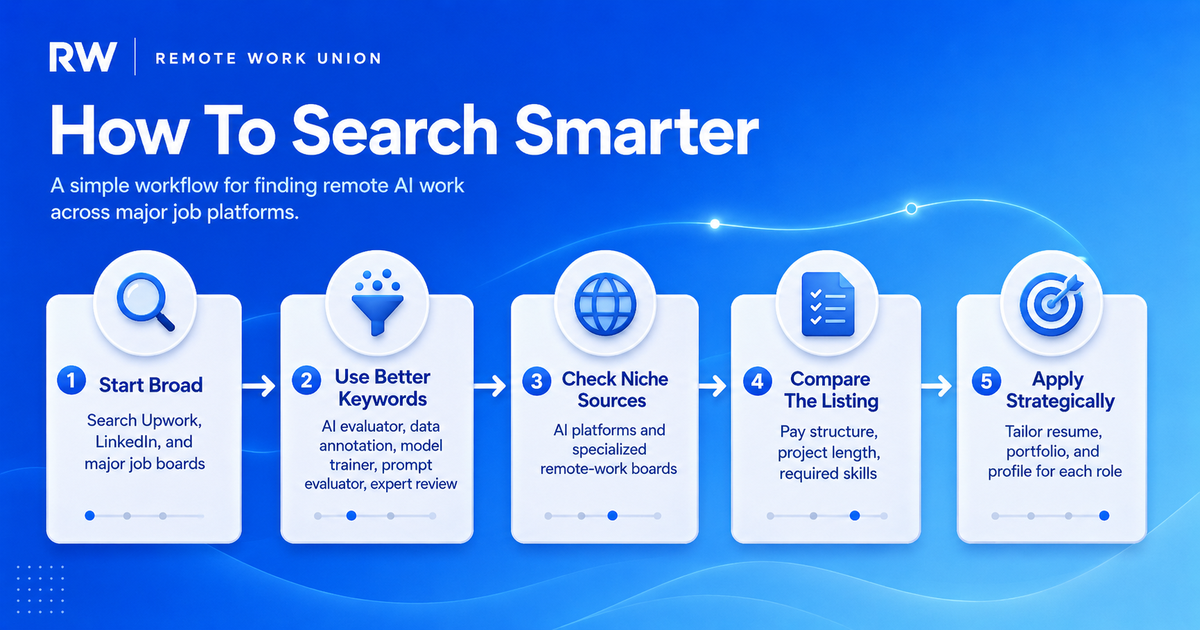
Step 1: Search broad sources. Check broad platforms such as Upwork, LinkedIn, Indeed, Google Jobs, Robert Half, USAJobs, and remote work boards using several keyword clusters. Save searches when possible. Use filters for remote, contract, part-time, freelance, and entry-level only when those filters help; sometimes too many filters hide relevant listings.
Step 2: Search specialized sources. Check AI training platforms, annotation platforms, expert networks, startup boards, and company career pages. Search for AI evaluator, model trainer, prompt evaluator, language evaluator, data annotation, expert review, AI tutor, search quality rater, coding evaluator, and human feedback.
Step 3: Track every serious application. Create a simple tracker with source, role title, keywords used, pay model, application date, screening step, follow-up date, and result. After a few weeks, you will know which sources produce real responses and which ones are wasting time.
Step 4: Improve based on response signals. If you get no responses, improve your profile and resume keywords. If you pass profile reviews but fail tests, practice accuracy, instruction-following, and written explanations. If you get interviews but no offers, tighten your examples. If one platform performs well, search for similar roles using the same task language on other platforms.
Tip: The most effective applicants do not spend equal time on all platforms. They track where real responses come from, then weight their weekly search time accordingly. Give more time to the sources that convert, and less to the ones that do not.
Final Takeaway
Remote AI work is scattered across more places than most applicants realize. Upwork can surface freelance projects. USAJobs can surface public-sector AI, data, research, and technology roles. Robert Half can surface staffing and contract roles that touch AI through business operations. Specialized job boards and AI platforms can surface direct model evaluation, data annotation, AI response review, RLHF, human feedback, and expert review opportunities.
The best applicants do not depend on one platform or one keyword. They search by task, compare listings carefully, tailor their profiles, and build a steady pipeline of applications. Remote AI work is real, but it rewards people who can recognize the work even when the job title changes.
Frequently Asked Questions
Does Upwork have legitimate AI training and evaluation work?
Yes. Upwork regularly has project-based AI evaluation, data annotation, prompt testing, chatbot review, LLM response comparison, and AI content editing work. The key is to search by task rather than job title — terms like "AI evaluator," "LLM evaluation," "prompt testing," "data annotation," and "AI fact checker" tend to surface more relevant listings than broad phrases like "AI job." Upwork rewards specific positioning, so a profile that describes the exact service you offer will outperform a generic one.
What kinds of AI work appear on USAJobs?
USAJobs tends to list AI work under formal government roles such as data scientist, program analyst, research analyst, information technology specialist, AI policy analyst, statistician, digital services specialist, and machine learning specialist. These are structured positions with formal requirements, documentation standards, and often security clearance or citizenship requirements. They are not typically quick annotation contracts — they are full-time or term-limited roles in government agencies or research offices.
Can I find real AI work through Robert Half?
Yes, but indirectly. Robert Half is a staffing firm that places candidates in contract and full-time business roles. Many companies now need people to support AI adoption through content operations, data quality, business analysis, QA testing, and knowledge management — and those roles often appear through staffing firms before they are listed on niche AI boards. Use business-friendly search terms and translate your AI experience into operational outcomes to get matched effectively.
What are the best search terms for finding remote AI work across multiple platforms?
Effective search clusters include: evaluation terms (AI evaluator, model evaluator, AI rater, LLM evaluator, chatbot evaluator); annotation terms (data annotation, data labeling, dataset review, text annotation, image labeling); prompt terms (prompt evaluator, prompt engineer, prompt writer, AI workflow testing); research terms (AI research assistant, fact-checker, search evaluator, source verification); expert review terms (domain expert AI, legal AI review, finance AI review, coding evaluator); and business AI terms (AI operations, content operations, QA analyst, technical writer, automation analyst).
How do I tell whether a remote AI listing is worth applying to?
Evaluate the listing against six criteria: role type (is the work evaluation, annotation, research, expert review, or business support?), pay model (hourly, per task, fixed, or salaried?), skill match (does the role need your actual skills?), application signals (does the listing explain the task and requirements clearly?), trust signals (does the source have credible company information and a clear application path?), and red flags (does it promise unrealistic earnings, hide the task, or use vague urgency?). A listing that passes all six checks is usually worth your time.