AI can write, summarize, translate, code, brainstorm, analyze, and answer questions in seconds. That speed is the reason tools from OpenAI, Anthropic, Google, Meta, Microsoft, Perplexity, xAI, and other AI companies have become part of everyday work. But speed is not the same as judgment.
A model can produce an answer that looks polished and still be wrong. It can sound confident and still miss the point. It can follow the surface of a prompt but fail the deeper intent. It can give a legal-sounding answer without understanding the risk. It can make a finance answer look neat while hiding a bad assumption. It can write a medical explanation that is easy to read but not safe enough. It can produce code that looks clean but fails in a real environment.
That is why AI companies still need humans. Not just engineers. Not just machine learning researchers. They need writers, editors, teachers, lawyers, finance professionals, accountants, marketers, salespeople, healthcare workers, engineers, analysts, designers, translators, and other real-world experts who can look at an AI answer and say: this is right, this is weak, this is misleading, this needs to be rewritten.
That human layer is one of the biggest reasons remote AI training jobs, AI evaluator jobs, AI response review jobs, and online AI research jobs exist. The model generates the answer. Humans judge whether the answer is good.
The Simple Reason Humans Still Matter: AI Does Not Know When It Is Wrong
A large language model predicts and generates text based on patterns. It can be extremely useful, but it does not experience the world, run a business, manage a classroom, argue a case, close a sale, reconcile a ledger, diagnose a patient, or debug production software the way a person does.
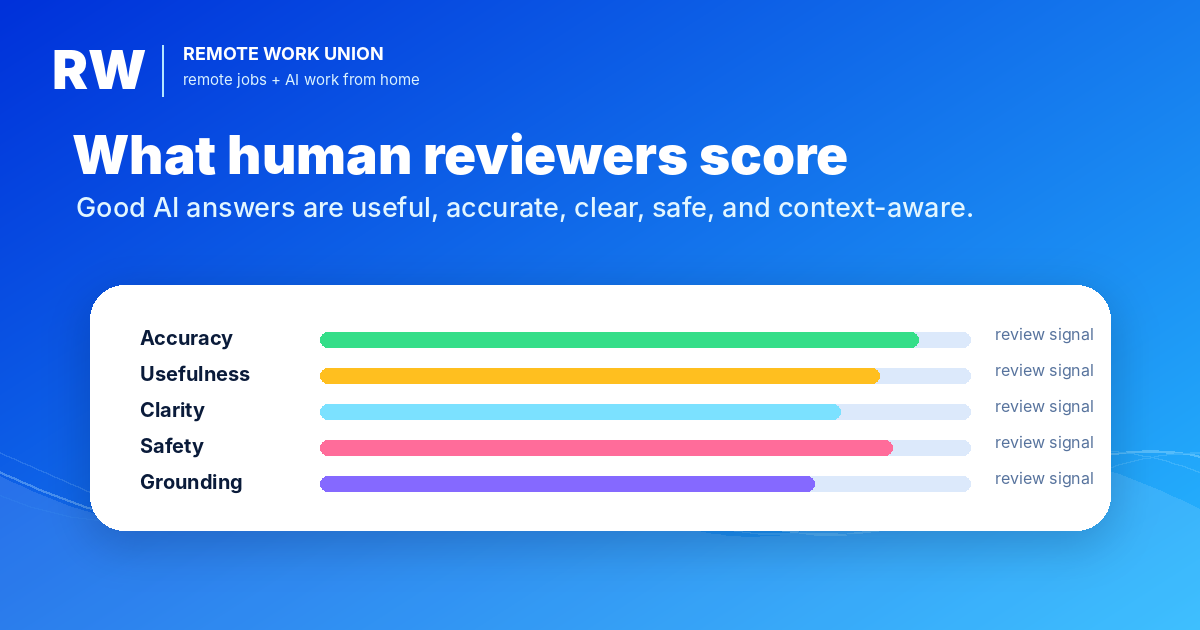
That matters because many questions are not just about producing words. They are about deciding what a good answer should do. A good answer may need to be accurate, clear, complete, safe, useful, specific, honest about uncertainty, written for the right audience, and appropriate for the user's context.
AI can imitate these qualities. Humans are still needed to evaluate them.
If a model learns that vague answers get rewarded, it becomes vague. If it learns that confident but unsupported answers get rewarded, it becomes confidently wrong. If it learns that long answers are always better, it becomes bloated. Human reviewers help correct those incentives.
What It Means to Review, Rank, and Improve AI Answers
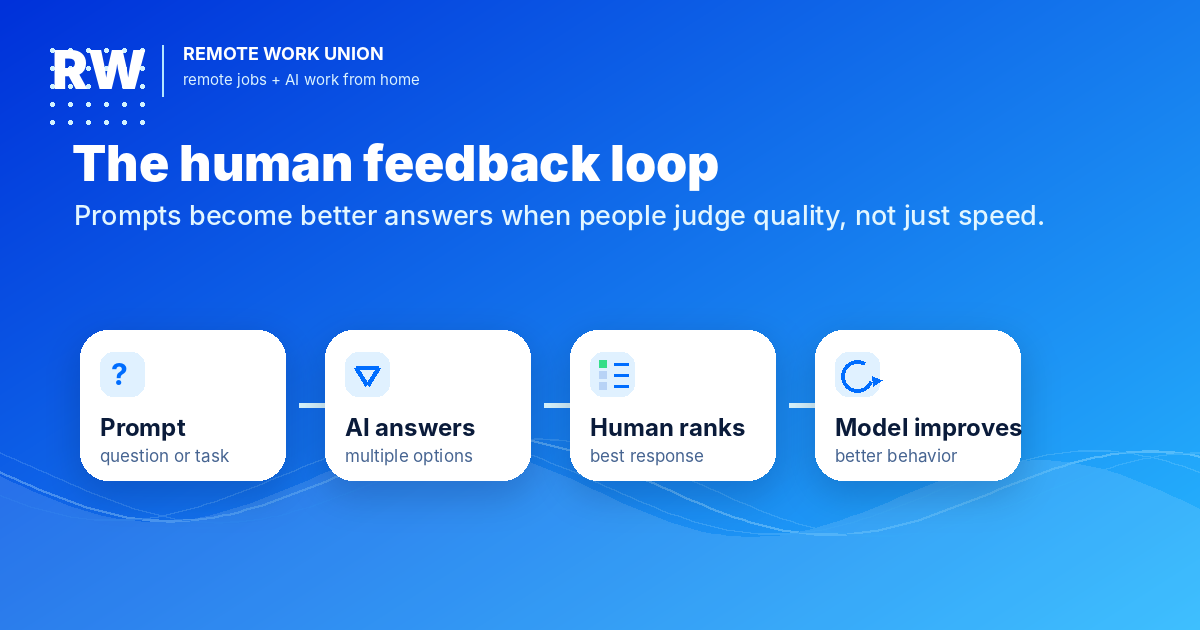
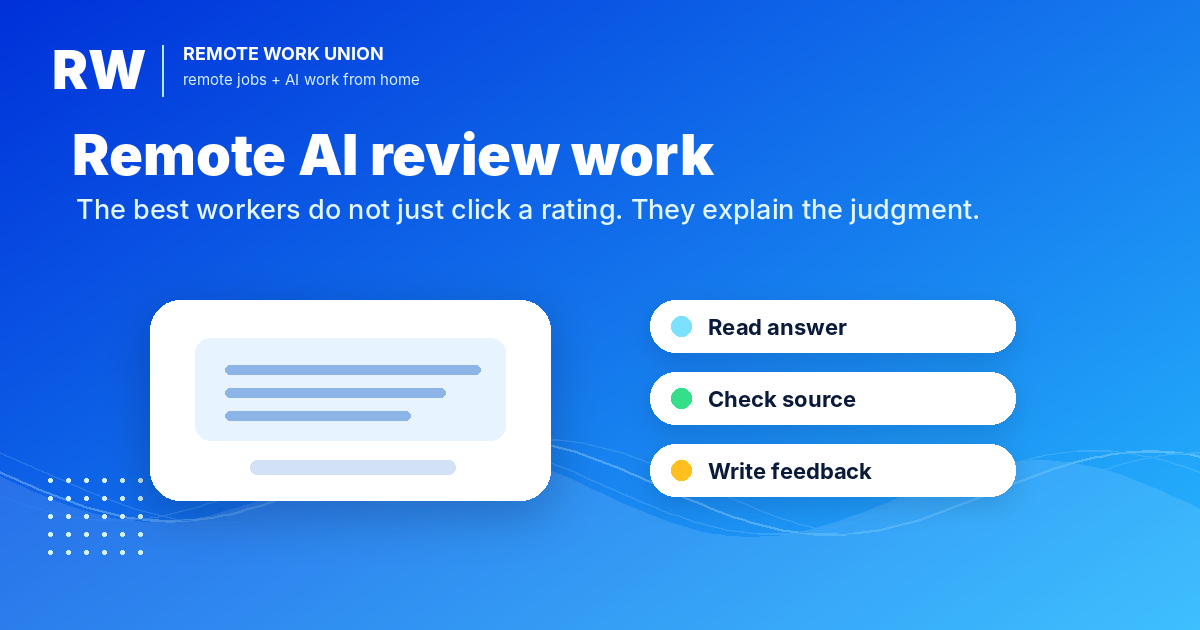
Most people hear "AI training" and imagine building a model from scratch. That is not what most remote AI jobs involve. A lot of the work is closer to quality control, editing, research, grading, fact-checking, and expert review. The company or platform gives the worker a prompt, one or more model responses, and a set of guidelines. The worker evaluates the responses and often explains the decision.
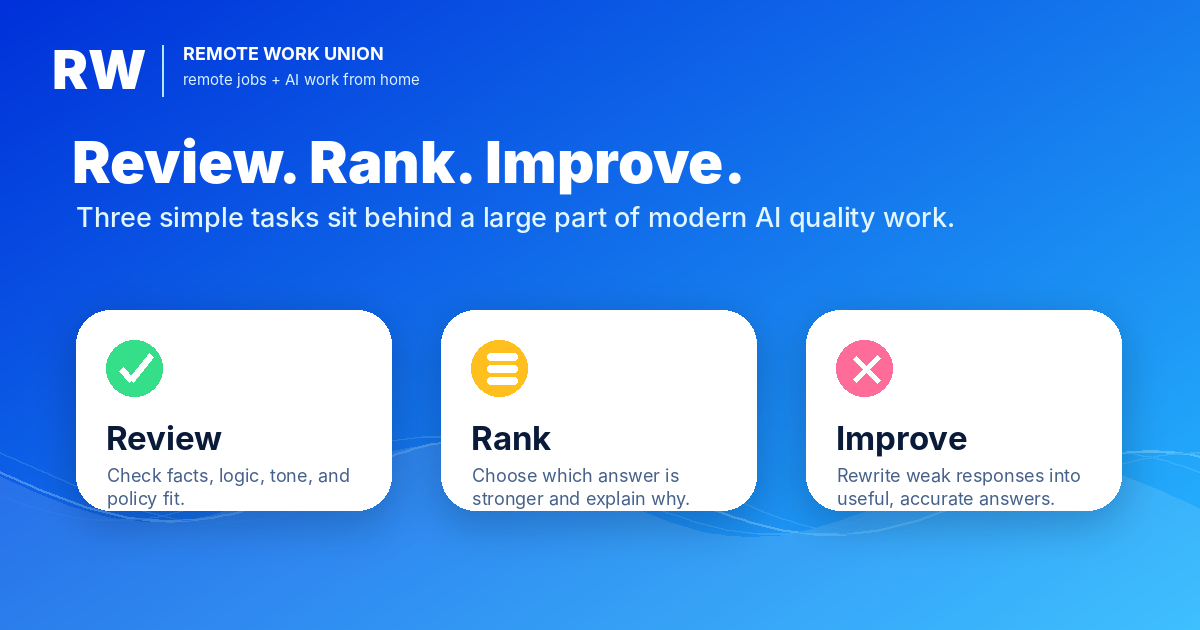
The three core tasks are review, rank, and improve.
Review
Review means reading an AI answer and judging whether it is good. A reviewer might check whether the answer follows the instructions, answers the actual question, uses accurate facts, avoids unsupported claims, handles sensitive topics correctly, or matches the requested tone. For example, a user might ask for a resume bullet rewrite, a contract explanation, a Python function, a marketing plan, or a finance calculation. The human reviewer looks at the model response and decides whether it is useful.
Rank
Rank means comparing two or more AI answers and deciding which one is better. This is common because AI companies often test different model versions, different prompts, or different training methods. The human does not just mark one answer as good or bad. They choose the stronger answer and explain why: more accurate, less repetitive, better structured, more practical, safer, clearer, or more directly responsive to the prompt.
Improve
Improve means rewriting or editing an AI response so it becomes a better example. This can include correcting facts, making the answer more concise, adding missing context, removing unsafe advice, improving structure, or making the response sound more natural. This is where strong writers, editors, domain experts, and professionals with real judgment can stand out. Anyone can click a rating. Fewer people can turn a weak answer into a strong one.
Why AI Companies Cannot Fully Automate Human Judgment
AI companies use automated benchmarks, synthetic tests, internal model graders, and technical evaluations. Those tools matter. But they do not remove the need for people.
A math benchmark can test whether a model gets a final number right. A coding benchmark can test whether a function passes unit tests. But many real user questions are messier. The user may be vague. The answer may involve tradeoffs. There may be no single perfect response. The best answer may depend on tone, timing, risk, culture, audience, legal context, or practical usefulness.
Humans are needed because they can evaluate qualities that are hard to reduce to a simple score. They can notice when an answer sounds good but does not solve the user's real problem. They can catch when the model is technically accurate but unhelpful. They can recognize when a legal, medical, finance, or safety answer needs more caution. The better AI gets, the more subtle the review work becomes. Early models made obvious mistakes. Stronger models often make polished mistakes — that is harder, not easier, to judge.
Human Feedback Is Part of How AI Learns What People Prefer
One major reason human review matters is that many AI systems are improved through feedback about what people prefer. A reviewer may compare two answers and choose the one that is more helpful. Another reviewer may rate whether an answer is safe. Another may rewrite an answer into a better version. Over time, that feedback helps AI systems become more aligned with the kinds of responses users actually want.
This is why terms like human feedback, preference ranking, RLHF, model evaluation, response ranking, and AI trainer jobs show up around remote AI work. The exact workflow changes by company and platform, but the underlying idea is consistent: models improve when high-quality human judgment is turned into useful training or evaluation data.
Key point: A strong AI evaluator is not merely labeling text — they are applying judgment. That distinction is what separates high-value reviewer work from basic data entry.
The Types of Mistakes Human Reviewers Catch
A human reviewer may catch obvious errors, but the highest-value work is often more nuanced. Here are the categories that matter most.
1. Factual Errors
AI can produce incorrect facts, outdated facts, mixed-up names, bad citations, or confident claims without support. A human reviewer can verify whether the answer is grounded. This is especially important for remote AI work involving research, finance, healthcare, law, education, and technical content.
2. Reasoning Problems
A model can start with the right facts but connect them badly — skipping steps, making hidden assumptions, or reaching the wrong conclusion. Humans can evaluate the logic behind the answer, not just the final sentence. This is where engineers, accountants, analysts, lawyers, consultants, and teachers are particularly valuable.
3. Tone Problems
An AI answer can be accurate and still sound wrong — too formal, too casual, too harsh, too soft, too robotic, or too vague. Human reviewers help models learn how answers should feel for different contexts. Writers, marketers, editors, support professionals, and communications people can be strong fits here.
4. Safety Problems
Some answers need extra care around health, financial decisions, legal disputes, or other sensitive topics. Human reviewers help identify when an answer creates risk or needs more caution. The goal is usually not reflexive refusal — in many cases, the better answer is useful but careful.
5. Helpfulness Problems
Some AI answers are technically correct but not useful. They answer around the question instead of answering it. They give a generic checklist when the user needs a practical next step. Good human reviewers know the difference between "not wrong" and "actually helpful."
6. Context Problems
AI can miss context that a human would catch. A job seeker asking for remote work help may need specific platform recommendations, not abstract career theory. A business owner asking for marketing help may need an action plan, not a lecture. The best reviewers understand user intent.
Why Subject-Matter Experts Are Becoming More Valuable
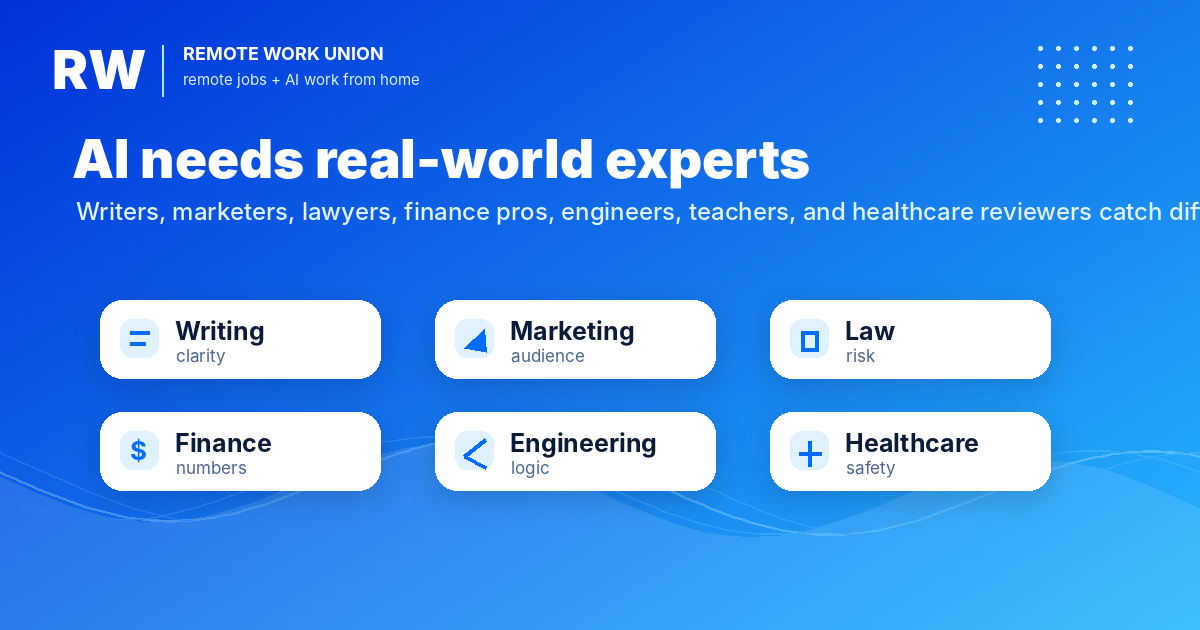
General AI review work can be useful, but expert review is where many of the higher-value remote AI jobs sit. AI companies and AI training platforms need people who can evaluate advanced answers in specific fields. A general reviewer can tell whether a response is clear. A lawyer can tell whether a legal explanation is misleading. A finance professional can catch a bad assumption in a valuation. An engineer can identify weak code. A teacher can judge whether an explanation would actually help a student.
Strong categories for expert AI review include:
- Writing and editing
- Marketing and sales
- Finance and accounting
- Law and policy
- Software engineering
- Data analysis and math
- Healthcare and life sciences
- Education and tutoring
- Operations and business strategy
- Translation and localization
The opportunity is not limited to people with AI backgrounds. A tax accountant, litigation paralegal, B2B sales manager, nurse, teacher, analyst, or technical writer may be more useful for a specific AI review task than someone who only knows AI terminology.
Why AI Still Needs Humans Even When Models Grade Other Models
AI companies increasingly use models to help evaluate other models. That makes sense at scale. But model-based evaluation still needs human oversight for three reasons.
First, an AI judge can inherit the same blind spots as the model it is judging — if both systems reward polished language over truth, the evaluation becomes weaker. Second, AI judges still need calibration: humans help define what "good" means, especially when the answer involves taste, risk, nuance, ethics, or professional judgment. Third, the final user is human — a model can estimate usefulness, but people are the ones who experience whether an answer helped.
What This Means for Remote Workers
For remote workers, this creates a practical opening. You do not need to be a machine learning engineer to participate in AI work. You need a skill that helps you judge answers.
A writer can evaluate clarity. A marketer can evaluate persuasion and audience fit. A salesperson can judge whether an outreach message sounds natural. A teacher can evaluate explanations. A lawyer can identify legal risk. A finance professional can check assumptions. An engineer can test code quality. A healthcare professional can evaluate whether language is safe and responsible.
Many applicants make the mistake of saying, "I do not have AI experience." But AI experience is not always the main thing platforms need. They may need people who can read carefully, think clearly, follow instructions, and apply domain expertise. If you have real work experience, you may already have the core skill: judgment.
Find remote AI reviewer and expert evaluation roles through Remote Work Union.
Browse Roles Now →Common Remote AI Job Titles to Search For
The job titles change across platforms, but the work often falls into similar categories. Search for: AI trainer, AI evaluator, AI response evaluator, AI data trainer, AI model evaluator, AI content reviewer, AI answer reviewer, AI prompt evaluator, AI research evaluator, human feedback specialist, RLHF evaluator, expert reviewer, domain expert AI trainer, LLM evaluator, AI writing evaluator, remote AI rater, online AI training jobs, work from home AI jobs, and remote AI jobs for experts.
You can also search platform-specific terms involving Mercor, Outlier AI, Handshake AI, micro1, DataAnnotation, Turing, Scale AI, and other AI work platforms. Do not rely on one platform — build a list and apply broadly.
What a Strong AI Reviewer Actually Does
A strong AI reviewer does not just say, "This answer is good." They can explain the reason:
- "Response A is better because it directly answers the prompt and avoids unsupported claims."
- "Response B is more detailed, but it includes a factual error and should not be ranked first."
- "The answer is safe but too vague to be useful."
- "The response follows the user's format but misses the user's actual intent."
- "The rewritten answer should be shorter, more specific, and more grounded."
That explanation matters. It turns a rating into useful signal. If you want to stand out for remote AI training jobs, practice explaining your reasoning in plain English. Be specific. Be calm. Be useful.
Skills That Help People Get Remote AI Training Work
- Careful reading: Most AI review work starts with reading the prompt, the model response, and the guidelines. Small details missed lead to inconsistent ratings.
- Clear writing: Many roles require written feedback. The best feedback is short, specific, and easy to understand.
- Domain expertise: A background in law, finance, healthcare, education, software, marketing, sales, operations, or writing can make you more competitive for expert review work.
- Fact-checking: Reviewers often need to verify claims, catch hallucinations, and distinguish supported information from speculation.
- Judgment: The best answer is not always the longest, safest, or most confident. Judgment means choosing the response that best serves the user.
- Guideline discipline: AI companies use rubrics. A strong reviewer can follow the rubric even when they personally prefer another style.
- Concision: The best reviewers can explain the problem quickly. Long feedback is not automatically better.
How to Position Yourself for These Roles
If you are applying for AI training jobs from home, do not present yourself as a generic job seeker. Present yourself as someone who can improve AI outputs in a specific area:
- Writer/editor: "I can evaluate clarity, tone, structure, and whether a response actually answers the prompt."
- Marketer: "I can judge whether AI-generated messaging fits an audience, channel, offer, and conversion goal."
- Lawyer/paralegal: "I can identify legal ambiguity, unsupported legal claims, and risk-heavy language."
- Finance/accounting professional: "I can review calculations, assumptions, financial explanations, and spreadsheet logic."
- Engineer/developer: "I can evaluate code correctness, debugging explanations, technical accuracy, and implementation quality."
- Teacher/tutor: "I can judge whether an explanation is appropriate for the learner's level and whether it teaches the concept clearly."
- Healthcare worker: "I can flag unsafe, incomplete, or misleading health-related explanations."
Why Humans Will Remain Part of AI Improvement
AI will keep getting better. That does not mean humans become irrelevant. It means the role of humans changes. As AI handles more basic generation, humans become more important at the judgment layer. The question becomes less "Can AI produce an answer?" and more "Is this answer good enough to trust?"
That question still belongs to people. People define what useful means. People notice when an answer creates risk. People understand context. People know when a technically correct response misses the human point.
Final Takeaway
The future of remote AI work is not only for coders. A major part of AI improvement depends on people who can read, think, compare, explain, and improve answers. If you have professional experience, writing ability, research skills, teaching experience, legal knowledge, finance knowledge, healthcare knowledge, marketing instincts, sales judgment, or technical expertise, you may already have skills that AI companies and AI training platforms need.
The model can generate. Humans judge quality. That is why remote AI reviewer jobs exist — and why they are likely to remain a real category of work as these systems continue to improve.