A real remote work platform should not charge you money just to start. It should not ask for an application fee, an interview fee, an equipment deposit, a task unlock fee, or a payment to receive your first assignment. In legitimate remote work, the worker is the person being paid. The platform may screen applicants, verify skills, require onboarding, test your writing, check your subject matter expertise, or ask you to follow quality guidelines. But it should not make you pay for the possibility of being considered.
This rule matters more than ever because remote work has expanded into categories that are easy to fake from the outside. People now search for work from home jobs, remote AI jobs, data annotation jobs, AI training jobs, model evaluation, prompt writing, research tasks, content review, expert review, and flexible online work that can be done without a traditional office. That demand creates real opportunity. It also creates room for scammers to imitate the language of real platforms.
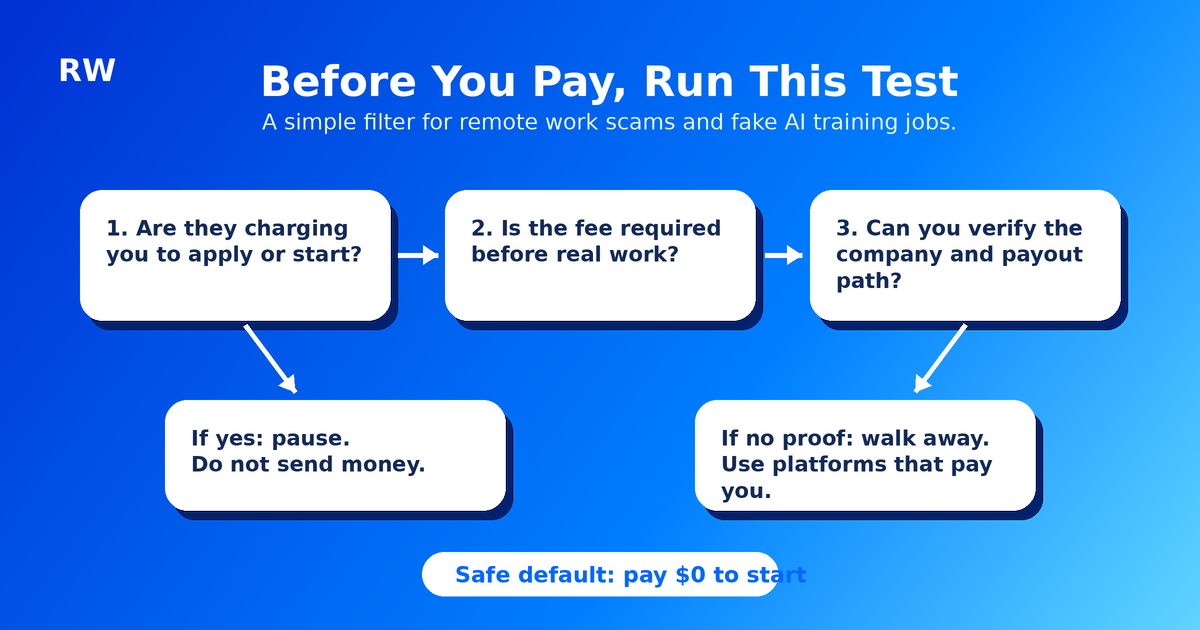
The safest way to think about it is simple: if a company is hiring or contracting workers to do useful work, the money should flow toward the worker. If money has to flow away from the applicant before anything real happens, stop and verify before continuing.
The Basic Rule: You Should Not Pay to Access a Job
Legitimate remote work platforms make money by helping companies find, screen, manage, and pay people who can complete useful work. That can include AI model evaluation, search quality review, writing, coding, translation, legal review, finance review, research, customer support, sales support, bookkeeping, virtual assistant work, and other remote roles. The worker may need to pass a test. The worker may need to sign a contractor agreement. The worker may need to provide payment details through a secure payout system. Those steps are normal.
What is not normal is being asked to pay a fee just to become eligible. A real platform does not need your $25, $49, $99, or $299 to prove you are serious. Seriousness is shown through your profile, your work samples, your application answers, your interview performance, and your ability to follow instructions. A platform that charges applicants before assigning work has already changed the relationship. It is no longer acting like a hiring platform. It is acting like it earns revenue from hopeful applicants.
That distinction is the reason application fees are such a strong warning sign. A job marketplace should be designed around matching people to work. A scam is often designed around converting job seekers into customers.
How Real Remote Platforms Usually Make Money
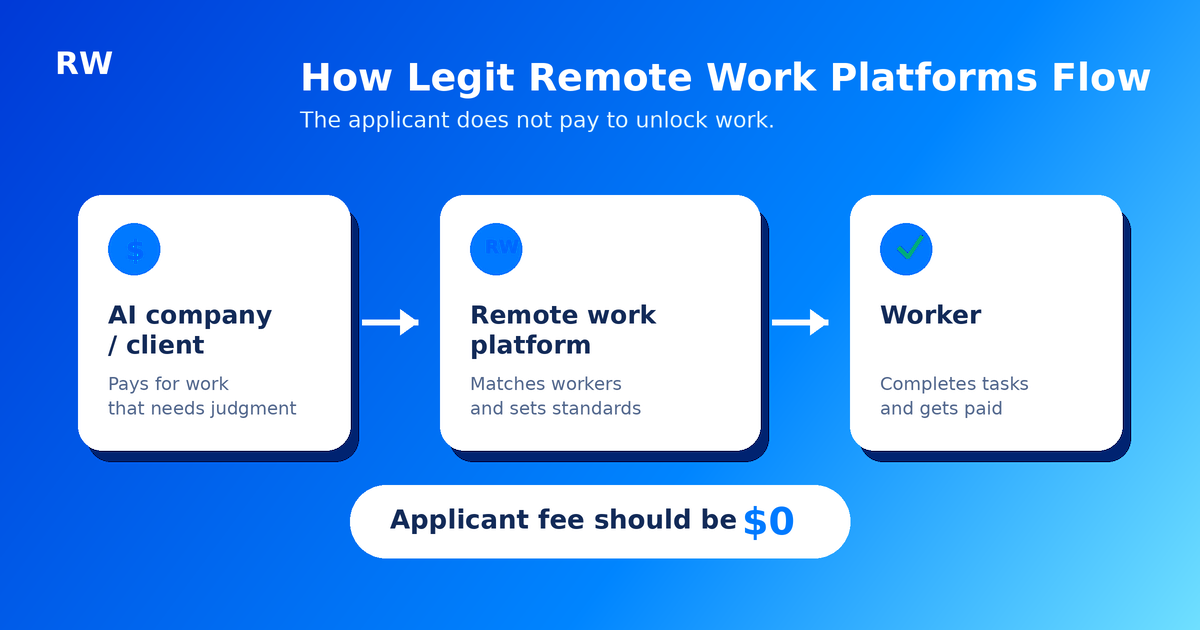
Real remote platforms generally earn revenue from the client side. A company needs work completed. That company pays a platform, agency, staffing partner, marketplace, or vendor to find qualified workers and manage the workflow. The platform then pays the contractor or employee according to the agreed rate or task structure.
This is especially common in remote AI work. AI companies and AI-adjacent teams need human judgment for tasks such as evaluating model answers, checking factual accuracy, comparing responses, writing prompts, reviewing code, labeling data, ranking search results, analyzing images, testing safety behavior, or applying domain expertise. People search for these roles using terms like AI training jobs, AI evaluator jobs, AI data annotation, model evaluation jobs, AI research jobs, prompt writer jobs, and remote AI reviewer work. Names such as OpenAI, Anthropic, Google, Meta, and Grok attract attention because people associate them with advanced AI systems and high-quality remote work. But whether the client is a famous AI company or a smaller vendor, the payment logic should be the same: the client pays for useful labor, and the worker gets paid for doing it.
Platforms such as micro1, Mercor, Handshake AI, Outlier, and other remote talent marketplaces may differ in how they screen workers, match roles, set rates, route tasks, or communicate availability. But the legitimate model is still based on workers being evaluated for work, not charged for access to work.
Where Fake Fees Usually Appear
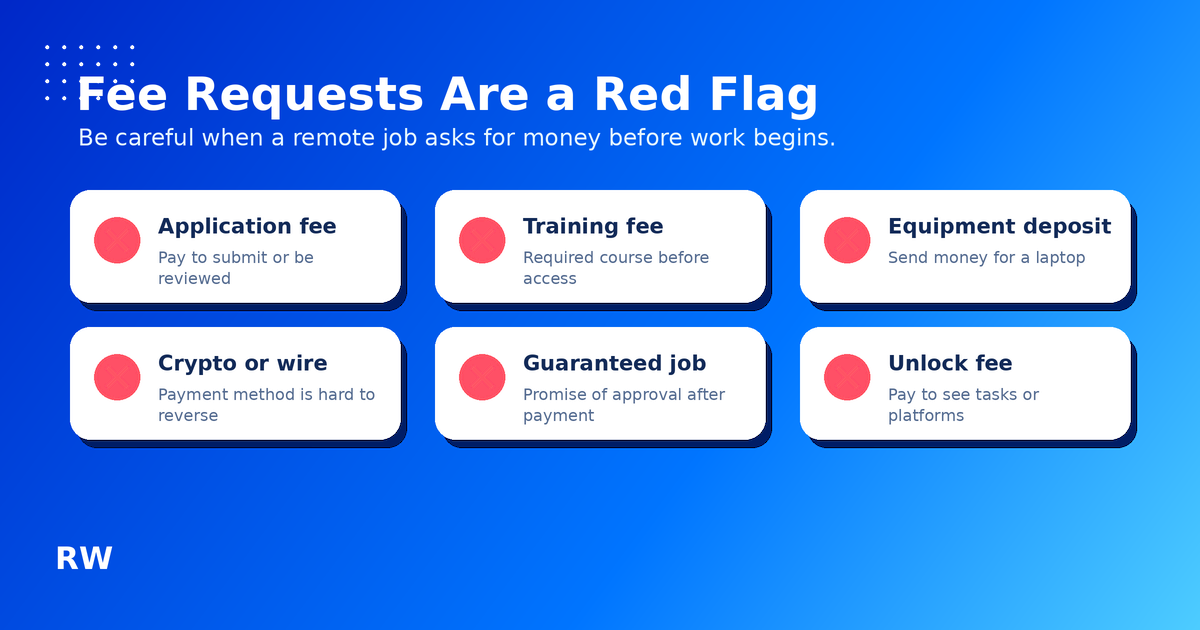
Scam offers often hide the fee inside language that sounds practical. Instead of saying "pay us for a job," they may call it an onboarding fee, profile verification fee, training fee, equipment deposit, software license, starter kit, background check, job guarantee, admin fee, placement fee, resume boost, or task unlock fee. The labels change, but the structure is the same. The applicant is being asked to pay before earning.
A common version is the fake equipment scam. The person is told they are hired for a remote job and must pay for a laptop, shipping, setup, or reimbursement process. Another version is the fake training program. The applicant is told that paid training is required before they can receive remote work. A third version is the fake task dashboard. The applicant can see "available jobs" but must pay to unlock them. These offers often use pressure, urgency, and vague promises. They want the applicant to move fast before checking whether the company is real.
The most suspicious requests are payments through methods that are hard to reverse, including crypto, wire transfer, gift cards, peer-to-peer payment apps, or payment to a personal account. A legitimate remote platform should not need you to send money to an individual recruiter or a random wallet address.
Why Remote AI Jobs Attract This Kind of Scam
Remote AI work is appealing because it sounds modern, flexible, and skill-based. Many roles do not require a traditional computer science degree. A strong writer, researcher, teacher, editor, lawyer, accountant, analyst, marketer, customer support professional, bilingual speaker, or generalist may be qualified for some AI training or model evaluation work. That is a real advantage for remote workers. It also makes the category easy for scammers to imitate.
A fake recruiter can copy the words "AI training," "data annotation," "LLM evaluation," "prompt review," "remote research," or "expert feedback" without having real client work behind the offer. They can promise high hourly rates, flexible hours, worldwide hiring, no interviews, instant approval, and guaranteed assignments. Then they attach a fee. The fee may look small compared with the promised pay, which is exactly why it works on people who are eager to start quickly.
The best protection is to separate the job category from the payment request. Remote AI jobs can be real. Data annotation and AI model evaluation can be real. Expert review work can be real. But a fee to access them is still a warning sign.
Real remote work pays you — it never charges you to start. Find legitimate roles at RemoteWorkUnion.com.
Find Roles Hiring Now →Legitimate Platforms Still Have Standards
No-fee does not mean no screening. Real platforms can be selective. They may reject applicants. They may pause accounts when there is no project match. They may require identity verification, tax forms, onboarding modules, skill assessments, writing tests, interviews, or sample tasks. They may pay different rates for generalist work, expert work, coding work, legal work, medical review, finance review, or advanced research. None of that is automatically suspicious.
The important difference is that screening is used to decide whether you are qualified. A fee is used to extract money before qualification is proven. A legitimate platform can say "we cannot match you right now." A suspicious one says "pay first, then we will unlock the opportunity."
This is why applicants should not assume every delay is a scam. A slow response, no projects after passing, a paused account, or a changing task queue can happen on real platforms. The red flag is not uncertainty. The red flag is being charged to move through the process.
Acceptable Costs Versus Suspicious Fees
There are normal personal costs associated with remote work. You may already pay for a computer, internet connection, phone, quiet workspace, resume tool, portfolio site, or optional course that improves your skills. Those are not the same as paying a platform to start a job.
A useful test is whether the cost is optional, controlled by you, and useful outside one supposed job. Buying a better headset for many remote interviews is your choice. Paying a stranger for a "mandatory headset deposit" before you have verified the company is different. Taking an optional writing course because you want to improve is your choice. Paying a required training fee to unlock a job dashboard is different. Improving your resume is your choice. Paying an application fee to be considered is different.
The safer standard is this: do not pay the platform, recruiter, or supposed employer for access to work. Invest in your own skills if you choose, but do not buy your way into a job that has not paid you yet.
What to Check Before Applying
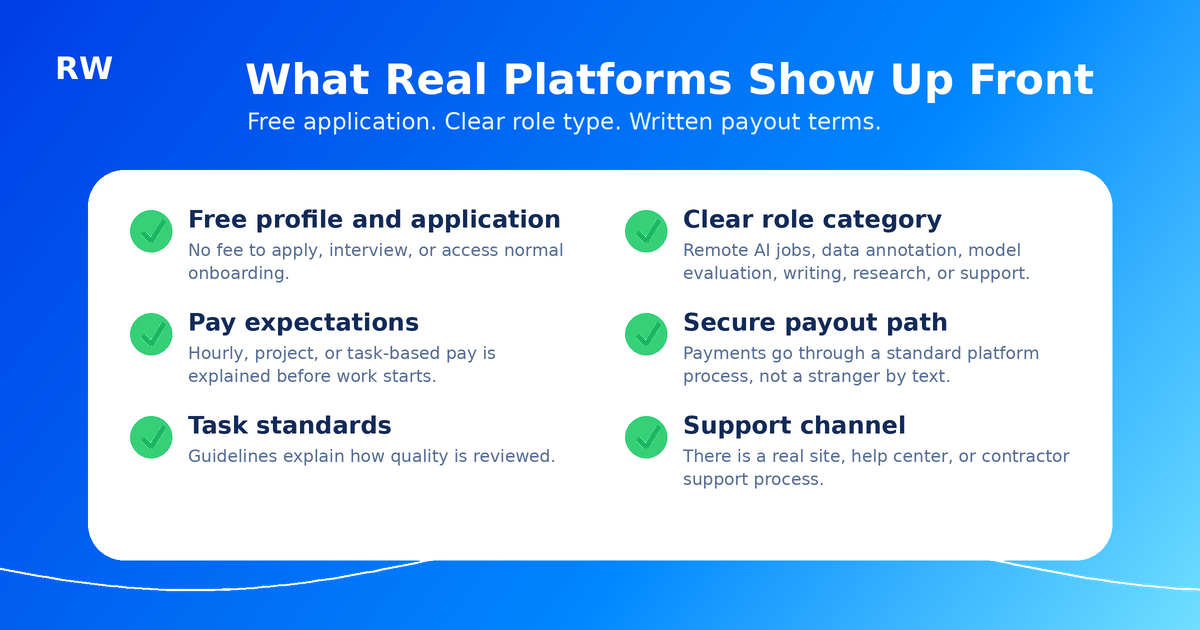
Before applying to any remote work platform, check the basics. Look for a real company domain, a consistent brand, clear role descriptions, written payout terms, contractor or employment terms, support contact, and a secure application process. The application should explain what kind of work you are applying for, such as AI training, data annotation, model evaluation, research, writing, customer service, sales, marketing, bookkeeping, recruiting, or virtual assistant work.
Pay attention to the email address and payment path. A real company may contact you from an official domain or a recognized hiring system. A fake recruiter may use a personal email, a misspelled domain, a messaging app only, or an account that cannot be traced back to the platform. Be extra careful if the person wants to move the conversation off-platform quickly and then asks for money.
Also check whether the offer makes sense. Very high pay can be real for expert-tier work, but it usually comes with a skill requirement. A platform paying strong rates for legal review, advanced coding, finance analysis, medicine, science, or high-level writing will normally screen for those skills. Instant approval with no meaningful review and a required fee is not a strong opportunity. It is a warning sign.
What to Do If a Platform Asks for Money
If a remote work platform asks you to pay, slow down. Do not send money while you are still excited, rushed, or afraid of missing out. Ask what the fee is for, whether it is required, who receives it, whether it is refundable, and whether you can apply without paying. Then verify the platform independently instead of relying on links sent by the recruiter.
Search for the company name, domain, support page, terms, and complaints. Look for whether the role exists on the official site. Compare the email address with the company domain. Check whether the payment request goes to the company or to an individual. If the request involves crypto, gift cards, wire transfer, or reimbursement schemes, treat that as a serious warning sign.
If you already paid, document everything. Save emails, screenshots, payment confirmations, usernames, phone numbers, domains, and messages. Contact the payment provider quickly to ask whether the charge can be reversed. Report the account or posting on the platform where you found it. Then move on to safer applications instead of sending more money to recover the first payment.
The Better Strategy: Apply Widely, But Do Not Pay to Start
The best remote workers treat applications like a pipeline. They apply to multiple legitimate platforms, build a strong profile, use clear keywords, follow instructions carefully, and keep improving their examples. That is more effective than paying a fee to one questionable opportunity.
For remote AI work, build a profile around skills you already have. If you are a writer, emphasize writing quality, editing, research, factual accuracy, and prompt evaluation. If you have legal, finance, medical, engineering, marketing, design, operations, teaching, or customer support experience, describe how that expertise helps you judge outputs, review instructions, compare responses, or improve AI systems. If you are a generalist, emphasize attention to detail, curiosity, reading comprehension, clear writing, and consistency.
Real platforms want useful judgment. Scams want fast payment. That difference should guide every remote job search.
Final Takeaway
Real remote work platforms do not need to charge you just to start. They may be selective. They may take time to respond. They may not always have tasks available. They may require tests, onboarding, identity checks, or skill proof. But the core promise should remain clear: you are applying to be paid for work, not paying for access to work.
When a remote work opportunity asks for money upfront, treat it as a stop sign. Verify the company, check the role, inspect the payment method, and compare the offer with legitimate platforms. The safest path is to build a strong profile, apply to real work from home jobs, and avoid any platform that turns job seekers into customers.
Ready to apply for jobs? Go to RemoteWorkUnion.com to find roles hiring now.
Frequently Asked Questions
Is it normal for a remote work platform to charge an application fee?
No. A legitimate remote work platform does not charge you to apply, interview, or access normal onboarding. Real platforms earn revenue from the companies or clients that need work done — not from applicants. If a platform asks for a fee before assigning any work, that is a red flag.
What fees are normal versus suspicious when applying for remote work?
Normal costs are things you control and own: a computer, internet access, a portfolio site, or an optional course you choose. Suspicious fees are required payments to a platform, recruiter, or employer before work begins — such as application fees, training unlock fees, equipment deposits sent to a stranger, or crypto/wire transfer payments. If the fee goes to the platform or recruiter rather than a store or service you chose, stop and verify before paying.
Do legitimate remote work platforms ever reject applicants or slow down task availability?
Yes. No-fee does not mean guaranteed work. Real platforms can be selective, pause accounts when there is no project match, or have slow task queues. These are normal operational issues. The red flag is not a slow process — the red flag is being asked to pay money to move through the process.
What should I do if a remote work platform already asked me for money?
Stop sending money immediately. Document everything: emails, screenshots, usernames, payment confirmations, domains, and phone numbers. Contact your payment provider as quickly as possible to ask whether the charge can be reversed. Report the account or posting on the platform where you found it. Then move on to verified platforms that do not charge to start.