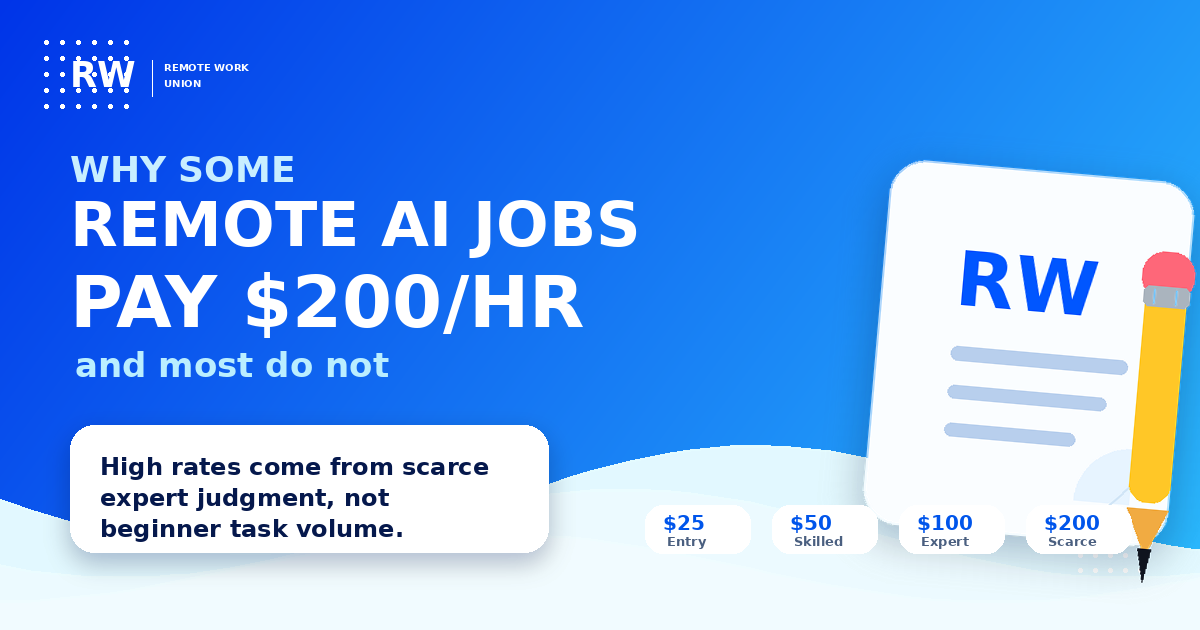
The phrase "remote AI job" covers a wide range of work. Some people are doing basic annotation tasks from home. Others are reviewing difficult model answers in law, finance, software engineering, medicine, science, writing, research, safety, or business strategy. Those jobs may all sit under the same broad category, but they do not sit in the same labor market.
That is why some remote AI jobs advertise rates near $200 an hour while many others pay a much lower hourly rate. The difference is usually not hype. It is the difference between simple task completion and scarce expert judgment. A platform does not pay expert-level rates because someone wants flexible work. It pays expert-level rates when the AI company needs feedback from someone who can judge answers that most applicants cannot judge well.
For beginners, this is important. A $200 an hour AI training role is possible in the market, but it is not the normal starting point. Most people begin with general AI reviewer work, writing evaluation, data annotation, prompt comparison, search quality, or simple model response rating. Higher-paying work usually comes later, after a worker proves quality, passes harder screens, or brings specialized knowledge that platforms cannot easily replace.
The Main Reason Some AI Jobs Pay So Much
AI companies do not only need people to click labels. They need people who can tell whether an answer is useful, factual, safe, complete, and aligned with a specific instruction. That judgment gets harder as the subject matter gets harder.
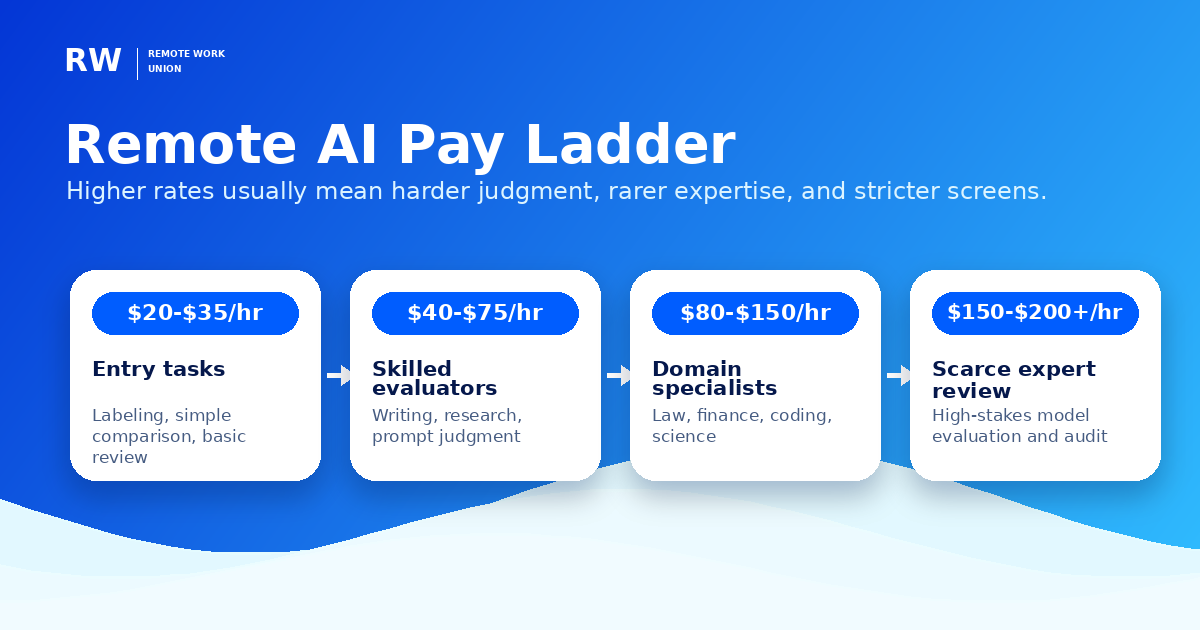
A simple task might ask a worker to choose which of two responses sounds better. A more advanced task might ask whether a model correctly applied a legal standard, solved a programming problem, identified a flaw in a financial analysis, summarized a medical concept responsibly, or produced a research answer with proper reasoning. The second category requires deeper knowledge. Fewer people can do it. That scarcity pushes rates up.
This is the basic pay ladder in remote AI work: the more judgment the task requires, the more the platform must care about the worker's background, writing quality, accuracy, and consistency.
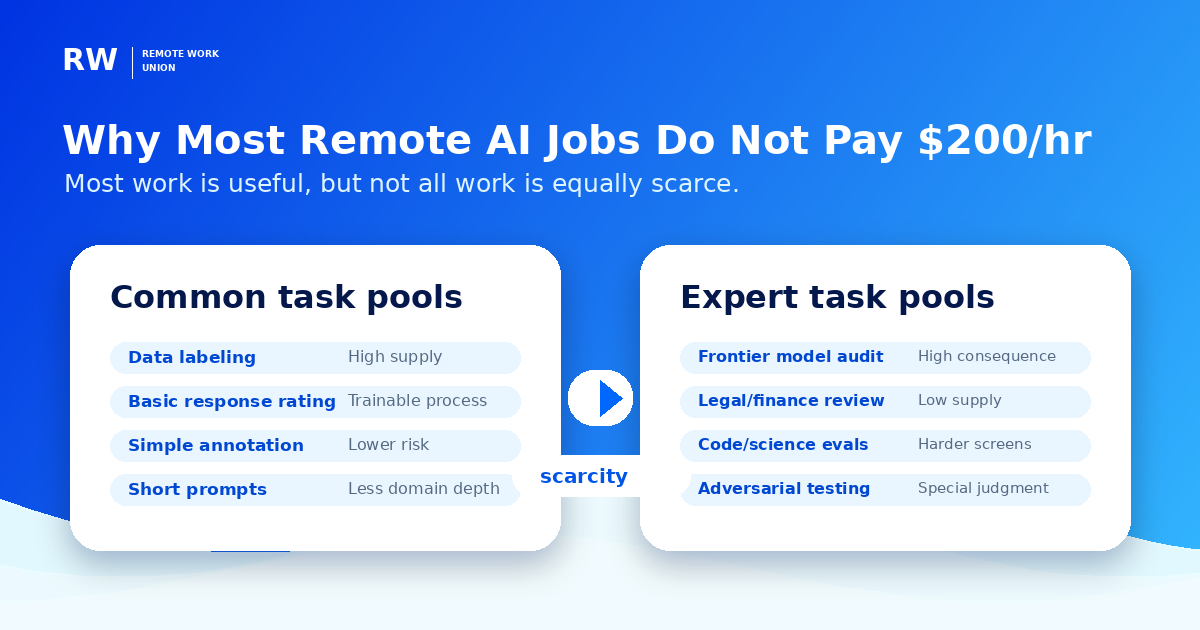
Why Most Remote AI Jobs Do Not Pay $200 an Hour
Most remote AI jobs do not pay $200 an hour because most AI work is not built around rare expertise. A large amount of AI training work is operational. It needs reliable people, but the tasks can be taught with guidelines. When a task can be done by a large pool of qualified applicants after a short training period, the rate usually stays closer to standard remote contractor pay.
That does not make the work bad. Many entry-level and mid-tier AI jobs are still better than surveys, low-paid gig apps, or unpaid internships. They can also be useful stepping stones. But they are not priced like expert consulting because the platform is buying consistency, not scarce judgment.
The biggest mistake applicants make is assuming every AI training job should pay like a top expert role. Platforms such as micro1, Mercor, Handshake AI, Outlier, and similar marketplaces may have different projects, different screens, and different rates. The rate usually reflects the specific project, not the entire company. One person can be assigned to lower-rate work on one project and higher-rate work on another if their profile fits.
The Six Factors That Raise Remote AI Pay
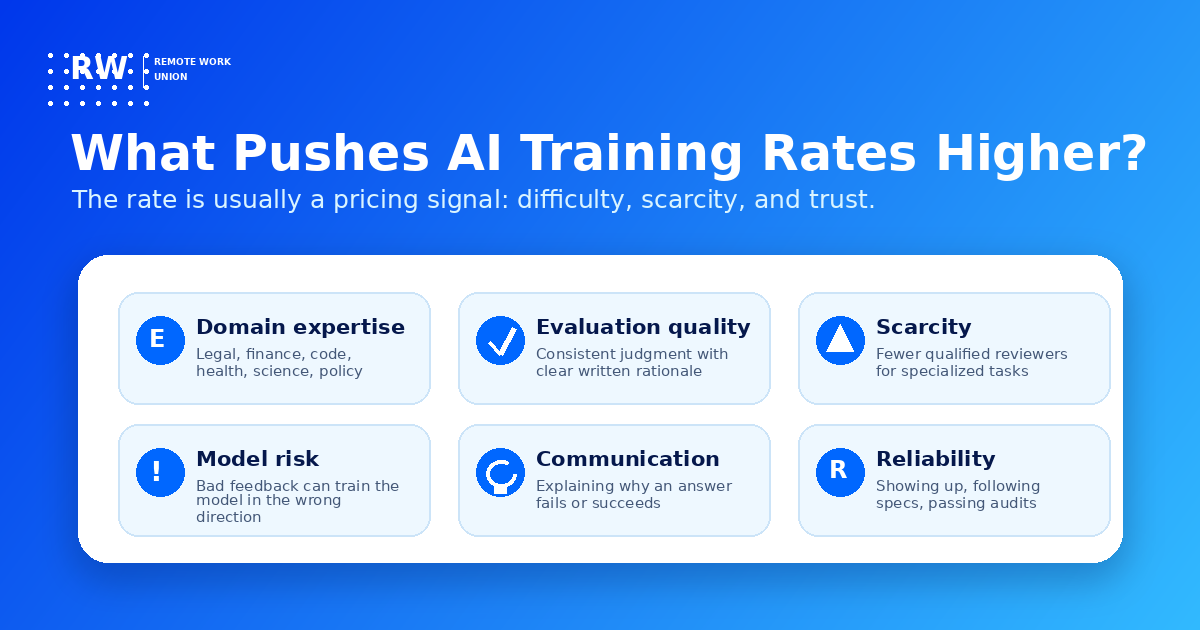
1. Domain expertise. The clearest path to higher rates is specialized knowledge. Law, accounting, finance, software engineering, medicine, science, mathematics, cybersecurity, economics, language, and advanced research all have fewer qualified reviewers than general writing tasks.
2. Evaluation quality. Platforms care about whether your judgments match the task rules. A smart person who ignores instructions will not last. A reliable reviewer who explains decisions clearly is more valuable.
3. Scarcity. If thousands of applicants can do a task, the rate usually falls. If only a smaller group can pass the screen, the rate has room to rise.
4. Risk. Some model evaluations matter more than others. Safety, factuality, medical, financial, legal, coding, or policy-heavy tasks can create higher risk if the evaluation is wrong. Higher-risk tasks often require stricter review and better workers.
5. Writing clarity. AI training work often depends on written rationales. You may need to explain why a response failed, where the reasoning went wrong, or how the answer should be improved. Clear writing can separate a strong evaluator from an average one.
6. Reliability. Remote AI platforms need workers who follow instructions, submit clean work, keep deadlines, and pass audits. High rates are not only about intelligence. They are about trust.
What a $200 an Hour AI Job Usually Looks Like
A high-rate remote AI role is usually not a beginner data entry job. It is more likely to involve expert model evaluation, advanced prompt review, adversarial testing, specialized research, code review, legal or finance analysis, technical writing, safety evaluation, or domain-specific annotation.
The work may also be irregular. A platform might have a short project that pays very well because it needs a specific type of expert for a specific model evaluation. That does not always mean the worker will have 40 hours every week at that rate. Some of the best-paying AI work is project-based, waitlist-based, or dependent on client demand.
This is why remote workers should think in terms of a platform stack, not a single perfect job. A worker might use micro1 for one application path, Mercor for expert matching, Handshake AI for AI training contracts, Outlier for evaluation projects, and direct company pages for AI labs or vendors connected to OpenAI, Anthropic, Google, Meta, Grok, and other major AI companies. The goal is not to chase one rate. The goal is to build enough qualified options that better projects become possible.
Ready to apply for AI training jobs at the right level for your background? Remote Work Union can help.
Find Roles Hiring Now →Beginner Work Still Matters
Beginners should not skip the lower levels. General AI reviewer jobs, data annotation jobs, prompt rating jobs, search evaluation roles, and writing evaluation work can teach the mechanics of the field. You learn how rubrics work. You learn how platforms test quality. You learn how to write concise explanations. You learn how to avoid careless mistakes.
That experience can help you qualify for better work later. It also gives you language for your profile. Instead of saying only "I want remote work," you can say you have experience evaluating AI responses, following annotation guidelines, comparing model outputs, writing rationales, checking factuality, and reviewing prompts. That is more searchable and more relevant to AI platforms.
The key is to start where you honestly qualify, then move upward. Do not claim expertise you do not have. AI platforms test applicants, and false claims usually fail quickly. A better strategy is to combine your real background with AI training keywords. A teacher might focus on writing evaluation and education tasks. A bookkeeper might focus on finance review. A paralegal might focus on legal research tasks. A developer might focus on code evaluation. A marketer might focus on content quality, ads, SEO, and brand voice evaluation.
How to Position Yourself for Higher-Paying Remote AI Work
Your profile should make your strongest signal obvious. If you have a professional niche, put it near the top. Do not bury it under vague phrases like "hard worker" or "fast learner." AI platforms are often trying to match profiles to projects. The clearer your profile is, the easier it is to route you into the right screen.
Use practical keywords: AI model evaluation, AI training, prompt evaluation, response rating, data annotation, research, fact-checking, subject matter expert, writing evaluation, code review, legal review, financial analysis, policy review, safety evaluation, and remote AI reviewer. Then add the tools, industries, and credentials that prove your fit.
You should also prepare short samples of your judgment. For writing-heavy roles, that might mean a clean explanation of why one answer is better than another. For research roles, it might mean a short fact-check with sources. For coding roles, it might mean a concise bug explanation. For finance or legal roles, it might mean a simple analysis that shows you understand the domain without overcomplicating the answer.
A Realistic Path From Low-Rate Tasks to Expert-Tier Work
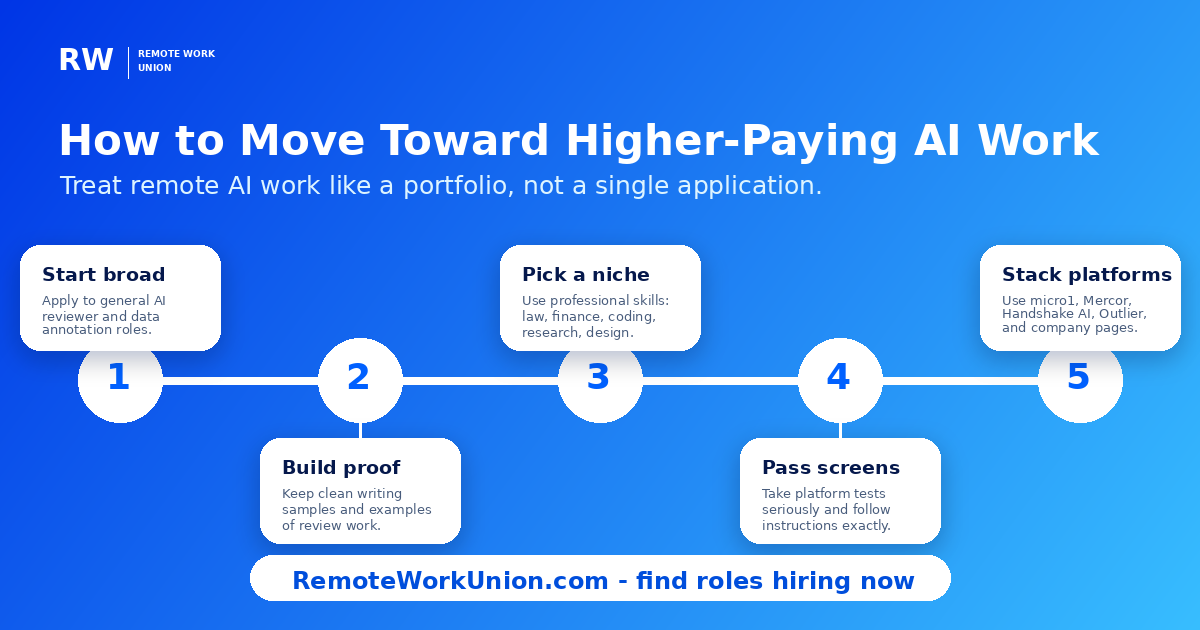
Step one is to apply broadly to legitimate remote AI platforms. Step two is to complete the screens carefully. Step three is to take any solid starter project seriously. Step four is to improve your profile based on what you learn. Step five is to apply to higher-skill tracks once you can describe your experience clearly.
The people who move up are often not the people who apply once and wait. They build a portfolio of remote work applications. They keep profiles updated. They test multiple platforms. They read instructions carefully. They avoid scams. They document the skills they are building. They use their real expertise instead of pretending to be a general expert in everything.
In remote AI work, the long-term opportunity is not only getting paid for time. It is getting paid for judgment. If you can prove judgment in a field that AI companies care about, your rate ceiling is higher.
Red Flags to Avoid
Do not pay a platform to apply for work. Legitimate remote AI jobs and AI training platforms should not require an upfront fee for access to basic applications. Be careful with anyone promising guaranteed $200 an hour work with no screening, no experience, and no application process.
Be careful with fake recruiters, copied job posts, and websites using the names of major AI companies without a real connection. OpenAI, Anthropic, Google, Meta, Grok, and other major AI companies are powerful keywords, but scammers use powerful keywords too. Check the domain, the application path, and the payment terms before giving personal information.
Also avoid misrepresenting credentials. Expert-tier AI jobs often include tests. If the task is truly technical, legal, medical, financial, or scientific, the screen will likely expose weak knowledge. A truthful profile can grow over time. A fake expert profile usually burns opportunities.
Frequently Asked Questions
Can beginners earn $200 an hour doing remote AI training work?
$200/hr is not a typical beginner rate. Most beginners start with general AI response rating, data annotation, or content review at a lower hourly rate. The path to higher-paying work requires building proof of quality, specializing in a domain where fewer people qualify, and applying to higher-skill project tracks. That path is real, but it usually takes time.
What types of remote AI jobs pay the most?
Expert model evaluation in law, finance, medicine, software engineering, science, and research tends to command the highest rates. Safety evaluation, adversarial testing, coding review, and complex reasoning tasks also pay more because they require rarer expertise and carry higher stakes if the evaluation is wrong.
Which platforms offer high-paying remote AI jobs?
Platforms like micro1, Mercor, and Handshake AI connect domain experts with higher-skill AI training projects. Outlier also has expert-tier projects. Direct applications to major AI companies and their vendor partners can also surface premium evaluation roles. The rate depends on the specific project, not just the platform name.
Do I need a degree to get a high-paying remote AI job?
Many high-paying AI evaluation projects require demonstrated expertise, and some require credentials. But a degree alone is not enough. Platforms evaluate your writing, your judgment, your domain knowledge, and your ability to pass their assessments. A strong professional background and clear profile can matter as much as a credential.
How do I move from low-rate to high-rate AI training work?
Start with legitimate work you qualify for. Build a track record. Update your profile to emphasize specific expertise. Apply to higher-skill project tracks after completing beginner work. Use platforms that match workers to specialized projects based on background. The people who move up treat AI training like a professional discipline, not just a side hustle.