Working in AI from home no longer means you have to become a software engineer, data scientist, or machine learning researcher. A large part of modern AI work depends on people who can read carefully, compare answers, follow instructions, research claims, and explain why one response is better than another. For non-technical remote workers, that creates a practical path into AI training jobs, AI evaluator jobs, AI data annotation jobs, prompt evaluation work, AI response reviewer projects, and human feedback roles.
This guide is for people who want to work online and get paid for judgment instead of phone calls. It is not about pretending every AI job is easy. It is about understanding which AI jobs are realistic for writers, researchers, teachers, analysts, bilingual workers, students, recent graduates, and professionals with domain knowledge.
What "Work in AI From Home" Actually Means
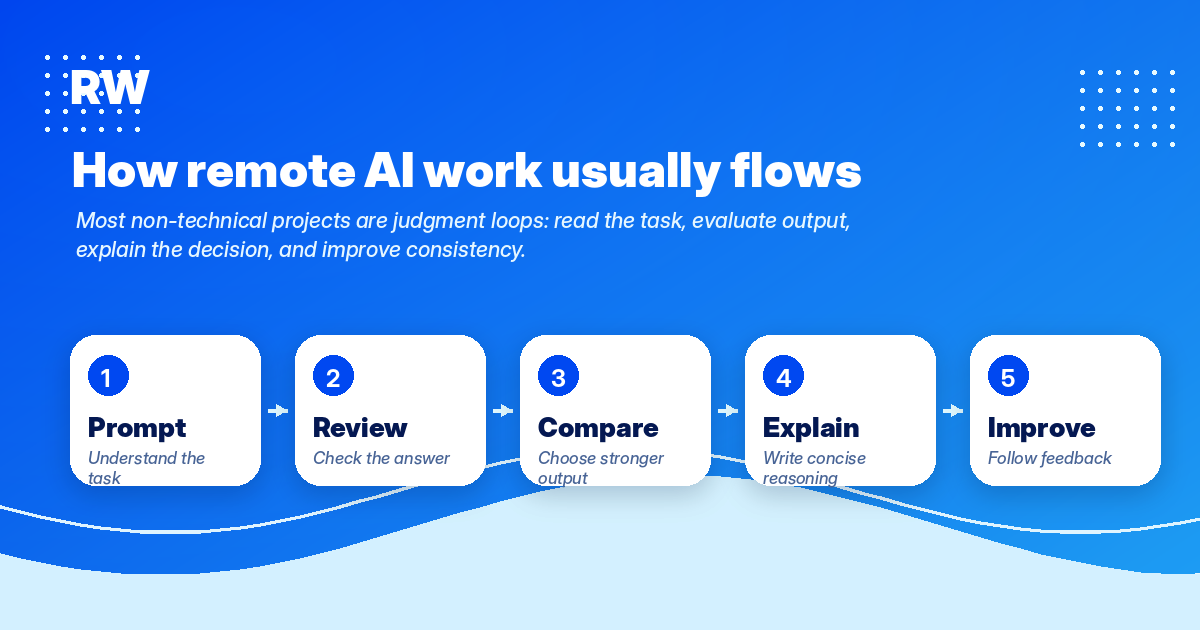
Remote AI work is usually not one single job title. It is a category of projects where human reviewers help improve AI systems. Some tasks are simple, such as labeling whether a short answer is helpful. Other tasks are more demanding, such as evaluating legal reasoning, checking medical writing for accuracy, comparing code explanations, grading math steps, or reviewing financial analysis. Non-technical workers most often fit into the human review layer — reading a prompt, inspecting one or more AI-generated answers, choosing the stronger answer, flagging hallucinations, rewriting a weak response, or writing a short explanation.
The reason these jobs exist is simple: AI systems can generate text quickly, but speed is not the same as quality. Human judgment is still needed to determine whether an answer is accurate, complete, safe, useful, clear, and aligned with instructions. A remote worker who can make those judgments consistently can be valuable even without a coding background.
Why Non-Technical Workers Can Be a Strong Fit
Many applicants assume AI jobs are only for engineers. That is not accurate. A teacher can evaluate explanations for clarity. A finance professional can review business analysis. A nurse or medical writer can spot unsafe health language. A lawyer or paralegal can check legal nuance. A bilingual worker can rate translation quality and cultural tone. A journalist, researcher, or strong writer can fact-check claims and identify weak reasoning.
The strongest non-technical applicants usually bring three things: subject matter awareness, clean writing, and disciplined judgment. Subject matter awareness helps you notice whether an answer makes sense. Clean writing helps you explain decisions in a way a reviewer can understand. Disciplined judgment helps you apply the same rubric the same way across many tasks instead of following instinct randomly.
Common Remote AI Job Types for Non-Coders
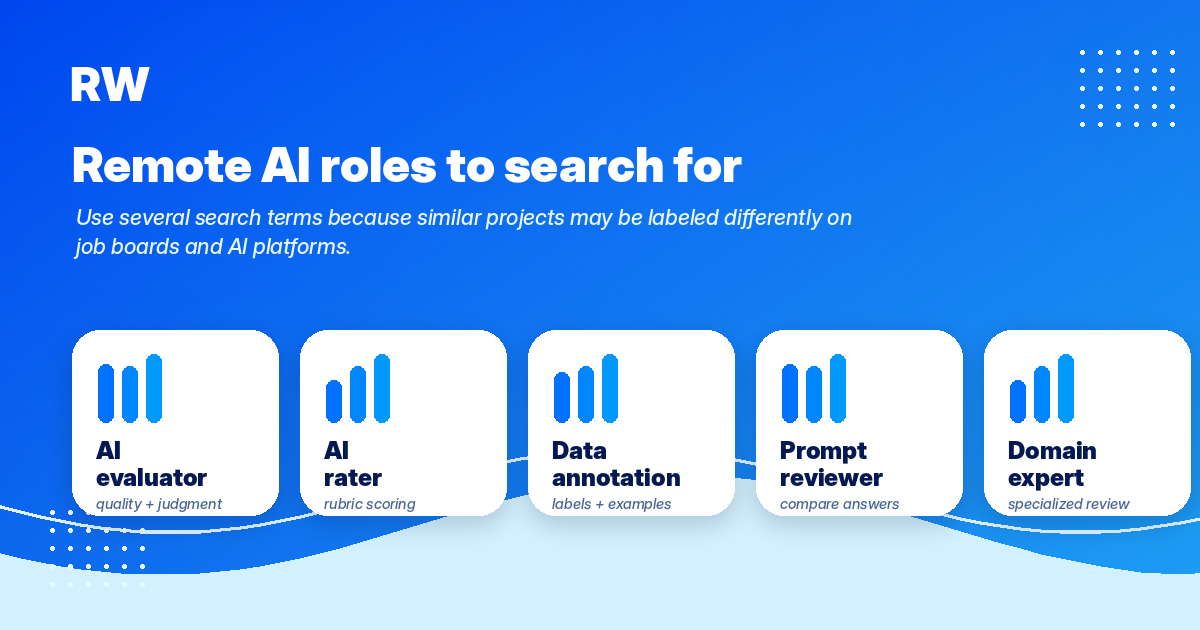
AI evaluator jobs: AI evaluators review model responses and judge whether they follow instructions, answer the question, avoid obvious mistakes, and meet the quality bar.
AI rater jobs: AI raters score search results, chatbot answers, or model outputs using a rubric. These roles reward consistency more than creativity.
AI data annotation jobs: Data annotation work involves labeling, categorizing, or preparing examples for AI systems. Some annotation tasks are simple; others require research, writing, domain expertise, or language fluency.
Prompt evaluation jobs: Prompt evaluators test how AI systems respond to instructions. They may compare two answers, identify missing requirements, rewrite prompts, or flag where a response failed.
AI response reviewer jobs: Response reviewers assess tone, accuracy, completeness, structure, safety, and usefulness. Strong writers and editors can fit this category well.
Human feedback and RLHF jobs: RLHF (reinforcement learning from human feedback) jobs ask humans to rank, label, or correct outputs to guide model behavior. The job title may sound technical, but many tasks are judgment-based rather than code-based.
Expert review jobs: Expert review projects are built around specialized knowledge — law, medicine, finance, accounting, education, science, or other professional fields. These can be among the better matches for experienced workers.
What the Work Looks Like Day to Day
A typical task begins with instructions. The instructions may tell you to prioritize factual accuracy, helpfulness, safety, tone, formatting, or user intent. You then read a prompt and one or more AI responses. Your job is to decide whether the answer did what it was supposed to do. Sometimes you select a score. Sometimes you choose between two answers. Sometimes you write a short explanation. Sometimes you edit or rewrite the answer.
The work sounds simple until the edge cases appear. One response may be more polished but less accurate. Another may answer the question directly but miss a formatting requirement. A third may be mostly correct but include one confident false claim. Good reviewers learn to slow down, isolate the task requirements, and make decisions that match the rubric instead of rewarding whichever answer sounds better.
Remote Work Union connects you to legitimate work-in-AI-from-home roles for non-technical workers. Apply for free.
Find Roles Hiring Now →Skills That Matter More Than Coding
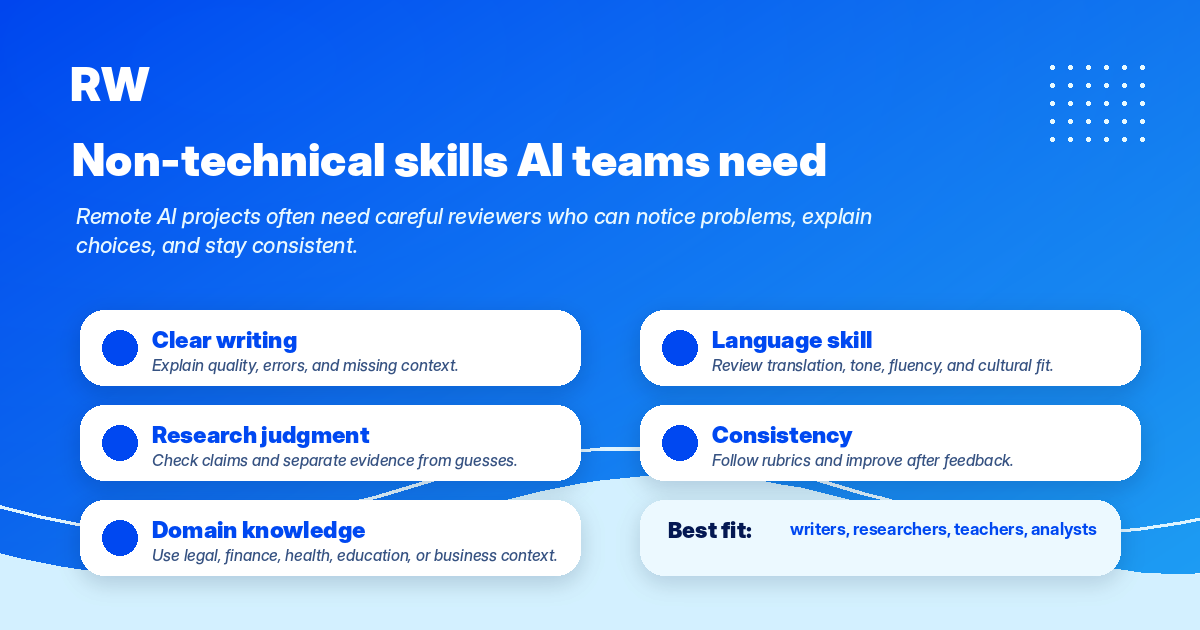
Clear writing is the core skill. Even when the task is mostly multiple choice, written explanations often determine whether your work passes review. A useful explanation is specific: it says what the answer did well, what it missed, and why the chosen rating fits the rubric.
Research judgment is another major skill. Some tasks require checking whether a claim is supported. A good reviewer knows the difference between a primary source, a summary, a forum comment, and a guess.
Attention to instructions matters more than speed. Remote AI jobs often include detailed guidelines, and the guidelines can change between projects. Workers who treat the rubric as the product tend to improve.
Domain expertise helps you qualify for better-fit projects. Do not hide your professional background — package it clearly.
Consistency is the final skill. Platforms do not only want a smart answer once. They want repeatable judgment across many examples.
How to Search for Work in AI From Home
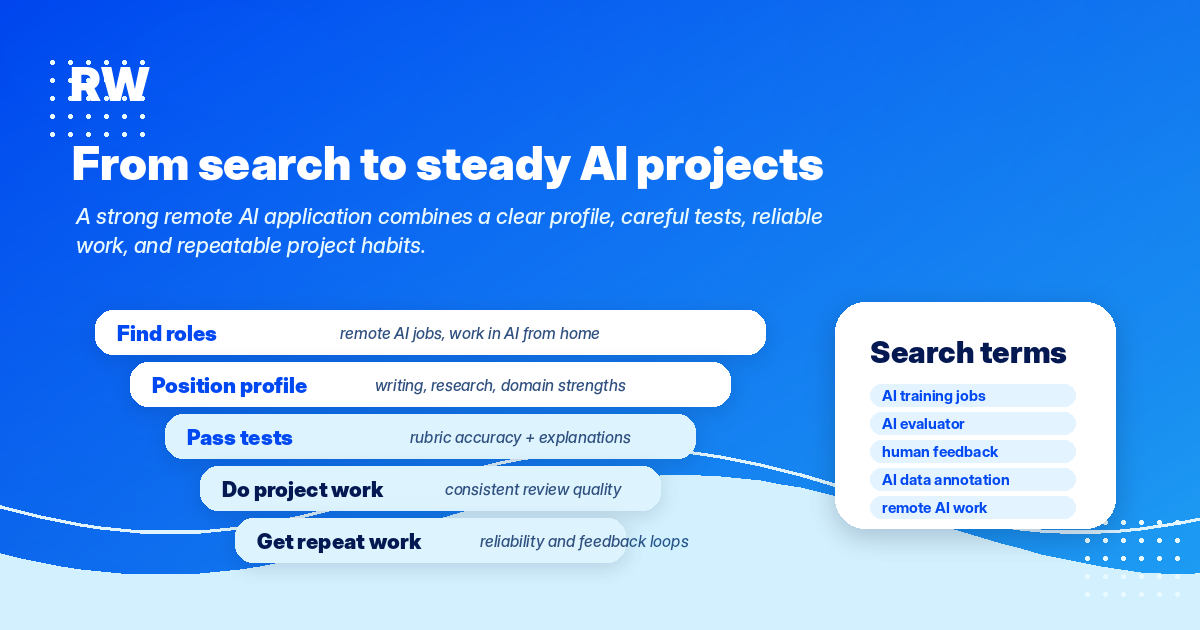
Search broad first, then narrow. Start with terms such as remote AI jobs, work in AI from home, AI training jobs, AI evaluator jobs, AI rater jobs, AI data annotation jobs, AI response reviewer jobs, human feedback jobs, prompt evaluation jobs, and remote AI research jobs. Then add your specialty: legal, finance, medical, nursing, education, bilingual, coding, math, writing, editing, business, or science.
Also search platform-specific phrases such as Mercor AI jobs, Outlier AI jobs, DataAnnotation jobs, Surge AI jobs, micro1 AI jobs, Stellar AI jobs, and Handshake AI. The strongest search strategy is to combine job title, work mode, and specialty — for example: remote AI evaluator finance, AI data annotation healthcare remote, prompt evaluation jobs for writers, or bilingual AI training jobs from home.
How to Build a Profile That Fits AI Training Work
Your profile should make the platform's decision easier. Lead with the type of AI work you can do, not with every job you have ever had. A simple positioning line: "Remote AI evaluator with strong writing, research, and business analysis skills." Or: "Bilingual AI response reviewer focused on translation quality, tone, and factual accuracy."
Then prove the claim with concrete skills: rubrics, annotation, response evaluation, A/B comparison, fact-checking, prompt review, error analysis, quality scoring, research, editing, domain expertise, and written feedback. If you have used AI tools, mention them practically — familiar with comparing outputs from ChatGPT, Claude, Gemini, Copilot, Grok. Do not overclaim.
Application Tips That Save Time
Apply to multiple categories, but customize the angle. A generalist application should emphasize writing, research, and judgment. An expert application should emphasize domain knowledge. A bilingual application should emphasize fluency, cultural nuance, and translation review. Take qualification tests slowly — many applicants fail because they rush. Keep a tracker with platform, role title, date applied, status, test type, pay range, and follow-up notes. Do not build your entire income plan around one platform.
How to Avoid Scams and Low-Quality Listings
Remote AI jobs attract scammers because the keywords are popular. Be careful with any listing that promises guaranteed income, asks you to pay for access to work, avoids naming the company, pressures you to move to encrypted chat immediately, requests sensitive financial information too early, or describes vague tasks with unrealistically high pay. Real AI work has clear task descriptions: rating model outputs, annotating data, evaluating prompts, fact-checking AI responses, or applying domain expertise. Specificity is a good sign. Vagueness is a warning sign.
A Realistic Weekly Plan for Beginners
Day 1: Write a focused remote AI profile. Choose your angle: generalist reviewer, writer, researcher, bilingual worker, student, educator, analyst, or domain specialist.
Day 2: Build a keyword list — broad terms plus specific task-type terms plus your field.
Day 3: Apply to a focused batch of roles. Tailor the first paragraph to the task type.
Day 4: Practice evaluation. Take a public AI answer, compare it against a prompt, and write a five-sentence review.
Day 5: Take tests carefully. Block time, remove distractions, and follow the rubric.
Day 6: Expand to adjacent searches: remote jobs no phone calls, work from home AI jobs, online research jobs, AI writing evaluation, search quality rater, and remote annotation work.
Day 7: Update the tracker and repeat. The goal is a repeatable system, not one perfect application.
Frequently Asked Questions
Can non-technical workers do AI training jobs from home?
Yes. Working in AI from home no longer requires software engineering or data science. Many AI training and evaluation jobs depend on people who can read carefully, compare answers, follow instructions, research claims, and explain why one response is better than another. Writers, researchers, teachers, analysts, bilingual workers, students, and professionals with domain knowledge can all qualify.
What types of AI work from home fit non-coders best?
AI evaluator jobs, AI rater jobs, data annotation jobs, prompt evaluation jobs, AI response reviewer jobs, human feedback and RLHF jobs, and expert review jobs. Each rewards different skills — writing, research, domain knowledge, language fluency — rather than coding ability.
What skills matter most for working in AI from home?
Clear writing, research judgment, attention to instructions, domain expertise, and consistency. Platforms need people who can follow rubrics, write concise explanations, and apply the same standard across many tasks.
How do I avoid scams when searching for AI work from home?
Avoid any listing that promises guaranteed income, asks you to pay for access to work, avoids naming the company, or pressures you to move to encrypted chat. Real AI training work has clear task descriptions, legitimate application processes, and specific skill requirements.
What search terms should I use to find work in AI from home?
Search for remote AI jobs, work in AI from home, AI training jobs, AI evaluator jobs, AI rater jobs, AI data annotation jobs, AI response reviewer jobs, human feedback jobs, prompt evaluation jobs, AI model training jobs, and remote AI research jobs. Then add your specialty area.