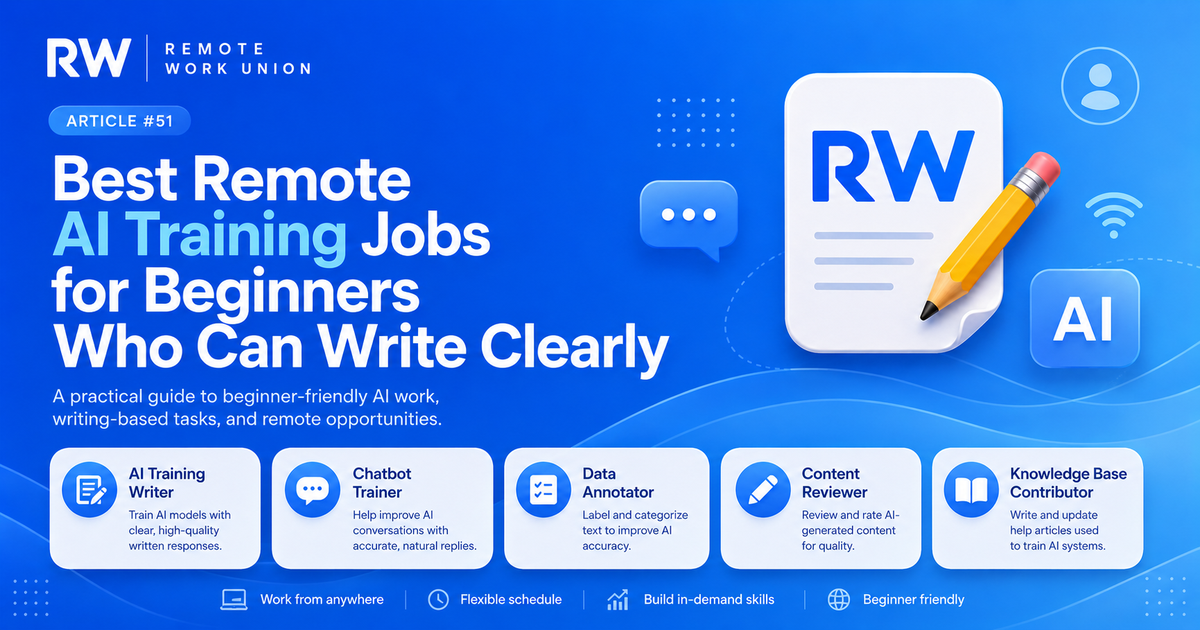
Remote AI training jobs are one of the most practical entry points into artificial intelligence work for people who can write clearly, follow instructions, compare answers, and notice small mistakes. You do not always need to be a software engineer. Many projects need humans who can read prompts, judge model responses, label data, rewrite weak answers, check facts, and explain why one output is better than another.
For beginners, the best remote AI training jobs usually sit at the intersection of writing, research, editing, judgment, and careful review. The work can be called AI training, AI data annotation, AI model evaluation, chatbot response rating, prompt evaluation, RLHF, human feedback, LLM evaluation, search quality review, or content quality review. The labels vary, but the core skill is consistent: helping AI systems produce clearer, safer, more useful answers.
What Remote AI Training Jobs Actually Are
AI training jobs involve human judgment. A project might ask you to compare two AI-generated answers and choose the better one. Another project might ask you to label whether a response follows instructions. Another might require you to rewrite a weak response into a clearer version.
Other tasks involve fact-checking, categorizing text, evaluating tone, identifying unsafe content, or building examples that teach a model what a high-quality answer looks like. These roles support the AI ecosystem behind tools such as ChatGPT, Claude, Gemini, Copilot, Grok, and other AI assistants.
The common thread is not technical skill — it is careful human judgment. AI systems can generate text, but they need humans to assess whether that text is accurate, useful, safe, and well-structured. That gap is where beginners who can write clearly have a real opportunity.
Key point: You are not building AI. You are helping AI improve by contributing reliable, well-reasoned human feedback — a skill that rewards careful thinkers as much as technical experts.
Why Clear Writers Have an Advantage
Clear writing matters because AI training work is not only about spotting problems — it is about explaining them. A strong reviewer can say why an answer is incomplete, why a claim needs support, why a tone feels wrong, or why a rewritten version is easier to understand.
That explanatory ability is hard to fake and easy to verify. When a screening test asks you to choose the better of two AI responses and explain why, a vague answer — "Response A is better because it is clearer" — fails. A strong answer names the specific issue: "Response A is better because it directly addresses the user's question in the first sentence, avoids hedging language that makes the answer harder to act on, and gives a concrete example instead of a vague generalization."
People with backgrounds in writing, editing, teaching, tutoring, customer support, research, law, finance, healthcare writing, technical documentation, marketing, journalism, operations, or academic work often have useful transferable skills. If your work has ever required you to communicate clearly, evaluate quality, or notice when something is off — you likely have more relevant experience than you realize.
Best Beginner-Friendly AI Training Job Types
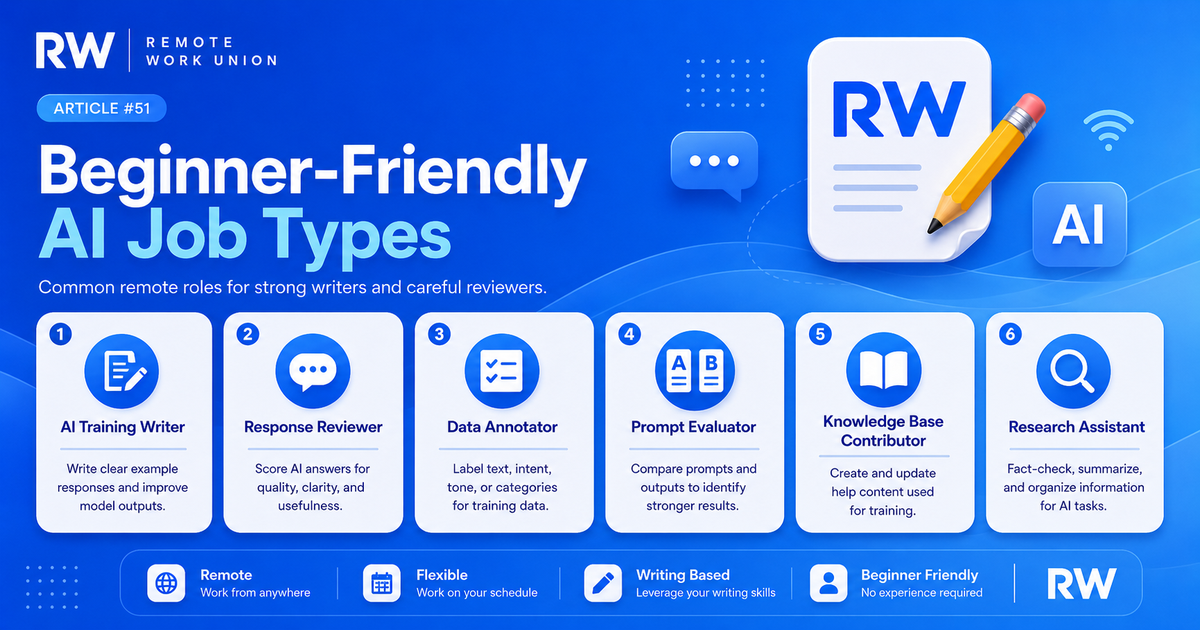
Not all AI training roles are equally accessible to beginners. These six types tend to have the lowest technical barriers while still rewarding strong communication and analytical skills.
1. AI Training Writer
Creates example answers, improves model responses, and rewrites confusing outputs. This role is the best fit for strong writers who can control structure, tone, and plain language. You may be asked to write an ideal answer to a question from scratch, or to improve a weak AI-generated answer so it becomes genuinely useful.
2. Response Reviewer
Scores AI answers for quality, clarity, helpfulness, accuracy, safety, and instruction-following. May compare two responses and write a short explanation of the decision. This is one of the most common entry-level AI training roles and is accessible to anyone who can read critically and write a clear rationale.
3. Data Annotator
Labels text so AI systems can learn patterns. Tasks might include classifying sentiment, tagging intent, categorizing topics, or flagging policy violations. A reliable starting point for consistent, detail-oriented people. Less writing-heavy than other roles, but consistency and accuracy matter more than speed.
4. Prompt Evaluator
Tests how well an AI system responds to instructions. You create or evaluate prompts and assess whether the model's response follows the intent of the request. Fits people who like structured analysis, A/B testing, and rubric-based judgment.
5. Knowledge Base Contributor
Writes and updates articles, FAQs, and documentation used to train or guide AI systems. Strong fit for beginners good at explaining processes, summarizing information clearly, and organizing answers for a specific audience.
6. Research Assistant / Fact-Checker
Verifies claims, summarizes sources, and identifies unsupported statements in AI-generated content. Useful for people with academic, journalism, legal, or business backgrounds who are comfortable working with citations and evaluating source quality.
Skills That Transfer Well
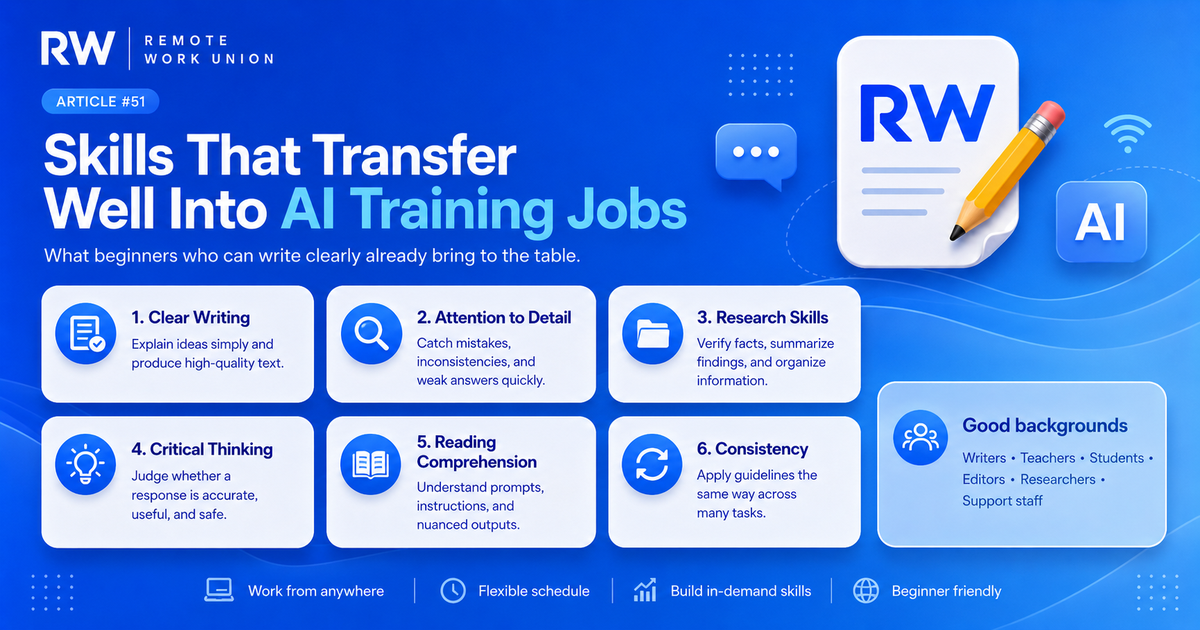
The skills that matter most in remote AI training jobs are clear writing, attention to detail, reading comprehension, research, consistency, and judgment. You do not need all of them equally — different roles weight them differently.
A good AI reviewer can read a prompt, understand exactly what was requested, notice when the AI answer dodges the task, and explain the issue in plain language. A good annotator can apply the same rule consistently across many tasks without drifting. A good training writer can turn a messy response into a useful one without adding unsupported claims or changing the meaning.
Backgrounds that transfer well include:
- Writing and editing: Journalism, copywriting, content writing, technical writing, academic writing, grant writing.
- Teaching and tutoring: Curriculum design, rubric-based grading, explaining complex ideas in plain language.
- Research: Academic research, market research, legal research, investigative journalism, library science.
- Operations and quality assurance: Process documentation, standard operating procedures, error detection, checklist-based review.
- Customer support: Written communication, empathy in tone, clear responses to complex questions.
- Domain expertise: Law, finance, medicine, science, engineering, languages — expert knowledge is valuable in specialized review projects.
How to Prepare Your Application
Make your writing and judgment easy to understand from the first line of your profile or resume. Do not describe only what you have done — describe what you can evaluate. AI training platforms need to quickly understand whether your background matches their current projects.
Use direct evidence: writing samples, editing experience, research experience, tutoring experience, content review, quality assurance, rubric-based grading, or side projects that required structured analysis. If you have published articles, edited documents, graded essays, written reports, or reviewed any kind of content for accuracy and clarity, those examples are relevant.
Useful resume keywords for AI training roles:
- AI trainer, AI evaluator, model evaluation, LLM evaluation
- data annotation, response reviewer, prompt evaluation
- RLHF, human feedback, content review, fact-checking
- rubric-based assessment, A/B comparison, instruction-following review
Write your headline or summary to reflect your strongest evaluation skill. Instead of "experienced writer and researcher," try "writer and researcher available for AI response evaluation, fact-checking, and content quality review." The second version tells a platform exactly where to place you.
Remote Work Union connects beginners with legitimate remote AI training and evaluation roles. Apply for free and find projects matched to your skills.
Find Roles Hiring Now →How to Pass AI Training Assessments
Most AI training platforms require you to pass a screening task before getting paid work. These assessments are not designed to trick you — they are designed to see how you perform on the actual work.
The most important rule is simple: read every instruction twice. Many applicants fail not because they lack knowledge, but because they miss a constraint in the task description — a word count limit, a required format, a safety rule, or a specific rubric definition.
Common mistakes to avoid:
- Choosing the longer answer just because it looks more complete — length is not the same as quality.
- Ignoring factual accuracy in favor of tone or style.
- Missing instruction violations — when an AI response doesn't follow what the prompt actually asked for.
- Writing explanations that are too vague: "Response A is better because it's clearer" is not a useful rationale.
- Adding unsupported information when rewriting a response — only improve what the task asks you to improve.
A strong assessment response explains the decision using specific criteria: accuracy, instruction-following, completeness, tone, safety, helpfulness, or reasoning quality. If you can name the deciding factor and explain it in one or two sentences, your assessment will stand out.
Where to Search for Remote AI Training Jobs
General job boards often bury AI training roles under vague titles. Use specific search phrases to find the right openings faster. Try combinations of these terms:
- Remote AI training jobs, AI model evaluator jobs, AI response reviewer jobs
- Data annotation jobs from home, LLM evaluator jobs, prompt evaluator jobs
- AI rater jobs, RLHF jobs, human feedback jobs
- Chatbot trainer jobs, AI writing evaluator jobs, content quality reviewer remote
- Search quality evaluator, knowledge base writer remote, AI fact checker jobs
Apply across multiple platforms rather than waiting on one. Availability shifts quickly on AI training platforms — a project that has no openings today may post a batch of new slots next week. Track your applications in a simple spreadsheet so you know where you stand on each platform.
How to Get Started (30-Day Plan)
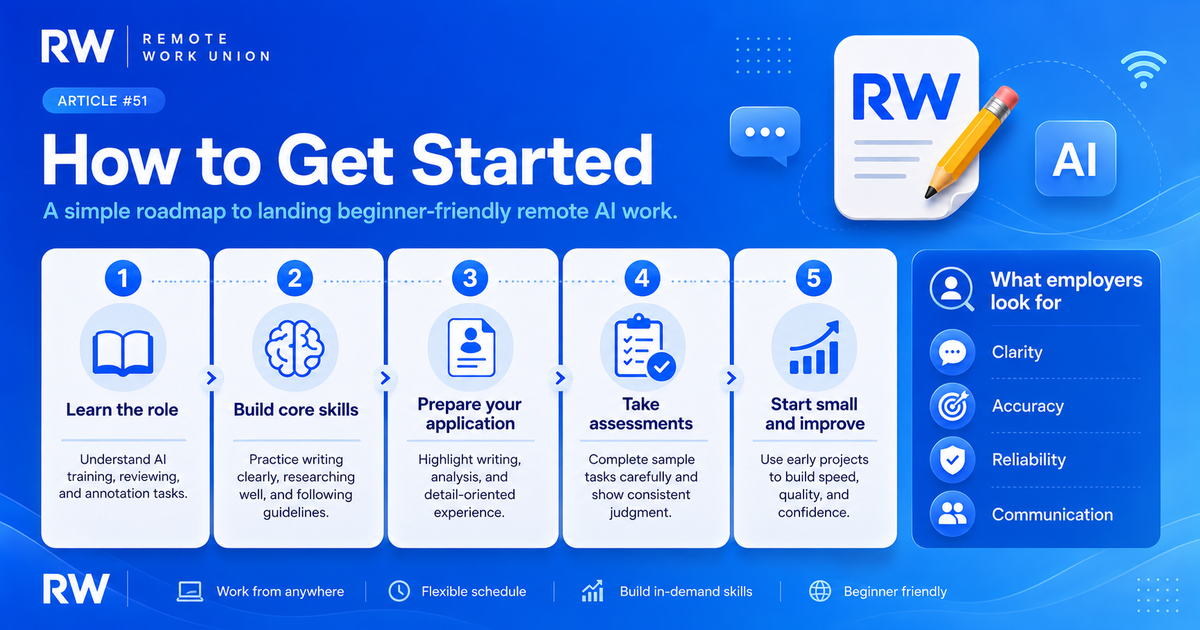
Start narrow, then specialize. Trying to do everything at once is less effective than identifying your strongest lane and applying within it first.
Week 1 — Choose your lane and prepare your profile. Identify your strongest skill: clear writing, research, editing, domain expertise, or structured review. Rewrite your resume and profile headline using evaluation-focused language. Prepare one or two short writing samples that show analytical judgment.
Week 2 — Apply to your first batch of roles. If you are a strong general writer, start with AI training writer, response reviewer, and prompt evaluator searches. If you are research-oriented, look for fact-checking, AI research assistant, and search quality evaluation roles. Submit applications to several platforms at once rather than waiting for one response before moving to the next.
Week 3 — Pass your first assessment. When invited to a screening task, slow down. Read the full instructions before starting. Complete the task using the required format. Review it once before submitting. Focus on explaining your decisions specifically, not generally.
Week 4 — Get your first project and focus on quality. Once accepted into a project, prioritize accuracy over speed. Early work establishes your reliability rating. Consistent, high-quality output makes you eligible for more projects, better-paid tasks, and longer-term assignments.
Beginner tip: Do not wait until your profile is perfect before applying. Apply to a focused set of roles now, then improve your profile based on what you learn from each platform's feedback and screening process.
Frequently Asked Questions
Do I need coding experience for remote AI training jobs?
Not always. Many writing, annotation, review, research, and response evaluation roles do not require programming. If you can read carefully, follow instructions, compare answers, and explain your reasoning in writing, you may qualify for a wide range of beginner-friendly AI training roles.
Are AI training jobs the same as data entry jobs?
No. AI training usually requires significantly more judgment than basic data entry. You are not just copying or transferring information — you are evaluating quality, comparing options, identifying errors, and explaining decisions using a rubric or set of criteria.
Can students and recent graduates apply for AI training jobs?
Yes, if the role allows your location and background. Many beginner-level AI training roles are open to students, recent graduates, and career changers who can demonstrate strong writing, research, or analytical skills.
What should I put on my resume for AI training jobs?
Highlight writing, editing, research, tutoring, support, documentation, content review, QA, analysis, rubric-based grading, or detail-oriented project work. Use evaluation-focused language: AI trainer, AI evaluator, model evaluation, LLM evaluation, data annotation, response reviewer, prompt evaluation, RLHF, human feedback, content review, and fact-checking.
What job titles should I search for as a beginner?
Search for: AI trainer, AI evaluator, AI response reviewer, data annotator, prompt evaluator, AI writing evaluator, content quality reviewer, research assistant, fact-checker, RLHF evaluator, and AI rater. Use combinations with "remote," "work from home," and "no experience required" to find beginner-level openings.
How much can beginners earn in remote AI training jobs?
Pay varies widely by platform, task type, and expertise level. General annotation and response review roles typically start at entry-level rates. Specialized expert review roles — for people with domain knowledge in law, finance, medicine, or technical fields — often pay significantly more. Starting with any role builds a track record you can use to qualify for better projects.
Final Takeaway
The best remote AI training jobs for beginners are not only for coders. They are also for people who can write clearly, read carefully, follow instructions, compare options, explain decisions, and improve weak answers.
Every AI system that learns from human feedback needs contributors who can perform those tasks reliably. That demand is not shrinking — it is growing as AI tools become more widely used and the need for careful human evaluation expands. If writing and careful analysis are among your strongest skills, remote AI training work is a genuinely practical place to start.