AI fact-checking jobs are a growing category of remote AI work where human reviewers help evaluate whether model outputs are accurate, supported, current, and useful. These roles overlap with AI evaluator jobs, AI training jobs, model evaluation work, search quality rating, RLHF tasks, and data annotation. The core idea is simple: an AI system produces an answer, and a human worker checks whether that answer should be trusted.
AI models can sound confident even when they are wrong. A chatbot might invent a source, confuse two similar companies, summarize an outdated rule, or turn a narrow fact into a sweeping claim. Fact-checking tasks are designed to catch those problems before they become part of training data or product feedback. For remote workers with research, editing, legal, medical, finance, or analytical backgrounds, this work is one of the strongest entry points into paid AI training roles on platforms like Outlier AI, Mercor, Handshake AI, and micro1.
What AI Fact-Checking Jobs Usually Involve
An AI fact-checking task typically starts with a prompt and a model answer. Your job is to review the answer like a careful editor, researcher, and quality evaluator at the same time. You may be asked to label the answer as accurate or inaccurate, compare two AI responses, identify unsupported claims, rewrite a correction, or explain why one answer is better than another.
A simple example: a user asks for a list of remote jobs paying above a certain hourly rate. The model gives a polished answer, but one job no longer exists, one company is described incorrectly, and one salary estimate is presented as guaranteed when it actually varies by project. A fact-checker would flag those issues, explain what is wrong, and describe how the answer should be improved.
The Main Things Human Reviewers Verify
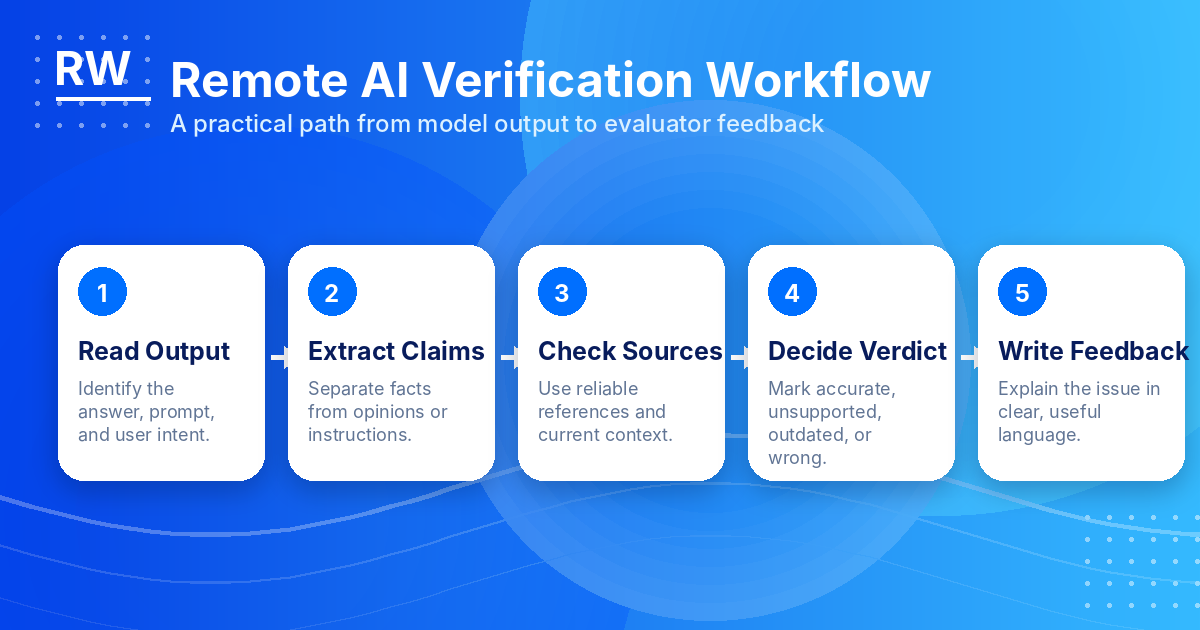
Accuracy is the obvious category, but it is not the only one. AI fact-checkers verify several layers of an answer.
- Factual claims: names, dates, definitions, locations, company descriptions, product details, formulas, historical events, and step-by-step explanations.
- Source quality: a weak source, an old forum post, or a vague citation may not support a claim. Good reviewers look for evidence that is relevant, credible, and specific.
- Context: many AI mistakes are oversimplifications. The model may leave out an important exception, blur the difference between countries, or present a trend as universal.
- Freshness: some topics change quickly — platform rules, pricing, laws, company leadership. A strong reviewer knows when freshness matters.
- Reasoning: some model outputs contain correct final answers but weak logic, or use a valid source to support the wrong conclusion.
The Basic Workflow for Remote AI Fact-Checking
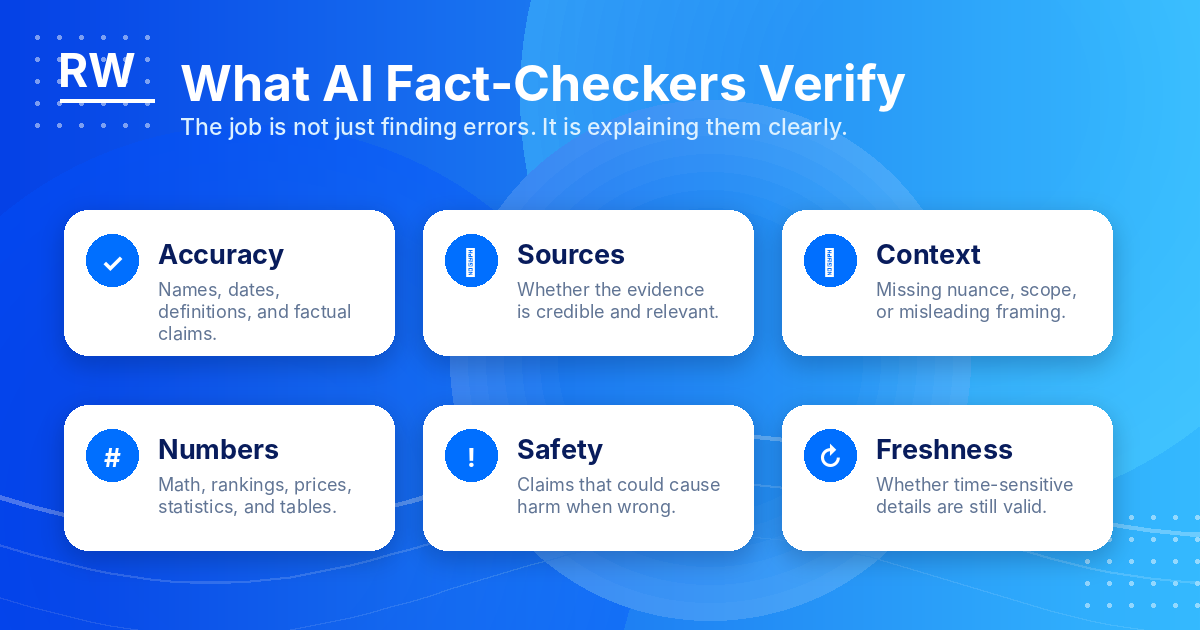
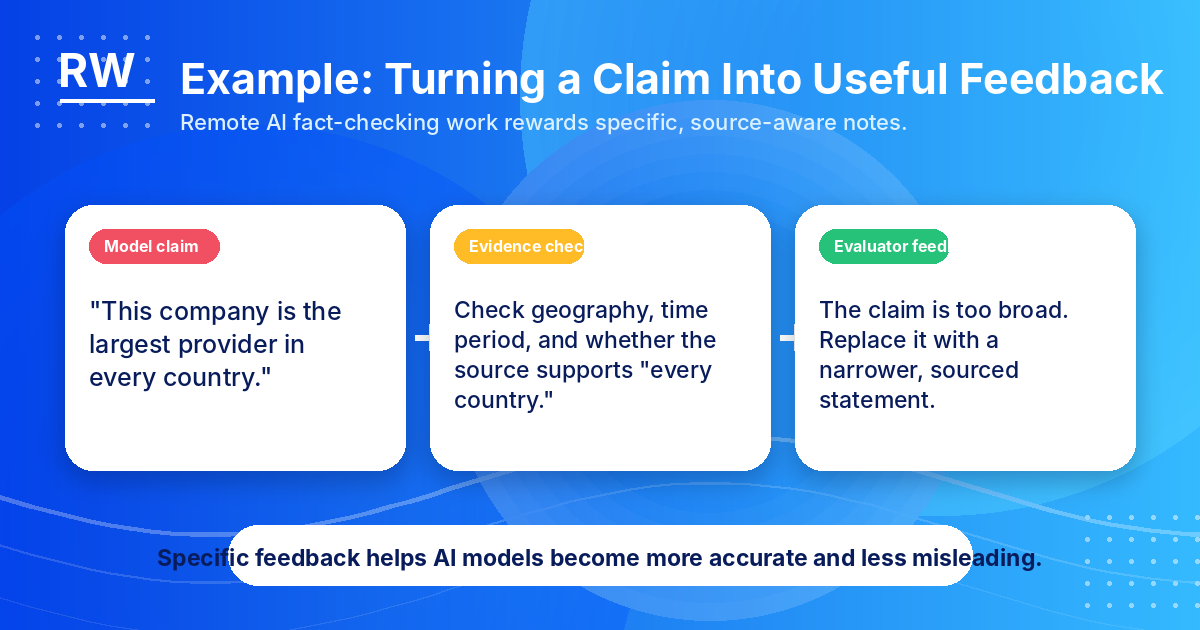
Most AI fact-checking jobs follow a repeatable workflow. First, read the prompt carefully — before judging the model, you need to understand what the user wanted. Second, identify checkable claims. Not every sentence needs verification. A line like "this can be frustrating" is subjective; a line like "this platform pays $50/hr for all projects" is factual. Third, look for reliable evidence from official documentation, primary sources, or credible publications. Fourth, compare the evidence to the model output — the question is not just "did I find something related?" but "does this evidence actually support the exact wording?" Fifth, assign a verdict or rating. Sixth, write specific, short feedback that says what is wrong, why it is wrong, and how the answer should be fixed.
Remote Work Union connects you to legitimate remote AI fact-checking and model evaluation roles. Apply for free to find roles hiring now.
Find Roles Hiring Now →Common Task Types in AI Fact-Checking Jobs
- Response verification: review a single model answer and decide whether it is accurate. Common in AI training because platforms need humans to identify hallucinations.
- Side-by-side comparison: see Response A and Response B, choose which one is better for accuracy, completeness, safety, or clarity.
- Citation checking: verify whether cited links or sources actually support the claims the model made.
- Claim extraction: identify which sentences contain factual claims to build datasets for later verification work.
- Rewrite and correction: fix an answer after identifying the problem, keeping it useful without adding unnecessary complexity.
Skills That Make You Competitive
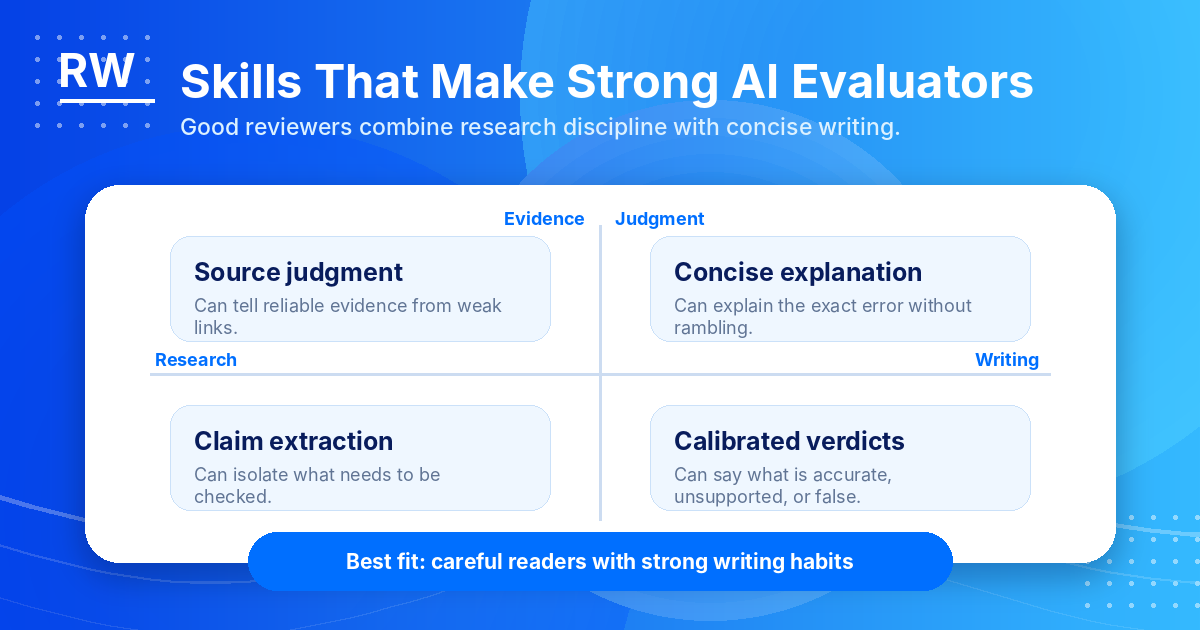
The strongest applicants for AI fact-checking jobs usually have four core skills: careful reading, research judgment, clear writing, and consistency. Careful reading means noticing qualifiers — words like "always," "never," "all," "best," "only," "guaranteed," and "currently" can change whether a sentence is true. Research judgment means knowing the difference between a source that mentions a topic and a source that proves a claim. Clear writing means you can explain an issue in two precise sentences, not a long paragraph. Consistency means applying the same standard across all tasks.
Who Is a Good Fit for This Work?
AI fact-checking jobs fit writers, editors, researchers, teachers, analysts, consultants, journalists, lawyers, medical writers, finance professionals, and detail-oriented generalists. You do not always need to be a coder. Many model evaluation jobs reward language skill and evidence judgment more than programming. Technical knowledge can open additional opportunities in code evaluation or data analysis projects, but most writing-focused fact-checking work prioritizes reading comprehension and clear feedback above technical background.
Tip: The best fit is usually someone who can work independently, handle ambiguity, and explain decisions clearly. If you enjoy checking claims, spotting weak logic, and improving written answers, this work rewards those exact strengths.
How to Search for AI Fact-Checking Jobs
Many companies do not use the phrase "AI fact-checking jobs" even when the work involves fact-checking. Try related keywords: AI evaluator, AI trainer, AI model evaluator, AI response evaluator, model evaluation, LLM evaluator, RLHF evaluator, search quality rater, data annotation, prompt evaluator, AI content reviewer, AI writing evaluator, and human feedback jobs. You can also search around major AI products — OpenAI, Anthropic, Claude, Google Gemini, Meta AI — but many remote AI training roles appear through contractor platforms, vendors, or specialized AI evaluation companies rather than directly at the large AI labs.
What to Put in Your Resume
For AI fact-checking jobs, your resume should make your evidence and writing skills obvious. Mention research, editing, quality review, source verification, technical writing, data analysis, or domain-specific expertise when relevant. Translate past experience into skills that matter for model evaluation: accuracy, judgment, communication, and attention to detail. You can also prepare short examples before applying — take a public AI-generated answer, identify factual claims, verify them, and write a concise evaluation.
Mistakes That Hurt New Evaluators
- Overexplaining: long feedback is not automatically better. If a claim is unsupported, say what claim is unsupported and what evidence is missing.
- Relying on one quick search: search snippets can be misleading. Open the source, read the relevant section, and make sure it supports the claim.
- Treating every issue as equally serious: a typo is different from a false medical claim. Good evaluators weigh severity.
- Ignoring the prompt: an answer can be accurate but too advanced or too long if those do not match what the user asked for.
- Guessing when uncertain: it is better to say a claim is not verified than to pretend the evidence is stronger than it is.
Frequently Asked Questions
What are AI fact-checking jobs?
AI fact-checking jobs are remote contractor roles where human reviewers verify whether AI model outputs are accurate, supported, current, and useful. Tasks may include rating responses, comparing two answers, identifying hallucinations, checking citations, and writing feedback explaining what is wrong and how to fix it.
What skills do AI fact-checkers need?
The four most important skills are careful reading (noticing qualifiers like "always," "never," "guaranteed"), research judgment (finding reliable evidence and checking it actually supports the claim), clear writing (concise feedback that explains the issue), and consistency (applying the same standard across many tasks).
Who is a good fit for AI fact-checking work?
AI fact-checking work fits writers, editors, researchers, journalists, teachers, analysts, lawyers, medical writers, finance professionals, and detail-oriented generalists. You do not need to be a coder. Many model evaluation jobs reward language ability, research skill, and evidence judgment more than technical background.
How do I find AI fact-checking jobs?
Search for AI evaluator, AI model evaluator, AI response reviewer, RLHF evaluator, search quality rater, data annotation, prompt evaluator, and AI fact-checker. Platforms like Outlier AI, Mercor, Handshake AI, and micro1 all have relevant roles. Also check LinkedIn, Upwork, and job boards for AI training and model evaluation roles.