Applying for remote work from outside the United States is not the same as applying for a local job. You are not only trying to prove that you can do the work. You also have to prove that you are easy to hire, easy to pay, easy to schedule, and easy to trust from another country.
That does not mean international applicants are at a disadvantage in every category. Many remote jobs, remote AI jobs, AI training roles, AI evaluation projects, data annotation jobs, prompt writing tasks, bilingual reviewer roles, and research-based work-from-home jobs are built for distributed talent. The problem is that many applicants waste time applying to roles that are clearly US-only, do not explain their availability, or submit a profile that makes the company worry about logistics.
The better strategy is simple: filter jobs correctly, build a remote-ready profile, show proof of your skills, and apply only where your country, schedule, and payment options make sense. This guide explains how to do that.
What This Article Covers
- Start With the Location Rule, Not the Job Title
- Why Some Remote Jobs Are US-Only
- Target Remote Work Categories That Travel Better Across Borders
- Build a Profile That Answers the Employer's Hidden Questions
- Use a Simple International Remote Resume Format
- Show Proof, Even If You Have Never Had a Remote Job Before
- Handle Time Zones Like a Professional
- Set Up Payments Before You Need Them
- Apply to Platforms and Direct Jobs at the Same Time
- Write Applications That Reduce Risk
- Avoid the Biggest Mistakes International Applicants Make
- How to Know a Remote Job Is Worth Applying To
- A Simple Weekly Application System
- Frequently Asked Questions
Start with the location rule, not the job title
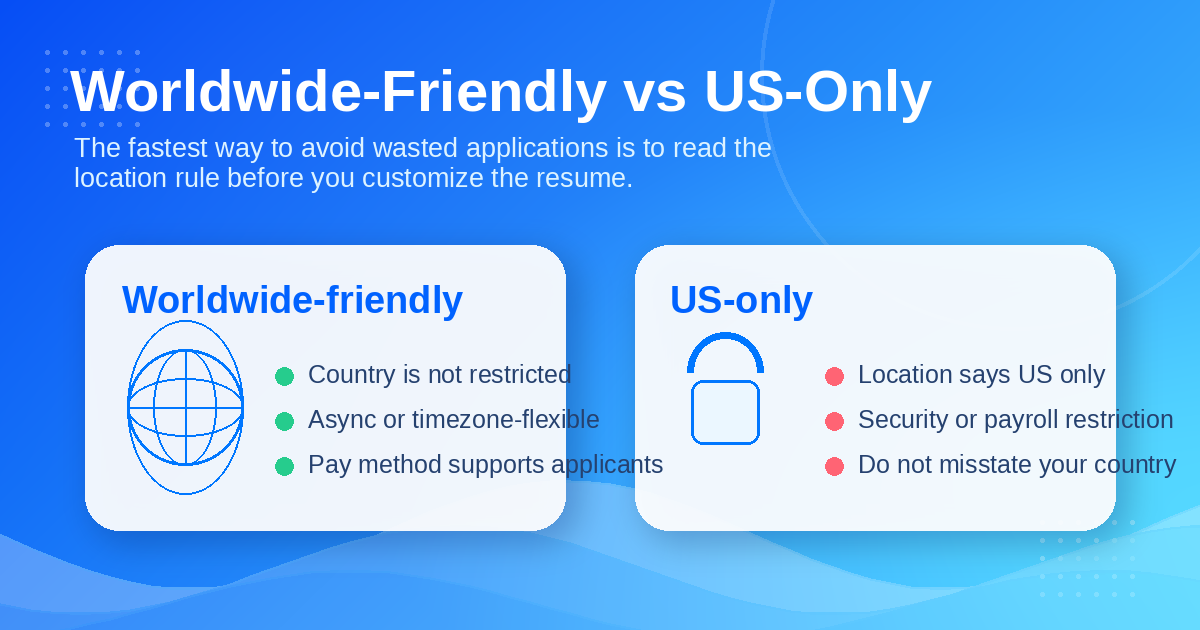
The first line to check is not the pay rate. It is not the company name. It is not the headline that says remote. The first line to check is the location rule.
A job can say remote and still be restricted to one country. Common wording includes US remote, US only, must be authorized to work in the United States, remote within the United States, North America only, or open to specific countries. Those roles may still be legitimate remote jobs, but they are not worldwide remote jobs.
International applicants should look for wording such as worldwide, global, anywhere, remote-first, distributed team, international contractors, open to applicants in your region, or specific references to your country. On AI training platforms, the location rule may appear during onboarding rather than in the public job description, so read every eligibility screen carefully.
Important: Do not try to bypass location rules by pretending to be in the United States. That can create problems with identity checks, payment setup, tax documentation, security review, and account status. A stronger approach is to find platforms and roles that are actually open to your country.
Why some remote jobs are US-only
US-only does not always mean the company dislikes international workers. Often it is about payroll, taxes, client contracts, security requirements, employment law, background checks, time zones, or data access rules.
For example, a company may only have payroll infrastructure in the US. A client may require that work be completed by people in a specific country. A role may involve sensitive customer data that cannot be accessed from certain jurisdictions. A hiring manager may need real-time collaboration during US business hours. None of that means you should stop applying for remote work. It means you should stop treating every remote job as available to every country.
The best international applicants read restrictions quickly and move on quickly. The goal is not to convince every US-only role to make an exception. The goal is to build a pipeline of remote jobs, work-from-home jobs, and remote AI work opportunities where your location is not a problem.
Target remote work categories that travel better across borders
Some remote jobs are naturally easier to hire across borders than others. Work that is asynchronous, output-based, language-based, research-based, or project-based often travels better than roles that require phone support, local licensing, in-person meetings, or country-specific compliance.
Strong categories for applicants outside the US often include AI training, AI evaluation, AI data annotation, search evaluation, content review, prompt writing, translation, transcription, research assistance, writing, editing, design, software development, QA testing, virtual assistance, bookkeeping for small businesses, customer research, operations support, and specialized subject matter review.
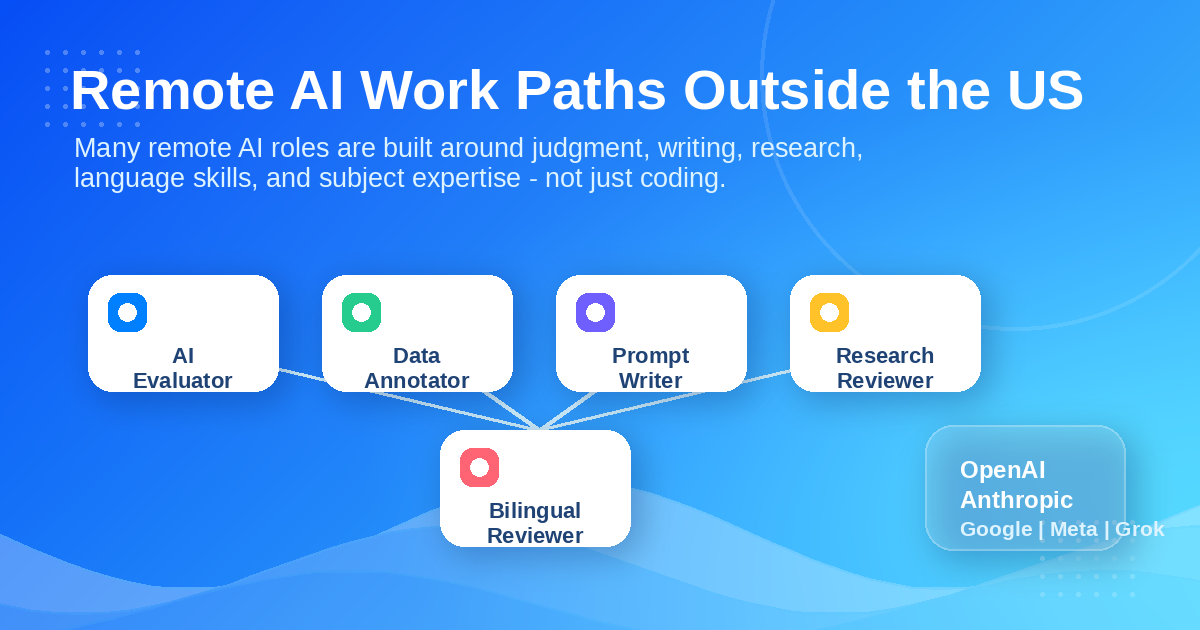
Remote AI work deserves special attention because many AI companies and AI labs need human judgment at scale. The broader AI ecosystem around companies such as OpenAI, Anthropic, Google, Meta, and other model builders relies on people who can evaluate answers, compare outputs, identify mistakes, improve prompts, label data, review reasoning, and test whether AI responses are useful. Some of this work is technical. Much of it is not. Writing ability, research ability, domain expertise, language skill, and attention to detail can matter more than coding.
That is why international applicants should not only search for remote jobs. They should also search for remote AI jobs, AI training jobs, AI evaluator roles, data annotation jobs, AI content reviewer jobs, prompt writer roles, and research reviewer opportunities.
Build a profile that answers the employer's hidden questions
When a US company or global platform reviews an international applicant, it has several hidden questions. Can this person communicate clearly in writing? Can they work without constant supervision? Can they follow instructions? Can they meet deadlines across time zones? Can we pay them? Do they understand the difference between contractor work and employment? Can they produce reliable work without creating extra management work?
Your resume and application should answer those questions directly. Include your country and time zone if the platform asks for it. State your availability in a simple way, such as available for four hours of overlap with Eastern Time or available for asynchronous work with daily check-ins. Mention remote tools you can use, such as Google Workspace, Slack, Notion, Airtable, Trello, Zoom, Loom, ChatGPT, Claude, spreadsheets, or project management tools when relevant.
For AI training and remote evaluation roles, emphasize skills that match the work: writing, editing, fact-checking, research, comparing two responses, spotting errors, following rubrics, explaining why one answer is better than another, domain expertise, bilingual ability, and careful reading. These are real remote work skills. Do not hide them under vague phrases like hardworking or fast learner.
Use a simple international remote resume format
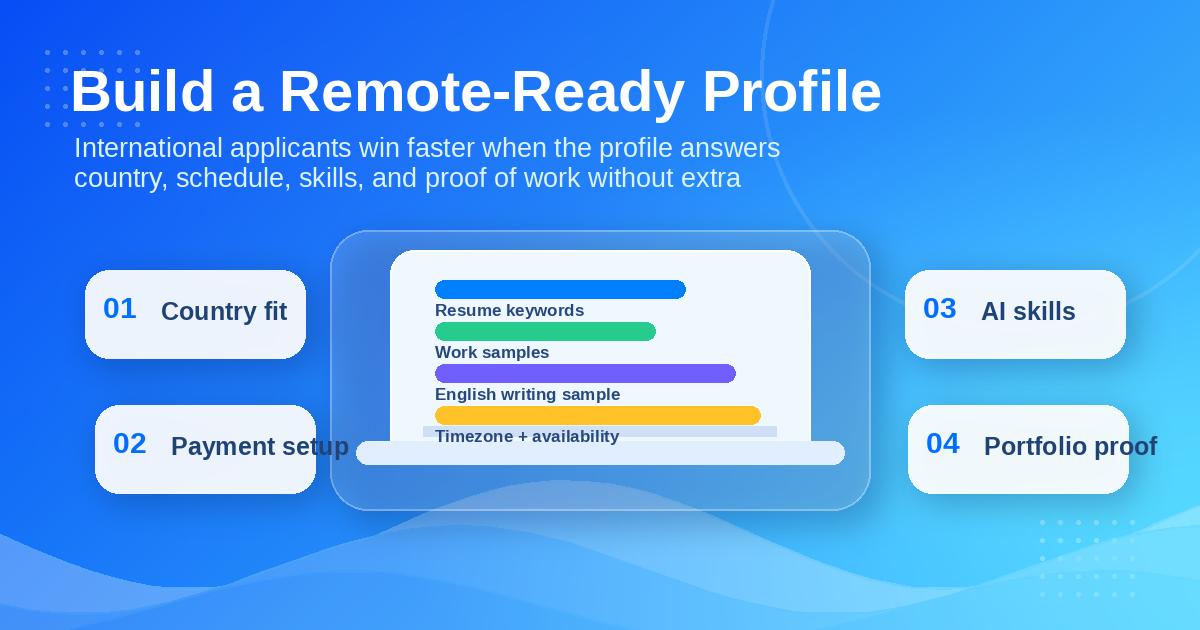
Your resume does not need to look complicated. It needs to be easy to scan. Use a clear headline, a short summary, a skills section, relevant experience, project examples, education, and links to work samples if you have them.
A strong headline could be: Remote AI Evaluator | Research and Writing | Available for Global Contractor Work. Another could be: Content Reviewer and Data Annotation Specialist | English Writing | Remote Work. The exact title depends on the jobs you want, but the goal is to make your remote fit obvious.
In the summary, explain what you do, what kind of remote work you want, and why you are useful. For example: Detail-oriented research and writing professional applying for remote AI training, AI evaluation, data annotation, and content review roles. Strong English writing, fact-checking, rubric-following, and asynchronous communication skills. Available for contractor work from [country/time zone].
Then match your skills to the job category. For AI training jobs, list skills such as AI response evaluation, prompt writing, data labeling, research, editing, content quality review, search evaluation, spreadsheet tracking, and accuracy review. For virtual assistant work, list inbox management, scheduling, data entry, CRM updates, customer support writing, and process documentation. For writing jobs, list SEO writing, content briefs, editing, CMS publishing, and research.
Show proof, even if you have never had a remote job before
One of the biggest advantages for international applicants is proof of work. A hiring manager may not know your local school, employer, or market. But they can understand a clean writing sample, a polished portfolio, a spreadsheet sample, a design sample, a translation sample, or a short case study.
If you are applying for remote AI jobs, create samples that show judgment. You can write a short comparison of two AI answers and explain which one is better. You can fact-check a short article and show the corrections. You can create a prompt and explain what a good answer should include. You can summarize a complex topic in simple language. You can build a small research document with sources and clear conclusions.
These samples do not need to be long. They need to be clear. The goal is to prove that you can read instructions, communicate in writing, and produce work that does not require someone else to clean it up.
Handle time zones like a professional
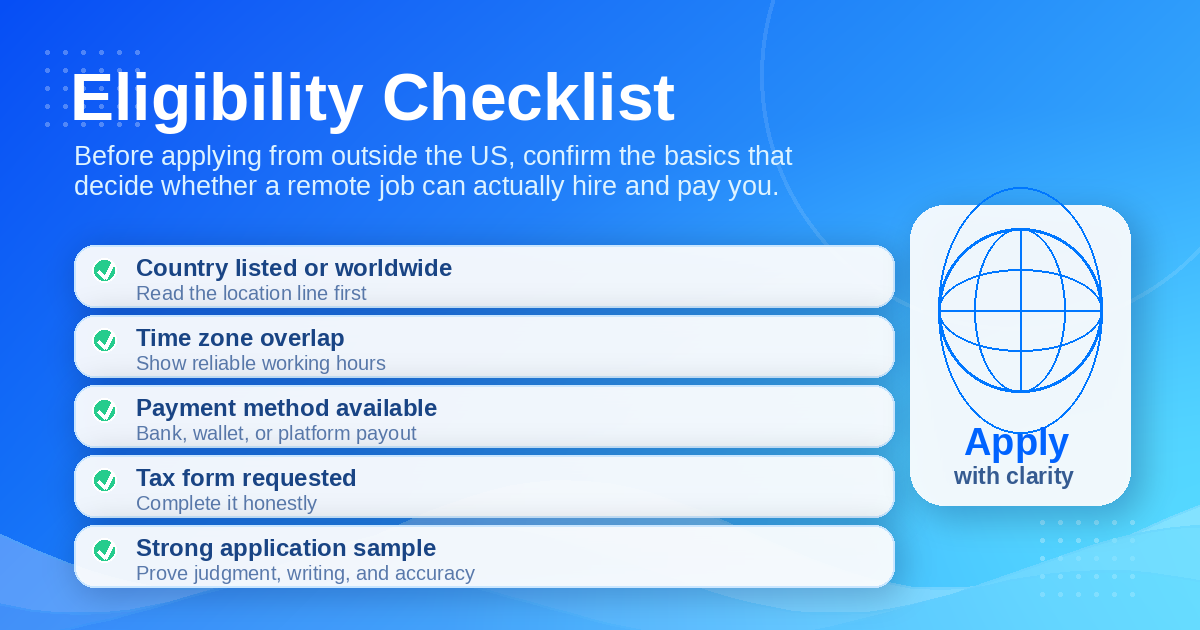
Time zones are not a dealbreaker if you explain them clearly. They become a dealbreaker when the employer has to guess.
Use practical language. Instead of saying flexible schedule, write something specific: Available for asynchronous work and two to four hours of overlap with US Eastern Time. Or: Available Monday through Friday, 9 a.m. to 6 p.m. GMT+1, with daily written updates. Or: Open to project-based remote work with 24-hour turnaround windows.
This matters for remote work outside the US because many jobs do not need full-day overlap. AI training, data annotation, writing, editing, research, and QA tasks often focus on completed work rather than meetings. But some roles still need live collaboration. If the job requires a US schedule, be honest about whether you can reliably work it.
Ready to apply for worldwide-friendly remote AI work? Find roles that are open to international applicants on RemoteWorkUnion.com.
Find Roles Hiring Now →Set up payments before you need them
Remote platforms and contractor jobs may pay through bank transfer, PayPal, Wise, Payoneer, Deel, Stripe, direct deposit, or platform-specific payout systems. Availability depends on the company and your country.
Before you apply heavily, make a simple payment checklist. Confirm whether you have a bank account that can receive international transfers. Confirm whether common payout tools are available in your country. Make sure your name, address, and identity documents are consistent. Keep your tax information ready. If a platform asks for tax forms, answer honestly and follow the platform instructions.
Payment friction is one of the easiest ways to lose momentum after getting accepted. A remote job application is not complete until you can actually receive money from the work.
Apply to platforms and direct jobs at the same time
A common mistake is relying on one remote work platform. A better approach is to build a pipeline. Apply to remote AI platforms, AI training platforms, data annotation platforms, freelance marketplaces, company job boards, staffing firms, and direct remote roles.
Platforms can be faster because they already use contractor workflows. Direct jobs can be better for stability. Freelance work can help you build proof and reviews. Company job boards can lead to higher-quality long-term roles. None of these channels is perfect by itself. Together, they create more chances.
For AI-related work, search beyond one phrase. Use remote AI evaluator, AI trainer, AI data annotator, AI content reviewer, AI response evaluator, prompt writer, LLM evaluator, search quality rater, research reviewer, bilingual AI evaluator, and subject matter expert AI training. For broader remote work, search remote writer, remote research assistant, remote virtual assistant, remote QA tester, remote operations assistant, remote customer support chat, remote editor, and work from home no phone.
Write applications that reduce risk
Your application should make you look reliable, not desperate. Keep it specific and practical. Mention the role, your relevant skill, your remote work setup, your availability, and the proof you can provide.
A simple structure works: first sentence, state the role you are applying for. Second sentence, state the skill that matches the job. Third sentence, explain your remote availability. Fourth sentence, offer proof or a relevant sample. Fifth sentence, close directly.
For example: I am applying for remote AI evaluation and content review work. I have strong English writing, research, fact-checking, and rubric-following skills, and I am comfortable comparing AI responses for accuracy and usefulness. I am based outside the US and available for asynchronous contractor work with daily written updates. I can provide a short writing or evaluation sample if helpful.
That is stronger than a generic message because it answers the concerns that remote employers already have.
Avoid the biggest mistakes international applicants make
The first mistake is applying to US-only roles without reading the location rules. The second is hiding your country until the end of the process. The third is using a generic resume that does not mention remote skills. The fourth is applying with no work sample. The fifth is treating every remote job as if it pays or hires the same way in every country.
Another mistake is sounding too broad. Saying I can do anything online is weaker than saying I can do AI response evaluation, research, fact-checking, data annotation, and writing-based remote work. Employers do not want unlimited willingness. They want a reason to trust you with a specific task.
Also avoid overusing AI-generated applications. It is acceptable to use tools to organize your thoughts, but your application should sound like a real person who understands the job. Remote AI companies and AI training platforms are especially likely to notice generic AI-written answers.
Quick check: Before submitting any application, confirm three things: the job is open to your country, you can receive payment through an available method, and your application mentions something specific about the role rather than a generic summary of your experience. These three checks alone will improve your response rate.
How to know a remote job is worth applying to
A remote job is worth your time when the location rule matches your country or says worldwide, the work matches your skills, the pay method is realistic, the application does not charge you to begin, and the company or platform gives clear instructions.
Be careful with any remote job that asks you to pay for training before work starts, promises unrealistic income with no screening, refuses to explain the work, asks for sensitive information too early, or tries to move the conversation into suspicious private channels. Legitimate remote work can be flexible, but it still has a real application process.
For international applicants, the best opportunities are usually not the easiest-looking ones. They are the roles where your writing, language ability, research judgment, technical skill, design skill, operations skill, or subject expertise makes you more valuable than a generic applicant.
A simple weekly application system
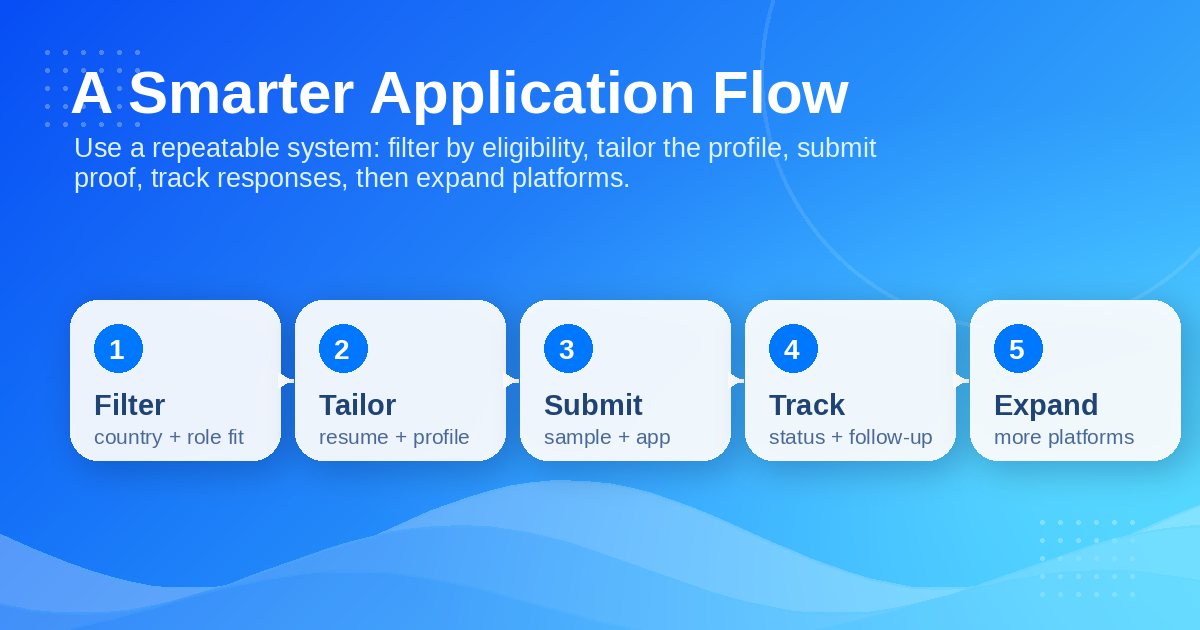
Use a weekly system instead of applying randomly. On Monday, find roles and sort them into worldwide-friendly, region-specific, and not eligible. On Tuesday, customize resumes and profiles for the best matches. On Wednesday and Thursday, submit applications and complete assessments. On Friday, track responses, follow up where appropriate, and add new platforms to your list.
Keep a simple spreadsheet with columns for platform, role, country eligibility, pay range, date applied, assessment status, response, payout method, and notes. This is especially useful for remote AI work because task availability can change, platforms can pause accounts, and different roles may open at different times.
The applicants who improve fastest are usually the ones who treat remote work like a system. They track what they applied to, learn which profiles get responses, and keep expanding their options.
Frequently Asked Questions
Can I apply for remote AI jobs from outside the United States?
Yes. Many remote AI training, AI evaluation, data annotation, prompt writing, and research reviewer roles are open to applicants worldwide. The key is checking the location rule before applying. Look for wording such as worldwide, global, anywhere, remote-first, or open to international contractors. Avoid roles that say US only or require US work authorization.
What kinds of remote jobs travel best across international borders?
Asynchronous, output-based, language-based, research-based, and project-based work usually travels best. Strong categories for international applicants include AI training and evaluation, data annotation, prompt writing, translation, transcription, research assistance, writing, editing, design, QA testing, virtual assistance, and specialized subject matter review.
How do I explain my time zone when applying for remote jobs from outside the US?
Be specific rather than vague. Instead of saying flexible schedule, write something like: Available for asynchronous work and two to four hours of overlap with US Eastern Time. Or: Available Monday through Friday, 9 a.m. to 6 p.m. GMT+1, with daily written updates. Many AI training and data annotation tasks focus on completed work rather than meetings, so full-day overlap is often not required.
How do I get paid for remote work if I am based outside the US?
Before applying heavily, confirm your payment options. Common payout methods include bank transfer, PayPal, Wise, Payoneer, Deel, Stripe, and platform-specific payout systems. Availability depends on the company and your country. Make sure your identity documents are consistent, your tax information is ready, and your account details match your real information. Payment friction after acceptance is one of the most common ways to lose momentum.
What mistakes do international applicants make when applying for remote work?
The most common mistakes are applying to US-only roles without reading the location rules, hiding your country until late in the process, using a generic resume that does not mention remote skills, submitting no work sample, and treating every remote job as if it pays or hires the same way in every country. Another common mistake is using AI-generated applications that sound generic — remote AI companies are especially likely to notice.