India is one of the strongest markets in the world for remote work because many Indian applicants already have the skills remote employers care about: written English, technical literacy, research ability, customer support experience, accounting knowledge, software familiarity, and the ability to learn new tools quickly.
The problem is not that remote work jobs are impossible to find. The problem is that most applicants apply too broadly, use weak profiles, chase low-quality WhatsApp or Telegram offers, and do not prepare for the payment and documentation side before they start earning.
This guide explains the best remote work jobs in India, how to apply from home, how to position yourself for remote AI jobs, and how to think about getting paid legally and professionally.
The Best Remote Work Jobs in India Are Not All the Same
When people search for work from home jobs in India, they often see everything mixed together: surveys, data entry, customer support, freelance gigs, software jobs, content writing, virtual assistant work, online tutoring, and AI training platforms. Some of those can be legitimate, but they are not equal.
The best remote work jobs usually have three traits: they pay for skill, judgment, reliability, or domain knowledge; they have a real application process instead of asking you to pay money upfront; and they give you a dashboard, contract, written scope, invoice, or clear payment record.
For Indian applicants, the strongest categories are remote AI training, model evaluation, research, writing, editing, virtual assistance, customer support, accounting, bookkeeping, software QA, data analysis, translation, and localization.
Remote AI Jobs Are a Strong Fit for Many Indian Applicants
Remote AI jobs are growing because major AI companies and AI labs need humans to help evaluate, improve, and test large language models. These jobs may involve reviewing AI answers, comparing two model responses, writing prompts, checking factual accuracy, labeling data, rating helpfulness, editing outputs, or giving feedback on whether an answer is safe and useful.
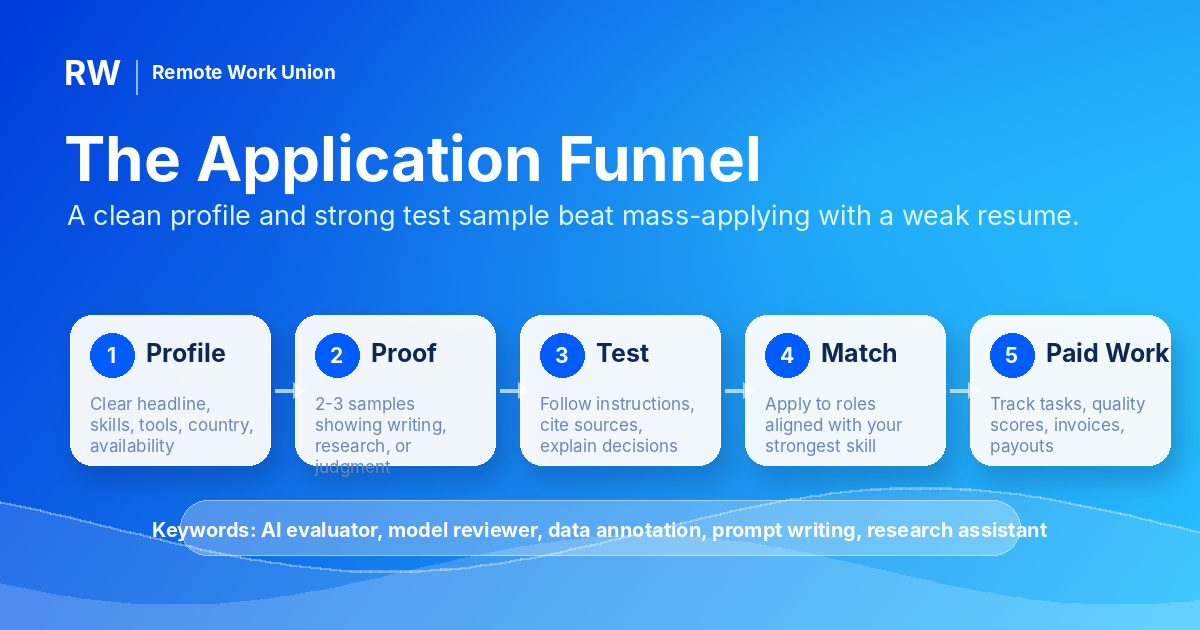
These roles are often described with keywords like AI trainer, AI evaluator, AI data annotator, model evaluator, model reviewer, prompt writer, AI content reviewer, AI research assistant, RLHF contributor, search quality evaluator, and human feedback specialist.
This is why remote AI work can be a good match for people in India who have strong English, careful reading habits, research skills, software familiarity, or subject-matter expertise. You do not always need to be a coder. Coding helps for some roles, but many AI training tasks need writers, editors, researchers, teachers, lawyers, finance professionals, customer support workers, operations people, and generalists who can judge whether an answer is actually good.
When you apply, use the language employers and platforms are already searching for. Mention skills such as AI model evaluation, data annotation, prompt writing, response ranking, fact-checking, web research, English writing and editing, quality assurance, domain expertise, and spreadsheet and documentation skills.
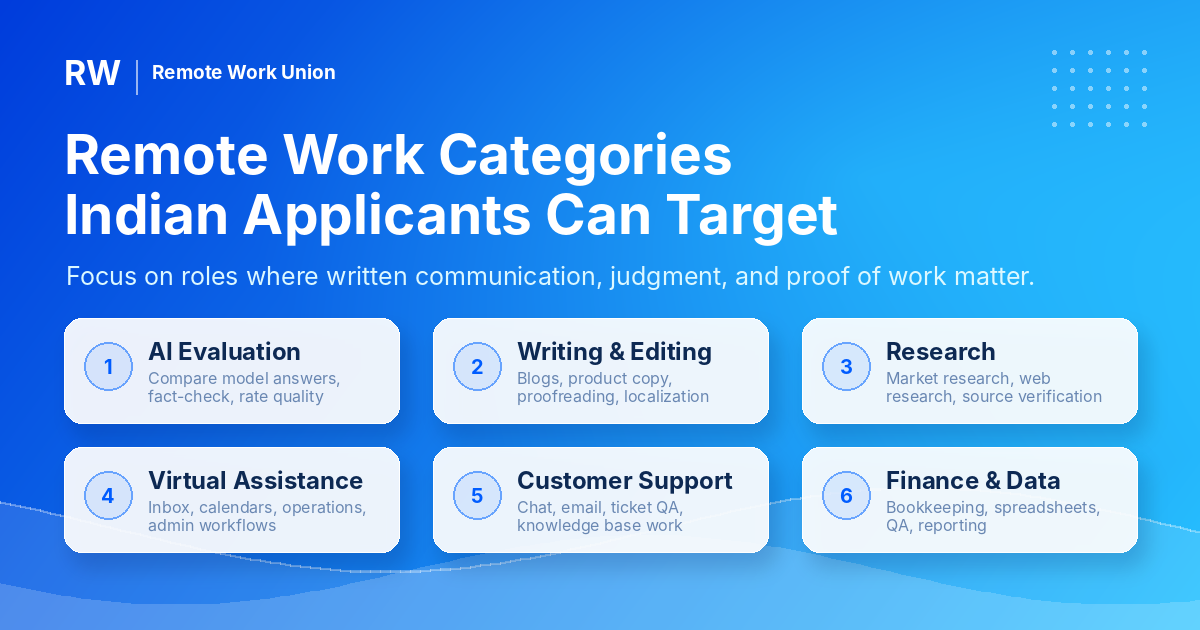
The Best Remote Work Categories for Applicants in India
1. AI Training and Model Evaluation
AI training work is one of the most important remote work categories to watch. A typical task might ask you to compare two AI responses and decide which is better. Another task might ask you to write a high-quality answer, check sources, classify errors, or explain why a response fails.
Good candidates are detail-oriented and can follow instructions exactly. The best applicants do not just say, "I am interested in AI." They show that they can evaluate writing, spot hallucinations, explain reasoning, and improve an answer.
2. Writing, Editing, and Proofreading
Writing and editing jobs can include blog posts, website copy, product descriptions, social media content, email copy, documentation, SEO briefs, and proofreading. Indian applicants can compete well when they show clean writing, fast turnaround, and topic flexibility.
A strong writing profile should include two or three samples. These do not need to be famous publications. They can be original samples that prove you can explain a topic clearly.
3. Research and Fact-Checking
Research roles are a natural fit for AI work, content operations, market research, recruiting, sales support, and data verification. These jobs reward people who can find reliable information, summarize it clearly, and cite or record where it came from.
For AI research jobs, the most valuable skill is not browsing fast. It is knowing which source is trustworthy and how to turn messy information into a clean answer.
4. Virtual Assistant and Operations Work
Virtual assistant roles can include inbox management, scheduling, customer follow-up, CRM updates, spreadsheets, document formatting, travel planning, data cleanup, and project tracking. These jobs are best for people who are organized, responsive, and comfortable using tools like Google Workspace, Microsoft Office, Notion, Airtable, Slack, Trello, Asana, and ChatGPT.
To stand out, describe the workflows you can handle: calendar coordination, lead tracking, inbox triage, customer follow-up, executive admin, SOP documentation, spreadsheet reporting, or recruiting coordination.
5. Customer Support Without Phone Calls
Many people want work from home jobs with no phone calls. In India, written customer support can be a good option if you have strong English and patience. Look for roles in chat support, email support, ticket support, trust and safety, content moderation, help center writing, and support QA.
Phone support is not the only path. Written support is often a better match for remote-first companies because it creates records, is easier to quality-check, and can be done across time zones.
6. Accounting, Bookkeeping, and Data-Minded Roles
India has many applicants with finance, accounting, bookkeeping, spreadsheet, and operations experience. Remote employers often need help with reconciliations, invoice tracking, reporting, expense categorization, payroll support, ecommerce reporting, and data cleanup.
For these jobs, emphasize accuracy, confidentiality, Excel or Google Sheets, QuickBooks or other accounting tools, and any industry-specific knowledge you have.
How to Build a Remote Work Profile That Gets Noticed
A weak profile says: "Looking for online work from home. Hardworking and fast learner. Any job is okay."
A stronger profile says: "Remote AI evaluator and research assistant based in India. Strong English writing, fact-checking, model response evaluation, spreadsheet QA, and documentation skills. Available for AI training, data annotation, prompt writing, web research, and written support roles."
The second profile works better because it gives the platform matching system and the human reviewer clear signals. It says what you do, where you are, what skills you offer, and which remote roles you should be considered for.
How to Apply Without Looking Like a Beginner
Many applicants hurt themselves by writing that they have "no experience." Even if you are new to remote work, you probably have transferable experience. A teacher can evaluate explanations. A customer support worker can judge helpfulness. A student can research and summarize. A finance worker can check calculations. A writer can improve tone and clarity. A programmer can test technical answers.
Instead of saying, "I have no experience," say what you can evaluate:
- "I can review whether an AI answer follows instructions and gives a useful response."
- "I can fact-check claims and identify unsupported statements."
- "I can compare two pieces of writing and explain which one is clearer."
- "I can clean spreadsheets and identify inconsistencies."
- "I can write prompts and judge whether the output matches the user request."
Where Indian Applicants Should Look for Remote Work
Do not rely on one job board. Remote work is spread across several channels: AI training and data annotation platforms, freelance marketplaces, remote job boards, company career pages, recruiting platforms, LinkedIn posts, startup communities, and referrals and newsletters.
For AI work, search terms like AI evaluator, AI trainer, data annotation, LLM evaluator, prompt writer, model reviewer, AI content reviewer, search quality rater, and AI research assistant.
For general remote work, search for remote customer support, email support, virtual assistant, research assistant, content editor, SEO writer, data analyst, QA tester, bookkeeper, operations assistant, and recruiting coordinator.
Do not assume every role is open to India. Check the location field before applying. Your time is better spent applying to roles that clearly allow international, worldwide, contractor, freelance, or India-based applicants.
Remote AI training and model evaluation work is open to strong applicants in India. Find the roles that fit your background and are hiring now.
Find Roles Hiring Now →How to Get Paid From Home in India
Getting paid is part of the job. Before you start, make sure your basic payment setup is professional.
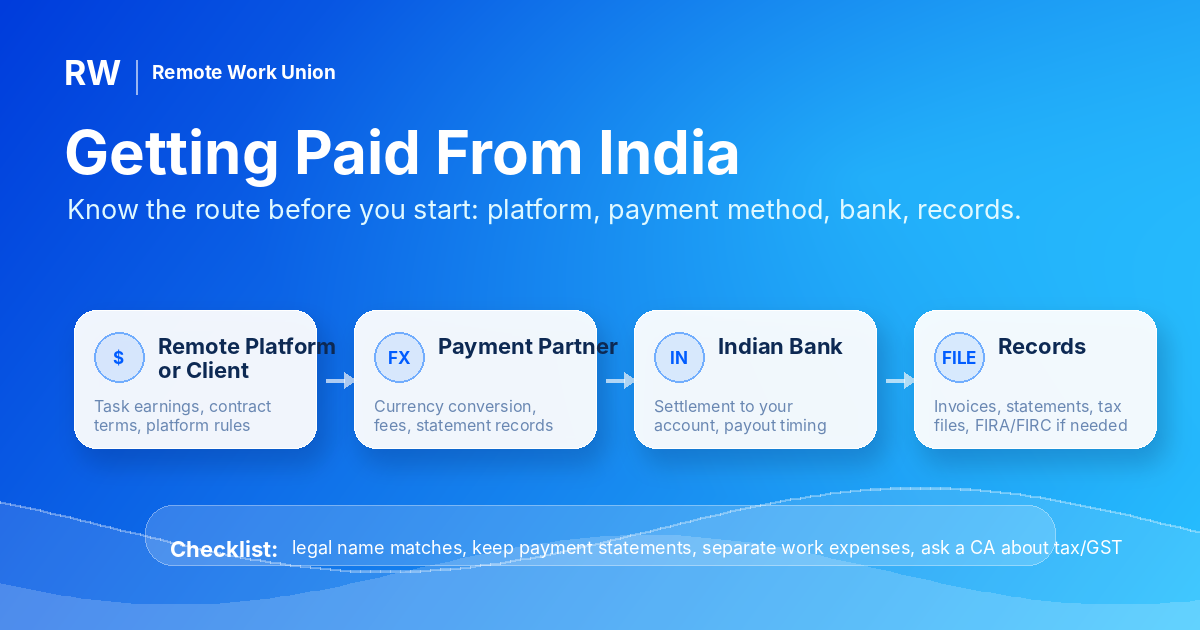
You will usually need: a bank account in your own legal name; a payment method accepted by the platform or client; your PAN and tax information when required; matching name details across platform, bank, and payment account; a simple invoice or payment record for direct clients; and a spreadsheet tracking date, client/platform, amount, currency, fees, and INR received.
International remote payments may arrive through a platform wallet, payment processor, wire transfer, PayPal, Payoneer, Wise, or another approved payment partner depending on the platform and client. Fees, conversion rates, withdrawal timing, and documentation differ. Always check the current terms before choosing a payment route.
For foreign inward remittances, keep records. Some payment processors provide downloadable remittance advice or FIRA/FIRC-style documentation. Keep your own copies of platform statements, invoices, payout confirmations, and bank credits.
Tax and Compliance Basics for Indian Remote Workers
This is general information, not tax or legal advice. Once you earn meaningful income, ask a qualified CA about your exact situation.
In India, freelance or contractor income is commonly handled under business or profession income rather than salary income. The Income Tax Department provides guidance for individuals with income from business or profession and discusses ITR-3 and ITR-4 depending on eligibility and presumptive taxation rules.
GST can also matter for freelancers and service exporters. Under Indian GST law, export of services can qualify as zero-rated supply when conditions are met. The practical lesson is simple: keep clean records from day one. If your earnings grow, good records make taxes, GST questions, refunds, and bank documentation easier.
How to Avoid Remote Work Scams in India
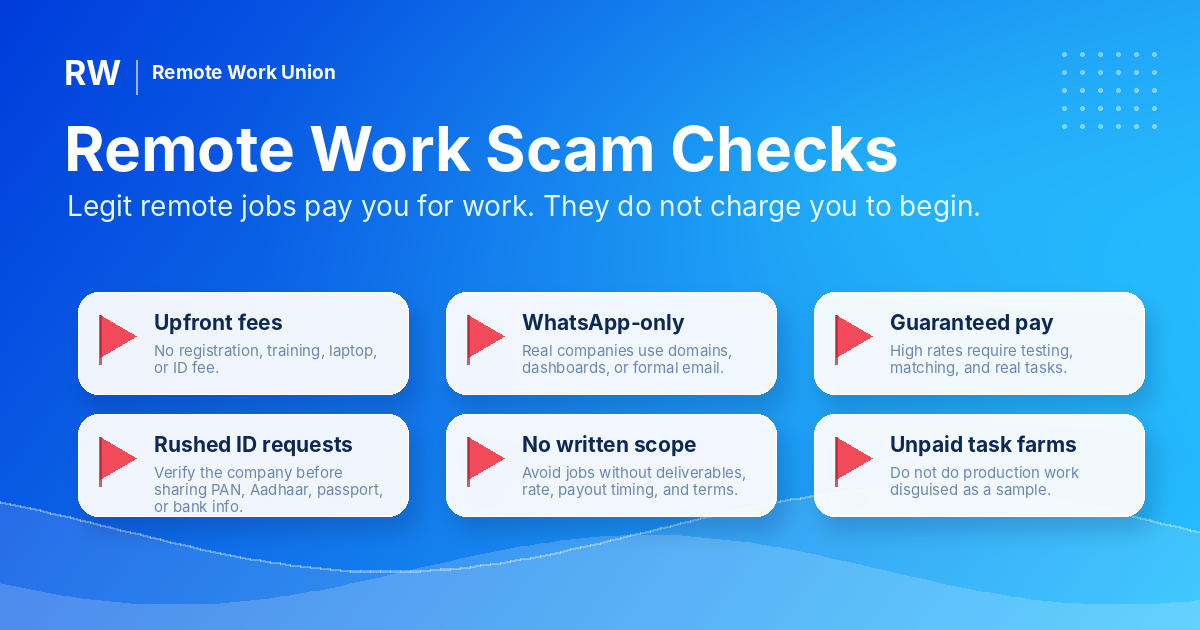
Remote work scams are common because many applicants want fast income from home. Use a simple rule: real remote work pays you; it does not charge you.
Be careful with any job that asks for registration fees, training fees, security deposits, laptop deposits, software purchase fees, crypto payments, paid verification, payment before interview, or Aadhaar, PAN, passport, or bank details before you can verify the company.
Also be careful with jobs that only communicate through WhatsApp or Telegram, promise guaranteed high pay, refuse to share a company domain, or ask you to do unpaid production work as a "sample."
A real remote work opportunity should have a clear role, payment method, work scope, hiring process, company identity, and written terms.
A Practical 7-Day Plan for Indian Applicants
Day 1: Choose your category. Pick one primary category: AI evaluation, writing, research, support, virtual assistant, accounting, QA, or data analysis.
Day 2: Build your profile. Write a headline, summary, skills list, and tool list. Use keywords from your target role.
Day 3: Create proof. Make two work samples. For AI evaluation, compare two AI answers and explain which is better.
Day 4: Apply to platforms. Apply to remote AI platforms, freelance marketplaces, remote job boards, and curated job lists. Track each application in a spreadsheet.
Day 5: Improve your tests. Study the instructions before every test. Slow down. Most applicants fail because they rush, not because they are incapable.
Day 6: Set up payments. Confirm your bank details, payment options, legal name, PAN information if needed, invoice template, and tracking spreadsheet.
Day 7: Follow up and repeat. Follow up where appropriate. Apply to more roles in the same category. Improve your profile based on what the job descriptions keep asking for.
Final Advice
Remote work jobs in India are real, but the best opportunities usually go to people who present themselves like professionals. Build a specific profile. Use the right keywords. Show proof. Apply to legitimate platforms. Keep payment records. Avoid anyone asking you to pay first.
Ready to apply for jobs? Go to RemoteWorkUnion.com to find roles hiring now.
Frequently Asked Questions
Can Indian applicants get remote AI training jobs without coding experience?
Yes. Many remote AI training tasks need writing, research, data annotation, content review, and judgment rather than coding. Technical AI roles exist but they are a subset of the full remote AI job market.
What is the easiest remote work category to start with in India?
The easiest starting point depends on your existing skills. Writers can start with AI content review or writing evaluation. Detail-oriented workers can start with data annotation. Researchers can start with fact-checking or search quality evaluation. Finance professionals can start with financial reasoning or spreadsheet review tasks.
How do Indian remote workers get paid from international clients?
Payment methods vary by platform and client. Common options include PayPal, Payoneer, Wise, wire transfer, and platform-specific wallets. Always verify fees, timing, currency conversion, and country support before committing to a payment route.
What should I do if I get no response after applying for remote work in India?
Check your spam folder and platform dashboard first. Then improve your profile with clearer keywords, add work samples, and apply to additional platforms. No response often means the role paused or the profile was too generic rather than a final rejection.