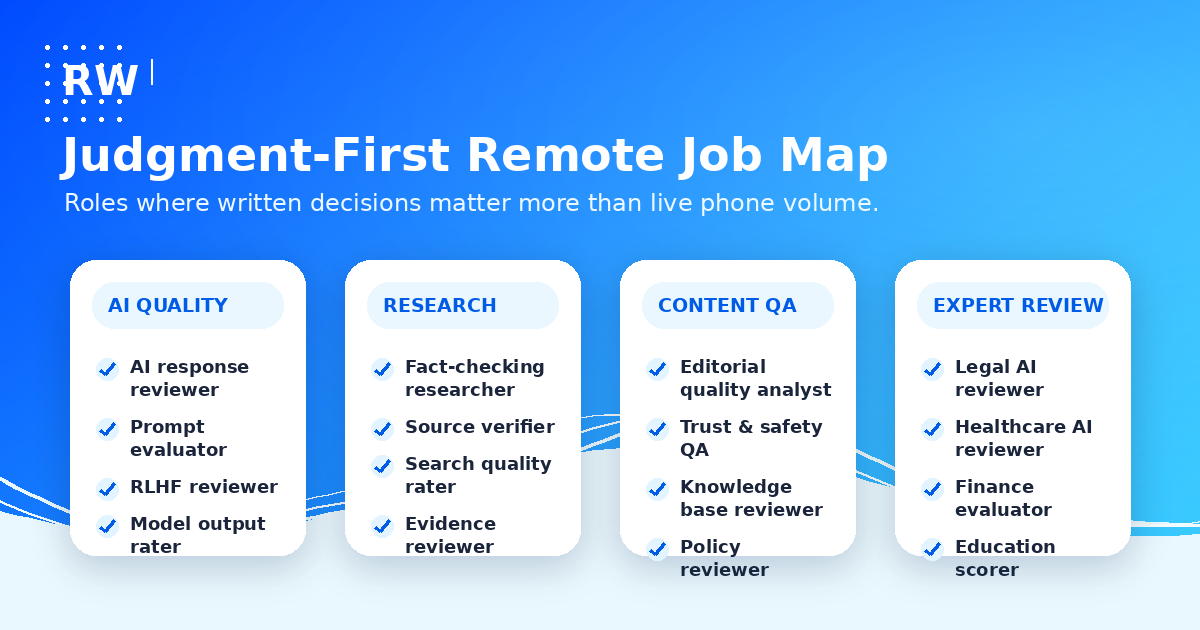
The best remote jobs that pay for judgment instead of phone calls are roles where your value comes from evaluating information, comparing options, spotting mistakes, and explaining your decision clearly. These jobs can include AI response reviewer, AI evaluator, prompt evaluator, data annotation quality reviewer, search quality rater, fact-checking researcher, content quality analyst, online assessment scorer, trust and safety QA analyst, and subject-matter expert reviewer.
These roles are especially attractive for people who want work-from-home jobs with no phone calls, no sales scripts, no customer support queue, and no live call-center schedule. Instead of being paid to talk continuously, you are paid to read, assess, score, label, research, and write concise explanations. In 2026 and beyond, this kind of work matters because AI systems, search products, recommendation engines, learning tools, and business software still need human judgment to evaluate quality.
Why Judgment Work Is Different From Phone Work
Many remote jobs are technically work from home, but they still revolve around calls. Customer support, appointment setting, telemarketing, insurance intake, sales development, and virtual receptionist jobs can all be remote, but the daily experience is often a headset, a queue, a script, and performance metrics built around talk time.
Judgment-based remote work is different. The central question is not how many calls you can answer. It is whether you can make reliable decisions when the answer is not obvious. You may compare two AI-generated responses, decide whether a source supports a claim, judge whether a search result satisfies the user intent, review whether a piece of content follows policy, or score an answer against a detailed rubric.
This is why remote AI training jobs, AI model evaluation jobs, AI rater jobs, prompt evaluation jobs, data annotation jobs, and fact-checking jobs are showing up in more job searches. They fit people who are careful readers, strong writers, patient reviewers, and good explainers.
What Employers Mean by Judgment
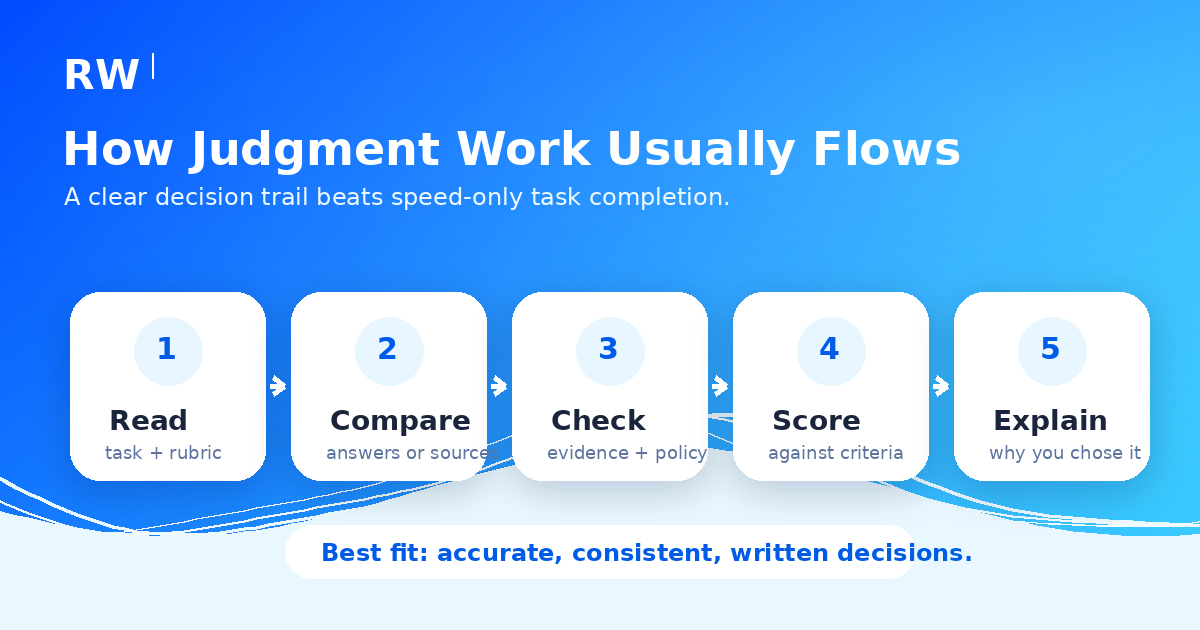
Judgment does not mean guessing. It means applying a standard consistently. In remote review work, judgment usually combines five things: understanding the task, reading the instructions, identifying the relevant evidence, comparing options, and explaining the final decision.
A strong reviewer can say more than "A is better than B." They can explain why A is more accurate, more complete, safer, more helpful, better supported, more concise, or more aligned with the user intent. A strong reviewer also knows when an answer sounds confident but is unsupported. That matters in AI evaluation, search quality rating, data annotation quality control, editorial QA, and expert review projects.
The best remote jobs that pay for judgment tend to reward consistency. If two similar tasks appear on different days, the platform or employer wants you to evaluate them the same way. That is why rubrics, examples, calibration tests, gold-standard tasks, quality scores, and reviewer notes are common in this category.
10 Remote Jobs That Pay for Judgment
1. AI Response Reviewer
AI response reviewer jobs are among the clearest examples of judgment-based remote work. In this role, you may read a user prompt and compare one or more AI answers. Your job is to judge which response is better and explain why. The work can involve accuracy, helpfulness, tone, safety, formatting, completeness, refusal quality, instruction-following, and clarity.
Search terms to use include AI response reviewer jobs, AI rater jobs, AI evaluator remote, AI model evaluator, chatbot evaluator, human feedback AI jobs, and RLHF jobs. Many roles support AI evaluation without being direct employment at a major AI company. You may see keywords around ChatGPT, Claude, Gemini, Grok, Copilot, Meta AI, Perplexity, OpenAI, Anthropic, Google, Microsoft, and xAI, but always read the actual posting carefully.
2. Prompt Evaluator
Prompt evaluator jobs focus on whether a prompt and response pair produced a useful result. You may test prompts, compare outputs, identify failure cases, rewrite prompts, or rate how well a model followed detailed instructions. A prompt evaluator may judge whether the model followed constraints, avoided unsupported claims, used the requested format, answered the actual question, or handled ambiguity properly.
Search for prompt evaluation jobs, prompt evaluator remote, AI prompt reviewer, AI training jobs from home, and AI quality evaluator.
3. Data Annotation Quality Reviewer
Data annotation jobs from home often involve labeling text, images, audio, documents, or search results. The judgment-focused version is quality review. Instead of only labeling new examples, you may inspect other labels, catch inconsistencies, compare edge cases, and decide whether annotations follow the guidelines.
This work can be quieter than customer service because it is usually task-based and asynchronous. Useful searches include data annotation quality reviewer, data annotation QA remote, AI data annotation jobs, labeling quality analyst, machine learning data reviewer, and dataset quality analyst.
4. Search Quality Rater
Search quality rater jobs ask humans to evaluate whether search results, web pages, snippets, answers, or recommendations satisfy a query. A search quality rater may judge whether a result is relevant, trustworthy, fresh enough, complete, spammy, misleading, or useful. You may also review whether an AI-generated answer properly reflects the sources behind it.
Search for search quality rater jobs, internet rater jobs, web search evaluator, search evaluator remote, AI search evaluator, and online rater jobs.
5. Fact-Checking Researcher
Fact-checking researcher jobs pay for careful verification. You may review claims, find sources, compare dates, identify unsupported statements, check quotes, or verify whether a document accurately represents a source. This work can appear in media, education, marketing, AI evaluation, policy, finance, legal support, and research operations.
Search for fact-checking jobs remote, remote researcher jobs, source verification jobs, claims reviewer, AI fact checker, research analyst remote, and content accuracy reviewer.
Looking for judgment-based remote work? RemoteWorkUnion.com lists roles hiring now.
Find Roles Hiring Now →6. Content Quality Analyst
Content quality analyst roles involve reviewing written content, web pages, knowledge base articles, product copy, AI outputs, or user-generated material against standards. You may check clarity, policy compliance, usefulness, accuracy, tone, formatting, or brand fit.
Search for content quality analyst remote, content reviewer remote, editorial QA analyst, content operations analyst, policy quality analyst, and knowledge base reviewer.
7. Online Assessment Scorer
Online assessment scorer jobs pay people to evaluate written answers, tests, essays, exams, educational responses, and training submissions. Some roles are seasonal or part-time. Others are tied to learning platforms, tutoring companies, certification programs, or internal training teams. This work rewards rubric discipline — you are judging whether the response meets defined criteria, not whether you personally like an answer.
Search for remote assessment scorer, online test scorer, essay scorer remote, educational evaluator, rubric scorer, and work from home scoring jobs.
8. Subject-Matter Expert Reviewer
Subject-matter expert review is one of the strongest judgment-based categories because domain knowledge matters. Lawyers, paralegals, nurses, doctors, medical writers, finance professionals, accountants, teachers, tutors, coders, scientists, engineers, and business analysts may qualify for specialized review projects.
In AI work, expert reviewers may evaluate whether a model answered a legal, medical, financial, coding, education, or technical question correctly. Search for expert AI reviewer, legal AI evaluator, medical AI reviewer, finance AI evaluator, coding evaluator remote, education AI reviewer, domain expert AI training, and subject matter expert remote contract.
9. Trust and Safety QA Analyst
Trust and safety QA roles involve reviewing whether content, accounts, messages, ads, or platform actions follow policy. The judgment component is real: you must apply policy consistently, understand edge cases, and document why a decision fits the rule.
The no-phone version of this category is usually written review, policy QA, appeal review, or audit work rather than live customer support. Search for trust and safety QA remote, policy reviewer remote, content policy analyst, moderation quality analyst, appeal reviewer remote, and platform integrity analyst. Note: some trust and safety jobs can involve difficult content — read the posting carefully before applying.
10. Product Feedback Tester
Some remote product testing jobs pay for structured feedback rather than live calls. You may test an app, workflow, website, AI assistant, browser feature, search experience, onboarding flow, or help center and then write notes about what worked, what failed, and where the experience was confusing.
The better fit for no-phone work is asynchronous product feedback, QA notes, usability review, bug reproduction, or written evaluation. Search for product feedback tester remote, usability reviewer, app tester remote, website QA tester, AI product tester, and written user testing jobs. Filter out anything requiring live moderated calls if your goal is no-phone work.
Skills That Help You Get These Jobs
The strongest applicants for judgment-based remote jobs usually show five skills.
Clear writing. Most of these roles require short explanations. You do not need to write like a novelist, but you need to explain decisions in plain language.
Rubric discipline. A rubric is not a suggestion. It is the scoring system. People who ignore instructions usually fail screening tests even if they are smart.
Comparison ability. Much AI evaluation work asks you to decide whether Response A or Response B is better. Good reviewers can identify the deciding factor.
Research habits. Fact-checking, search quality rating, and source review require evidence. You need to know when a source supports a claim and when it does not.
Consistency. Remote platforms often measure whether your decisions match expected standards. Changing your logic from task to task is a problem.
Search Terms to Use
Use search terms that match the actual work. Good searches include work from home jobs no phone calls, remote jobs no phone calls, AI evaluator jobs, AI rater jobs, AI response reviewer jobs, prompt evaluation jobs, data annotation jobs from home, RLHF jobs, human feedback jobs, fact-checking jobs remote, search quality rater jobs, content quality analyst remote, online assessment scorer, and expert AI reviewer.
Also search by skill and ecosystem. For example: ChatGPT evaluator, Claude AI evaluator, Gemini AI training jobs, Grok AI evaluator, Microsoft Copilot evaluator, OpenAI reviewer, Anthropic reviewer, Google AI rater, Meta AI evaluation, and Perplexity AI reviewer. These searches can help you understand the market, but always verify the actual employer, contractor, platform, pay structure, and task requirements.
How to Make Your Application Stronger
Do not apply like a generic customer support candidate if the job is asking for judgment. Instead, show proof that you can evaluate.
A strong resume bullet might say: "Evaluated AI-generated responses against detailed rubrics for accuracy, helpfulness, instruction-following, and clarity, with written rationales for each rating." Another strong bullet might say: "Reviewed source evidence, identified unsupported claims, and wrote concise quality notes for research and content tasks."
If you do not have direct AI evaluation experience, build a small portfolio. Compare two AI answers to the same prompt and explain which one is better. Fact-check a short paragraph and show the source trail. Rewrite a vague prompt into a clearer one and explain the improvement. Review a search result page and identify which results actually match the intent. These samples show the skill behind the job title.
Portfolio tip: Avoid overemphasizing speed. Speed matters, but accuracy matters more in judgment work. If your application only says you are fast, detail-oriented, and a quick learner, it will sound like every other application.
Red Flags to Avoid
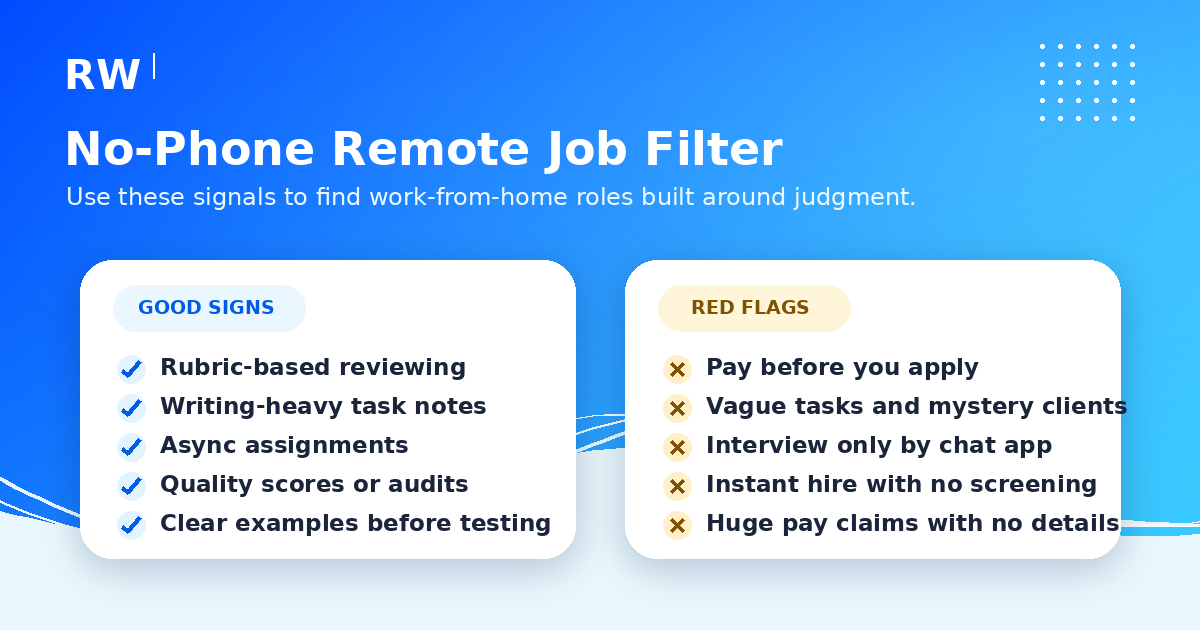
No-phone remote jobs attract scammers because many applicants want flexible work. Be careful with posts that promise unusually high pay with no screening, ask you to pay for access, move the entire process to a private chat app, hide the company name, avoid a written contract, or describe the job only as easy money.
Legitimate judgment-based work usually has some kind of screening. That may be a skills test, sample task, identity verification, tax form, platform onboarding, training module, or quality guidelines. A real job should also explain the task type, payment model, expectations, and review process.
Who This Work Is Best For
These jobs are best for people who like quiet work, written reasoning, independent tasks, research, editing, comparing options, and spotting small mistakes. They are also good for people who want remote part-time jobs from home, flexible AI work, side income, or a path away from phone-heavy customer service.
They are not ideal for people who hate reading instructions, dislike repetitive tasks, want every task to be creative, or struggle with written explanations. Judgment work can be flexible, but it is not mindless. The work pays for attention.
The best remote jobs that pay for judgment instead of phone calls are not always labeled that way. They may appear as AI evaluator jobs, AI rater jobs, AI response reviewer jobs, prompt evaluation jobs, data annotation QA roles, search quality rater jobs, fact-checking researcher jobs, content quality analyst roles, online assessment scoring jobs, or expert AI reviewer projects. The common thread is simple: you are paid to make careful decisions and explain them.