Legal professionals are well positioned for a specific corner of remote AI work: tasks that require careful reading, structured judgment, document analysis, source checking, and clear written reasoning. The strongest opportunities are not usually traditional law firm jobs. They are AI evaluation, legal review, policy review, compliance review, contract analysis, and research tasks where human expertise helps improve the quality of AI systems. These expert-tier legal AI roles commonly pay $50–$200/hr, depending on your specialization and the complexity of the review.
For lawyers, paralegals, compliance specialists, legal researchers, law students, and legal operations professionals, this can be a practical way to move into remote AI jobs without becoming a software engineer. The work rewards the same habits that legal work already builds: precision, patience, risk awareness, citation discipline, and the ability to explain why one answer is better than another.
Why Legal Professionals Are a Strong Fit for Remote AI Jobs
AI systems are used to draft, summarize, classify, compare, answer questions, extract facts, and reason through complicated instructions. That creates a need for reviewers who can tell whether an answer is accurate, complete, safe, consistent, and useful. Legal professionals already practice those skills in high-friction environments where small wording differences matter.
A legal background can help with remote AI work because many projects require reviewers to read closely, apply written criteria, identify missing context, compare competing outputs, flag unsupported claims, and explain errors in plain language. These tasks are close cousins of legal research, document review, memo writing, contract comparison, compliance analysis, and issue spotting.
Best Remote AI Job Types for Legal Professionals
The best role depends on your background. A licensed attorney may fit expert legal evaluation, policy review, or complex reasoning tasks. A paralegal may fit contract review, document classification, legal research support, and workflow-heavy annotation. A legal researcher may fit source verification, citation review, fact-checking, and long-form response evaluation.
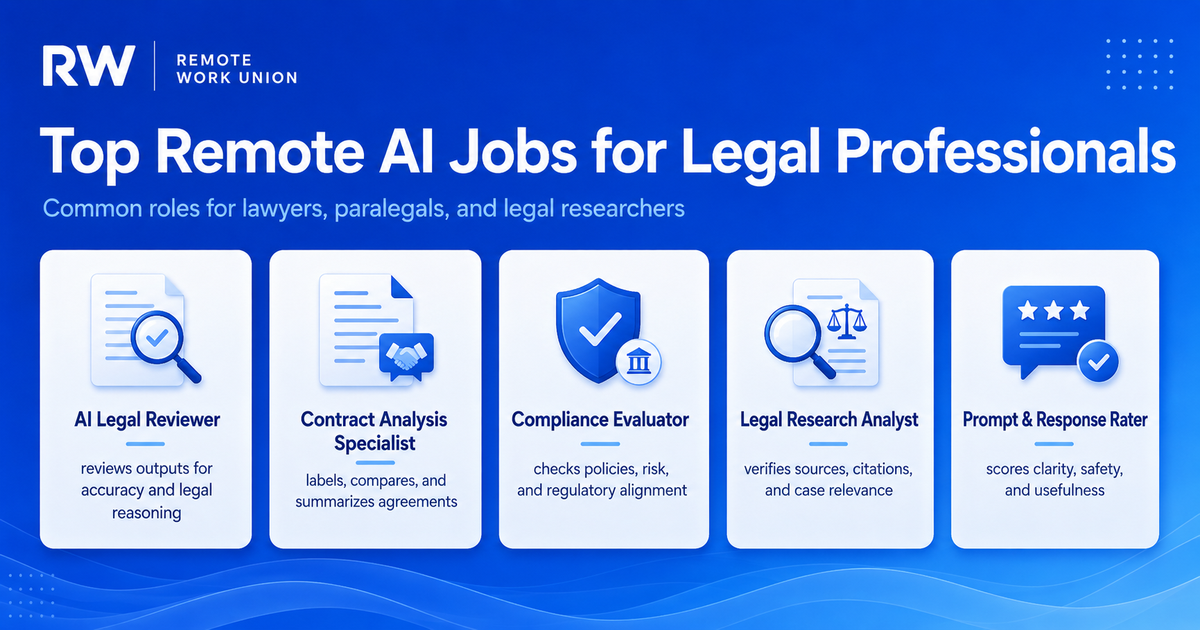
1. AI Legal Reviewer
An AI legal reviewer evaluates model outputs that involve legal concepts, legal process, compliance language, or professional reasoning. The work may involve comparing two answers, rating one answer against a rubric, checking whether an answer overstates certainty, or identifying where a response needs stronger caveats.
This role is a natural fit for lawyers and experienced legal researchers because it requires judgment. The goal is usually not to provide legal advice to a client. The goal is to evaluate whether an AI-generated response is clear, accurate, properly limited, and aligned with the instructions.
2. Contract Analysis Specialist
Contract analysis projects often involve labeling clauses, comparing terms, summarizing agreements, identifying missing provisions, extracting dates or obligations, or checking whether a summary matches the source document. AI companies and AI workflow teams need humans who can help train, test, and evaluate tools that read complex documents.
This is especially relevant for paralegals, contract managers, legal operations professionals, and attorneys with transactional experience. Strong applicants can show that they understand clause structure, defined terms, obligations, exceptions, renewal language, indemnity, confidentiality, termination, payment provisions, and risk allocation.
3. Legal Research Analyst
Legal research analyst work in AI can include checking whether a response cites the right source, whether a summary matches the underlying document, whether a statement is supported, or whether the AI missed an important distinction. Some projects may involve public sources, legal explainers, policy documents, statutes, regulations, or general research.
This role is a strong match for people who enjoy source verification, citation checking, and careful comparison. It is also one of the better paths for legal researchers who want remote work but do not want to spend all day on phone calls or administrative support.
4. Compliance Evaluator
Compliance evaluator roles focus on whether outputs follow rules, policies, safety standards, or internal guidelines. The work can include reviewing AI answers for risk, checking whether content follows a written policy, identifying missing disclaimers, or scoring whether a response should be revised.
This can fit lawyers, compliance analysts, risk specialists, privacy professionals, and legal operations workers. The most valuable skill is not memorizing every rule — it is the ability to read a standard, apply it consistently, and explain why an output passes or fails.
5. Prompt and Response Rater
Prompt and response rater jobs are broader AI evaluation roles. Reviewers may compare two chatbot answers, label mistakes, judge helpfulness, identify hallucinations, score reasoning quality, or rewrite a response to make it more accurate. These jobs may appear under names such as AI rater, AI response reviewer, prompt evaluator, AI model evaluator, human feedback reviewer, or RLHF contractor.
Legal professionals can stand out in these roles because they are trained to justify conclusions. A strong reviewer does not simply say an answer is bad — they explain what is missing, what is unsupported, what assumption is risky, and what a better answer would do.
Legal professional ready for remote AI work? RemoteWorkUnion.com lists roles hiring now.
Find Roles Hiring Now →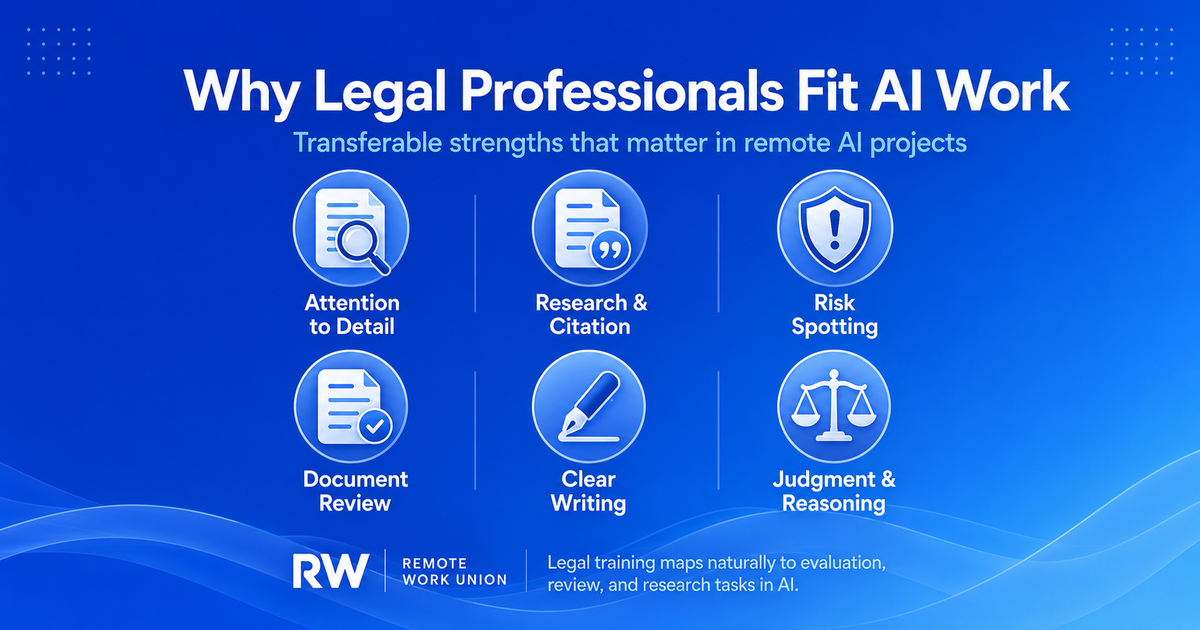
Skills to Emphasize With a Legal Background
Most applicants describe their legal background too narrowly. For AI work, translate that experience into AI-relevant language:
Rubric-based review: applying written criteria consistently across many examples. Source verification: checking whether an answer is supported by the underlying material. Issue spotting: noticing missing context, hidden assumptions, and risk-heavy wording. Document comparison: identifying differences between versions, clauses, summaries, and obligations. Clear written feedback: explaining errors concisely and recommending better output. Confidentiality and discretion: handling sensitive materials carefully and following instructions.
Strong resume keywords include: evaluation, annotation, A/B comparison, response rating, rubric scoring, legal research, source checking, fact-checking, contract review, compliance review, policy review, document analysis, quality assurance, and expert feedback.
How to Build Proof Before Applying
Remote AI applications are easier when you can show proof of judgment. You do not need to publish client work or reveal confidential information. Instead, create clean, general samples that show how you think:
- A one-page sample comparing two AI-generated legal explainers and explaining which one is safer and clearer.
- A contract summary sample using a public template or fictional agreement.
- A compliance policy review sample that flags ambiguous, unsupported, or risky language.
- A source verification sample that shows claims, sources, and whether each claim is supported.
- A short writing sample that turns dense legal language into plain English without changing meaning.
The purpose of these samples is not to offer legal advice. The purpose is to demonstrate reading comprehension, accuracy, judgment, and structured feedback.
How Lawyers, Paralegals, and Researchers Should Position Themselves
Lawyers should lead with expert judgment, domain knowledge, research discipline, and risk awareness. A strong positioning line could be: "Attorney with experience in legal research, document review, contract analysis, and rubric-based evaluation, seeking remote AI projects involving legal reasoning, policy review, and response quality assessment."
Paralegals often have exactly the operational skills AI teams need: document handling, detail review, organized research, formatting consistency, and procedure-following. A strong line: "Paralegal with experience in legal research, document review, citation checking, and structured case support, seeking remote AI evaluation and annotation projects involving accuracy review, source verification, and legal document analysis."
Legal researchers should emphasize source quality, citation discipline, search strategy, and the ability to separate supported claims from unsupported claims. A strong line: "Legal researcher skilled in source verification, citation review, factual analysis, and clear written summaries, seeking remote AI research and response evaluation projects."
Search Terms to Use
Use several keyword clusters instead of relying on one job title:
- Remote AI jobs for lawyers / AI legal reviewer jobs / AI legal evaluator jobs
- Legal AI trainer jobs / Legal research AI jobs / AI jobs for paralegals
- Contract annotation jobs / Contract analysis AI jobs / Compliance AI evaluator jobs
- Policy reviewer AI jobs / AI response reviewer jobs / Prompt evaluation jobs
- RLHF jobs for legal experts / Human feedback jobs in AI / Remote legal research jobs AI
What to Watch Out For
Remote AI work can be flexible, but it is not magic money. Good projects usually require tests, written evaluations, accuracy, and consistency. Some opportunities are short-term, project-based, or part-time. Treat the application process like professional work, not a casual gig signup.
Also be careful with confidentiality. Do not upload client documents into public tools, do not reuse privileged material as samples, and do not describe matters in ways that reveal sensitive information. Use fictional documents, public templates, or generalized examples when building a portfolio.
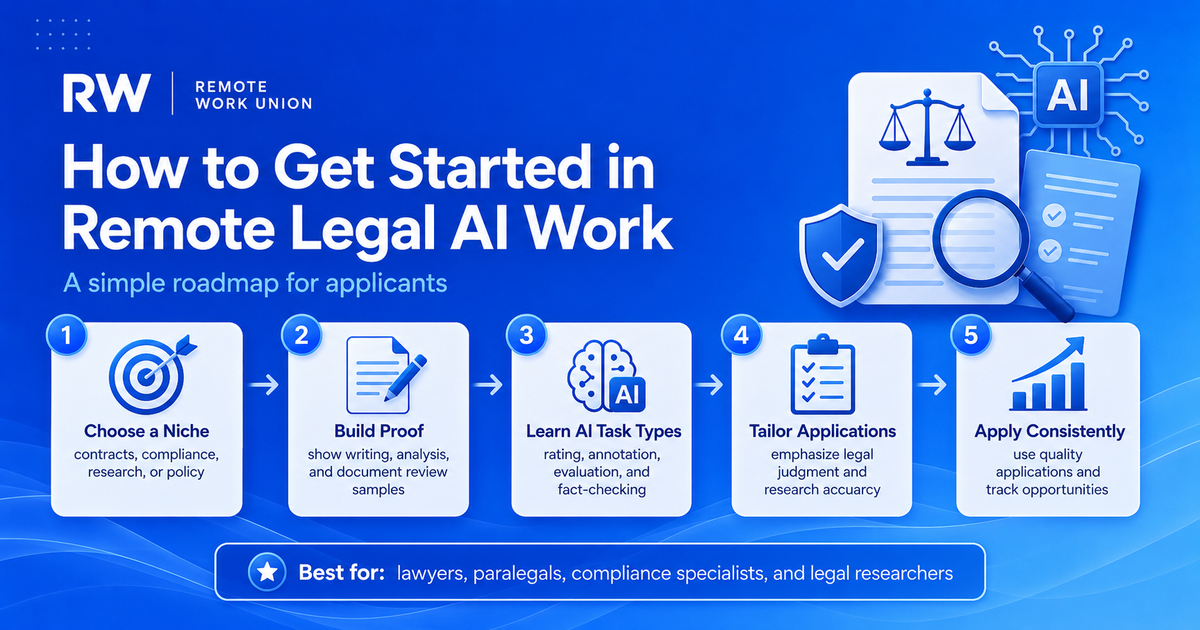
A Practical Application Checklist
- Pick a niche: contracts, compliance, policy, research, litigation support, privacy, or general legal reasoning.
- Create one or two non-confidential work samples that show evaluation, comparison, and explanation.
- Update your resume with AI-relevant keywords: rubric review, annotation, response rating, source verification, A/B comparison, and quality evaluation.
- Use multiple job title searches because platforms describe the same work differently.
- Apply consistently and track where you applied, what test you took, and what keywords worked.
- Keep your profile focused on accuracy, judgment, research, writing, and document review.
Bottom line: AI legal reviewer, contract analysis specialist, compliance evaluator, legal research analyst, and prompt and response rater roles all rely on the same core strengths: careful reading, precise judgment, clear writing, and disciplined review. Legal professionals who translate their experience into AI evaluation language can compete for remote jobs that value expertise, accuracy, and human feedback.