Prompt writing has become one of the most practical entry points into remote AI work for people who are strong writers, editors, researchers, teachers, marketers, analysts, or subject matter experts. You do not need to be a software engineer to do many AI training jobs. You do need to be clear, precise, skeptical, and able to explain why one AI response is better than another.
That is the difference between casual prompt writing and paid remote AI work. A prompt writer is not only someone who types a clever instruction into ChatGPT. In a real AI training workflow, prompt writing can include testing instructions, comparing model outputs, checking factual accuracy, writing rubrics, finding edge cases, improving task wording, and reviewing conversations for quality. Those skills are useful to AI companies, AI labs, data vendors, and remote work platforms because better prompts and better evaluations help models improve.
This guide breaks down the best remote AI jobs you can do as a prompt writer without coding, what each role actually involves, which skills matter most, and how to present yourself so platforms like Handshake AI, Mercor, micro1, Outlier, DataAnnotation, and other AI work marketplaces can understand your fit.
What prompt writers actually do in remote AI jobs
Most people hear "prompt writer" and think the job is simply writing instructions for an AI model. That can be part of the work, but the better remote AI jobs usually involve evaluation. AI companies need people who can test whether a model follows instructions, produces accurate information, avoids unsupported claims, and gives an answer that is useful to a real user.
A prompt writer might write a task such as: "Explain this legal clause to a small business owner in plain English." The work does not stop there. The evaluator may then compare two AI answers, identify which answer is more accurate, decide whether either answer missed the user intent, and explain the ranking in a few clear sentences. That explanation is often the most valuable part of the task because it turns human judgment into training data.
The strongest prompt writers are not just creative. They are controlled. They know how to define the task, limit ambiguity, specify format, include constraints, and notice when an AI model sounds confident but is wrong. That is why prompt writing overlaps with editing, research, teaching, policy review, product testing, customer support, and quality assurance.
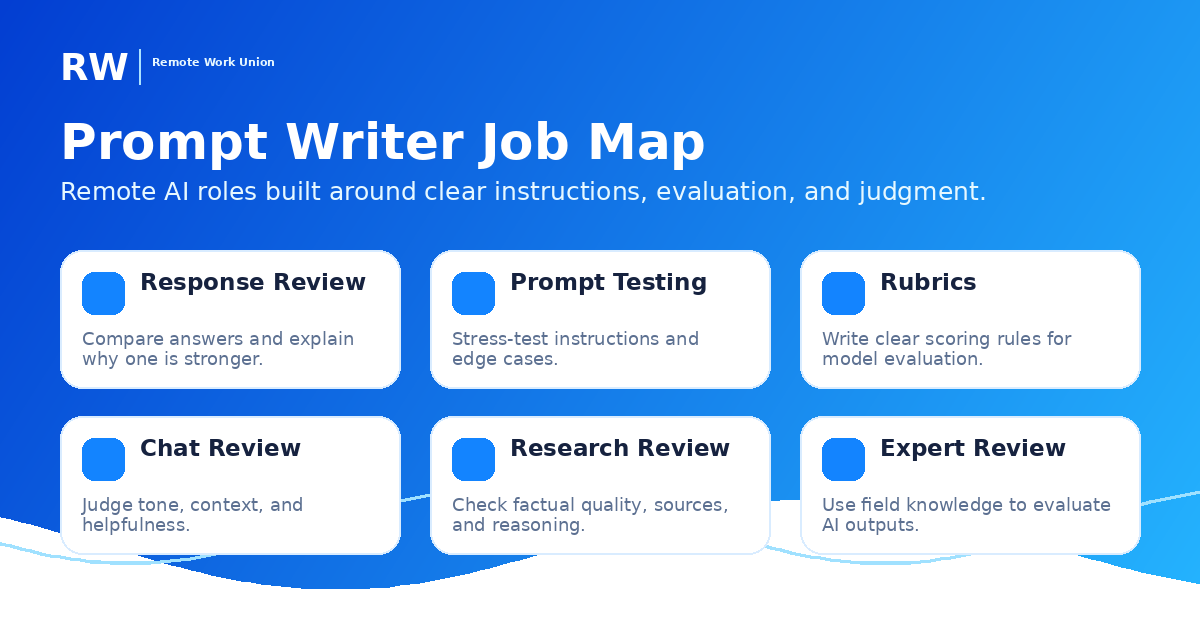
The best remote AI jobs for prompt writers without coding
These roles use prompt writing, reasoning, and communication skills. Some are beginner-friendly. Others pay more because they require expertise, careful judgment, or specialized knowledge. The exact title can vary by platform, but the work usually falls into the categories below.
1. AI response evaluator
An AI response evaluator reviews model outputs and decides which response is better. You may compare two answers side by side, rate an answer against a rubric, or explain whether the response follows the prompt. This is one of the clearest remote AI jobs for prompt writers because the work depends on understanding both the instruction and the answer.
What you do: read the prompt, evaluate the response, identify accuracy issues, judge clarity, check tone, and write a short explanation. You may be asked to rate helpfulness, safety, factuality, completeness, or instruction-following.
Why it fits prompt writers: good prompt writers understand what the prompt is asking for. They can tell when an answer is vague, incomplete, too broad, too confident, or not aligned with the user intent.
Best for: writers, editors, teachers, customer support professionals, researchers, marketers, and anyone who can explain judgment clearly.
2. Prompt tester
A prompt tester writes prompts designed to expose model weaknesses. This can include confusing instructions, multi-step requests, edge cases, tone changes, formatting constraints, or questions where the model must be careful. The goal is not to trick the AI randomly. The goal is to test whether the model can follow a realistic user request under pressure.
What you do: create prompts, test model responses, look for failures, and document what happened. You may test whether the model follows a format, avoids hallucinations, handles ambiguity, or responds appropriately to sensitive topics.
Why it fits prompt writers: strong prompt testers know how to write instructions that are clear enough to evaluate but difficult enough to reveal weaknesses.
Best for: people who enjoy product testing, quality assurance, editing, research, or finding mistakes fast.
3. AI writing evaluator
AI writing evaluators focus on prose quality. They review whether an AI-written answer is coherent, natural, persuasive, concise, or appropriate for the audience. This role can overlap with copywriting, content editing, creative writing, journalism, education, and communications.
What you do: judge writing quality, compare drafts, evaluate tone, suggest better wording, and identify generic or robotic language. In some projects, you may rewrite a weak response so the model has a better example to learn from.
Why it fits prompt writers: prompt writers already think about audience, purpose, format, and tone. Those are the same factors that make an AI answer useful or unusable.
Best for: copywriters, content writers, editors, authors, social media managers, PR professionals, and people with strong language instincts.
4. Rubric writer or task designer
Rubric writing is one of the more valuable no-code AI roles because it shapes how other workers evaluate outputs. A rubric tells reviewers what counts as a strong answer, what counts as a weak answer, and how to score the difference. A vague rubric creates bad data. A clear rubric creates consistent human judgment.
What you do: define task requirements, write rating criteria, create examples, explain failure cases, and make sure a reviewer can apply the standards consistently.
Why it fits prompt writers: a good prompt writer can turn a messy goal into clear instructions. A good rubric writer does the same thing for evaluation.
Best for: teachers, trainers, editors, managers, consultants, policy writers, and people who can create clear standards.
5. Conversation evaluator
Conversation evaluation focuses on chat quality across multiple turns. Instead of judging one answer in isolation, you look at the full interaction. Did the AI understand the user? Did it remember the relevant context? Did it answer the actual question? Did it ask a needed follow-up? Did it become repetitive or unhelpful?
What you do: review chat transcripts, score response quality, flag issues, and explain whether the assistant handled the conversation well.
Why it fits prompt writers: prompt writers understand how context changes across a conversation. They can tell when an answer looks good alone but fails in the full thread.
Best for: customer success professionals, support reps, coaches, teachers, sales reps, and anyone who understands how conversations work.
6. AI research evaluator
AI research evaluators review whether model answers are accurate, well-supported, and logically sound. These roles are especially useful for people who are good at online research, fact-checking, source review, and explaining uncertainty. You may evaluate search-based answers, summaries, or responses that make factual claims.
What you do: check facts, compare sources, identify unsupported claims, rate source quality, and explain where the AI answer went wrong.
Why it fits prompt writers: strong prompts often require context, source awareness, and precise constraints. Strong research evaluation uses those same habits.
Best for: researchers, journalists, analysts, students, librarians, legal assistants, consultants, and detail-oriented generalists.
7. Domain expert AI reviewer
Domain expert reviewing is where prompt writing can become more valuable. Some AI projects need reviewers with expertise in law, medicine, finance, accounting, engineering, science, education, coding, marketing, sales, operations, or other fields. You still may not need to code, but you do need to use your professional judgment.
What you do: review prompts and responses in your field, identify incorrect reasoning, write better examples, and explain what a skilled professional would expect.
Why it fits prompt writers: expert reviewers can write realistic prompts that only someone with domain knowledge would know how to evaluate.
Best for: professionals with a clear background, certification, degree, portfolio, or work history in a specific field.
8. Safety, policy, and content quality evaluator
Some remote AI work focuses on whether a model response follows safety, policy, or quality guidelines. This does not always mean reviewing extreme content. It can also mean checking whether an answer is appropriate, avoids harmful advice, respects user intent, and handles sensitive topics carefully.
What you do: apply written guidelines, classify responses, identify policy issues, and explain whether the model response should be accepted, revised, or rejected.
Why it fits prompt writers: policy evaluation rewards careful reading and consistent standards. The work is closer to editing and compliance than coding.
Best for: detail-oriented applicants, moderators, compliance workers, editors, support professionals, and people comfortable following rules precisely.
9. Localization and multilingual prompt reviewer
If you are fluent in more than one language, multilingual AI evaluation can be a strong no-code remote option. AI systems need prompts and responses reviewed across languages, dialects, cultural contexts, and regional expectations. Translation alone is not enough. The work often requires judging whether the answer feels natural and whether it matches the user intent in that language.
What you do: write prompts in another language, evaluate translated responses, identify unnatural phrasing, check cultural fit, and compare local context.
Why it fits prompt writers: multilingual prompt writing requires precision, tone control, and cultural judgment.
Best for: translators, bilingual professionals, language teachers, international applicants, and people with strong written fluency.
10. AI content editor
An AI content editor reviews AI-generated drafts and improves them. This can include rewriting introductions, removing fluff, improving structure, correcting factual issues, and making the final output sound more useful to the reader. This role sits between prompt writing, editing, and content strategy.
What you do: edit AI drafts, write better prompts for revisions, identify gaps, improve clarity, and make content more human.
Why it fits prompt writers: the best prompt writers can diagnose why an AI answer is weak and then give the model a better instruction.
Best for: editors, content writers, SEO writers, marketers, educators, and people who understand content quality.
Which prompt writing roles are easiest to start with?
The easiest roles are usually AI response evaluation, prompt testing, content review, and conversation evaluation. These roles require strong reading and writing, but they do not always require a rare credential. They are a good fit if you can compare answers, explain why one is stronger, and follow instructions closely.
The harder but often more valuable roles are rubric writing, domain expert reviewing, research evaluation, and specialized writing evaluation. These jobs can be more selective because the platform needs proof that you have expertise or unusually strong judgment.
A beginner should not try to look like a senior prompt engineer. A better approach is to look like a reliable evaluator. Show that you can read carefully, write clearly, follow a rubric, explain your reasoning, and produce consistent work.
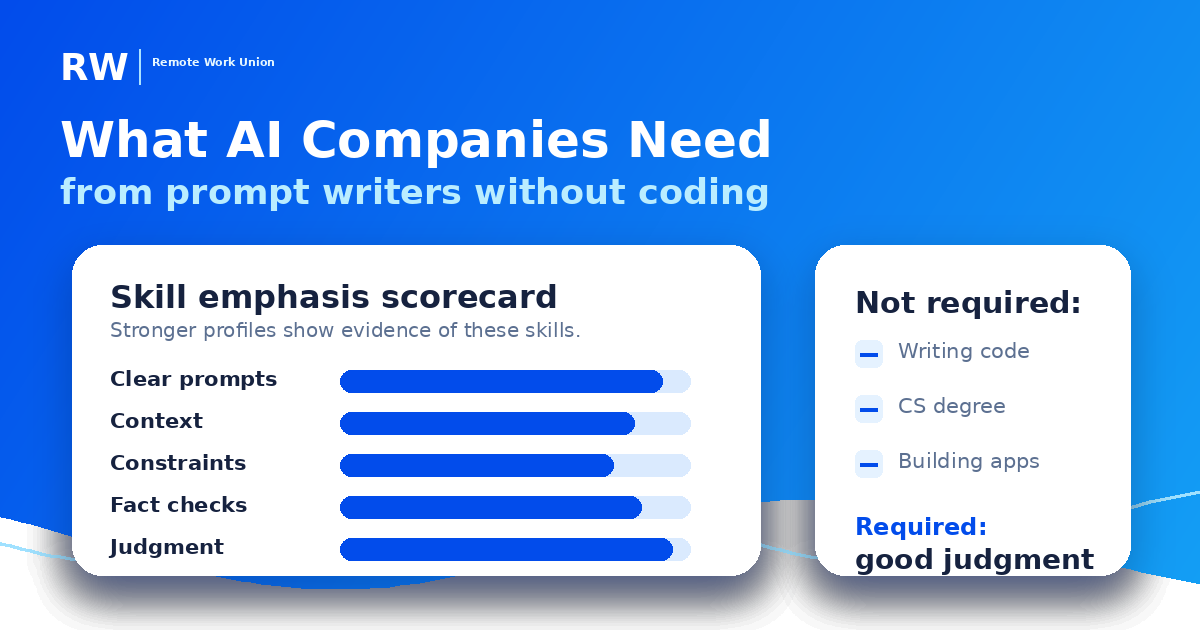
Skills that matter more than coding
For no-code remote AI jobs, the platform is usually not asking you to build software. It is asking whether your judgment can improve training data. These skills matter most:
- Clear writing — you can write prompts, explanations, and feedback that are easy to understand.
- Instruction-following — you can apply project rules exactly, even when they are detailed.
- Critical thinking — you can tell when an answer sounds good but does not actually solve the request.
- Fact-checking — you notice unsupported claims, outdated information, weak sources, and hallucinations.
- Audience awareness — you can judge whether an answer fits the reader, context, and tone.
- Structured reasoning — you can explain why you made a rating instead of relying on a vague feeling.
- Domain knowledge — you can use your real background in finance, law, health, education, coding, business, marketing, or another field.
Coding can help in some AI roles, but it is not the only valuable skill. AI companies also need people who understand language, human intent, quality, trust, safety, research, and expert reasoning.
Writers, editors, researchers, teachers, and domain experts are strong candidates for no-code remote AI jobs. Find prompt writer and evaluator roles hiring now.
Find Roles Hiring Now →How to make your profile look like a prompt writer profile
Most applicants make their profile too generic. They say they are interested in AI, remote work, or flexible jobs. That is not enough. A stronger profile tells the platform exactly what kind of AI work you can do.
Use phrases that match the work: prompt writing, AI response evaluation, model evaluation, rubric writing, content quality review, research review, AI writing evaluation, instruction-following, fact-checking, and conversational AI. These are the terms that connect your background to remote AI jobs.
Then add proof. If you are a writer, mention editing, content strategy, SEO, copywriting, or creative writing. If you are a teacher, mention grading, rubrics, feedback, lesson design, and explanation. If you are in customer support, mention conversation quality, user intent, tone, and escalation. If you are in finance, legal, healthcare, science, or engineering, mention the exact area where your judgment is strongest.
A simple profile formula
Use this structure when applying to remote AI platforms:
- Start with your strongest relevant background: writing, research, editing, teaching, support, analysis, or domain expertise.
- Connect it to AI work: prompt writing, response evaluation, model testing, or rubric-based review.
- Add proof: years of experience, portfolio, degree, certification, published work, professional role, or measurable output.
- State your task fit: evaluation, writing, research, conversation review, domain expert review, or content editing.
Prompt writing samples you can create without coding
A strong application can include short examples that prove you understand the work. You do not need to build an app or write code. You can create a small prompt writing sample that shows how you think.
Sample 1: Compare two answers
Write a prompt, create or collect two sample AI-style answers, and explain which answer is better. Focus on clarity, accuracy, completeness, and tone. The explanation matters more than the prompt itself.
Sample 2: Rewrite a weak prompt
Take a vague prompt and improve it. Add context, constraints, format, audience, and success criteria. This shows you understand how prompt quality changes output quality.
Sample 3: Build a mini rubric
Create a five-point rubric for evaluating an AI response. Include categories such as instruction-following, factual accuracy, completeness, clarity, and safety. This is especially useful if you want rubric writer or task designer work.
Sample 4: Show domain expertise
If you have a professional background, write a realistic prompt from that field and explain what a correct answer must include. For example, a finance prompt could test whether a model understands cash flow, risk, or debt. A legal prompt could test whether a model avoids giving unsupported legal advice. A marketing prompt could test whether a model understands audience, positioning, and conversion intent.
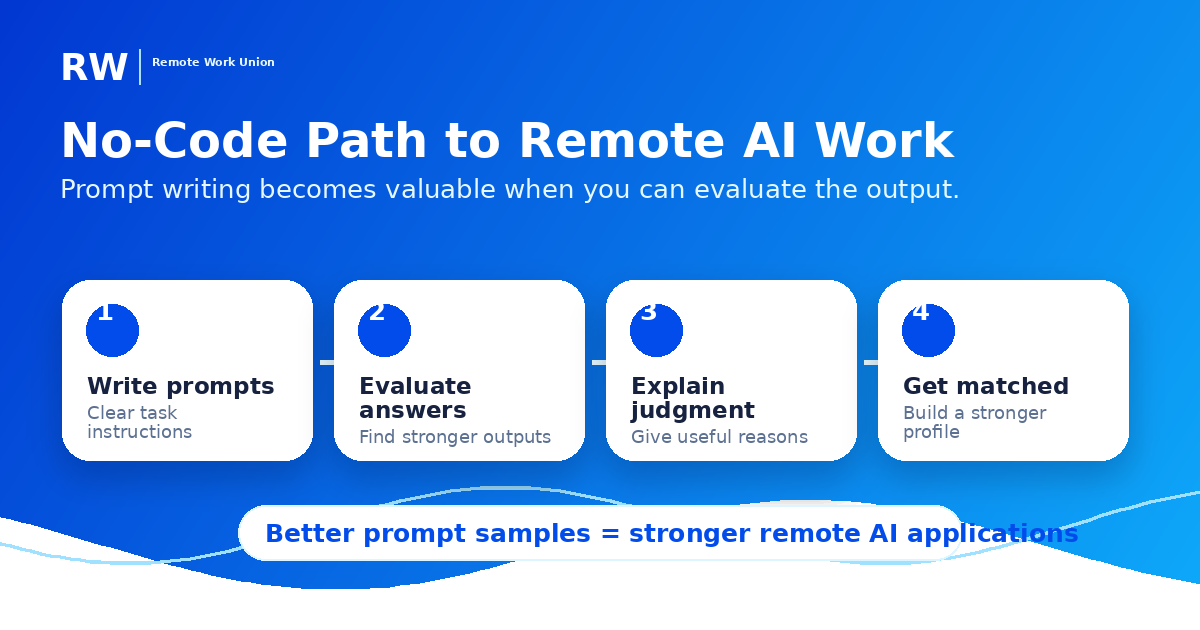
Where to apply for prompt writer AI jobs
Prompt writer roles can appear under many titles, so do not search only for "prompt writer." Search for remote AI jobs, AI training jobs, AI evaluator, AI response reviewer, AI writing evaluator, model evaluator, prompt evaluator, task writer, rubric writer, AI content editor, and data annotation roles.
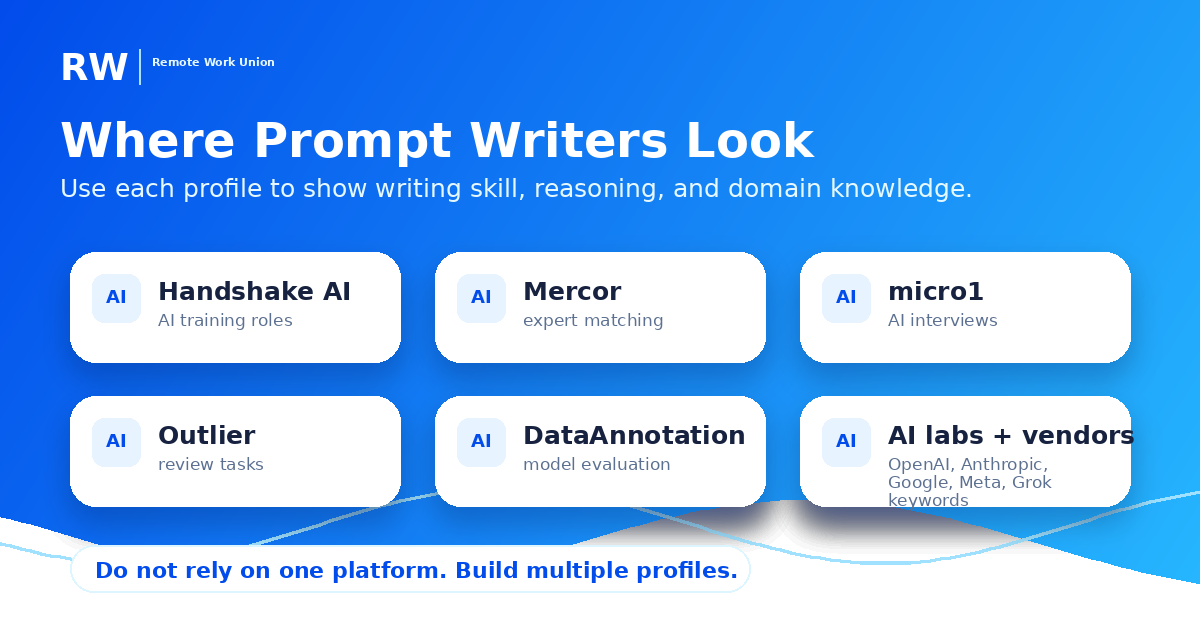
Remote AI platforms and marketplaces to research include Handshake AI, Mercor, micro1, Outlier, DataAnnotation, and similar AI training platforms. You can also search for vendor roles connected to major AI companies such as OpenAI, Anthropic, Google, Meta, xAI, and Grok-related projects. Many applicants never find these roles because they search for traditional job titles instead of AI training and evaluation keywords.
The best strategy is to build multiple profiles instead of depending on one platform. One platform may have no projects this week while another has active writing, research, or evaluation work. Remote AI work can be inconsistent, so your goal is to create more chances to be matched.
Mistakes that make prompt writer applications weaker
The biggest mistake is making the work sound too easy. Saying "I use ChatGPT a lot" does not prove that you can do AI evaluation. Platforms need people who can follow rules, write clean explanations, and apply judgment consistently.
- Do not describe yourself only as an AI enthusiast. Describe the specific work you can do.
- Do not claim expert status in a field where you have no proof. Apply as a generalist when needed, but be honest.
- Do not submit messy writing. Your application is a writing sample.
- Do not ignore instructions. AI training tasks often test whether you can follow detailed guidelines.
- Do not depend on one platform. Build a broader remote AI application pipeline.
- Do not confuse prompt writing with prompt engineering. Many no-code roles are evaluation and review jobs, not technical engineering jobs.
Who is a strong fit for no-code prompt writing jobs?
You may be a strong fit if you are the kind of person who notices when an answer is almost right but not quite. These jobs are good for people who like reading, writing, editing, teaching, research, analysis, and structured feedback. They are also good for professionals who want to turn existing expertise into remote work without switching into software engineering.
Writers can evaluate style and clarity. Teachers can write rubrics and feedback. Researchers can check claims. Customer support professionals can review conversation quality. Marketers can judge audience fit. Lawyers, finance professionals, healthcare workers, engineers, and other experts can evaluate domain-specific answers. The common thread is judgment.
How to start this week
Start by choosing one role category: AI response evaluator, prompt tester, AI writing evaluator, research evaluator, or domain expert reviewer. Then update your profile around that category. Add keywords, write a short positioning statement, and create one sample that proves your fit.
Next, apply across several legitimate AI training platforms. Look for roles that mention prompt writing, AI evaluation, model evaluation, writing review, rubric writing, content quality, data annotation, or expert review. Keep your application simple and specific. The goal is not to sound technical. The goal is to sound useful, reliable, and easy to match to the right remote AI tasks.
Prompt writing without coding is not a shortcut around skill. It is a way to use a different skill set. If you can write clearly, think carefully, evaluate quality, and explain your reasoning, remote AI work may be one of the best ways to turn those abilities into online income.
Frequently Asked Questions
Do prompt writer AI jobs require coding?
No. Most remote AI jobs for prompt writers are built around writing, judgment, and evaluation — not coding. Platforms need people who can read a prompt, compare two AI answers, spot weak responses, write rubrics, and explain ratings. A CS degree is not required for these roles.
What is the difference between prompt writing and prompt engineering?
Prompt engineering typically refers to building technical systems and optimizing AI model behavior through code or APIs. Prompt writing for remote AI work usually means creating clear task instructions, testing AI responses, evaluating quality, and writing rubrics — all of which can be done without coding.
Which remote AI jobs are easiest to start with as a prompt writer?
AI response evaluation, prompt testing, content review, and conversation evaluation are the most accessible starting points. These roles require strong reading and writing but not specialized credentials. The goal is to show you can follow instructions, compare outputs, and explain your reasoning clearly.
How do I build a prompt writer profile for AI platforms?
Use phrases like prompt writing, AI response evaluation, model evaluation, rubric writing, content quality review, research review, instruction-following, and conversational AI. Add proof from your background: editing, teaching, writing, research, customer support, or domain expertise. Keep the profile specific and evidence-based rather than generic.
Where do prompt writers apply for remote AI jobs?
Search for remote AI jobs, AI training jobs, AI evaluator, AI response reviewer, AI writing evaluator, model evaluator, prompt evaluator, task writer, and rubric writer. Platforms commonly discussed include Handshake AI, Mercor, micro1, Outlier, and DataAnnotation. You can also find relevant work through vendor roles connected to AI companies such as OpenAI, Anthropic, Google, Meta, xAI, and Grok.