AI has created a new category of flexible online work that can be especially useful for college students and recent graduates: remote jobs where humans evaluate, improve, label, test, and research AI systems. These roles are not all software engineering jobs. Many of the best entry paths are built around clear writing, careful judgment, research ability, subject knowledge, language skills, and the ability to compare two answers and explain which one is better.
For students, these jobs can fit around classes, internships, campus life, and travel. For recent graduates, they can create a practical bridge between school and a first full-time career. The right remote AI job can help you build proof that you can work independently, follow detailed instructions, communicate clearly, and use modern AI tools responsibly.
This guide explains the best remote jobs for college students and recent graduates interested in AI, what each role actually does, which skills matter, how to search, how to apply, and how to avoid wasting time on generic remote job listings.
Why College Students and Recent Graduates Fit Remote AI Work
Many AI training and evaluation projects need people who can read carefully, compare details, follow rubrics, and give useful feedback. That lines up well with skills students already practice in school: summarizing information, checking sources, writing explanations, evaluating arguments, and learning new tools quickly.
The strongest applicants are not always the most technical. A biology major may be useful for healthcare-related AI review. A finance graduate may be useful for business, accounting, or market analysis tasks. A journalism student may be strong at fact-checking and source review. A bilingual student may be useful for language evaluation. A computer science student may be a fit for code evaluation, but there are also many AI-adjacent roles for people who do not want a full-time software role.
The main advantage for students and recent graduates is flexibility. Some AI evaluator jobs, data annotation jobs, prompt testing projects, and research review tasks are contract-based or task-based. That means they may not replace a stable salary immediately, but they can be valuable for income, experience, portfolio building, and learning how AI systems are improved in the real world.
Best Remote Job Paths for Students and Grads Interested in AI
1. AI Evaluator or AI Model Response Reviewer
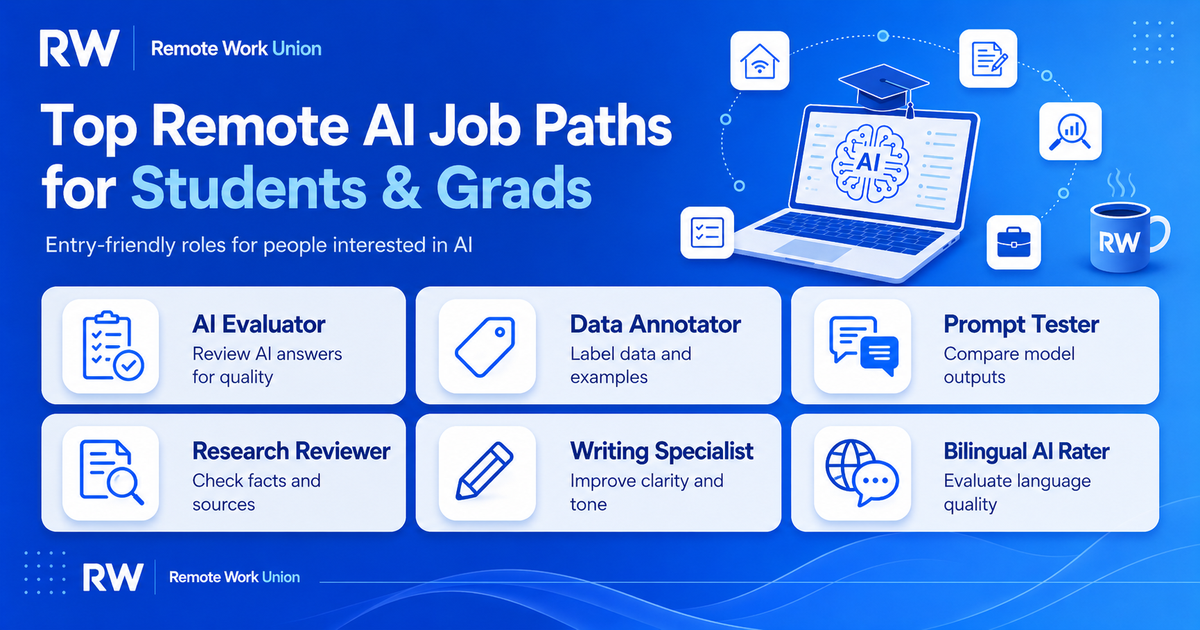
AI evaluator jobs are one of the clearest entry points into remote AI work. In this role, you review AI-generated answers and judge whether they are accurate, helpful, safe, clear, and complete. You may compare two responses, choose the better one, rate each response against a rubric, or explain why one answer should be preferred.
This type of work appears under several names: AI evaluator, AI model evaluator, AI response reviewer, AI rater, chatbot evaluator, AI trainer, RLHF reviewer, and human feedback reviewer. The exact title changes by platform, but the core task is similar: use human judgment to improve AI output quality.
Students who are strong writers, careful readers, or quick at noticing mistakes can do well here. Recent graduates can also use academic subject knowledge to qualify for more specialized projects. A history major might evaluate source use. A psychology graduate might evaluate explanations in behavioral science. A business graduate might evaluate financial reasoning or professional writing tasks.
2. Data Annotation Specialist
Data annotation jobs from home involve labeling examples so AI systems can learn patterns. The work can include categorizing text, tagging images, rating search results, identifying sentiment, organizing examples, or marking whether content follows a specific guideline.
For college students, data annotation can be a practical first step because it usually rewards patience, consistency, and attention to detail more than a long resume. It can also introduce you to the basic workflows behind AI model training without requiring you to build models yourself.
Good data annotators are precise. They read the instructions, apply the same standard repeatedly, and avoid guessing when a task requires evidence. This makes it a good fit for students who like structured tasks, checklists, and clear quality standards.
3. Prompt Tester or Prompt Evaluation Assistant
Prompt evaluation jobs are built around testing how AI systems respond to different instructions. You may write prompts, compare model outputs, identify whether the model followed the request, or explain what made a response strong or weak.
This is a strong path for students who already use ChatGPT, Claude, Gemini, Copilot, Grok, or other AI assistants for research, brainstorming, studying, coding practice, or writing help. The key is not just knowing how to use AI. It is knowing how to judge the result.
A good prompt tester can explain why a response is too vague, why it missed a constraint, why it made an unsupported claim, or why another response is more useful for the user. That type of judgment is valuable in AI model evaluation and AI training work.
4. Research Reviewer and Fact-Checking Assistant
AI systems often need human reviewers who can check whether an answer is grounded, current, and supported by reliable sources. Research reviewer roles can involve verifying claims, checking citations, comparing sources, identifying outdated information, or flagging unsupported statements.
This can be one of the best remote jobs for students who like research-heavy classes, debate, journalism, policy, science, finance, law, or academic writing. You do not need to be a professor to be useful. You need to know how to search carefully, read skeptically, and separate a strong source from a weak one.
Recent graduates can use this work to show employers that they can handle information quality. That matters in many careers beyond AI, including marketing, consulting, finance, law, policy, operations, and product roles.
5. Writing Evaluation and Editing Specialist
Some remote AI jobs focus on writing quality. Tasks may include evaluating tone, rewriting unclear answers, checking grammar, improving structure, comparing two drafts, or rating whether an answer matches the user intent.
This role can fit English majors, communications students, journalism students, education majors, humanities graduates, and anyone who can explain ideas clearly. It can also fit people from technical majors who are unusually good at making complex subjects easy to understand.
Writing evaluation work is not the same as generic content writing. In many AI jobs, the work is more analytical: you are judging whether writing is useful, accurate, concise, complete, and appropriate for the audience. That makes it a good resume builder for editorial, content, support, training, research, and AI operations roles.
6. Bilingual AI Rater or Language Evaluation Specialist
Bilingual workers and language students can be strong candidates for AI language evaluation. These roles may involve rating translations, checking whether a response sounds natural, identifying language errors, evaluating cultural context, or comparing outputs in two languages.
Search terms for this path include bilingual AI rater, language evaluator, AI translation reviewer, multilingual data annotation, search quality rater, and AI localization reviewer. Students studying Spanish, Portuguese, French, German, Arabic, Hindi, Japanese, Korean, Chinese, or other languages may find language-focused remote AI projects more accessible than general remote jobs.
The strongest bilingual applicants are not just conversational. They can explain why one translation is more natural, why a phrase sounds awkward, or why a response may be technically correct but culturally off.
7. Coding Evaluation for Computer Science Students
Computer science students and bootcamp graduates can look for remote AI coding evaluation jobs. These may involve reviewing code generated by an AI model, testing whether a solution works, comparing two coding answers, writing unit tests, or explaining why one approach is cleaner than another.
This path is useful for students who want AI-related work but do not want to commit immediately to a full-time software engineering role. It can help build practical experience with debugging, code review, documentation, test cases, and technical communication.
Common search terms include AI coding evaluator, code reviewer AI jobs, coding data annotation, software AI trainer, coding prompt evaluator, and technical AI evaluator. The bar is usually higher than general writing evaluation, but the work can also be more specialized.
8. AI Search Quality Rater
Search quality rating is another remote-friendly path connected to AI, search engines, assistants, and answer systems. In these roles, you may judge whether search results are relevant, whether a page satisfies the search intent, whether an answer is trustworthy, or whether an AI-generated summary is useful.
This type of work is especially relevant as people search for terms like Google AI training jobs, Microsoft AI training jobs, Gemini AI training jobs, Claude AI training jobs, AI Mode jobs, Ask AI jobs, and LinkedIn AI jobs. The important point is to look beyond the brand keyword and understand the task: evaluate quality, relevance, usefulness, and user intent.
Students with strong research habits can do well here because the work often requires careful reading rather than advanced coding.
9. AI Operations Assistant or AI Workflow Assistant
Some entry-level remote AI jobs are less about rating individual outputs and more about supporting AI workflows. These roles may include organizing prompts, tracking evaluation tasks, documenting processes, maintaining spreadsheets, cleaning examples, summarizing findings, or helping a team manage AI review projects.
This path is a good fit for business students, operations-minded graduates, project coordinators, virtual assistants, and people who like systems. It can also be useful for students who want to move from task-based AI work into more stable remote roles later.
Useful keywords include AI operations assistant, AI project assistant, AI research assistant, AI workflow coordinator, prompt library assistant, and remote AI support role.
10. Domain-Specific AI Reviewer
Domain-specific AI review is where recent graduates can separate themselves from generic applicants. AI companies and AI training platforms often need people who understand specific subjects: education, law, finance, accounting, healthcare, engineering, math, science, creative writing, marketing, or business analysis.
A college degree, major, internship, research project, or portfolio can help here. A nursing student may be useful for healthcare-adjacent review. A finance graduate may be useful for business analysis tasks. A teacher or tutor may be useful for education prompts. A law student may be useful for legal research review, as long as the role does not ask them to give legal advice beyond their qualifications.
The best approach is to search both broadly and specifically. For example, search remote AI evaluator jobs and also finance AI evaluator jobs, legal AI research jobs, education AI training jobs, healthcare AI reviewer jobs, and domain expert AI jobs.
Skills That Matter Most
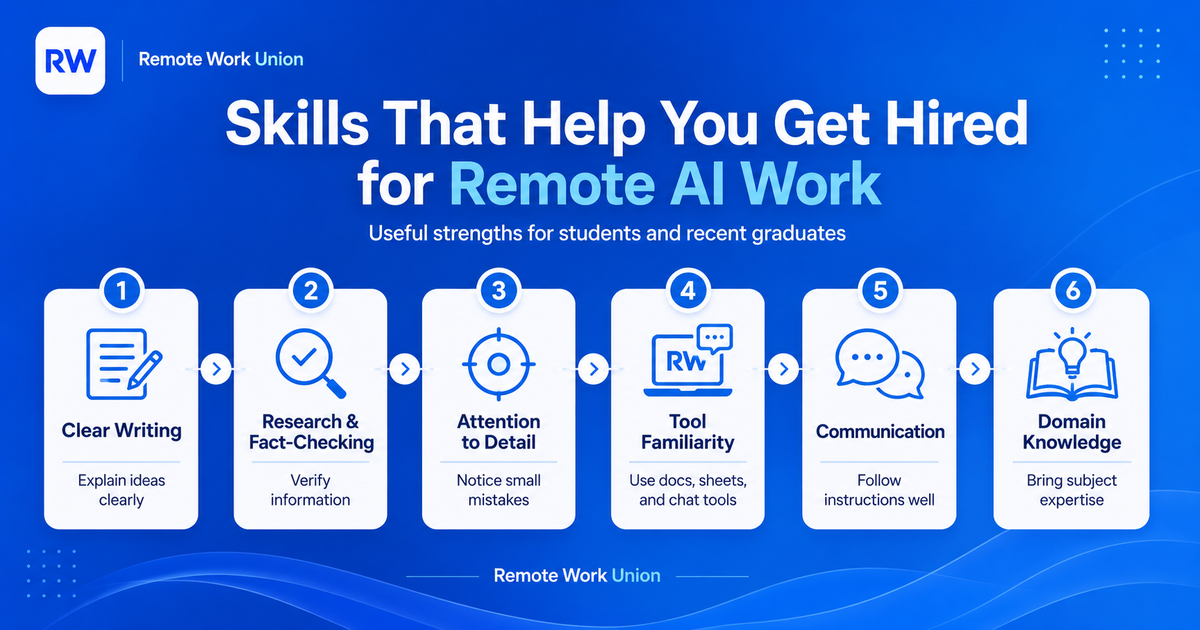
The best remote AI jobs for students and new graduates usually reward practical work habits more than flashy credentials. Clear writing matters because reviewers must explain decisions. Research ability matters because AI responses can sound confident while still being wrong. Attention to detail matters because small differences often decide which answer is better.
Tool familiarity also helps. You should be comfortable with documents, spreadsheets, task trackers, browser research, AI chat tools, and basic file organization. Communication matters because remote work often depends on written instructions. Domain knowledge matters because specialized projects need people who understand the subject well enough to catch subtle errors.
Before applying, practice comparing AI answers. Ask an AI tool a question, generate two responses, then write a short evaluation: Which answer is more accurate? Which follows the instructions better? Which is clearer? What would you change? This simple practice builds the same mental habit used in many AI evaluator jobs.
How to Build a Resume for Remote AI Jobs
A strong resume for remote AI work should make your judgment visible. Instead of only listing your major, show that you can evaluate, research, write, and follow structured criteria. Use language such as evaluated responses, applied rubrics, compared outputs, checked sources, annotated examples, improved clarity, tracked quality, and documented decisions.
Students can include coursework, research papers, tutoring, lab work, editorial work, debate, coding projects, language study, internships, campus jobs, and freelance work. Recent graduates can add capstone projects, work samples, writing samples, GitHub repositories, research summaries, or case studies.
Resume bullets can be simple: "Evaluated written responses for clarity, accuracy, and completeness using structured criteria." "Researched source material and summarized findings in concise written notes." "Compared multiple outputs and documented quality differences with clear rationale." "Used spreadsheets and task trackers to organize review work and maintain consistency."
Remote Work Union connects students and recent graduates to legitimate remote AI training and evaluation roles. Apply for free.
Find Roles Hiring Now →Where to Search for Remote AI Jobs
Use a mix of broad and specific search terms. Broad searches include remote AI jobs, work from home AI jobs, AI training jobs, AI model trainer jobs, AI evaluator jobs, AI rater jobs, and data annotation jobs from home. Specific searches include prompt evaluation jobs, AI response reviewer jobs, paid AI research jobs from home, bilingual AI rater, coding AI evaluator, and domain expert AI reviewer.
You can also search platform and company keywords such as Mercor AI jobs, Handshake AI, DataAnnotation, Outlier AI, Surge AI jobs, micro1 AI jobs, Stellar AI jobs, LinkedIn AI jobs, Google AI training jobs, Microsoft AI training jobs, Claude AI training jobs, and Gemini AI training jobs. Treat those as search terms, not guarantees. Openings, rates, tests, requirements, and availability can change often.
The goal is to avoid generic remote job boards where thousands of people apply to the same vague listing. Search for the task type, the platform, the skill, and the subject area. For example: "remote AI evaluator writing", "biology AI reviewer", "finance AI trainer", "Spanish AI rater", or "coding prompt evaluator".
How to Apply Without Looking Generic
Generic applications are easy to ignore. A better application quickly proves that you understand the work. Mention the task type directly: evaluating AI responses, comparing model outputs, labeling data, checking facts, reviewing writing quality, or applying rubrics. Then connect that task to your experience.
For a student, that might mean: "My coursework required research writing, source evaluation, and clear explanations under detailed assignment criteria." For a recent graduate, it might mean: "My capstone project required analyzing complex information, documenting decisions, and presenting findings clearly." For a bilingual applicant, it might mean: "I can evaluate whether translated or multilingual responses are accurate, natural, and context appropriate."
If the platform asks for a test, take it seriously. Read the instructions twice. Do not rush. Most AI evaluation tests are not trying to see whether you can sound impressive. They are trying to see whether you can follow the rubric, notice constraints, and explain your judgment clearly.
Red Flags to Avoid
Avoid any remote job that asks you to pay for access, buy a starter kit, deposit a check, move money, or share sensitive personal information before you understand the company and the role. Real remote AI work may require identity verification, tax forms, or platform onboarding, but it should not require you to pay to get hired.
Be cautious with listings that promise unrealistic income with no skills, no screening, and immediate approval. Also be careful with vague "AI data entry" jobs that do not explain the actual task. Legitimate AI work usually describes a clear workflow: rate responses, annotate examples, compare outputs, review sources, test prompts, or evaluate language quality.
Finally, protect your school schedule and long-term career goals. Flexible contract work can be useful, but it should not replace building skills, relationships, internships, portfolio samples, and professional references.
A Simple Application Plan
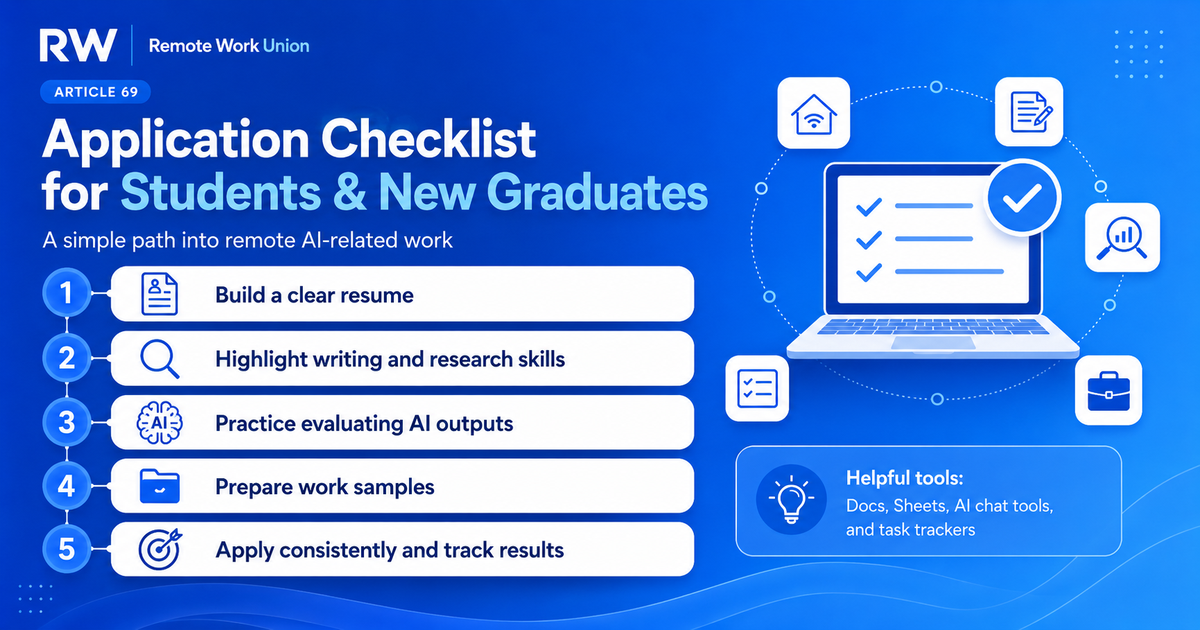
Start by choosing two or three role types that fit your strengths. If you write well, target AI evaluator, writing specialist, and prompt tester roles. If you like research, target fact-checking and AI research reviewer roles. If you are bilingual, target language evaluation. If you code, target technical AI evaluator roles. If you are organized, target AI operations or data annotation work.
Next, prepare a one-page resume, a short writing sample or work sample, and a simple tracker. Your tracker can include the platform, role title, date applied, test status, follow-up status, and notes. Remote AI work can involve many applications, so tracking matters.
Then apply consistently. Do not depend on one platform. Search broadly, test carefully, and keep improving your application materials. If you are rejected, treat it as feedback and refine your examples, not as proof that you cannot do the work.
Tip: The best remote jobs for students are not always the highest-paying ones on the first application. Build a track record on smaller projects first. Strong performance leads to better project matching over time.
Final Takeaway
The best remote jobs for college students and recent graduates interested in AI are not limited to engineers. AI systems need human reviewers who can write clearly, check information, compare outputs, label examples, evaluate language, and bring real subject knowledge to the review process.
Start with the role that matches your current strengths. Build a clean resume. Practice evaluating AI outputs. Apply to multiple platforms. Track your results. Over time, remote AI work can become more than a side job. It can become proof that you understand one of the most important work categories of the next decade.
Frequently Asked Questions
Are remote AI jobs good for college students?
Yes, they can be a strong fit when the work is flexible and the student can manage deadlines responsibly. The best roles reward writing, research, attention to detail, and independent work habits.
Do I need to know how to code?
Not always. Coding helps for technical AI evaluation roles, but many AI training jobs focus on writing, research, language, data labeling, fact-checking, or general response evaluation.
Can recent graduates get remote AI jobs without full-time experience?
Yes. Recent graduates can use coursework, internships, research projects, writing samples, tutoring, languages, or subject expertise to show they can evaluate information carefully.
Are AI evaluator jobs the same as data entry jobs?
Not exactly. Some tasks are repetitive, but AI evaluation usually requires judgment: comparing responses, applying guidelines, checking accuracy, and explaining decisions. That is different from simple data entry.
What is the best first role to try?
For most students, the best first role is AI evaluator, data annotator, prompt tester, or research reviewer. Choose based on your strongest skill: writing, detail, research, language, coding, or subject knowledge.