Copywriters and content writers are some of the best-positioned professionals in the remote work economy. The skills remote companies need most — language, research, revision, deadline management, and written communication — are exactly what writers have been developing for years.
In 2026, remote writing work spans far beyond blog posts and ad copy. It now sits across content marketing, SEO, email, product copy, UX writing, technical documentation, editing, AI training, prompt writing, AI model evaluation, and content quality review. Writers who understand this expanded landscape have more options — and better-paying options — than they did just a few years ago.
Why Writers Are Strong Remote Work Candidates
Writing is judged by deliverables, not location. A strong article, email, or landing page does not require the writer to be in an office. That makes writing one of the most naturally remote-compatible professions.
But the deeper reason writers are well-positioned is judgment. Good writers do not just produce words — they understand context. A headline is not just a sentence. A blog post is not just word count. An AI-generated answer is not automatically useful because it sounds confident. Writers ask: Is the message clear? Do the facts support this? Does the tone fit the situation? Does this actually answer what the reader was looking for?
That judgment is valuable in both traditional remote writing jobs and AI training roles — which is why the market for remote writing work has expanded significantly as AI companies need more human evaluators.
1. Remote Copywriter
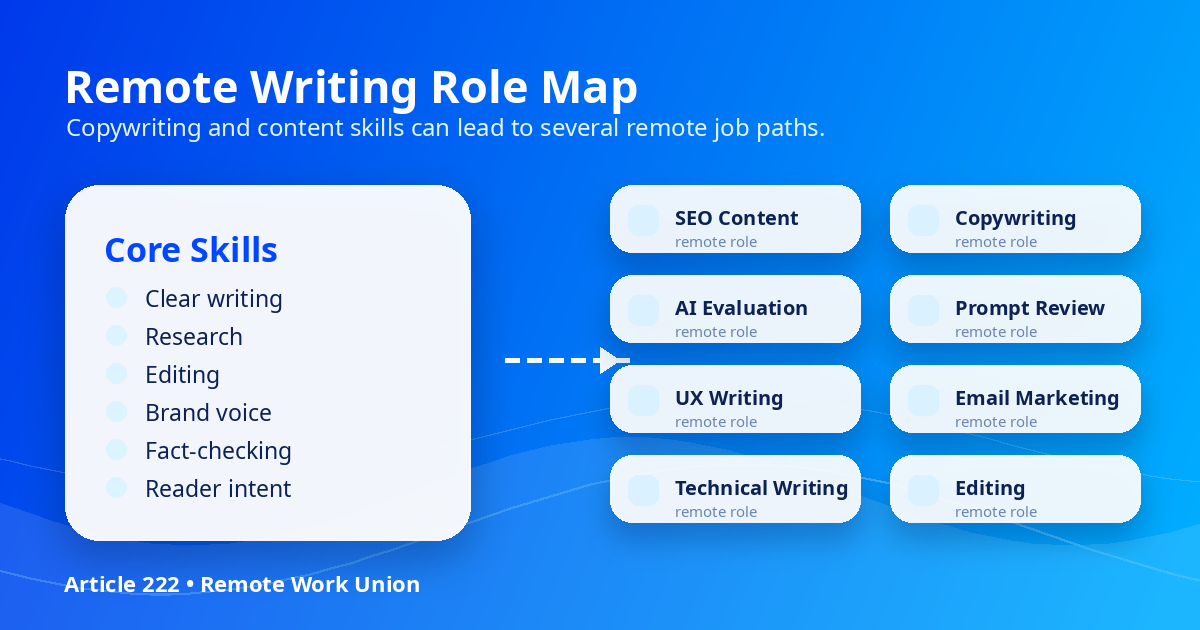
A remote copywriter writes words that help a business achieve a result — a sale, a signup, a call, a download. This can be full-time, part-time, freelance, or contract work, for agencies, startups, e-commerce brands, fintech companies, SaaS products, or AI companies.
Strong copywriters understand offers, objections, and conversion. They know the difference between features and benefits. They can write for cold audiences and warm retargeting campaigns. They can make a technical product feel approachable or a simple product feel premium.
This is one of the highest-leverage remote writing roles because strong copy directly affects revenue. Companies know it, and skilled conversion copywriters can command significantly better rates than generalist writers.
Keywords for search: remote copywriter, conversion copywriting, landing page copywriter, email copywriter, product page copy, ad copywriter, direct response copy.
2. SEO Content Writer
SEO content writing involves creating articles, guides, comparison pages, and educational content designed to match search intent. This means understanding search queries, structuring articles with useful headings, writing FAQs, using plain language, and providing examples that genuinely help the reader.
SEO content is one of the most consistent remote writing income sources because companies publish constantly and need a steady output of quality articles. It is also a strong entry point — companies do not always need a senior brand strategist to start producing helpful blog content, and many hire writers with strong research and communication skills.
Keywords for search: SEO content writer, content writer remote, keyword-based articles, evergreen content, informational content, search intent writing.
3. AI Training, AI Model Evaluation, and Prompt Review Work
This is one of the most important new remote work categories for writers, and it is growing rapidly. AI companies — including those building systems connected to OpenAI, Anthropic, Google, Meta, and xAI — need human reviewers to evaluate whether AI answers are accurate, useful, safe, and well-written.
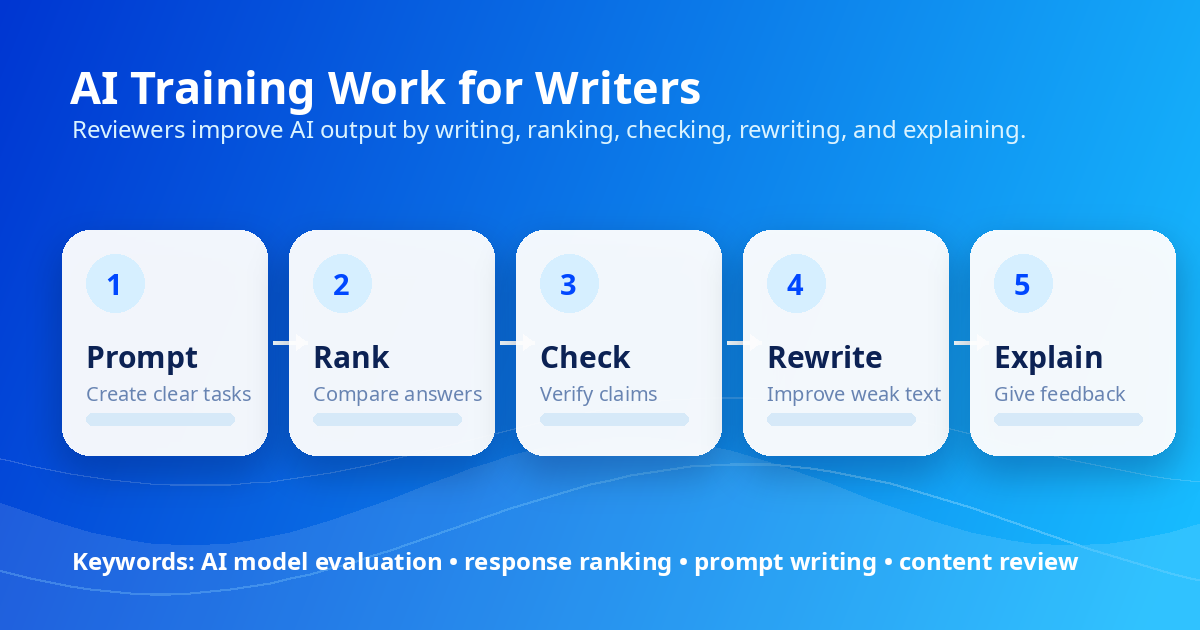
The work includes writing prompts to test AI models, comparing two AI responses and rating the better one, checking facts in AI-generated content, rewriting weak responses, identifying unsupported claims, judging tone and style, and explaining clearly why one response is stronger than another.
Writers are strong candidates for this work because the job rewards language judgment more than technical knowledge. You do not need to know how the model was trained. You need to know whether the final answer actually works for a real reader.
Platforms to explore: micro1, Mercor, Handshake AI, Outlier, and similar AI training platforms. Rates vary by task type and expertise level, but expert-tier AI evaluation work can reach $50–$200/hr for reviewers with strong domain knowledge or writing specialization.
Keywords for this work: AI training, AI model evaluation, AI response rating, prompt writing, prompt evaluation, data annotation, content quality analyst, AI content reviewer, RLHF, search quality rater, model response reviewer.
4. Editor and Proofreader
Editors fix grammar, tighten structure, check consistency, enforce style guides, improve headlines, fact-check, and prepare content for publication. Companies publish constantly across newsletters, help center pages, product updates, blog posts, scripts, social content, landing pages, ad copy, white papers, and AI-generated drafts.
As AI tools produce more first drafts, human editors are becoming more important — not less. Someone has to decide whether the draft is accurate, whether the tone is right, whether the logic holds up, and whether the final version is actually usable. That is the job of a skilled editor.
Keywords for search: remote editor, proofreader remote, content editor, fact-checker, style guide enforcement, copy editor, developmental editor.
5. UX Writer and Product Content Writer
UX writing involves creating small but critical pieces of language inside websites, apps, and software products: button text, error messages, onboarding screens, tooltips, form labels, notifications, empty states, menu items, and help text.
Good UX writing is invisible when it works — users move through an interface smoothly because every word guides them clearly. When it fails, users get confused, frustrated, or abandon a product. This makes UX writing genuinely high-value work at companies building digital products.
This role is a strong fit for writers who prefer clarity over cleverness, and who enjoy working closely with designers and product managers.
Keywords for search: UX writer remote, product content writer, microcopy, content design, app copy, interface writing, plain language specialist.
6. Email Marketing and Lifecycle Copywriter
Email marketing copywriting involves creating welcome sequences, product education emails, retention campaigns, abandoned cart emails, newsletters, reactivation sequences, customer updates, and transactional copy. Nearly every online business uses email, which means demand for email copywriters is consistent and often recurring.
This role rewards writers who can be persuasive without being spammy, who understand when to inform versus when to sell, and who can track results and adjust based on open rates, click-throughs, and conversions.
Email copy is one of the strongest niches for freelance writers and remote contractors because companies need email campaigns every week — not just once at launch.
Keywords for search: email copywriter, lifecycle marketing, welcome sequence, email drip campaign, newsletter writer, retention copy, customer email.
7. Technical Writer and Documentation Specialist
Technical writers create product documentation, internal guides, API docs, knowledge base articles, training materials, standard operating procedures, and support content. This work does not always require an engineering background — it requires patience, accuracy, and the ability to explain step-by-step processes to people who need them.
Remote technical writing positions are common in software, fintech, healthcare, logistics, cybersecurity, AI companies, and operations-heavy businesses. Pay is often higher than general content writing because good technical documentation directly reduces support costs and onboarding time.
Keywords for search: technical writer remote, documentation specialist, knowledge base writer, SOP writer, API documentation, help center content, product docs.
8. Content Strategist and Content Operations Specialist
Content strategists decide what should be written, why, who it is for, how it should be structured, where it should be published, and how success should be measured. Content operations specialists build and manage the systems behind writing: editorial calendars, content briefs, templates, quality checks, contributor management, CMS workflows, content audits, and performance tracking.
These roles are strong for experienced writers who want to move into leadership or systems-level work. They are also highly compatible with remote work because distributed teams especially need clear content systems to function well.
Remote Work Union connects writers to legitimate remote writing and AI evaluation roles. Find roles hiring now.
Find Roles Hiring Now →How to Position Yourself for Remote Writing Jobs
Do not describe yourself too generally. "I am a passionate writer" communicates almost nothing to a hiring manager or platform matching system. You need specifics: what kind of writing you do, who you help, what topics you understand, what outcomes your writing supports.
Include keywords relevant to your target role: remote copywriter, SEO content writer, AI training, AI model evaluation, prompt writing, content editing, fact-checking, email copywriting, product copy, technical writing, or content strategy.
Example strong positioning statement: "Copywriter and content writer specializing in clear, research-backed content for remote work, AI tools, SaaS, education, and consumer technology. Experienced in SEO articles, email copy, landing pages, editing, prompt evaluation, and AI response quality review."
That kind of statement is searchable, specific, and tells a platform or employer exactly where to route you.
What to Put in a Remote Writer Portfolio
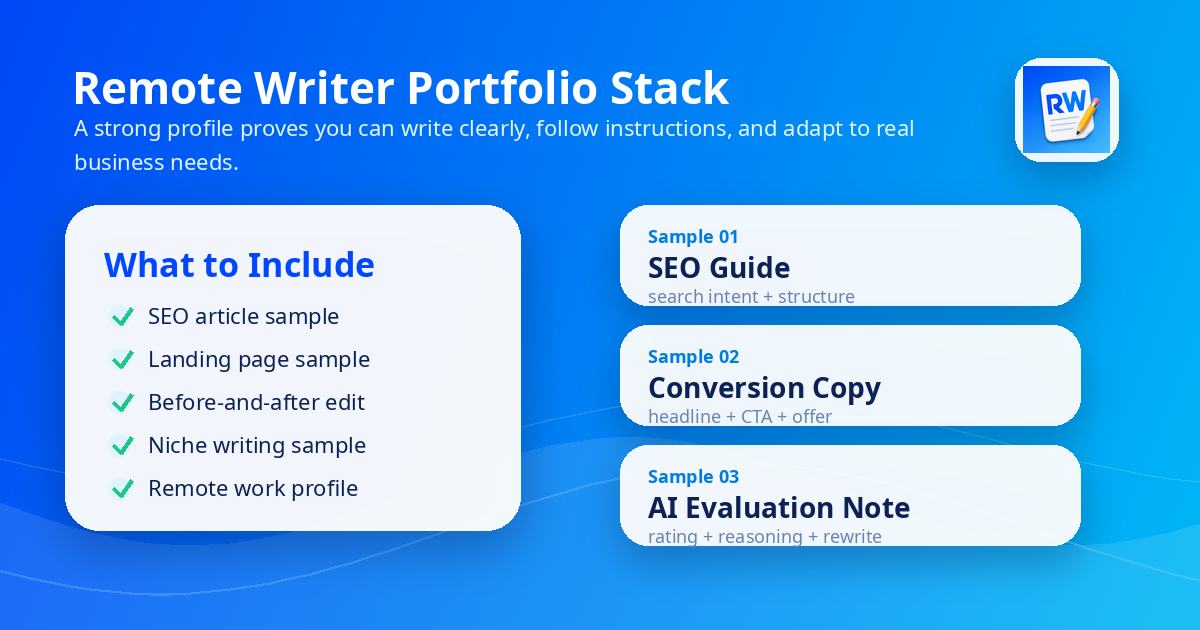
Five strong samples beat 20 random ones. Your portfolio should include:
- An SEO article sample — shows research, structure, and search intent understanding
- A landing page or product copy sample — shows persuasion, offer clarity, and conversion thinking
- An email campaign sample — shows voice, sequencing, and reader psychology
- A before-and-after editing sample — shows that you can improve writing, not just produce it
- A niche sample — shows subject-matter knowledge in your strongest area
For AI training work specifically: create a sample evaluation note using a fictional prompt and response. This shows the platform you understand the work even if you do not have paid AI experience yet. Do not reveal details of private platform tasks if you have them — just create a fictional example.
How to Apply Without Sounding Generic
Do not write a long biography. Lead with the role, a relevant skill, and proof.
- For copywriting: Mention conversion-focused writing, landing pages, offers, email campaigns, or paid ad copy specifically.
- For content writing: Mention SEO, research, outlines, search intent, and clean structure.
- For AI training: Mention prompt writing, response comparison, fact-checking, rating explanations, and editing AI-generated text.
- For editing: Mention style guides, accuracy checks, restructuring, headline improvement, and final polish.
The goal is to give the reader one clear reason to put you in the right pile. Vague enthusiasm does not do that. Specific skills and proof do.
Pay, Schedule, and Stability
Remote writing pay varies widely across the spectrum. Entry-level content writing, general annotation, and basic editing pay at contractor rates. Specialized copywriting, technical documentation, AI model evaluation, and expert-tier review work pay significantly more — with expert AI evaluation roles reaching $50–$200/hr for writers with strong domain knowledge.
Pay structure also varies: some roles are hourly, some per word, some per project, and some AI training platforms pay by task or active work time. The more specialized your background and skills, the more leverage you have over your rate.
The most stable approach for most writers is to avoid relying on a single income source. Combining a part-time remote content role, freelance email or copywriting, editing projects, and AI training platforms creates income diversification and reduces the risk of any one source drying up.
How to Avoid Bad Remote Writing Jobs
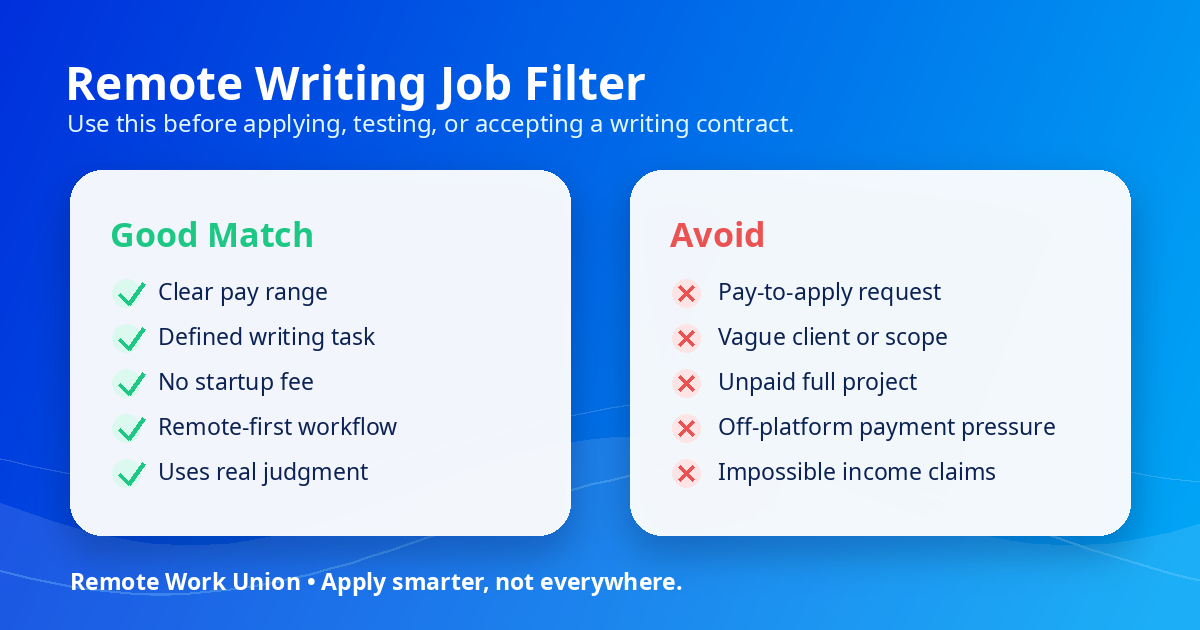
Real jobs do not require you to pay to apply. Be careful with anything requiring upfront fees, paid training, expensive certifications, crypto payments, or pressure to move off-platform for payment.
Writing tests are common and can be reasonable — a short paid or unpaid test can make sense for a real role. A full unpaid article that you cannot use elsewhere should be treated with skepticism.
Best Remote Writing Job by Background
- Freelance writing background: SEO content, newsletters, copywriting, editing — you already have the portfolio; focus on specializing.
- Journalism background: Research-heavy content, fact-checking, editorial roles, AI response evaluation — your skepticism and sourcing skills translate well.
- Marketing background: Landing pages, email copy, social content, content strategy, lifecycle marketing — lead with conversion outcomes.
- Teaching or tutoring background: AI training and educational content — explanation quality is exactly what platforms need.
- Customer support background: UX writing, help center content, knowledge base writing, conversation review — your user empathy is an advantage.
- Creative writing background: Prompt writing, dialogue evaluation, brand storytelling, content editing — position around language judgment.
7-Day Plan for Remote Writers
Day 1: Choose two target roles — for example, SEO content writer and AI model evaluator. Write a clear positioning statement for each.
Day 2: Update your resume and profile with specific writing and remote work keywords. Remove vague phrases.
Day 3: Create or polish three samples that match your two target roles.
Day 4: Build a simple portfolio page or shared folder with your best samples.
Day 5: Apply to remote writing roles and AI training platforms that match your country, skills, and availability.
Day 6: Write a short reusable application framework you can customize for each role — intro, key skills, proof, why you fit.
Day 7: Review what got responses, improve weak samples, continue applying to new roles.
Conclusion
Copywriters and content writers have more remote options than ever. Traditional writing jobs matter, but the category has expanded significantly into AI training, prompt evaluation, content quality review, UX writing, documentation, lifecycle marketing, and content operations.
Writers who win in this market position themselves around useful, specific skills rather than general writing ability. They build focused portfolios. They apply with evidence, not enthusiasm. They expand into adjacent categories like AI evaluation that reward exactly what good writers already do: read carefully, judge accurately, write clearly, and explain their reasoning.
Frequently Asked Questions
What remote jobs are best for copywriters?
The best remote jobs for copywriters include landing page and conversion copy, email marketing and lifecycle campaigns, SEO content writing, AI model evaluation and prompt review, UX writing, technical writing, and content strategy. AI training platforms have also become a major category — they pay writers to evaluate AI-generated content, compare answers, check facts, and write prompts. Platforms like micro1, Mercor, Handshake AI, and Outlier all use writers for this type of work.
Can content writers work in AI training jobs?
Yes. Content writers are strong candidates for AI training and model evaluation roles. The work often rewards writing judgment, research, fact-checking, instruction following, and clear explanations more than technical knowledge. Tasks include comparing AI responses, rating answer quality, rewriting weak outputs, checking factual accuracy, and explaining why one answer is better than another.
How do I position myself as a remote writer?
Avoid generic descriptions. Instead of saying you are a passionate writer, specify what kind of writing you do, who you help, what topics you know, and what results your writing supports. Include specific keywords: remote copywriter, SEO content writer, AI training, AI model evaluation, prompt writing, content editing, fact-checking, email copywriting, technical writing, or content strategy.
How do I get into AI training jobs as a writer?
Apply to platforms like micro1, Mercor, Handshake AI, and Outlier. Build a profile that highlights language judgment, research, fact-checking, and instruction-following. Create one or two short samples — such as a comparison of two AI answers or a before-and-after edit — to show your evaluation ability. Complete any required AI interview or assessment before expecting a response.
What should a remote writer portfolio include?
Five strong samples beat twenty random ones. Include an SEO article, a landing page or product copy sample, an email campaign example, a before-and-after editing sample, and one niche piece showing subject-matter knowledge. For AI training roles, add a sample evaluation note using a fictional prompt and response — this shows you understand the work even if you do not have paid AI experience yet.