Editors and proofreaders are a natural fit for remote work because most of the job is already digital: reading, checking, correcting, comparing, and giving clear feedback. The strongest opportunities are no longer limited to book publishing or basic typo correction. In 2026, editors can apply for remote proofreading jobs, copy editing jobs, SEO editing roles, technical editing roles, quality assurance roles, and AI training work that rewards careful judgment.
A strong editor does more than fix commas. Good editors notice when a sentence is vague, when a claim needs support, when a headline does not match the content, when the tone is wrong for the audience, and when a document looks finished but still has hidden problems. That kind of judgment translates well into remote work — and it is also directly useful in AI model evaluation.
Why Editors and Proofreaders Are Built for Remote Work
This is also why editors and proofreaders are useful in AI training and AI research workflows. Large language models can produce fluent writing, but fluency is not the same as accuracy. A response can sound confident while missing context, contradicting itself, using the wrong tone, ignoring instructions, or failing to answer the question. Editors are trained to catch exactly those problems.
For remote workers, this creates a wide set of possible roles. Some are traditional: proofreading, copy editing, content editing, and publishing support. Others are newer: AI response editor, AI model evaluator, prompt response reviewer, annotation quality analyst, LLM evaluator, and content QA reviewer. The labels change by company, but the core skill is the same: read carefully, judge quality, improve the work, and document what you changed.
1. Remote Proofreader
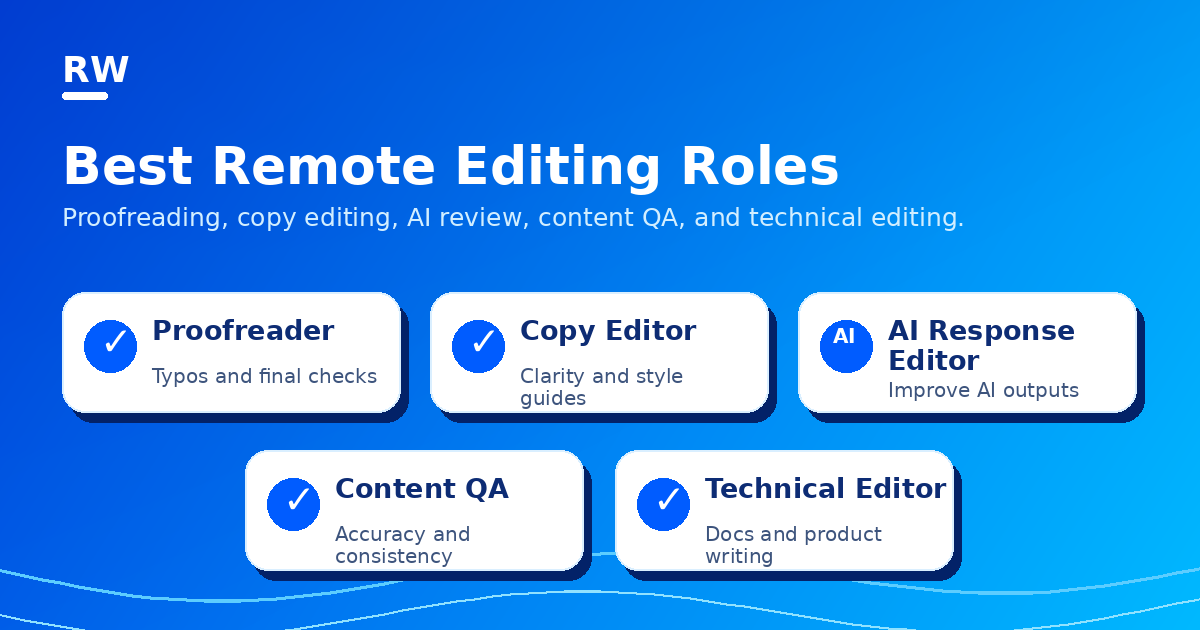
Remote proofreading is the cleanest entry point for many editors. Proofreaders review final-stage content for typos, grammar mistakes, punctuation issues, formatting problems, repeated words, missing words, capitalization errors, and obvious inconsistencies. This work can include blog posts, newsletters, ebooks, transcripts, resumes, product pages, course material, social posts, and internal documents.
The best proofreading applicants do not describe themselves only as detail-oriented. They prove it. Your profile should mention the types of documents you have reviewed, the style guides you can follow, the tools you use, and the kinds of mistakes you catch. A proofreader who can work in Google Docs, Microsoft Word, CMS editors, PDFs, and spreadsheets is more useful than someone who only says they are good at grammar.
Search terms to use include remote proofreader, proofreader jobs from home, freelance proofreader, proofreading QA, transcript proofreader, publishing proofreader, and content proofreader. A short before-and-after example can help more than a long resume.
2. Remote Copy Editor
Copy editors improve writing at the sentence level. They make content clearer, smoother, more consistent, and easier to read. A copy editor may correct grammar, but the job also includes tone, word choice, sentence flow, style guide consistency, headline alignment, and readability. Remote copy editing jobs exist in marketing, media, education, software, finance, healthcare, ecommerce, and agency work.
Niche matters: Profiles with a niche often look stronger than generalist copy editor labels. SaaS copy editor, finance copy editor, legal copy editor, healthcare copy editor, B2B content editor, academic copy editor, and SEO copy editor all signal a clearer, more matchable skill set.
3. Content Editor and SEO Editor
Content editors work above the sentence level. They look at structure, search intent, section order, audience fit, examples, internal links, calls to action, and whether the article actually answers the question it promises to answer. An SEO editor also checks titles, headings, keywords, meta descriptions, search intent, topical coverage, and readability.
Editors who understand SEO should emphasize quality and search intent together. You can improve content so it is useful to readers and easier for search engines to understand. Use terms like remote content editor, SEO editor, managing editor, content quality editor, blog editor, editorial strategist, and content operations.
4. AI Response Editor
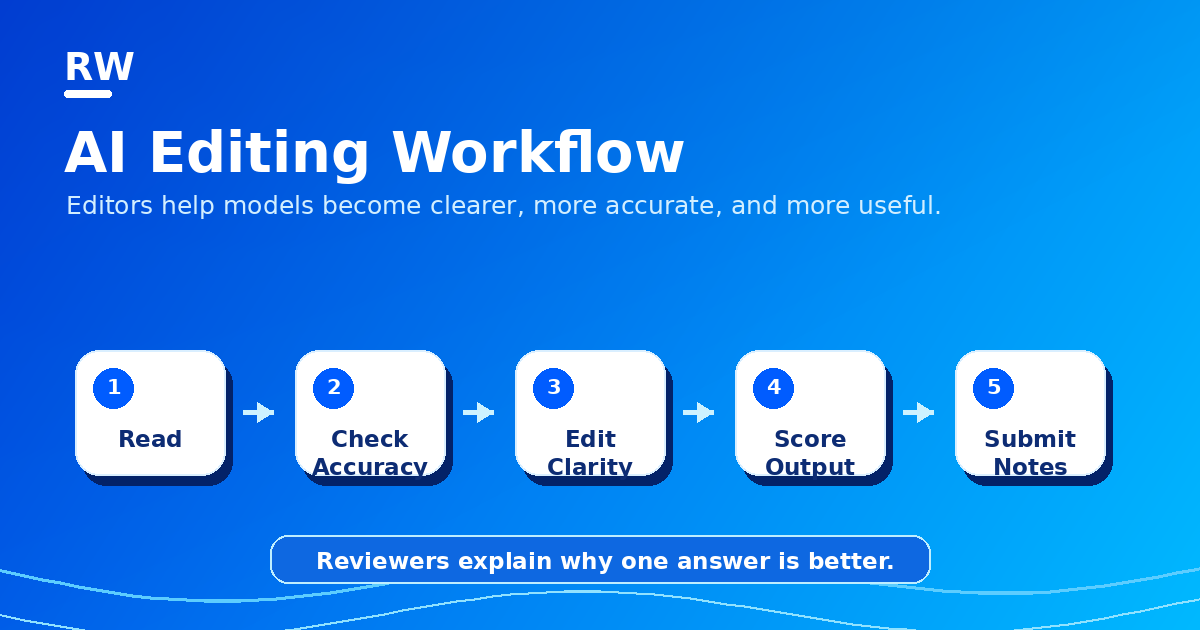
AI response editing is one of the most relevant newer categories for editors and proofreaders. In these roles, you may review answers written by an AI model, compare two responses, rewrite a weak answer, rate helpfulness, check whether instructions were followed, flag factual issues, or explain which response is better.
The reason editors fit these roles is straightforward: AI systems need human judgment. A model can write quickly, but someone still has to evaluate whether the answer is accurate, safe, complete, clear, and aligned with the prompt. Editors already know how to compare drafts, improve weak writing, and explain why one version is better than another. You do not necessarily need to be a coder for many AI editing jobs — non-technical AI evaluation often needs people with strong reading, writing, reasoning, research, and editorial skills.
Platforms and companies connected to AI training work may include names like micro1, Mercor, Handshake AI, Outlier, and vendors working with major AI companies such as OpenAI, Anthropic, Google, Meta, and xAI. The exact role names and availability change, so focus your profile on the skills that stay useful: editing, evaluation, accuracy, clarity, and written feedback. Titles include AI response editor, AI content reviewer, AI model evaluator, LLM evaluator, prompt response reviewer, and AI training specialist.
5. AI Data Annotation and Content QA
Many annotation tasks use the same mental muscles as editing. You may label examples, classify content, identify errors, judge whether a response followed instructions, rewrite outputs, or review other annotators' work for quality. Quality review roles can be a step up from basic annotation — instead of only completing tasks, you may inspect completed work, catch inconsistent labels, explain mistakes, and help improve guidelines.
That fits editors who are comfortable applying rules consistently. If you have ever followed a style guide, edited to a rubric, or reviewed writers against a standard, you already understand the core workflow. Useful search terms include AI data annotation, data annotation editor, AI evaluator, model response reviewer, content quality analyst, annotation QA, LLM evaluation, AI training reviewer, and AI writing evaluator.
Ready to find remote editing, content QA, and AI evaluation roles that match your skills?
See Roles Hiring Now →6. Technical Editor
Technical editing is a strong remote path for editors who can understand specialized material. Technical editors work on documentation, product guides, developer docs, help center articles, engineering explainers, scientific material, compliance documents, and internal knowledge bases. You do not always need to be an engineer to become a technical editor, but you do need comfort with complexity and the ability to preserve meaning while simplifying language.
In applications, use keywords that match the field: technical editor, documentation editor, knowledge base editor, product content editor, help center editor, UX writer editor, API documentation editor, compliance editor, and research editor.
7. Legal, Medical, Finance, and Expert Editing
Expert editing is where many editors can separate themselves from the crowd. A legal editor understands contracts, citations, case summaries, compliance language, and risk. A medical editor understands patient education, clinical terms, and regulated language. A finance editor understands investments, accounting, markets, insurance, and business writing. AI training platforms also value expertise — when models answer legal, medical, finance, science, or business questions, companies need reviewers who can recognize when an answer is incomplete, misleading, too confident, or outside the correct standard.
Do not hide your niche. A profile that says "copy editor" is broad. A profile that says "finance copy editor with experience reviewing investment, accounting, and business content" is much easier to match to a higher-value task.
8. Academic and Research Editing
Remote academic editors may review essays, research summaries, dissertations, journal submissions, grant materials, literature reviews, and educational content. The work often requires patience, consistency, and the ability to improve writing without changing the author's intended meaning.
Research editing also overlaps with AI evaluation — many AI tasks require checking whether a response is grounded, whether claims are supported, whether sources are used correctly, and whether the answer overstates what can be known. Relevant keywords include academic editor, research editor, citation editor, fact-checker, literature review editor, educational content editor, curriculum editor, and AI research evaluator.
9. Bilingual Editing and Localization QA
Bilingual editors can apply for remote roles that monolingual editors cannot. Localization QA, translation review, bilingual proofreading, language evaluation, and multilingual AI training all need people who understand meaning, tone, idioms, grammar, and cultural context across languages. The best bilingual editing profiles state the language pair, proficiency level, subject areas, and type of work — English-Spanish localization editor, French-English proofreader, Arabic content QA reviewer, or Portuguese AI response evaluator.
Do not describe bilingual skill as a side note. Language quality, localization judgment, and cultural accuracy are hard to automate perfectly, which is why human reviewers remain important.
10. Editorial Operations and QA Lead
Editors who have managed workflows can move into editorial operations. These roles include assigning work, building guidelines, checking final quality, reviewing freelancer output, maintaining style guides, improving templates, and tracking production. For remote teams, editorial operations is valuable because distributed work needs clear systems. This can also connect to AI training operations — projects need reviewers, auditors, quality leads, guideline writers, and people who can explain why certain outputs pass or fail.
Use keywords like editorial operations, content operations, QA editor, quality analyst, style guide manager, reviewer lead, annotation QA lead, and content quality manager.
Building a Remote Editor Profile That Gets Results
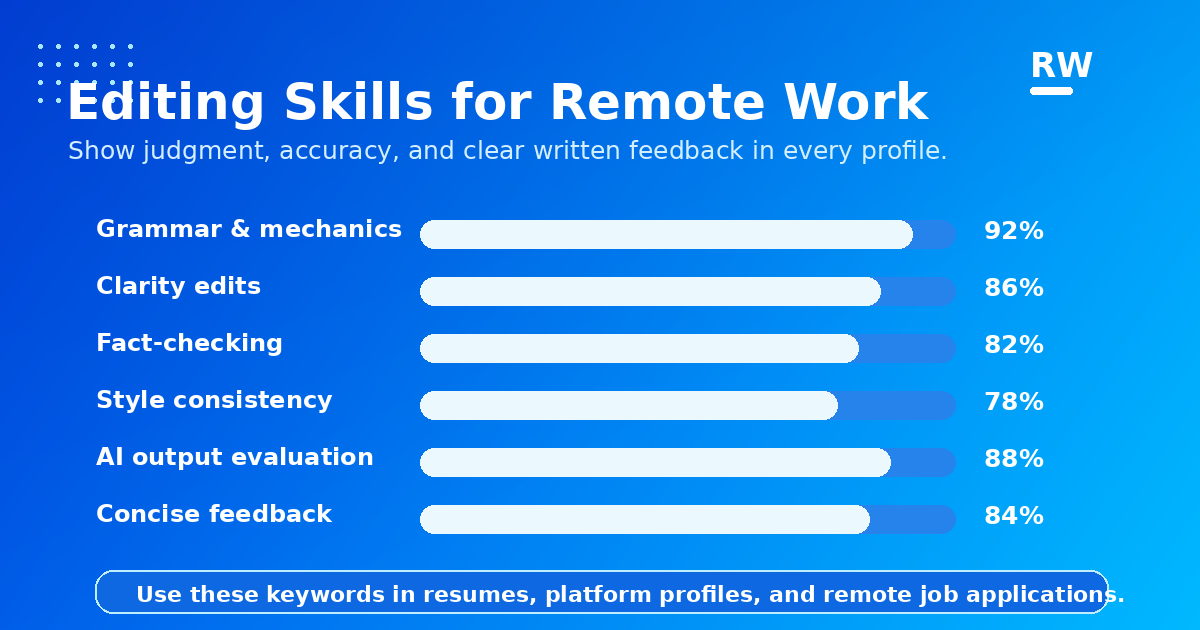
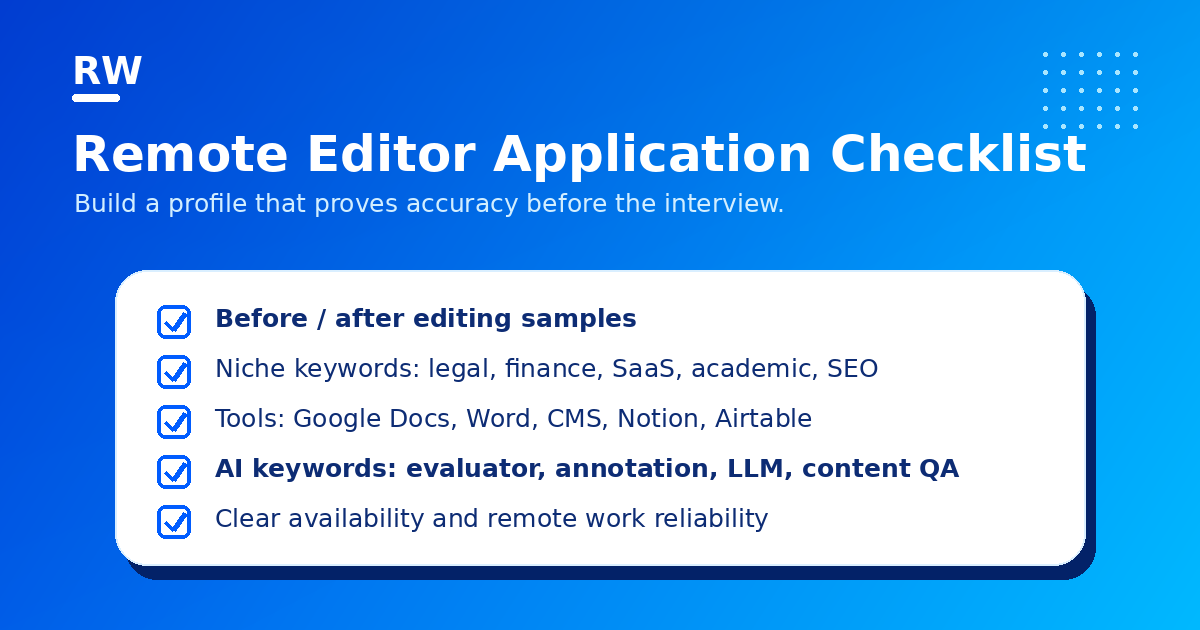
A strong remote editor profile should be specific, searchable, and proof-based. Do not rely on generic phrases like "excellent attention to detail." Show what you edit, how you edit, and what standard you can follow. Include your editing niches, document types, style guides, tools, and AI evaluation keywords. Mention Google Docs, Microsoft Word, track changes, CMS platforms, Grammarly, fact-checking, content QA, AI response evaluation, LLM evaluation, annotation, and model output review when they are accurate to your experience.
For AI-related applications, add a sample where you compare two answers to the same prompt. Explain which answer is better and why. Focus on helpfulness, accuracy, instruction following, clarity, completeness, and tone. That mirrors the kind of reasoning used in many AI model evaluation tasks.
Frequently Asked Questions
What remote jobs are available for editors and proofreaders?
Editors and proofreaders can apply for remote proofreader jobs, remote copy editor jobs, content editor and SEO editor roles, AI response editor positions, AI data annotation and content QA work, technical editing, expert editing in legal, medical, or finance fields, academic and research editing, bilingual editing and localization QA, and editorial operations roles.
Do editors need coding experience to work on AI training projects?
No, not for most AI evaluation and response editing work. Many AI training tasks use writing, reading, reasoning, research, and editorial judgment rather than software engineering skills. Editors who can compare AI outputs, identify errors, and explain which response is better are well-positioned for many model evaluation tasks.
How do I build a remote editing portfolio from scratch?
Create three to five samples showing before-and-after edits. Include one proofreading sample, one clarity edit, and one AI-style comparison where you rate two answers and explain which is better. If you lack client samples, practice with a rough draft you improve yourself. Samples that show reasoning matter more than credentials alone.
What keywords should editors use when applying to remote AI jobs?
Use terms like AI response editor, AI model evaluator, LLM evaluator, content QA, AI training reviewer, data annotation, model response reviewer, fact-checker, and annotation quality analyst. Add your niche: finance copy editor, legal document editor, healthcare content reviewer, or technical documentation editor.