Being bilingual is one of the clearest advantages you can bring to remote work. Companies need people who can translate, localize, review, research, support customers, evaluate AI responses, and understand how language changes across countries, cultures, and contexts.
The opportunity is not limited to traditional translation. Many remote jobs for translators and bilingual professionals now sit at the intersection of language, writing, quality control, customer experience, content review, and AI training. That means you do not always need a formal translation degree to compete. You need strong language ability, careful judgment, and a profile that makes your skills easy to match to the right work.
Why Bilingual Professionals Are a Strong Fit for Remote Work
Remote work rewards skills that can be delivered through text, documents, calls, dashboards, and asynchronous review. Language work fits that model naturally. A translator can review copy, a bilingual support specialist can respond to customers, a localization reviewer can check product text, and an AI language evaluator can compare model responses from anywhere with a laptop and reliable internet.
Bilingual professionals also bring context that software often misses. Literal translation is only one part of the job. Good language workers notice tone, intent, cultural references, idioms, formality, formatting, and whether a sentence sounds natural to a real person in the target language. That judgment is useful across many remote job categories.
1. Remote Translator and Translation Reviewer
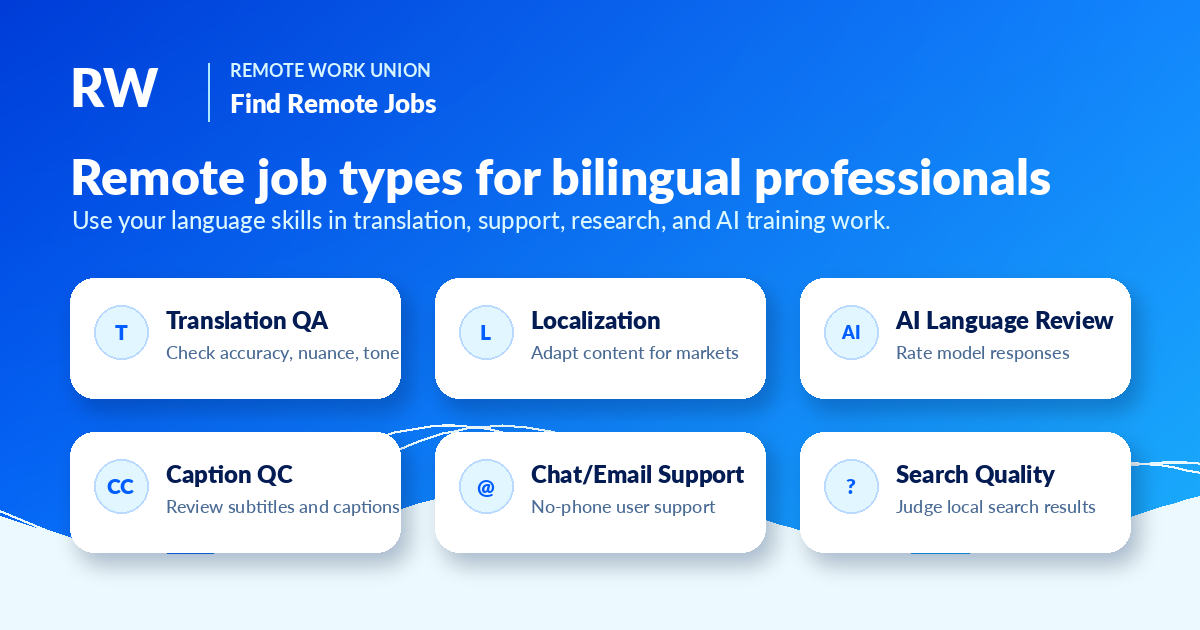
Traditional remote translator jobs still matter, especially for people who can work between high-demand language pairs and produce clean, accurate writing. These roles may include translating documents, website copy, product instructions, support articles, marketing content, subtitles, training materials, legal summaries, or internal communications.
A related role is translation reviewer or translation quality assurance specialist. Instead of producing the first translation, you review existing translations for accuracy, completeness, tone, terminology, grammar, and local usage. To stand out, use specific terms such as English to Spanish translation, bilingual content review, translation QA, localization review, glossary management, subtitle editing, and terminology consistency.
2. Localization Specialist
Localization goes beyond translation. A localization specialist adapts content for a specific market, audience, country, or region — changing examples, date formats, currency references, product language, idioms, cultural references, and calls to action so the content feels native to the audience. Remote localization work can appear in software, gaming, apps, e-commerce, education, creator platforms, marketing, documentation, and customer support.
This is a good path for bilingual professionals with marketing, UX, product, writing, or customer support experience. A strong localization profile should mention market adaptation, user experience, cultural nuance, brand voice, website localization, app localization, help center localization, and multilingual QA.
3. AI Translation Evaluator and Language Model Reviewer
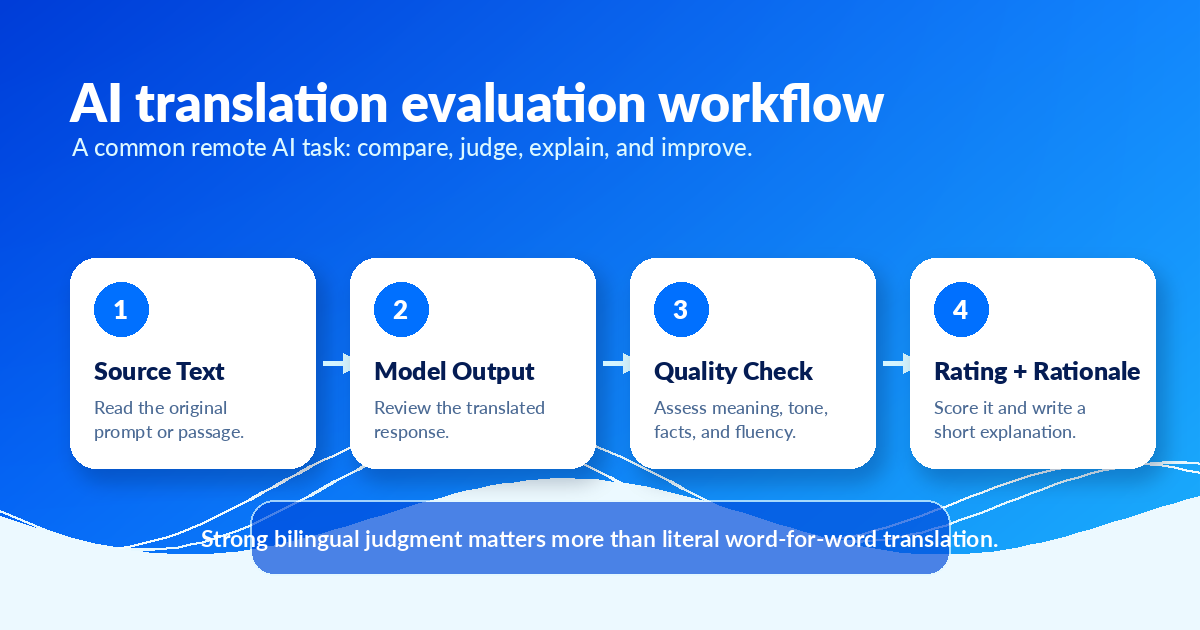
AI training work has opened a newer category of remote jobs for bilingual professionals. Instead of simply translating text, you may review how an AI model handles language. Common tasks can include comparing two responses, judging whether a translation preserves meaning, identifying awkward phrasing, checking factual accuracy, labeling errors, or writing a short explanation of which answer is better.
Key insight: The key skill is not just knowing two languages — it is judgment. Can you identify when a translation is technically correct but unnatural? Can you tell when an AI response sounds fluent but changes the meaning? Can you explain the issue clearly? Those are the language skills that make bilingual applicants competitive for remote AI work.
This work may appear under titles such as AI language evaluator, AI trainer, bilingual AI evaluator, model response reviewer, language data annotator, translation evaluator, multilingual AI reviewer, or AI content quality analyst. Major keywords include OpenAI, Anthropic, Google, Meta, Grok, model evaluation, AI training, data annotation, and response rating.
4. Multilingual Content Reviewer
Multilingual content reviewers help companies check user-generated content, ads, product listings, social posts, community reports, help articles, or platform content in more than one language. Some roles focus on policy and trust. Others focus on quality, tone, grammar, factual accuracy, or user safety. This role can be a good fit for bilingual professionals who notice small errors quickly and can follow detailed guidelines.
Use keywords such as multilingual content reviewer, bilingual content analyst, trust and safety analyst, content quality reviewer, policy reviewer, moderation QA, and language quality analyst.
5. Bilingual Customer Support by Chat or Email
Customer support is one of the most common remote work categories for bilingual professionals. Many companies need help supporting users in Spanish, French, Portuguese, German, Arabic, Japanese, Korean, Mandarin, Hindi, and other languages. Many roles are chat, email, ticket, or help desk based — not phone-heavy. For translators who want steadier work, bilingual support can be more predictable than project-based translation.
Search terms include bilingual customer support remote, multilingual customer service, email support, help desk support, customer success bilingual, customer experience specialist, and remote support representative.
6. Subtitle, Caption, and Transcription Quality Control
If you are good at listening, reading, and catching errors, subtitle and caption quality control can be a practical remote job category. This work may involve checking captions for timing, punctuation, speaker labels, readability, translation accuracy, or formatting rules. Bilingual professionals may review subtitles between two languages or check machine-generated captions for mistakes.
Useful keywords include subtitle editor, caption quality control, transcription reviewer, bilingual transcription, subtitle translation, closed caption QA, media localization, timed text, and audiovisual translation.
Ready to find bilingual remote work and AI language evaluation roles that match your skills?
See Roles Hiring Now →7. Search, Ads, and Data Quality Evaluation
Some remote language jobs involve evaluating search results, ads, maps, shopping listings, or online content for quality and relevance in a specific language or region. A bilingual professional can be useful because search quality is not only about language translation — it is also about intent. The same query can mean something different depending on the country, slang, season, local brands, or cultural context.
Search for terms such as search evaluator, ads quality rater, internet safety evaluator, online data analyst, map quality analyst, local search reviewer, and multilingual data evaluator.
8. Multilingual Copywriter or Content Adapter
Some bilingual professionals are better writers than literal translators. That can lead to remote work in multilingual copywriting, content adaptation, social media localization, email marketing, product page writing, and SEO content. This work is especially useful when a company wants content to feel native, persuasive, and natural in a specific market — not just translated.
Use keywords such as multilingual copywriter, bilingual content writer, SEO translator, transcreation, marketing localization, website copy localization, social media localization, and bilingual editor.
How to Build a Stronger Profile for Bilingual Remote Work
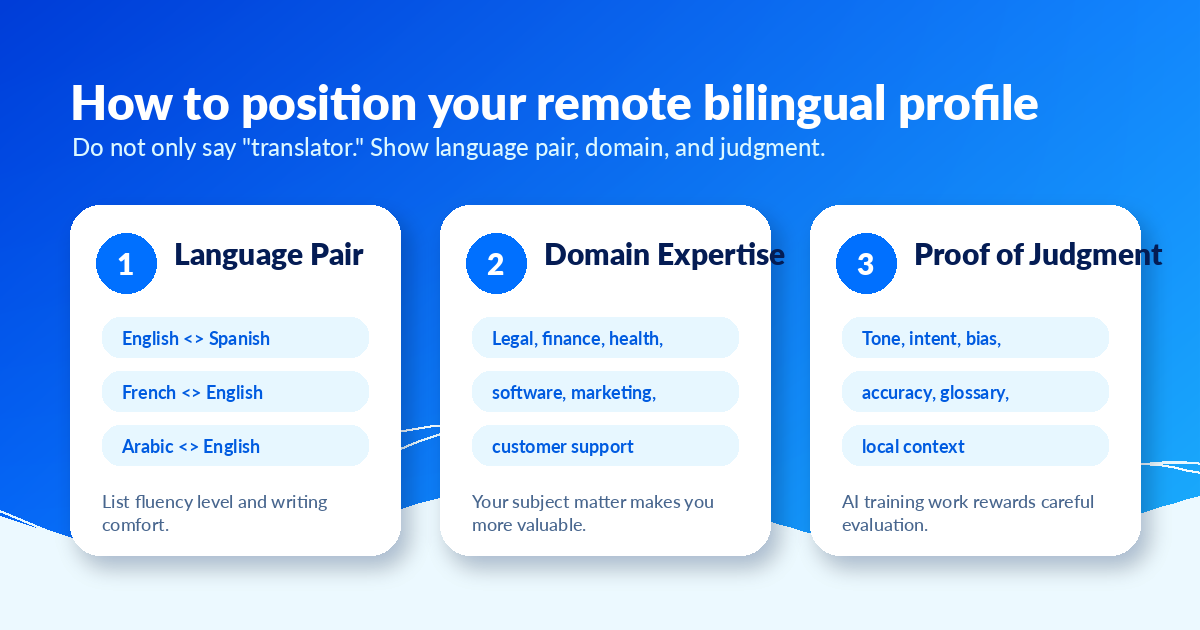
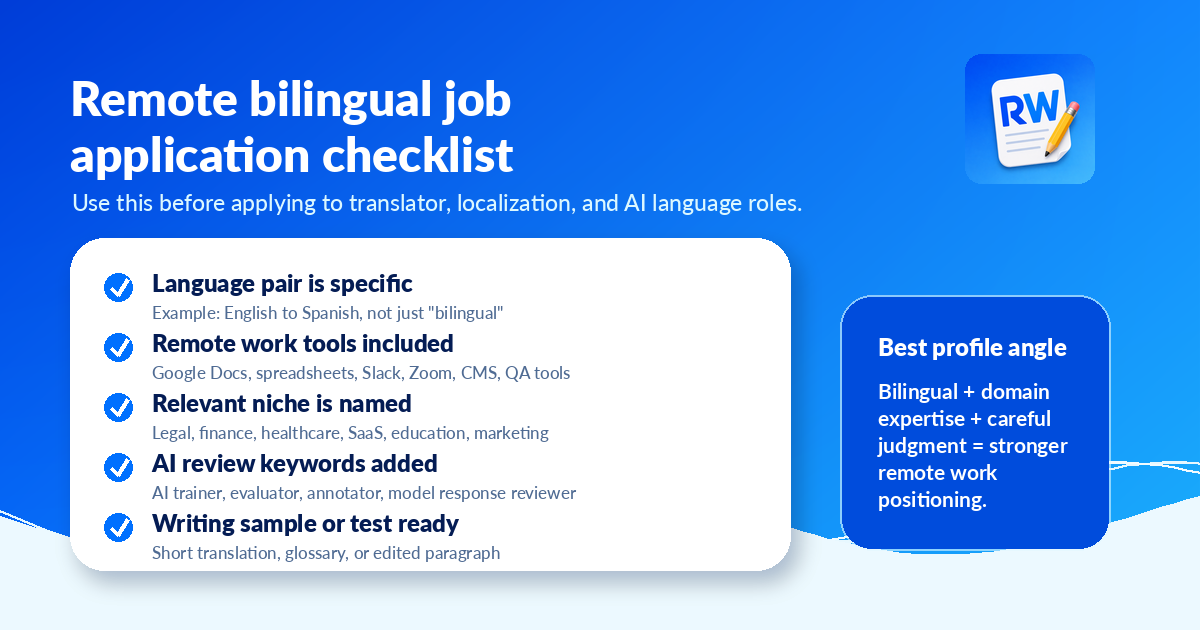
Your profile should make three things obvious: your language pair, your work context, and your judgment. Start with a direct headline: Bilingual English-Spanish Translator and AI Language Evaluator, French-English Localization Reviewer, Portuguese-English Content QA Specialist, or Bilingual Customer Support Specialist with AI Training Experience.
Then add proof. Mention the types of content you can handle — support articles, marketing pages, legal summaries, product documentation, transcripts, captions, research tasks, AI responses, or help center content. Include tools if relevant: Google Docs, spreadsheets, Slack, Notion, CMS tools, CAT tools, and AI tools. Finally, include judgment keywords: accuracy, tone, fluency, localization, terminology, cultural nuance, factual consistency, clarity, policy adherence, rubric-based review, model evaluation, and response comparison.
Do not describe bilingual skill as a side note. Treat it as a core asset. Language quality, localization judgment, and cultural accuracy are hard to automate perfectly, which is why human reviewers remain important.
Frequently Asked Questions
What remote jobs are available for bilingual professionals?
Bilingual professionals can apply for remote translator jobs, localization specialist roles, AI translation evaluator positions, multilingual content reviewer jobs, bilingual customer support roles, subtitle and caption QC work, search quality evaluation, and multilingual AI training or model evaluation projects.
Can translators work on AI training projects?
Yes. AI companies need bilingual professionals to review how models handle language, evaluate translation quality, judge whether responses are natural in the target language, and identify cultural or tonal errors. These roles use the same judgment skills as traditional translation but applied to AI outputs.
What languages are most in demand for remote bilingual work?
There is no single best language — demand depends on the company, market, task type, and project timing. English paired with Spanish, French, Portuguese, German, Arabic, Mandarin, Japanese, Korean, Hindi, and other widely used languages can appear across remote platforms. Rarer language pairs can reduce competition when a project needs them.
How should I position my bilingual skills for remote AI jobs?
State your language pair, proficiency level, subject areas, and type of work you can do. Add keywords like AI language evaluator, AI trainer, bilingual AI evaluator, model response reviewer, language data annotator, and multilingual AI reviewer. Pairing language skills with domain expertise like legal, finance, or healthcare makes your profile easier to match.