A lot of people think they need a niche before they can get paid online. They assume remote work is only for coders, designers, engineers, finance specialists, lawyers, or people with a clean job title that maps neatly to one skill.
That is not how a large part of remote work actually functions.
Many work from home jobs reward people who can read carefully, compare options, communicate clearly, follow instructions, spot mistakes, research unfamiliar topics, and make reasonable judgments without needing constant supervision. Those are generalist strengths. They are also exactly the strengths needed in many remote AI jobs, AI training jobs, data annotation projects, content quality roles, research jobs, no-phone support jobs, operations roles, and evaluation tasks.
Being a generalist does not mean being unqualified. It usually means your value is spread across several useful skills instead of concentrated in one obvious credential. The key is learning how to package that broad ability so remote hiring platforms and AI companies can understand where to place you.
What This Article Covers
- What a Generalist Actually Brings to Remote Work
- Why Generalists Fit the Growth of Remote AI Work
- 1. AI Response Evaluator
- 2. AI Data Annotation
- 3. Prompt Evaluator or Prompt Writing Assistant
- 4. Online Research Assistant
- 5. Fact-Checking and Source Review
- 6. Search Quality Rater
- 7. Content QA and Editorial Assistant Work
- 8. No-Phone Customer Support and Ticket Triage
- 9. Operations Assistant or Remote Coordinator
- 10. Customer Research and Voice-of-Customer Work
- 11. Knowledge Base and Documentation Reviewer
- 12. AI Safety and Red-Team Testing
- How to Position Yourself Without a Niche
- Frequently Asked Questions
What a generalist actually brings to remote work
A generalist is not someone who is "good at everything." That is too vague and usually not persuasive. A stronger definition is this:
A generalist is someone who can move between topics, learn context quickly, and produce useful work across writing, research, organization, communication, and decision-making tasks.
That matters because many remote jobs do not require a rare technical skill. They require reliable judgment. For example, a remote AI evaluator may need to compare two chatbot answers and decide which one is more helpful. A fact-checker may need to verify whether a claim is supported by credible sources. A data annotation worker may need to label examples consistently. A customer research assistant may need to read feedback and identify patterns. An operations assistant may need to keep a project moving without dropping details.
None of those roles require one narrow niche at the beginning. They require accuracy, patience, communication, and the ability to work independently.
Why generalists fit the growth of remote AI work
Remote AI work has created more opportunities for people whose strongest skill is judgment. AI systems are trained, tested, evaluated, and improved using human feedback. That feedback often comes from people who can judge whether an answer is clear, safe, accurate, useful, relevant, well-written, or aligned with instructions.
The broader AI ecosystem includes major AI companies and AI products connected to names like OpenAI, Anthropic, Google, Meta, and Grok. Around that ecosystem, many platforms and vendors need remote workers for AI training, AI evaluation, AI data annotation, prompt review, model response ranking, content review, search quality evaluation, and domain-specific feedback.
Some of those jobs require specialized expertise. Many do not. A beginner may not qualify for advanced coding, legal, medical, or finance evaluation projects, but they may still qualify for general writing, reasoning, instruction-following, content judgment, research, safety review, or data labeling tasks.
For a generalist, that is the opening. You are not selling one narrow title. You are selling the ability to make good decisions across changing tasks.
1. AI response evaluator
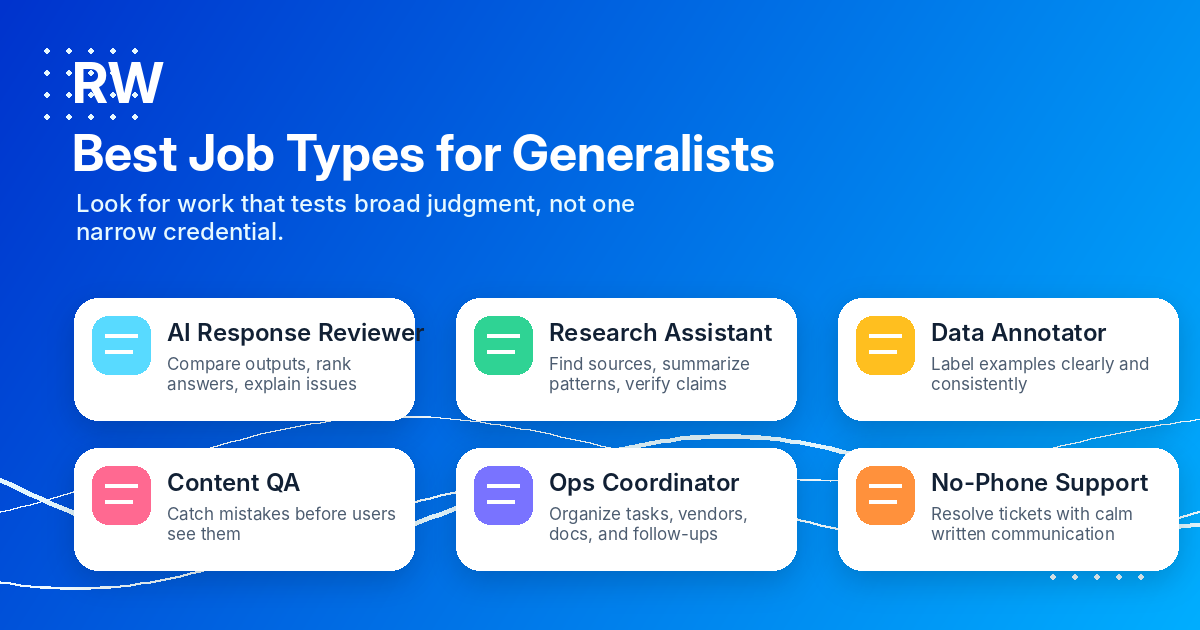
AI response evaluation is one of the best remote work categories for generalists. In this type of role, you may compare two AI-generated answers, rate helpfulness, identify factual errors, check whether the response followed instructions, or explain why one answer is better than another.
This work rewards broad reading ability. You do not always need to be a programmer. You need to understand the user's request, notice whether the answer is complete, identify weak reasoning, and explain your judgment clearly.
Good fit if you are strong at: reading carefully, comparing two options, explaining why something is better or worse, spotting vague or incomplete answers, writing short rationales, and following detailed guidelines.
Keywords to use in your profile include AI evaluator, AI response reviewer, AI training, model evaluation, prompt evaluation, content quality, answer ranking, instruction following, and human feedback.
2. AI data annotation
Data annotation is another strong entry point for generalists. The work may involve labeling text, images, search results, product listings, messages, conversations, or examples that help AI systems understand patterns.
Some annotation jobs are simple and repetitive. Others require careful judgment. A generalist can do well when the task involves reading guidelines, applying labels consistently, and noticing edge cases.
The advantage of data annotation is that it often gives beginners a way to build remote task history. The disadvantage is that work can be inconsistent, and the best projects may require passing qualification tests.
Good fit if you are strong at: consistency, detail orientation, pattern recognition, reading rules before acting, staying accurate during repetitive work, and asking whether an example fits a category.
Use keywords like data annotation, AI annotation, data labeling, text annotation, classification, categorization, quality control, and AI training data.
3. Prompt evaluator or prompt writing assistant
Prompt work is not only for technical people. Many remote AI platforms need workers who can test prompts, rewrite prompts, evaluate whether an AI response followed a prompt, or create examples that reflect real user requests.
A generalist may be especially useful here because people use AI for many topics: emails, summaries, planning, research, brainstorming, customer support, job applications, content writing, coding explanations, and everyday decision-making. A person with broad interests can often create more realistic prompts than someone who only thinks in one narrow category.
Good fit if you are strong at: writing natural instructions, thinking like a real user, testing whether instructions are clear, improving wording, comparing outputs, and explaining what went wrong.
Profile keywords: prompt writing, prompt evaluation, AI prompt testing, chatbot evaluation, instruction writing, model response review, and AI content evaluation.
Pay range: General AI evaluation and annotation roles often start at $20+/hr. Expert-tier roles for domain specialists can reach $50–$200/hr. Generalists can start at the entry level and move toward higher-value projects as they build task history.
4. Online research assistant
Research assistant work is a good remote job for generalists because the subject matter can change from week to week. You might research companies, competitors, products, job markets, creators, leads, industry trends, public data, or source material for content.
This is not the same as academic research. Many online research jobs are practical. The employer needs someone who can find information, organize it, summarize it, and separate useful sources from low-quality sources.
Good fit if you are strong at: searching the web effectively, reading quickly without missing key details, summarizing findings, checking source quality, organizing links and notes, and turning messy information into a clean brief.
Use keywords like online research, web research, market research, competitive research, source review, fact-checking, lead research, and research assistant.
5. Fact-checking and source review
Fact-checking is a natural fit for generalists who enjoy accuracy. This work may involve checking claims in articles, AI responses, marketing copy, summaries, product descriptions, or educational material.
For AI training work, fact-checking can be especially valuable because AI systems can produce answers that sound confident but contain unsupported claims. A human reviewer may need to verify whether a statement is true, whether a source actually supports it, or whether the answer should be rewritten.
Good fit if you are strong at: skepticism without being difficult, checking claims against sources, distinguishing opinion from fact, explaining uncertainty, catching misleading wording, and reading beyond the first search result.
Keywords: fact-checker, source reviewer, research evaluator, accuracy review, AI fact-checking, content verification, claim review, and editorial QA.
6. Search quality rater
Search quality rating is another remote work category that can fit generalists. These roles usually involve reviewing search results, judging whether a page satisfies a query, rating relevance, or evaluating the quality of online content.
The work is structured, but it requires human judgment. You need to understand what the user likely wanted, whether the result is useful, and whether the content is trustworthy.
Good fit if you are strong at: understanding search intent, comparing relevance, reading guidelines, rating examples consistently, thinking from the user's perspective, and noticing low-quality or spammy pages.
Use keywords like search quality rater, search evaluator, web evaluator, relevance rating, online content evaluation, and user intent.
7. Content QA and editorial assistant work
Content quality assurance is a practical work from home path for generalists with writing and editing instincts. You may review articles, landing pages, emails, help center content, product descriptions, or AI-generated copy before it gets published.
This role does not always require being a full-time writer. Sometimes the job is simply to catch errors, improve clarity, check formatting, verify links, make sure the copy matches instructions, and flag anything confusing.
Good fit if you are strong at: grammar and clarity, formatting checks, link checking, content organization, brand consistency, and reading like an end user.
Keywords: content QA, editorial assistant, proofreader, content reviewer, AI content editor, copy review, quality assurance, and publishing assistant.
Ready to turn your broad skills into remote work? Find AI training roles, research jobs, and content QA opportunities on RemoteWorkUnion.com.
Find Roles Hiring Now →8. No-phone customer support and ticket triage
Many generalists avoid customer service because they do not want phone work. That is reasonable. But not all customer support jobs require calls. Some work is email, chat, ticket triage, help desk support, community support, or knowledge base support.
This can be a strong fit for generalists because the role combines communication, problem solving, organization, and judgment. You may not need to be a technical specialist if you can follow documentation, identify the user's issue, write clearly, and escalate the right cases.
Good fit if you are strong at: written communication, staying calm with frustrated users, following templates without sounding robotic, sorting issues by urgency, documenting what happened, and knowing when to escalate.
Use keywords like no-phone support, email support, chat support, ticket support, customer operations, help desk, support specialist, and remote customer support.
9. Operations assistant or remote coordinator
Operations work is one of the most underrated paths for generalists. Companies need people who can keep things organized: schedules, spreadsheets, vendors, documents, tasks, handoffs, project updates, applicant tracking, onboarding, and internal processes.
A generalist can perform well here because operations work often touches many parts of a business. You do not need to be the deepest expert in one thing. You need to make sure nothing falls through the cracks.
Good fit if you are strong at: organization, written updates, spreadsheet basics, process improvement, follow-through, and keeping people aligned.
Keywords: operations assistant, remote coordinator, project coordinator, admin operations, virtual assistant, process coordinator, recruiting coordinator, and workflow management.
10. Customer research and voice-of-customer work
Customer research is different from customer support. Instead of solving one person's problem, you may read many reviews, survey responses, support tickets, comments, interviews, or social posts and identify patterns.
This is a good generalist role because it rewards interpretation. You need to understand what people mean, group similar complaints, notice common requests, and summarize insights in plain English.
Good fit if you are strong at: reading between the lines, grouping similar feedback, summarizing patterns, understanding customer frustration, turning messy text into themes, and writing useful reports.
Use keywords like customer research, voice of customer, insights assistant, user feedback analysis, survey analysis, qualitative research, and customer insights.
11. Knowledge base and documentation reviewer
Documentation work can fit generalists who are organized and clear writers. You may review help articles, internal guides, onboarding documents, FAQs, process documents, or AI-generated support content.
The goal is usually to make information easier to understand. You may check whether instructions are complete, whether steps are in the right order, whether screenshots or links are missing, and whether a user could follow the process without help.
Good fit if you are strong at: explaining steps clearly, organizing information, noticing missing context, simplifying confusing language, testing instructions from a beginner's perspective, and updating documents consistently.
Keywords: documentation reviewer, knowledge base assistant, help center content, process documentation, SOP writer, technical documentation assistant, and content operations.
12. AI safety and red-team testing for nontechnical users
Some AI testing work focuses on safety, policy, and edge cases. Not every safety project is technical. Some tasks need people to test how AI systems respond to ambiguous instructions, harmful requests, manipulative wording, sensitive topics, or confusing user prompts.
This type of work can fit generalists who have strong judgment and can explain risk clearly. It may require stricter guidelines and careful reasoning, but it can be a strong long-term direction once you have experience with AI evaluation.
Good fit if you are strong at: policy reasoning, edge-case thinking, calm judgment, explaining why something is unsafe or low quality, following detailed rules, and writing clear justifications.
Keywords: AI safety, red-team testing, policy evaluation, safety review, trust and safety, harmful content review, and model behavior testing.
How to position yourself when you do not have a niche
The biggest mistake generalists make is describing themselves too broadly. "I can do anything" sounds flexible, but it does not help a remote platform decide what to match you with.
A better strategy is to build a profile around a skill stack. A skill stack is a combination of practical abilities that point toward specific remote work categories.
For example:
- Writing + research + accuracy = AI response evaluation, fact-checking, content QA
- Organization + communication + follow-up = operations assistant, project coordinator, no-phone support
- Pattern recognition + patience + rule-following = data annotation, search quality rating, QA review
- Customer sense + summarization + analysis = customer research, voice-of-customer work, user feedback analysis
This framing is much stronger than simply saying you are a generalist.
A simple remote profile formula for generalists
Use this structure when applying to remote work platforms, AI training platforms, and work from home jobs:
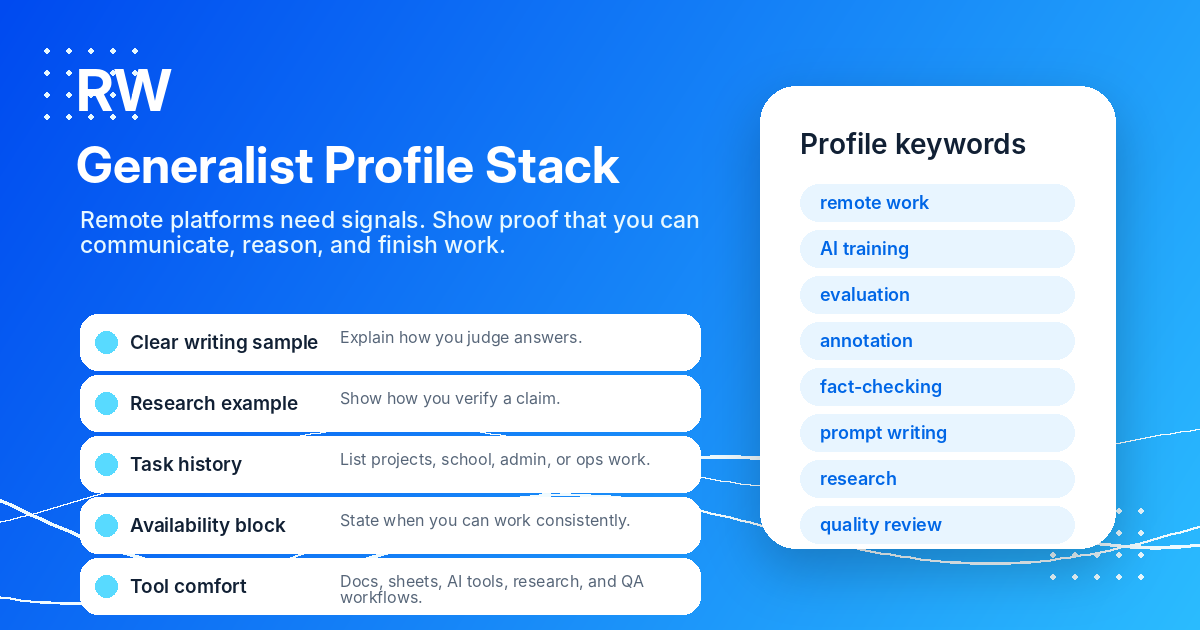
- Start with the work category you want.
- Name the skills that make you useful.
- Give proof from past work, school, freelancing, projects, or life experience.
- Mention tools and workflows you can handle.
- End with availability and reliability.
Example: "I am applying for remote AI evaluation and research-based work. My strengths are clear writing, careful reading, web research, fact-checking, and explaining why one answer is stronger than another. I have experience organizing information, reviewing content, summarizing findings, and working independently. I am comfortable with Google Docs, spreadsheets, ChatGPT, online research, content review, and written communication. I can commit to consistent weekly availability and follow detailed task guidelines."
That profile does not claim a fake niche. It turns broad ability into a clear remote work offer.
What generalists should not do when applying
Generalists often lose opportunities because they undersell themselves or apply too randomly. Avoid these mistakes:
- Do not lead with "I have no experience." Lead with relevant strengths.
- Do not say "I will do anything." Name the categories you fit.
- Do not apply to every role with the same profile. Adjust keywords for the job.
- Do not ignore qualification tests. Many platforms care more about the test than your resume.
- Do not exaggerate expertise. It is better to be honest and precise.
- Do not overlook no-phone support, QA, research, and operations roles while chasing only AI jobs.
- Do not assume a niche has to come before you start. A niche can develop after you see which work you are good at.
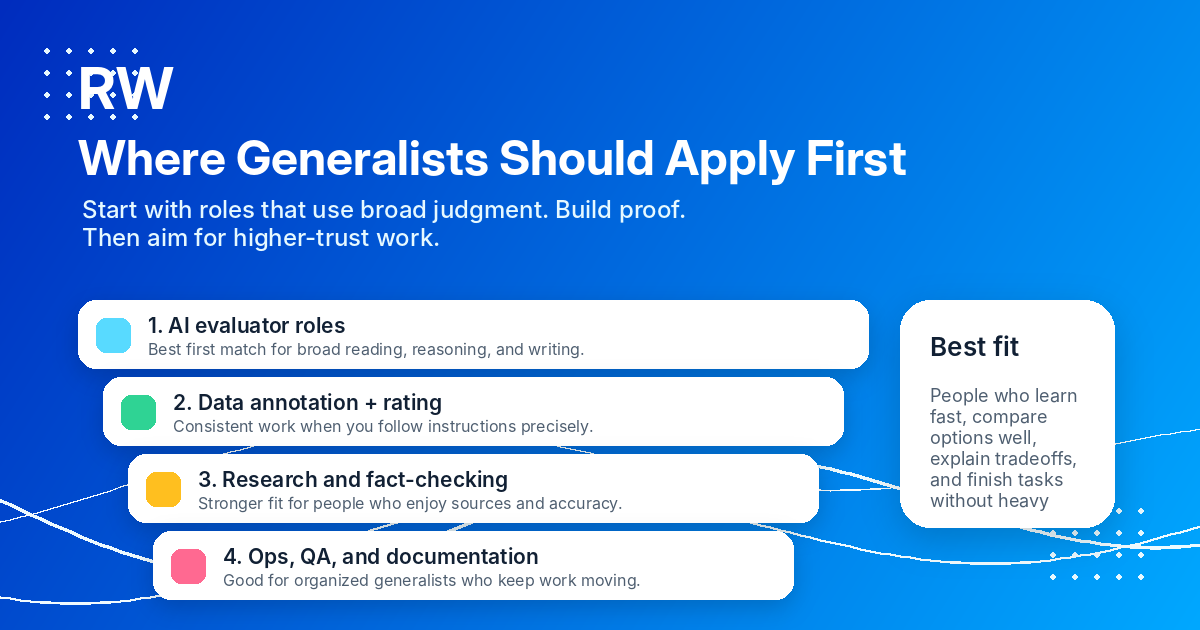
How to turn generalist work into a long-term remote career
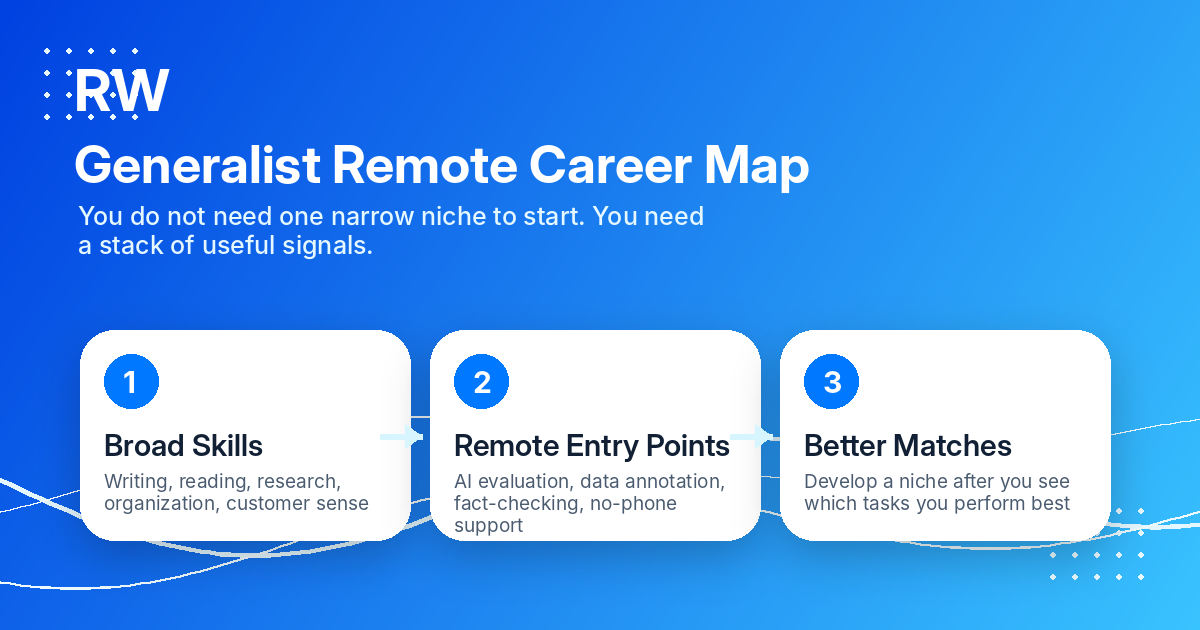
The long-term goal is not to stay vague forever. The goal is to use generalist work to discover where you perform best.
After a few projects, track what you are strongest at:
- Do you get good feedback on writing rationales? Move toward AI evaluation and content review.
- Do you enjoy verifying claims? Move toward fact-checking and research.
- Do you like structure and repetition? Move toward annotation, QA, and workflow roles.
- Do you understand customer problems quickly? Move toward customer research or support operations.
- Do you organize messy projects well? Move toward operations and coordination.
Your niche does not have to be invented in advance. It can be earned through evidence.
Frequently Asked Questions
Can I get remote work if I do not have a niche?
Yes. Many remote jobs reward transferable skills like writing, research, organization, detail orientation, judgment, and communication. You still need to apply to specific categories, but you do not need to begin with one narrow specialty.
Are remote AI jobs good for generalists?
They can be. AI evaluation, data annotation, prompt testing, response ranking, content review, and fact-checking often rely on broad human judgment. Some projects require expert credentials, but many general tasks are built for careful readers and clear writers.
What should I put on my resume if I am a generalist?
Use skill-based language tied to the role. Include writing, research, content review, data organization, customer communication, quality assurance, online tools, spreadsheets, documentation, AI tools, and independent remote work habits when accurate.
What if I have no remote work experience?
Use adjacent proof. School projects, admin work, customer service, writing samples, research projects, volunteer work, operations tasks, content editing, and freelance projects can all show useful skills. Remote platforms often care about whether you can pass the task test.
Should I choose a niche eventually?
Eventually, yes. But you do not need to choose one before you start. Begin with broad remote work categories, track what you do well, then specialize based on real performance.