Remote AI jobs are not only for software engineers, data scientists, or people who can code. A growing share of remote AI training, AI evaluation, AI data annotation, and AI content review work depends on people who can read carefully, reason across topics, notice weak answers, and explain what should be improved.
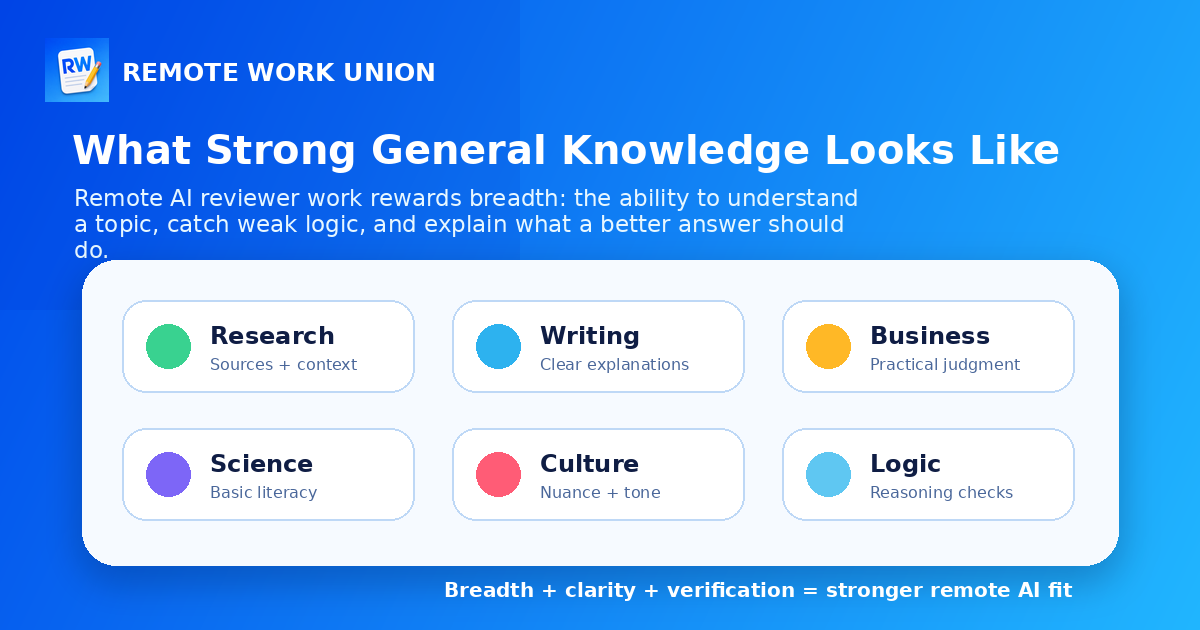
That is where strong general knowledge matters. If you understand history, science basics, business, culture, language, current events, internet research, and everyday common sense better than the average person, you may already have the foundation for remote AI work. The job is usually not to be a walking encyclopedia. The job is to judge whether an AI response is helpful, accurate, complete, safe, and well-written.
This guide explains the best remote AI jobs for generalists, what skills matter most, how to position yourself, and how to avoid wasting time on low-quality applications.
Why General Knowledge Matters in Remote AI Work
AI systems are trained and evaluated across many topics. One task may involve comparing two answers about personal finance. Another may ask whether a response explains a science concept clearly. Another may involve rating a draft email, reviewing a search summary, checking a legal-sounding answer for unsupported claims, or deciding whether an AI assistant followed a user instruction.
A narrow specialist can be useful for expert tasks, but many AI evaluation jobs need broad judgment. The reviewer has to understand enough about many subjects to know when an answer sounds plausible but is incomplete, misleading, overconfident, or poorly structured. This is why remote AI jobs can be a strong fit for writers, researchers, teachers, editors, analysts, consultants, journalists, college graduates, lifelong learners, and detail-oriented professionals from non-technical fields.
The most valuable generalists combine curiosity with discipline. They do not simply rely on instinct. They know when to verify, when to question an assumption, and when to explain uncertainty clearly.
Best Remote AI Job Types for Generalists
- AI response evaluator: You compare AI-generated answers, decide which response is better, and explain your reasoning. This role rewards reading comprehension, logic, and clear writing.
- AI content reviewer: You review outputs for quality, tone, relevance, safety, and instruction-following. This can overlap with editing, policy review, and customer experience work.
- AI data annotation specialist: You label, classify, rank, or structure information so AI systems can learn from it. Some tasks are simple, while others require strong judgment and domain awareness.
- Fact-checking and research reviewer: You inspect whether claims are supported, whether sources are appropriate, and whether an answer makes claims that should be qualified. This is a good fit for people who naturally verify information before trusting it.
- Prompt and instruction evaluator: You test whether an AI model follows instructions. This can involve identifying missing constraints, testing edge cases, and writing feedback that helps improve model behavior.
- Generalist AI trainer: You write examples, rate answers, improve prompts, and evaluate model responses across a wide range of everyday subjects. This is often the most direct match for people with broad knowledge but no coding background.
Skills That Matter More Than Coding
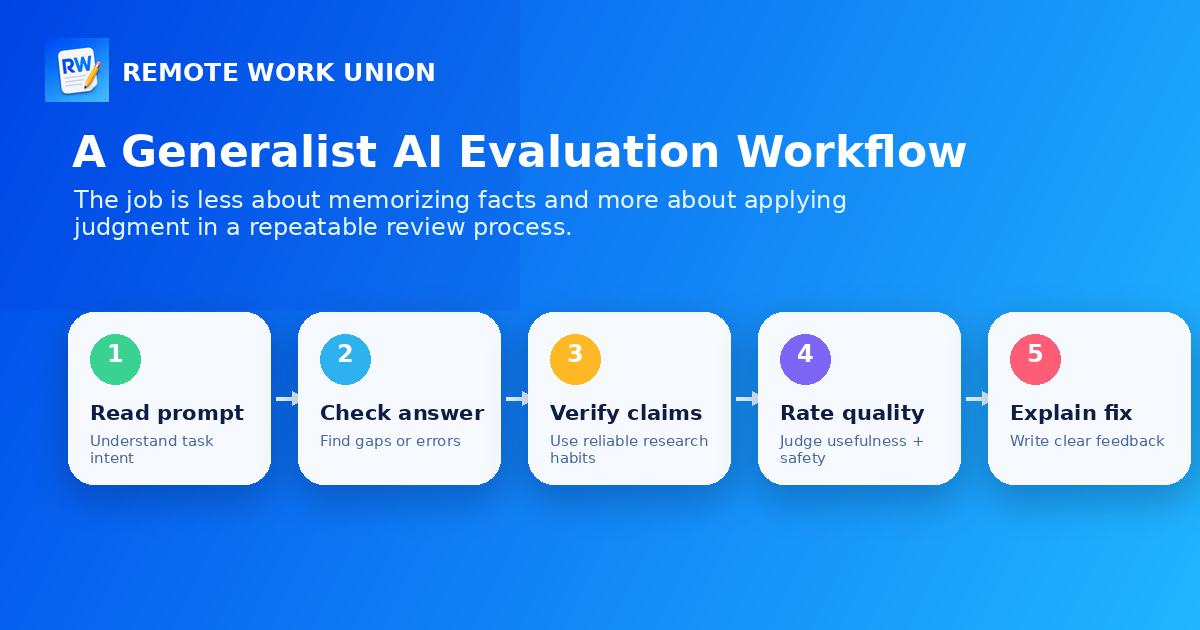
- Strong reading comprehension: You need to understand the user request, the AI answer, the grading rubric, and the difference between a minor issue and a serious failure.
- Clear written explanations: Many platforms care about why you made a judgment. A good reviewer can write concise feedback such as: "Response A is more complete because it addresses the user's constraint, but it should avoid making an unsupported claim about cost."
- Research discipline: General knowledge helps you notice when something may be wrong. Research discipline helps you avoid guessing. Good reviewers verify claims, compare sources, and separate confirmed facts from assumptions.
- Logical reasoning: AI answers often sound polished even when the reasoning is weak. You need to identify contradictions, missing steps, vague conclusions, and answers that appear confident without support.
- Judgment about tone and usefulness: The best answer is not always the longest answer. Remote AI jobs often require you to judge whether an answer is practical, direct, safe, and actually helpful for the person asking.
- Consistency: Platforms prefer workers who apply the same standards repeatedly. Being smart is not enough if your ratings are unpredictable or your explanations are too vague.
How to Know If You Are a Strong Candidate
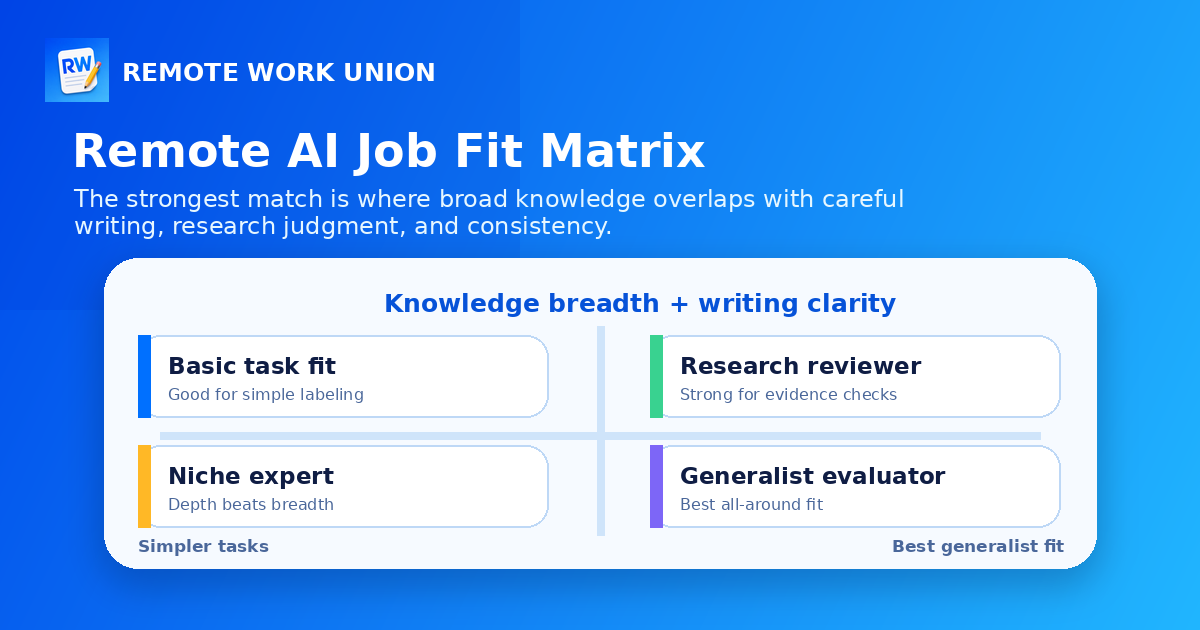
You may be a good fit for generalist remote AI work if you enjoy reading, comparing arguments, checking details, explaining why something is right or wrong, and learning new topics quickly. You do not need to know every subject deeply. You do need enough background knowledge to recognize when a response deserves a closer look.
A strong candidate can look at two answers and explain which one is more useful. A strong candidate can notice when an AI answer ignores part of the prompt. A strong candidate can say, "This might be correct, but it needs verification," instead of treating a confident sentence as a fact.
This work is especially promising for people who are naturally good at trivia, writing, editing, debate, research, teaching, customer support, operations, consulting, marketing, legal support, finance, or any role that required them to understand many topics at once.
Want to find AI training roles that fit generalist skills? Discover opportunities on RemoteWorkUnion.com.
Find Roles Hiring Now →How to Position Your Profile and Application
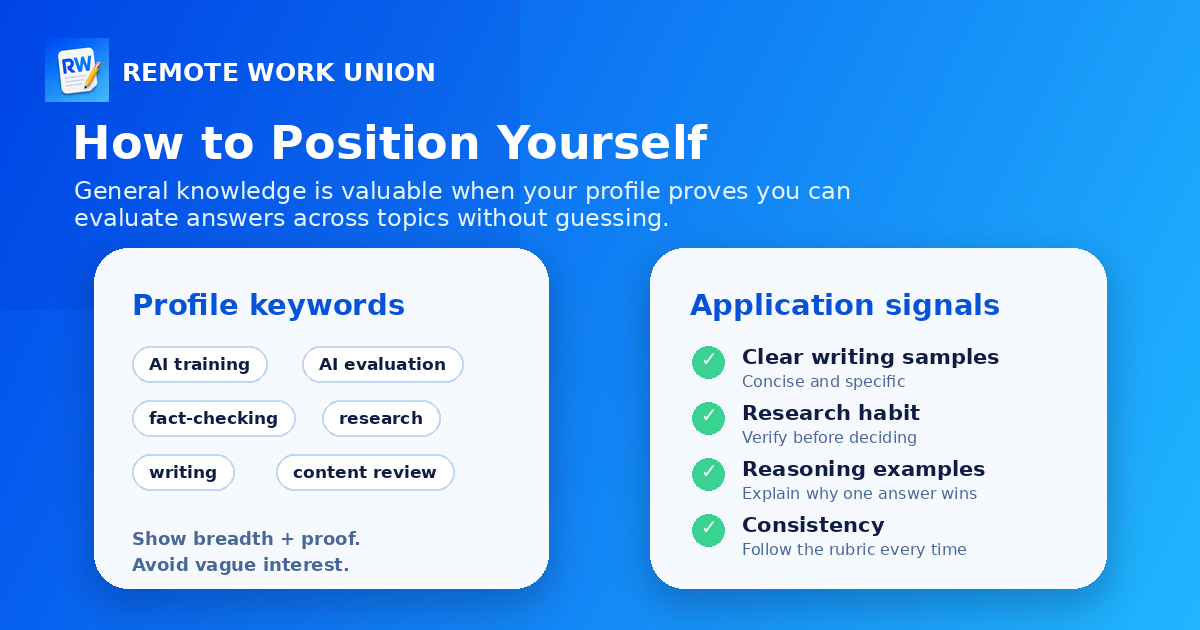
Do not describe yourself only as "interested in AI." That is too broad. Platforms and hiring teams need to know what you can actually do. Use specific language that connects your background to remote AI evaluation work.
Good profile keywords include: AI training, AI evaluation, AI response rating, AI data annotation, fact-checking, research, content review, writing, editing, prompt evaluation, instruction-following, general knowledge, quality assurance, and remote work.
Your application should show proof. Mention writing experience, research projects, editorial work, analysis, teaching, content creation, business writing, customer-facing judgment, compliance review, or any role where you had to evaluate information carefully. If you have no formal experience, create a simple sample: compare two AI-style answers and explain which one is better in 150 to 250 words.
For generalist roles, avoid pretending to be a narrow expert if you are not one. A better positioning statement is: "I have strong general knowledge, clear writing ability, and experience evaluating information across business, culture, technology, and everyday consumer topics."
Common Mistakes Generalists Make
The first mistake is applying too casually. Remote AI jobs can look informal, but the platforms still evaluate precision. A rushed profile, vague answers, or careless grammar can make a strong candidate look unreliable.
The second mistake is overclaiming expertise. General knowledge is valuable, but it is not the same as being a medical, legal, engineering, or finance expert. Strong reviewers know when to stay in their lane and when to flag uncertainty.
The third mistake is rating based on vibes. AI evaluation work requires evidence. If one answer is better, explain why. Did it follow the instruction more closely? Was it more accurate? Was it more complete? Was the structure easier to use? Did it avoid unsupported claims?
The fourth mistake is ignoring the rubric. Each platform has its own grading instructions. Even if you personally prefer one style of answer, your job is to apply the stated criteria consistently.
Where Major AI Company Keywords Fit Naturally
As AI tools from companies such as OpenAI, Anthropic, Google, Meta, and Grok become more common, the demand for human judgment remains important. These systems need evaluation across writing, reasoning, research, coding-adjacent tasks, safety, helpfulness, and real-world usefulness.
For profile positioning, it is reasonable to use phrases like "AI training jobs," "AI evaluator jobs," "remote AI jobs," "AI data annotation," "AI response review," and "work from home AI jobs." However, do not imply you worked for a major AI company unless that is true. Use the keywords to describe the kind of work, not to exaggerate your background.
How to Build Long-Term Opportunity
The best way to grow from generalist AI work is to become reliable first, then specialize where your strengths are obvious. If you consistently do well on research-heavy tasks, pursue research evaluator work. If your writing feedback is strong, pursue AI writing evaluator and editing tasks. If you understand business, finance, law, health, education, or technical topics, build toward subject matter expert projects.
Keep a simple record of your strongest categories, the types of tasks you complete fastest, and the mistakes you learn to avoid. Over time, remote AI platforms may route better work to people who are consistent, accurate, and easy to trust.
Key insight: General knowledge is not a fallback skill. In AI evaluation, it can be the foundation for a flexible remote career because it lets you move across topics, learn quickly, and apply judgment where automation still needs human review.
Conclusion
Remote AI jobs for people with strong general knowledge are a real path for non-technical professionals, writers, researchers, editors, teachers, analysts, career changers, and curious people who want flexible work from home. The key is to present yourself as more than someone who "knows a lot." Show that you can read carefully, verify claims, follow instructions, compare answers, and explain your judgment clearly.
You do not need to code to start. You do need precision, patience, research habits, and the ability to turn broad knowledge into useful feedback. That combination is exactly what many remote AI training and evaluation tasks need. Platforms like Handshake AI, Mercor, micro1, and Outlier AI all offer generalist-accessible paths alongside specialist roles — the key is matching yourself to the right opportunity.
Frequently Asked Questions
Do I need coding skills to get remote AI jobs with general knowledge?
No. Many remote AI training and evaluation jobs do not require coding. Platforms like Handshake AI, Mercor, micro1, and Outlier AI have roles for writers, researchers, editors, teachers, analysts, and other generalists who can read carefully, evaluate quality, fact-check claims, and explain their reasoning clearly.
What kinds of tasks do generalist AI evaluators do?
Generalist AI evaluators typically compare AI-generated responses and decide which is better, check whether answers are accurate and complete, rate responses for helpfulness and safety, write feedback explaining why one answer is stronger, and verify factual claims. The work rewards reading comprehension, research habits, and clear written explanations more than technical skills.
How do I position my profile for generalist remote AI jobs?
Use specific language that connects your background to evaluation work. Good profile keywords include AI training, AI evaluation, AI response rating, AI data annotation, fact-checking, research, content review, writing, editing, and quality assurance. Show proof through writing samples, research projects, editorial work, or any role that required you to evaluate information carefully.
How much do generalist remote AI jobs pay?
Pay varies by platform and task type. General AI training and evaluation work typically starts at $20 or more per hour, while expert-tier work for people with strong domain knowledge in areas like law, finance, medicine, or engineering can reach $50 to $200 per hour.
Where should I apply for remote AI jobs if I have strong general knowledge?
The best starting points are Handshake AI, Mercor, micro1, and Outlier AI. These platforms have roles for generalist reviewers, writers, researchers, and evaluators alongside specialist roles. Apply to the role that best matches your strongest demonstrated skill rather than applying broadly to every listing.