Some people are unusually good at spotting mistakes. They notice the typo in a sentence before anyone else does. They can tell when an answer sounds confident but does not actually answer the question. They catch missing details, duplicated rows, broken links, confusing instructions, weak sources, and small inconsistencies that most people scroll past.
That skill is more valuable in remote work than many people realize. A large part of modern online work is not about being the loudest person in a meeting or the fastest person on the phone. It is about reviewing information, checking quality, comparing options, following instructions, and explaining what went wrong. That is especially true in remote AI training, AI model evaluation, data annotation, quality assurance, proofreading, research, and content review.
For people who notice mistakes fast, the best remote jobs are not always traditional customer service or entry-level admin roles. The stronger fit is often work that rewards accuracy, judgment, patience, and clear written feedback.
Why Mistake-Spotting Is a Real Remote Work Skill
Remote companies rely on written instructions, digital workflows, software systems, documents, dashboards, and async communication. That creates many places where small mistakes can become expensive: a bad label in a dataset, an incorrect answer from an AI model, a broken checkout flow, a typo in a legal document, a false claim in a research summary, or a confusing support article.
People who notice mistakes quickly help companies prevent those problems. They act as a quality filter before work reaches customers, clients, hiring teams, internal databases, or AI systems. The work may look simple from the outside, but the best reviewers are not just clicking boxes. They are making judgment calls.
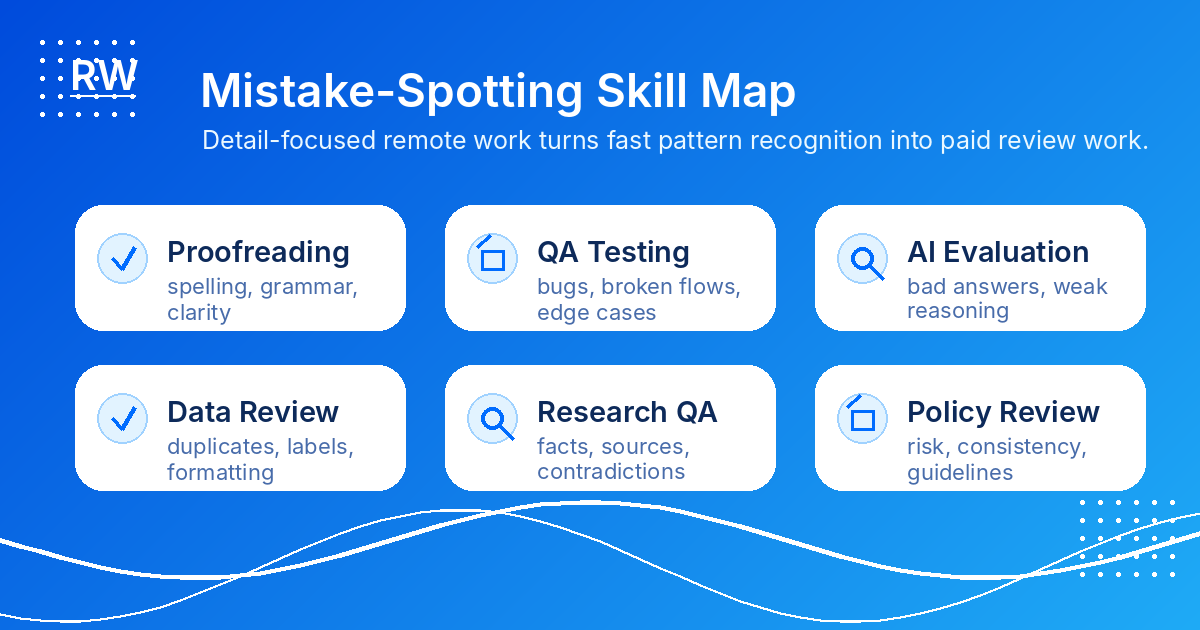
This is why detail-focused workers can do well in remote roles that involve QA, proofreading, AI evaluation, model response ranking, transcription review, fact-checking, compliance checks, and data validation. These jobs often reward the ability to slow down, compare carefully, and explain the problem in plain English.
1. AI Model Response Evaluator
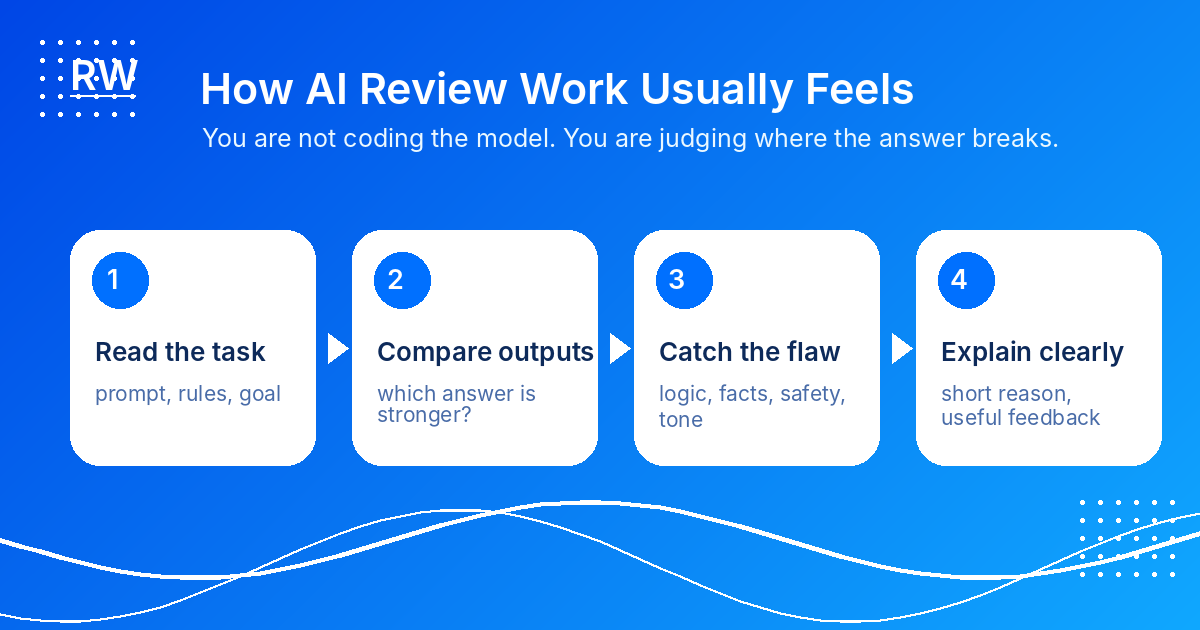
AI model response evaluation is one of the strongest remote work categories for people who notice mistakes fast. In these roles, you may compare two AI-generated answers, rate whether a response followed instructions, identify factual errors, judge tone, or explain why one answer is more useful than another.
This type of work can be a fit for people who are not coders. You do not always need to build the AI model. Many projects need people who can evaluate outputs using strong reading comprehension, logic, research ability, and subject-matter judgment. Platforms and companies connected to the AI industry may use terms like AI evaluator, AI trainer, AI rater, AI response reviewer, model evaluation specialist, prompt evaluator, or LLM evaluator.
The best applicants are precise. They can say more than "this answer is bad." They can explain that the answer ignored part of the prompt, invented a fact, used the wrong format, gave unsafe advice, missed a constraint, contradicted itself, or sounded fluent without being correct. That is exactly where fast mistake-spotting becomes useful.
2. Data Annotation Reviewer
Data annotation work is often described as labeling text, images, audio, documents, or search results so AI systems can learn from it or be evaluated against it. But there is also a review layer. Data annotation reviewers check whether labels are accurate, whether instructions were followed, and whether edge cases were handled consistently.
For detail-oriented applicants, review work is often more interesting than basic labeling. You may be asked to decide whether a category fits, whether a text passage was tagged correctly, whether a transcript has errors, or whether a task should be escalated because the instructions do not cover the situation.
Good reviewers are consistent. They do not just rely on instinct. They read the guidelines, apply the same standard across many examples, and notice when two similar items were treated differently.
3. Proofreader or Copy Editor
Proofreading is one of the most obvious remote jobs for people who notice mistakes fast. Proofreaders catch spelling, grammar, punctuation, formatting, consistency, and basic clarity issues. Copy editors go deeper by improving structure, tone, flow, accuracy, and readability.
This can include blog posts, newsletters, website pages, product descriptions, resumes, marketing copy, training materials, captions, transcripts, internal documents, and AI-generated drafts. As more companies use AI tools to produce rough content, human editors are still needed to catch the parts that sound off, read awkwardly, repeat the same point, or make claims that need checking.
A strong proofreading profile should mention accuracy, style guides, grammar, formatting, consistency checks, editing, content QA, and written communication. Applicants should also be ready to complete short editing tests.
4. Remote QA Tester
Quality assurance testing is another strong fit. Remote QA testers look for bugs, broken user flows, confusing screens, missing confirmations, mobile layout problems, incorrect form behavior, and anything else that prevents software from working as intended.
Some QA jobs require technical experience, automation knowledge, or coding. Others are closer to manual testing, website testing, app testing, or user experience review. These can be better for beginners who are observant, organized, and able to document exactly what happened.
A good QA note does not just say "it broke." It says what device or browser was used, which steps caused the problem, what was expected, what actually happened, and whether the issue happened more than once.
5. Fact-Checking and Research Assistant Work
Fact-checking and research roles are a natural fit for people who notice when something sounds questionable. Remote research assistants may verify claims, compare sources, summarize documents, find supporting evidence, check dates, confirm company details, or review AI-generated research for accuracy.
This work rewards curiosity and skepticism. The goal is not to argue with every sentence. The goal is to identify the claims that matter, check whether they are supported, and flag uncertainty when the evidence is weak.
In AI-related work, fact-checking can be especially important because a model may produce an answer that sounds polished while still being wrong.
6. Search Quality Evaluator
Search quality evaluation is remote review work where people judge whether search results, recommendations, ads, snippets, or online answers match user intent. This type of role can be a good match for people who quickly notice irrelevant results, misleading summaries, low-quality pages, or mismatched search intent.
The work requires patience and consistency. You may read a query, examine the result, and decide whether it is useful, trustworthy, current enough, or aligned with what the user likely wanted. Strong evaluators are good at separating personal opinion from the written guidelines.
Detail-oriented workers are some of the strongest candidates for remote AI evaluation, QA, and accuracy-based roles. Find opportunities that match your strengths.
Find Roles Hiring Now →7. Content Moderator or Policy Reviewer
Content review and policy evaluation can also fit people who notice mistakes fast, especially if they are good at applying rules consistently. These jobs may involve reviewing posts, comments, ads, listings, images, or text against platform policies.
The key skill is guideline adherence. A good reviewer can look at a piece of content and decide whether it violates a rule, is borderline, needs escalation, or is allowed. This category is not for everyone as some moderation work can involve sensitive material. But there are also lower-intensity policy review roles involving ads, listings, documents, or business content.
8. Compliance Review Assistant
Compliance review work involves checking documents, forms, listings, claims, internal records, or communications against rules and standards. It can appear in finance, insurance, healthcare operations, legal operations, HR, recruiting, marketplaces, and regulated business workflows.
This type of work rewards people who notice missing fields, mismatched dates, inconsistent names, unsupported claims, formatting problems, or incomplete records.
9. Transcription, Caption, and Audio Review
Transcription and caption QA can be a strong fit for people who catch small language errors quickly. The work may involve checking whether audio was transcribed correctly, whether captions are timed correctly, whether speaker labels are accurate, or whether punctuation makes the transcript readable.
The strongest applicants usually have good listening ability, spelling, formatting consistency, and patience.
10. Remote Operations Checker or Admin QA
Many companies need people to check operational work: applications, onboarding forms, invoices, spreadsheets, CRM entries, job listings, product catalogs, order records, or customer account details. These jobs may be listed as operations assistant, data quality specialist, admin QA, listing reviewer, catalog specialist, remote operations associate, or quality control assistant.
Applicants can stand out by emphasizing spreadsheet accuracy, data entry quality, documentation, process improvement, error tracking, and written communication.
How to Know Which Role Fits You Best
The best remote job depends on what kind of mistake you notice fastest.
If you instantly catch grammar and wording issues, proofreading, editing, transcript QA, and content review may fit. If you notice bad logic, weak reasoning, or answers that do not follow instructions, AI model evaluation may fit. If you notice software bugs or confusing app flows, QA testing may fit. If you notice unsupported claims or suspicious details, research and fact-checking may fit. If you notice missing fields, duplicates, and inconsistent records, data quality or operations QA may fit.
The mistake you naturally catch first is usually a clue. Build your remote work profile around that strength instead of describing yourself only as "hardworking" or "reliable."
Profile Keywords to Use When Applying
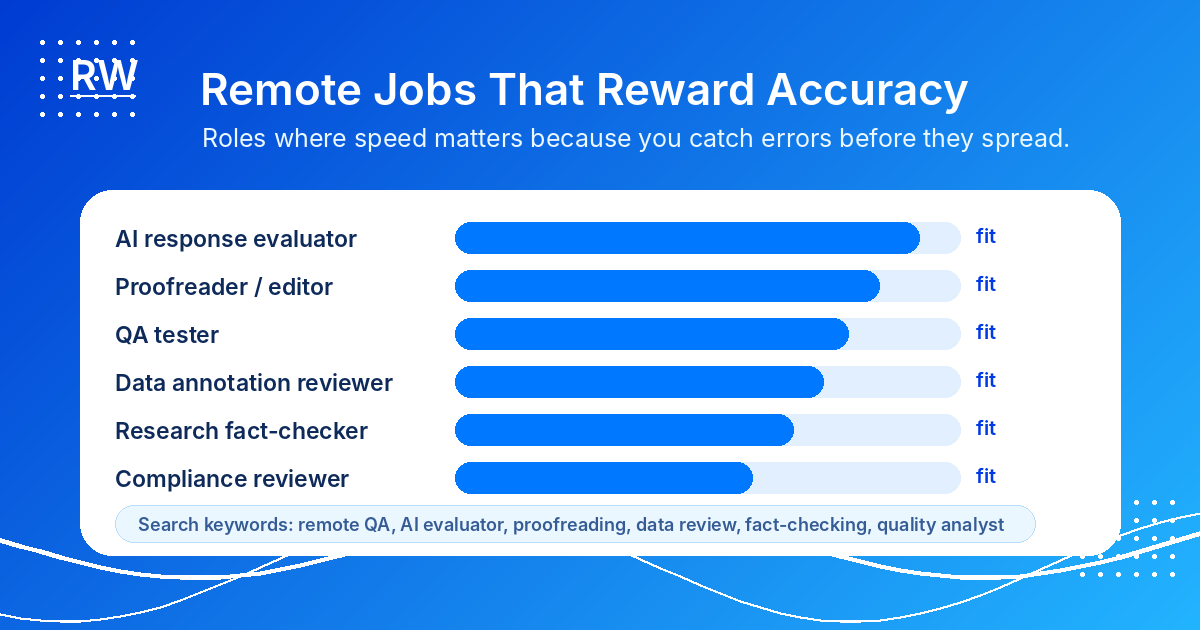
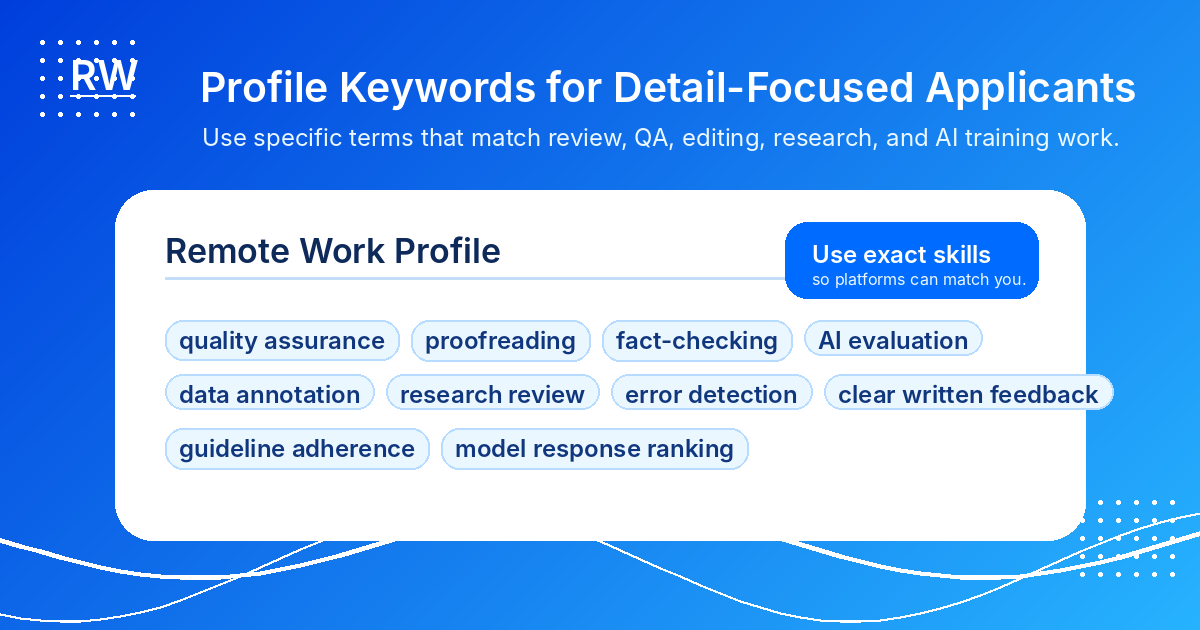
A detail-focused applicant should use direct keywords that match the work. Useful phrases include quality assurance, proofreading, copy editing, fact-checking, research review, AI evaluation, model response ranking, data annotation, data validation, content review, guideline adherence, policy review, transcription QA, spreadsheet accuracy, error detection, written feedback, and remote operations.
For AI training platforms, include terms that show judgment: follows instructions, compares responses, identifies hallucinations, checks factual accuracy, explains reasoning, evaluates tone, reviews prompts, and applies rubrics.
How to Apply Without Overselling Yourself
Many people make the mistake of applying to detail-oriented jobs with a vague profile. They write that they are "organized" and "a fast learner" but do not show what they can actually review.
A stronger application is specific. Instead of saying "I pay attention to detail," say that you are comfortable reviewing written responses for instruction-following, grammar, factual accuracy, formatting, and missing information.
Do not claim expert skills you do not have. Focus on remote jobs where the skill is judgment, accuracy, written feedback, research, editing, or QA.
Common Mistakes to Avoid
The first mistake is applying only to generic remote job titles. Search for specific role names like AI evaluator, AI trainer, data annotation reviewer, QA tester, proofreader, search quality evaluator, content quality analyst, fact-checker, and operations QA assistant.
The second mistake is ignoring tests and sample tasks. Many remote platforms use short assessments to see whether you follow instructions. Treat the assessment like paid work.
The third mistake is giving feedback that is too emotional or too vague. Good review work is calm and specific. If something is wrong, explain why it is wrong.
A Simple Starting Plan
Start with three categories: one AI review category, one quality review category, and one writing or research category. This gives you multiple paths without spreading your profile too thin.
Build a short profile that highlights your strongest detail-oriented skills. Add specific keywords. Track applications in a simple spreadsheet with platform, role, date applied, assessment status, response, and next step.
Final Takeaway
People who notice mistakes fast are not just being picky. In remote work, that can be a paid skill. Companies need people who can review AI outputs, check data, test software, proofread content, verify claims, apply guidelines, and explain problems clearly.
The strongest opportunities are usually not the broadest ones. They are the jobs where accuracy is the product.
If you are good at catching what others miss, build your remote work profile around that. Use specific keywords, apply to roles that reward review work, and treat every assessment as a chance to show accuracy.
Ready to apply for jobs? Go to RemoteWorkUnion.com to find roles hiring now.
Frequently Asked Questions
Do I need technical skills to get remote AI evaluation jobs?
No. Many AI evaluation roles need reading comprehension, judgment, and the ability to explain reasoning clearly. Coding helps for technical roles but is not required for content review, data annotation, response evaluation, or fact-checking work.
What is the difference between proofreading and AI content review?
Proofreading focuses on grammar, spelling, and consistency in final documents. AI content review involves evaluating whether an AI-generated response is accurate, helpful, complete, and appropriately formatted — often using a rubric or guidelines.
How do I show detail-oriented skills on a remote work application?
Use specific language rather than general claims. Mention tasks you have done: compared responses for accuracy, reviewed documents for formatting consistency, fact-checked claims, or flagged errors in datasets. Use keywords like quality assurance, accuracy, error detection, guideline adherence, and written feedback.
Are detail-oriented remote jobs high-paying?
Pay varies widely. AI evaluation roles for domain experts can pay $50–$200/hr. General proofreading and annotation roles often pay $15–$40/hr. The highest-paying detail-oriented remote jobs usually require subject matter expertise such as legal, finance, medical, or coding knowledge.