Subject matter experts are in a strong position for remote work because the internet does not only need people who can type fast, answer support tickets, or sit in meetings. It needs people who can judge whether an answer is actually right. That is where expert remote work starts.
A subject matter expert, often called an SME, is someone with deep knowledge in a specific field. That knowledge can come from a career, a degree, a license, a portfolio, or years of practical experience. The best remote work jobs for subject matter experts usually do not ask you to become a software engineer. They ask you to use judgment, accuracy, research, writing, and domain context.
This is especially important in AI training and AI evaluation. Large AI systems need expert feedback to improve. Model labs and AI companies need people who can review answers, catch subtle mistakes, test prompts, evaluate reasoning, check sources, and explain why one response is stronger than another. People search for opportunities connected to AI ecosystems like OpenAI, Anthropic, Google, Meta, Grok, and other AI platforms because this kind of work is becoming a serious remote category.
In This Article
- What Counts as a Subject Matter Expert?
- Best Remote Work Jobs for Subject Matter Experts
- The Best Fields for SME Remote Work
- Why AI Training Is a Strong Fit
- How to Position Yourself for Remote SME Jobs
- Application Mistakes to Avoid
- How to Build a Long-Term Remote Career Around Expertise
- Frequently Asked Questions
What Counts as a Subject Matter Expert?
You do not have to be famous in your industry to be a subject matter expert. You need enough knowledge to make better judgments than a general applicant. A tax preparer, nurse, paralegal, civil engineer, accountant, teacher, logistics manager, technical writer, UX researcher, translator, financial analyst, HR specialist, or real estate professional may all qualify for different types of SME remote work.
The key question is simple: can you evaluate work in your field with more accuracy than the average person? If you can spot errors, explain corrections, compare options, and use professional standards, you may have valuable expertise for remote AI training, expert review, content QA, research review, or advisory work.
Many people underestimate their expertise because they think an expert must have a PhD or senior title. Some roles do require advanced credentials, especially in medicine, law, science, or engineering. But many remote AI jobs and work from home roles need practical operators who understand how real work gets done. That practical judgment is often what AI systems struggle to copy.
Best Remote Work Jobs for Subject Matter Experts
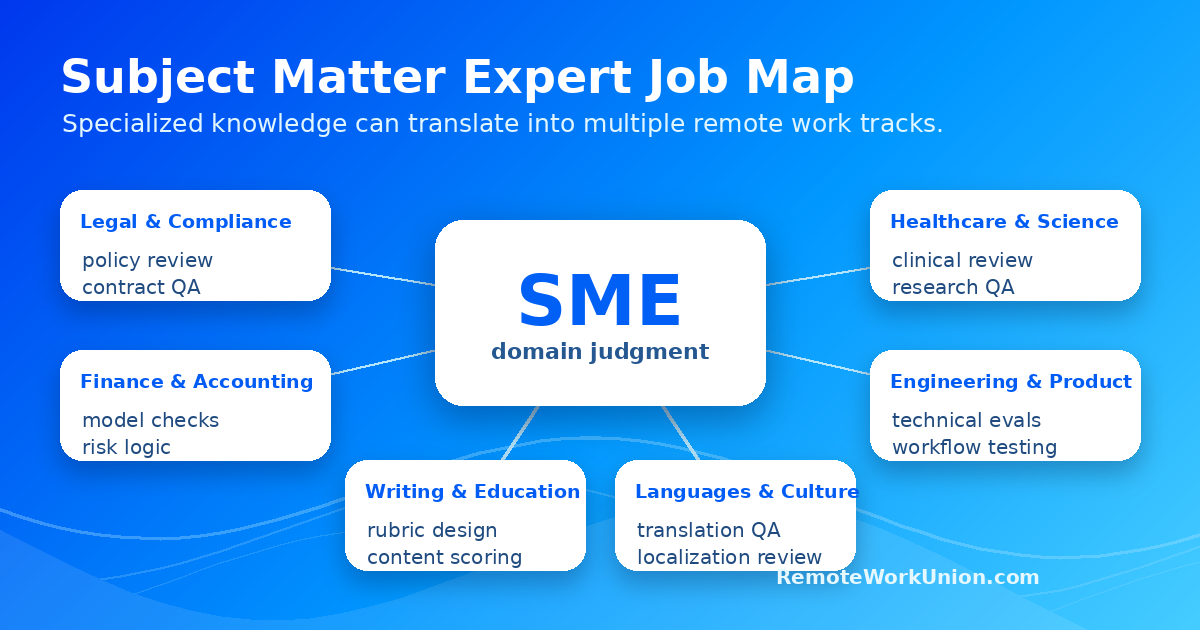
The best option depends on your domain, writing ability, availability, and comfort with evaluation tasks. These are the strongest categories to consider.
1. AI model evaluator. AI model evaluators review outputs from an AI system and decide whether the answer is accurate, safe, useful, and well-reasoned. A general evaluator may work on everyday questions. A subject matter expert may review finance answers, legal explanations, medical summaries, engineering responses, coding explanations, education content, or business analysis. This is one of the most relevant remote AI jobs for experts because it directly rewards judgment.
2. Domain-specific AI trainer. AI trainers help improve model behavior by writing examples, comparing responses, rating quality, or correcting flawed outputs. A subject matter expert can help the system learn the difference between a surface-level answer and a professional answer. This work may include prompt writing, response rewriting, rubric-based scoring, or creating examples that teach the model how experts think.
3. Expert fact-checker or research reviewer. AI outputs often sound confident even when they are incomplete or wrong. Expert fact-checking work involves checking claims, verifying sources, identifying missing context, and explaining what should be corrected. This is useful for researchers, journalists, analysts, academics, paralegals, finance professionals, and people who are naturally skeptical of vague answers.
4. Rubric writer or quality standard designer. A rubric tells reviewers how to judge quality. Subject matter experts are useful here because they know what good work looks like in a specific field. For example, a legal rubric may value jurisdiction, precision, risk disclaimers, and citation quality. A finance rubric may value assumptions, math, risk, and clarity. A healthcare rubric may value safety, scope, and uncertainty.
5. Technical content reviewer. Companies that publish educational content, documentation, training material, comparison guides, and product explainers need people who can review accuracy. Technical content review can be a work from home job for engineers, software professionals, accountants, marketers, HR specialists, operations managers, cybersecurity analysts, and other experienced professionals.
6. Test-item and assessment reviewer. Education companies, certification providers, tutoring platforms, and AI training projects need people who can review quiz questions, explanations, scoring rubrics, and learning material. Teachers, professors, tutors, test-prep instructors, and curriculum designers can use this path to find remote work that values subject knowledge.
7. Search quality and knowledge evaluation. Search engines, AI assistants, and knowledge platforms need evaluators who can judge whether a result answers the query, whether the source is trustworthy, and whether the response misses key facts. This can fit people with strong research habits, industry knowledge, and attention to detail.
8. Expert data annotation. Data annotation is not always low-level labeling. In expert fields, annotation can involve tagging legal clauses, categorizing medical concepts, reviewing financial statements, identifying product defects, classifying support conversations, or labeling domain-specific documents. The more specialized the data, the more valuable the reviewer can be.
9. Remote consulting or expert network projects. Some SMEs earn through project-based calls, written reviews, advisory notes, or market research interviews. This is not always steady work, but it can be a useful second track alongside AI evaluation platforms and other remote work jobs.
10. AI safety, policy, and risk review. Some projects need reviewers who can identify harmful instructions, misleading claims, compliance issues, or risky advice. Experts in law, healthcare, finance, education, privacy, trust and safety, and public policy may be useful for this kind of work.
The Best Fields for SME Remote Work
Some fields match remote AI work especially well because the work can be reviewed through text, documents, reasoning, or structured data. Strong categories include law, finance, accounting, healthcare, science, engineering, software, cybersecurity, education, marketing, HR, recruiting, procurement, supply chain, logistics, real estate, insurance, compliance, UX research, data analysis, writing, editing, translation, and local market knowledge.
Your field does not need to be glamorous. A person who deeply understands invoices, insurance claims, warehouse workflows, grant applications, customer research, clinical documentation, zoning language, payroll, or compliance checklists may be more useful than someone with a broad resume but no specific judgment area.
Remote work platforms often need narrow expertise because AI systems are evaluated one task at a time. A platform may not need a full-time employee for every domain, but it may need hundreds or thousands of specialists who can review specific categories of work. That is why subject matter experts can fit flexible work from home models so well.
Why AI Training Is a Strong Fit for Subject Matter Experts
AI training is not just writing prompts. It is quality control for machine-generated work. A model can produce a polished answer, but a human expert still has to decide whether it is complete, safe, grounded, and useful. That decision often requires context.
For example, a general reviewer may know that an answer about taxes sounds reasonable. A tax professional may notice that the answer ignores filing status, state rules, thresholds, or required documentation. A general reviewer may accept a legal summary. A paralegal or attorney may notice that the answer confuses legal concepts, overstates certainty, or fails to mention jurisdiction. A general reviewer may approve a technical answer. An engineer may see that it solves the wrong problem.
This is why the best remote AI jobs for subject matter experts tend to reward clear reasoning. The valuable skill is not only knowing the answer. It is explaining why an answer is right or wrong in a way that improves the system.
How to Position Yourself for Remote SME Jobs
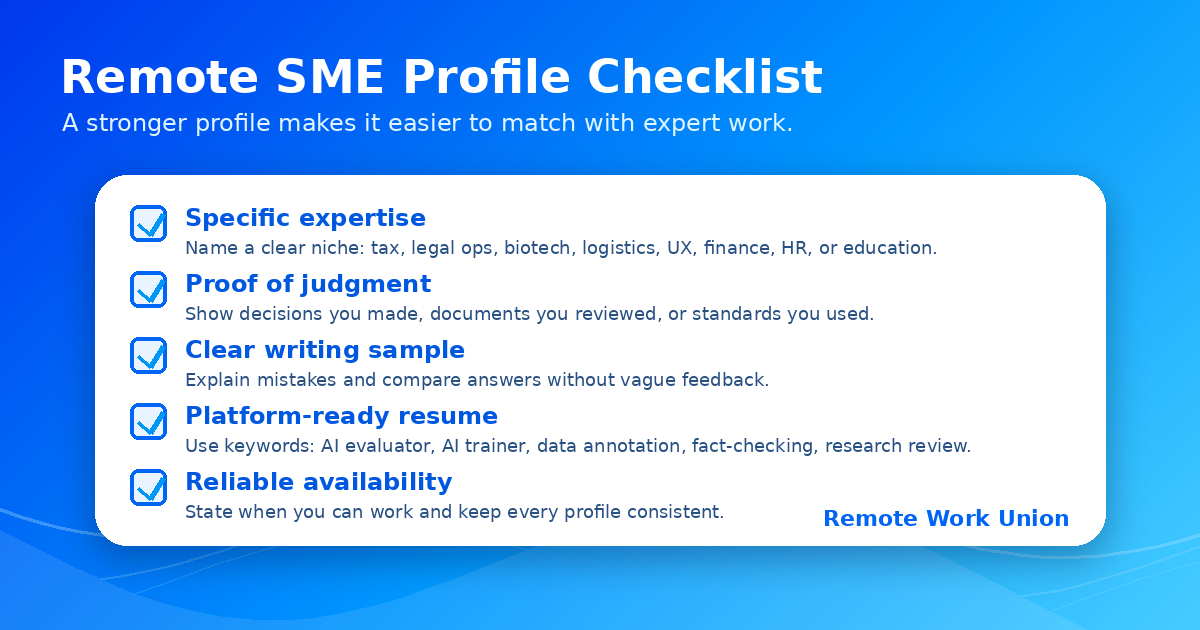
A subject matter expert profile should not read like a generic resume. It should make the platform understand exactly what you can review. Instead of saying you are experienced in business, say you can review financial analysis, B2B sales workflows, CRM implementation, hiring processes, supply chain documents, or customer research reports. Specificity helps matching systems and recruiters route you to better projects.
Use your headline carefully. Strong examples include Finance AI Evaluator, Legal Research Reviewer, Healthcare Content QA Specialist, Engineering Subject Matter Expert, Education Rubric Writer, Bilingual AI Trainer, Technical Documentation Reviewer, or Accounting Data Annotation Specialist. You can adjust the title to match your real background.
Your resume should include both traditional experience and remote AI keywords. Useful keywords include AI training, AI evaluation, AI model evaluator, data annotation, expert reviewer, fact-checking, research review, rubric scoring, quality assurance, prompt evaluation, content review, work from home, remote work, and subject matter expert.
If you have writing samples, documentation samples, published work, certifications, licenses, case studies, or examples of reviewed material, organize them. Even a short sample that shows how you compare two answers can help. Many remote AI platforms care about whether you can explain your judgment, not just whether you have a title.
Want AI training roles that match specialist expertise? Find opportunities hiring now.
Find Roles Hiring Now →Application Mistakes to Avoid
The first mistake is applying as a generalist when you have a niche. If you are an accountant, do not only say you want remote work. Say you can evaluate accounting explanations, review spreadsheet logic, check financial definitions, and assess business reasoning. If you are a teacher, do not only say you are good with students. Say you can review curriculum, grade explanations, write rubrics, and evaluate learning content.
The second mistake is overstating credentials. Remote platforms may test your knowledge. Be specific but honest. If you have practical experience but no license, describe the practical experience. If you have a license or certification, include it clearly. If your expertise is informal but strong, support it with portfolio evidence or detailed examples.
The third mistake is ignoring writing quality. Most expert AI work is text-based. Even if your field is technical, you need to explain your reasoning clearly. Platforms value reviewers who can write concise, precise feedback. Vague comments like "this is wrong" are less useful than a short explanation of what is wrong, why it matters, and how it should be corrected.
The fourth mistake is relying on one platform. Subject matter expert work can be project-based. Tasks may come and go. A stronger strategy is to join multiple legitimate remote work platforms, keep your profiles updated, and treat each accepted project as proof that can help you get better matches later.
How to Build a Long-Term Remote Career Around Expertise
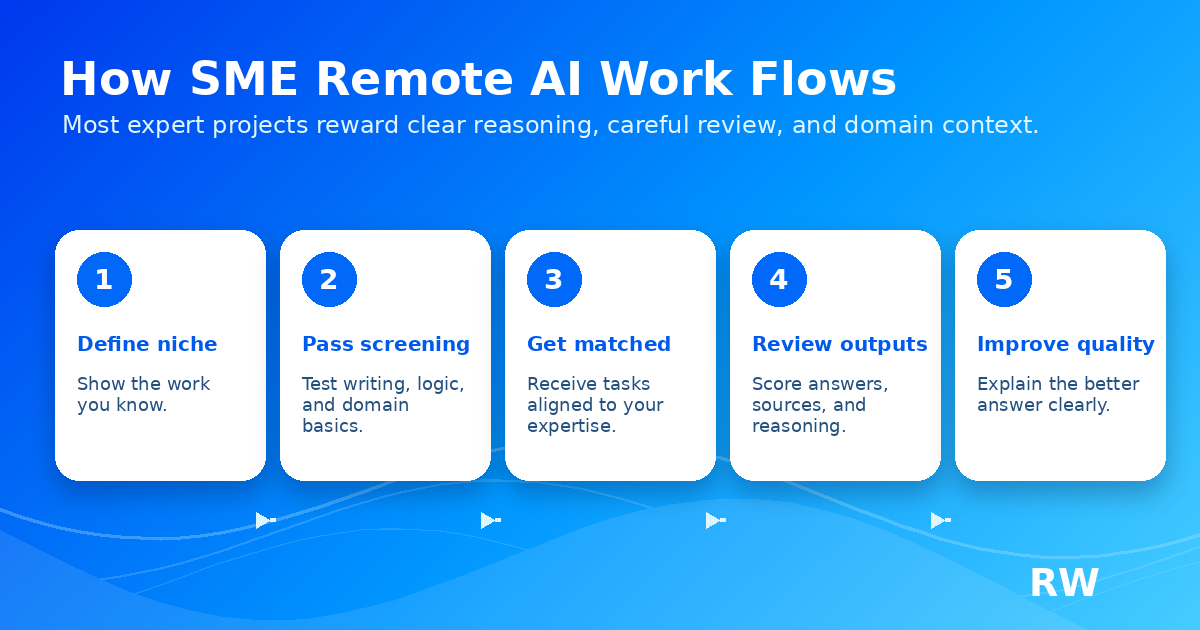
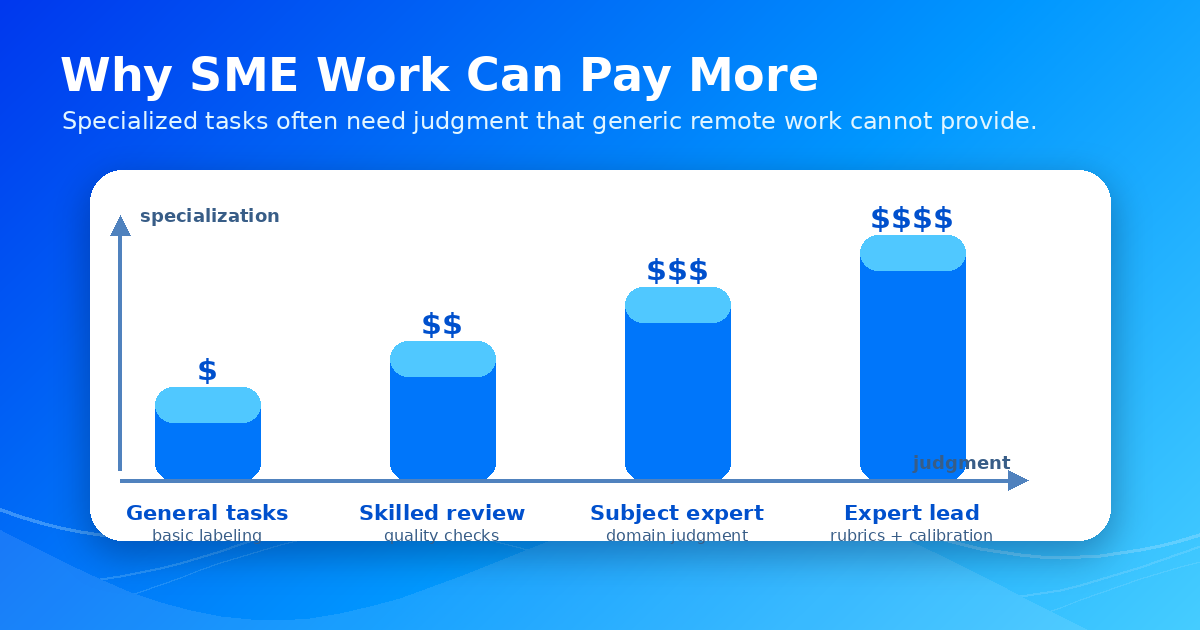
The strongest SMEs do not only complete tasks. They build a clear professional lane. Over time, you can move from basic review work to higher-value tasks such as calibration, rubric design, reviewer training, workflow testing, expert QA, and project leadership. That path is not automatic, but it is realistic for people who are reliable and consistently accurate.
Keep a record of the kinds of projects you complete, without sharing confidential information. Track the domains you reviewed, the tools you used, the quality standards you applied, and the type of feedback you delivered. This makes it easier to improve your profile later and apply for better remote work jobs.
The long-term advantage is that your subject knowledge compounds. A person with a clear niche becomes easier to match, easier to trust, and easier to recommend. In a crowded remote work market, being specific is often better than being broad.
Tip: Platforms like micro1, Mercor, Handshake AI, and Outlier AI all hire subject matter experts for remote AI evaluation, data annotation, and expert review roles. Applying to more than one platform increases the number of projects available to you at any given time.
Bottom Line
The best remote work jobs for subject matter experts are not limited to traditional consulting or full-time corporate roles. AI training, AI evaluation, expert review, fact-checking, rubric writing, content QA, research review, and domain-specific data annotation can all turn existing expertise into flexible work from home opportunities.
The best candidates are not always the people with the longest resumes. They are the people who can make accurate judgments, explain those judgments clearly, and apply real-world standards to AI outputs, documents, data, and content. If you have a field where you consistently notice what others miss, that knowledge may be more valuable than you think.
Frequently Asked Questions
What counts as a subject matter expert for remote AI work?
You do not need a PhD or a senior title. A subject matter expert is someone who can evaluate work in a specific field more accurately than a general applicant. Tax preparers, nurses, paralegals, accountants, teachers, logistics managers, technical writers, UX researchers, translators, and financial analysts may all qualify for different types of SME remote work.
What remote jobs pay subject matter experts the most?
Expert-tier AI model evaluation, rubric writing, and domain-specific AI training roles tend to pay the most for subject matter experts. Platforms like micro1, Mercor, and Handshake AI offer roles that can pay $50–$200/hr for specialists who can evaluate reasoning in their domain.
Do I need to be a coder to get remote AI training work as an SME?
No. Many remote AI training and evaluation roles are open to non-coders. Specialists in writing, finance, law, healthcare, education, marketing, HR, and operations can all find relevant roles. Coding experience helps for technical roles but is not required for most expert review and evaluation work.
How do I position myself as a subject matter expert for remote work platforms?
Use a specific headline like Finance AI Evaluator or Legal Research Reviewer rather than a generic title. Include keywords like AI training, AI evaluation, data annotation, expert reviewer, and fact-checking in your profile. If you have writing samples, reviewed documents, or certifications, include them. Specificity helps matching systems route you to better projects.
Which platforms hire subject matter experts for remote AI work?
micro1, Mercor, Handshake AI, and Outlier AI all hire subject matter experts for remote AI evaluation, data annotation, and expert review roles. These platforms connect specialists to AI labs and companies including OpenAI, Anthropic, Google, Meta, and others that need human expert feedback to improve their models.