Strong writing is one of the most useful skills in the work from home AI job market. A large share of AI training work is not coding, engineering, or data science. It is reading a model response, judging whether the answer is accurate, deciding which version is more helpful, explaining the reason, and rewriting unclear content so the model can learn from better examples. This expert-tier evaluation work commonly pays $50–$200/hr, depending on the difficulty of the project and the strength of your writing and judgment.
That is why Americans with strong writing skills can be competitive for remote AI jobs even without a technical background. AI labs, research vendors, annotation platforms, and model evaluation companies need people who understand English, U.S. context, tone, search intent, factual accuracy, and the difference between a polished answer and a weak answer. These jobs may appear under titles like AI writing evaluator, AI trainer, AI model evaluator, prompt response reviewer, AI content editor, chatbot evaluator, data annotation specialist, RLHF rater, search quality rater, or AI fact-checker.
The best roles are usually not generic typing from home jobs. They are judgment-based writing jobs. The work can involve reviewing AI answers for products associated with major AI companies and model ecosystems such as OpenAI, Anthropic, Google Gemini, Meta AI, Microsoft Copilot, xAI Grok, Perplexity, and other large language model teams.
Why Strong Writers Fit AI Training Work
AI models are trained and improved through feedback. When a chatbot answers a question, someone often has to decide whether that answer followed the instruction, used reliable information, gave enough detail, avoided hallucinations, and sounded natural. That judgment is heavily language-based.
A strong writer is valuable because they can spot vague claims, awkward phrasing, weak structure, unsupported conclusions, missing context, and answers that technically respond to a prompt but do not really solve the user's problem. Good evaluators can also explain their reasoning in a way that another human reviewer or training system can understand.
For U.S. applicants, American English and U.S. cultural context can matter. Some tasks ask reviewers to evaluate local search results, financial language, education examples, healthcare wording, consumer products, legal disclaimers, or workplace norms that are specific to the United States.
The Best Work From Home AI Jobs for American Writers
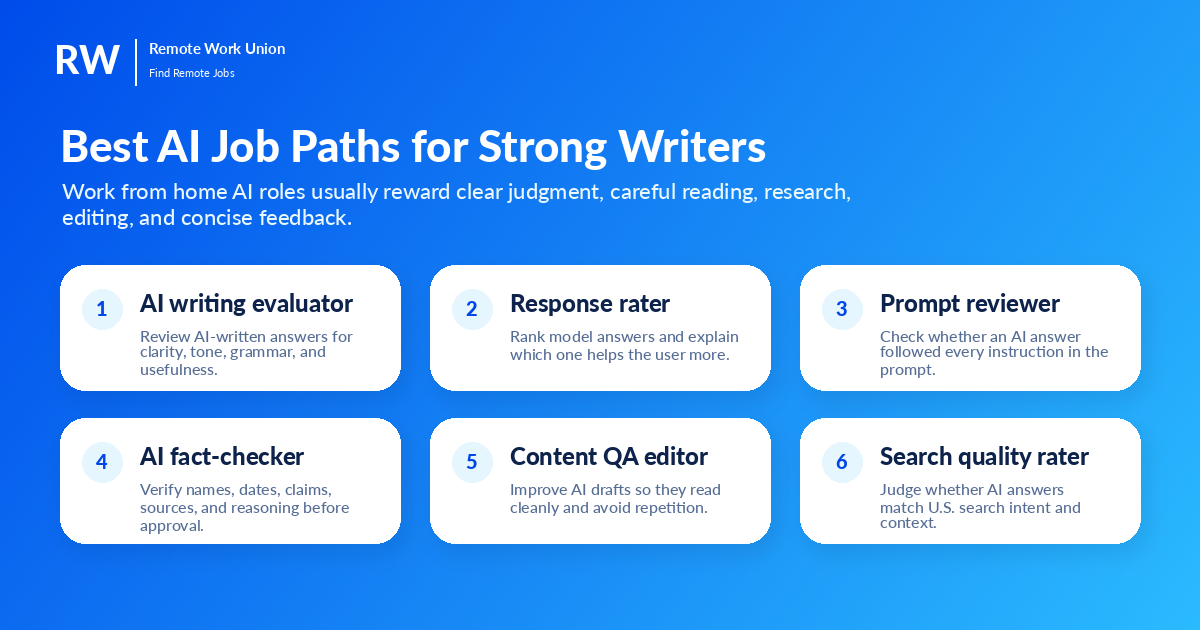
1. AI Writing Evaluator
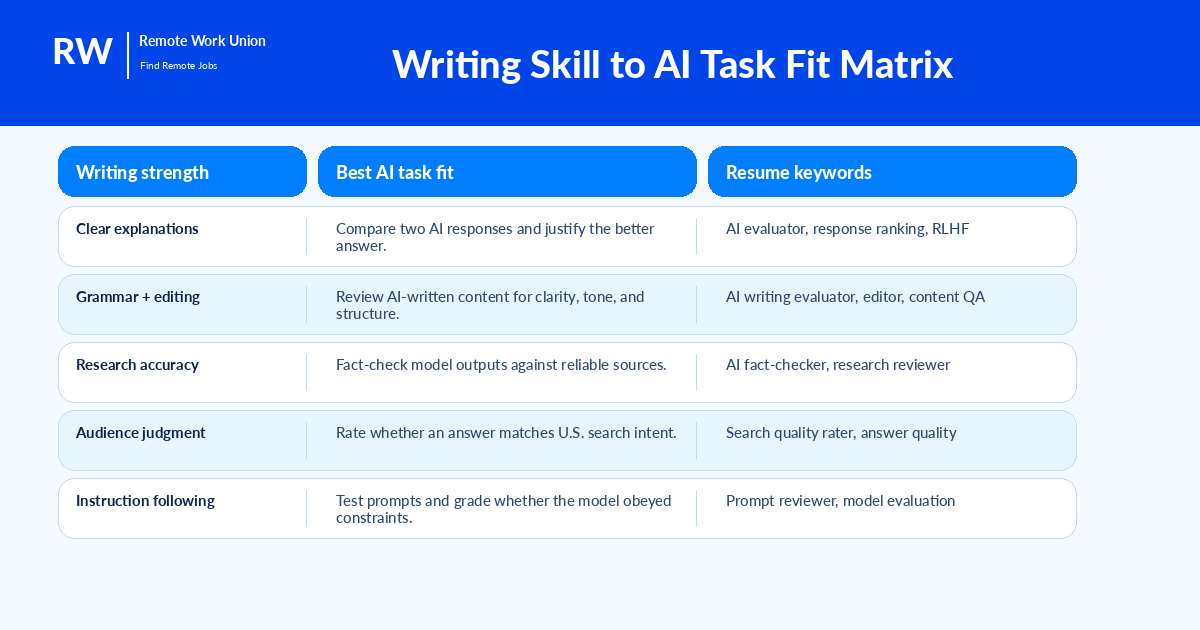
An AI writing evaluator reviews AI-generated text and judges whether it is clear, accurate, well-structured, and useful. This can include comparing two responses to the same prompt, rating the better answer, marking grammar or tone problems, and writing a short explanation of the decision.
This is one of the strongest fits for writers, editors, journalists, English majors, communications professionals, teachers, researchers, and people who are simply good at explaining things. Search for job titles such as AI writing evaluator, AI writing reviewer, LLM evaluator, AI content reviewer, response evaluator, AI trainer, and model evaluation specialist.
2. AI Response Reviewer or RLHF Rater
RLHF stands for reinforcement learning from human feedback. A human reviewer looks at model responses and gives structured feedback that helps the system learn which answers are better. The work may ask you to rank responses, grade helpfulness, assess instruction following, flag safety issues, or explain why one answer beats another.
The writing skill is in the justification. A weak evaluator says Response A is better. A strong evaluator explains that Response A directly answered the prompt, used a clearer structure, avoided unsupported claims, and gave the user an actionable next step.
3. AI Prompt Response Reviewer
Prompt response review is closely related to AI model evaluation. You may be given a user prompt and one or more AI answers. Your job is to decide whether the response followed the prompt, respected the constraints, used the right tone, and fully answered the request.
This is a good work from home AI job for Americans who are detail-oriented. Many tasks turn on small instruction-following details: word count, formatting, target audience, safety constraints, factual sourcing, or whether the model answered every part of a multi-part request.
4. AI Fact-Checking and Research Reviewer
AI fact-checking jobs are built around verifying claims. A model may produce a confident answer that sounds polished but contains a wrong date, invented source, outdated company detail, bad math, or misleading summary. Fact-checkers help catch those problems.
For strong writers, this role combines research and communication. You are not only checking facts; you are explaining what is wrong and how the answer should be improved. Search terms include AI fact-checker, research reviewer, AI research evaluator, content accuracy reviewer, search evaluator, and model output verification.
5. AI Content Editor
AI content editor roles focus on improving drafts produced by AI tools. The work may involve rewriting awkward paragraphs, tightening instructions, organizing information, checking tone, removing repetition, and making a response feel more useful for a real reader.
This job type fits editors, copywriters, content marketers, technical writers, bloggers, grant writers, resume writers, and anyone with a strong feel for clean language.
6. Search Quality Rater and AI Answer Quality Reviewer
A search quality rater or AI answer quality reviewer may judge whether a result, snippet, generated answer, or summary satisfies the user's query. American applicants can be useful for U.S. search intent. For example, a query about taxes, healthcare, schools, jobs, local services, sports, or consumer products may require local knowledge.
7. Data Annotation for Language Tasks
Language data annotation can be a strong fit for writers when it involves labeling tone, intent, sentiment, topic, source quality, safety category, or answer usefulness. Do not dismiss data annotation jobs automatically. The best language annotation projects are closer to editorial judgment than simple clicking.
8. Domain-Specific AI Evaluator
Some of the highest-value AI evaluation jobs are built around subject matter expertise. If you have experience in law, finance, healthcare, education, software, business, science, marketing, public policy, or academic research, your writing skill becomes even more valuable because you can evaluate specialized answers.
What Makes These Jobs Better Than Ordinary Online Writing Jobs
Traditional online writing jobs often depend on client acquisition, unpaid pitches, low-cost content mills, or search-engine content production. Work from home AI jobs are different because the writing is often used for evaluation, training, or quality control. The value is not just producing words. The value is knowing what good output looks like.
That distinction matters. A person who can write a polished blog post may still be weak at AI evaluation if they cannot follow a rubric. A person who is not a professional writer may still be strong if they can read carefully, explain tradeoffs, and apply instructions consistently.
How to Search for These Roles
Use several keyword clusters instead of searching only for AI jobs. The strongest searches usually combine remote work terms, AI training terms, and writing terms.
Start with searches like remote AI writing evaluator, work from home AI evaluator, AI model evaluation writing, AI response reviewer, LLM evaluator remote, AI trainer English, prompt response reviewer, AI fact-checking remote, data annotation English writing, search quality rater United States, and AI content editor contract.
Also search platform and company names alongside role terms. People often search for OpenAI jobs, Anthropic jobs, Google AI jobs, Gemini AI jobs, Meta AI jobs, Microsoft AI jobs, Claude AI training jobs, and Grok AI jobs. In practice, the role may not be posted by the AI company directly. It may appear through a vendor, contractor marketplace, AI training platform, staffing company, or research operations partner.
Looking for writing-based remote AI training and evaluation roles? Apply through Remote Work Union.
Browse Roles Now →How to Make Your Resume Fit AI Writing Jobs
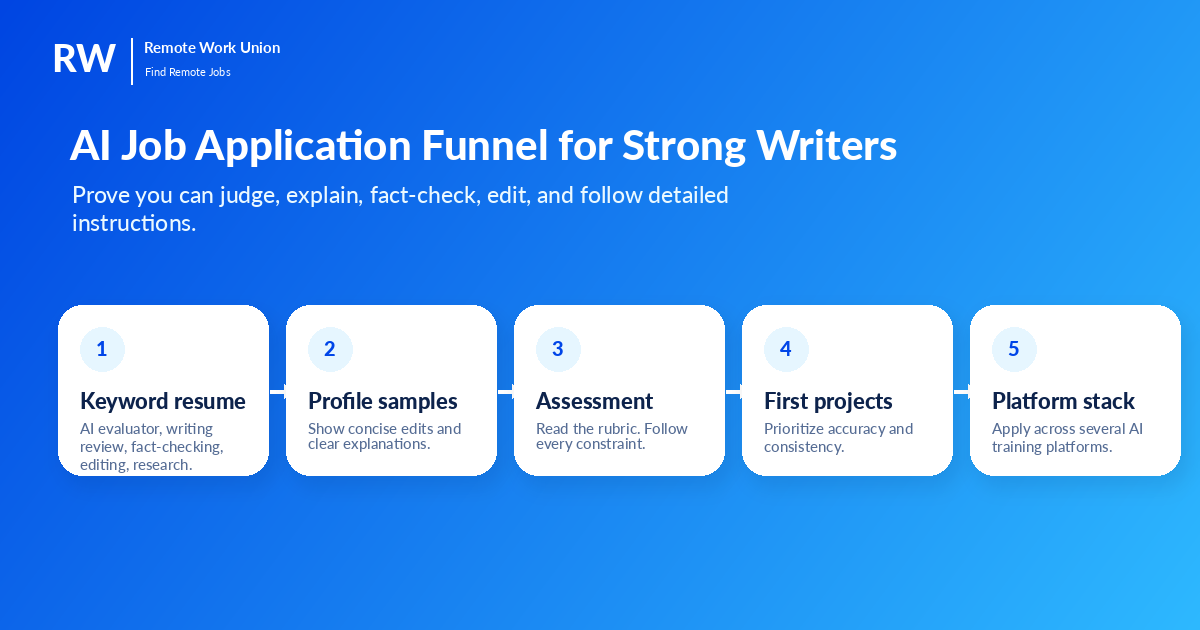
Your resume should make your writing skill obvious without sounding like a generic writer profile. Focus on evaluation, editing, research, accuracy, and clear explanation.
Useful resume phrases include: evaluated written responses for clarity and accuracy; edited long-form content for structure and tone; fact-checked claims using reliable sources; wrote concise feedback for quality improvement; compared alternative drafts and explained editorial decisions; followed detailed rubrics; reviewed AI-generated content; used ChatGPT, Claude, Gemini, or similar AI tools for research and drafting support.
If you have teaching, tutoring, journalism, customer research, legal research, operations, consulting, marketing, or academic experience, connect it to the task. AI platforms are often trying to identify people who can understand a prompt, evaluate an answer, and explain the decision in clean English.
How to Pass Writing-Based AI Assessments
Most assessments are not asking for the most creative answer. They are testing whether you can follow instructions. Read the rubric before you start. Notice whether the task asks you to rank, rate, rewrite, explain, label, or fact-check.
When comparing two AI answers, look for instruction following first. Did each answer do what the prompt requested? Then evaluate factual accuracy, completeness, clarity, formatting, safety, and tone. If one response is more polished but less accurate, accuracy usually matters more.
Your written justification should be specific. Avoid vague comments like it is better written. Use concrete reasons: it answered all three requested questions; it avoided unsupported claims; it explained the process step by step; it used the requested format; it was more concise; it did not overstate uncertainty.
What to Avoid
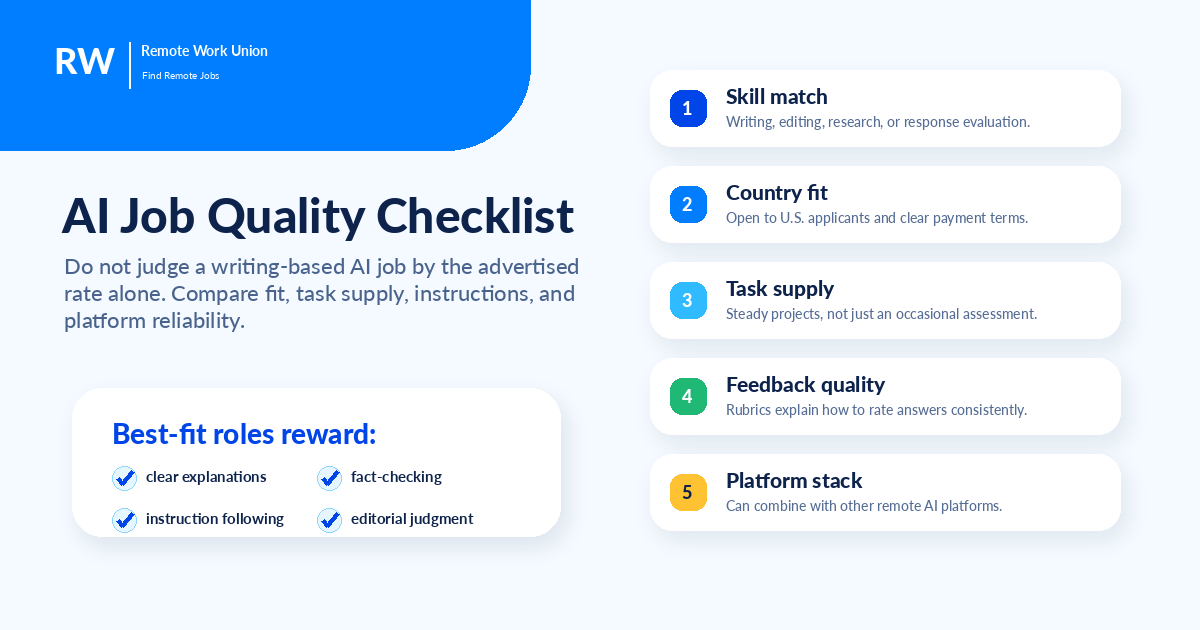
Avoid applying only to one platform. Remote AI training work can be inconsistent, and task supply may change. A stronger strategy is to build a stack of several reputable platforms and keep applying while you improve your profile.
Avoid presenting yourself as only a creative writer. Creative writing can be valuable, but many AI evaluation roles need precision, not just style. Emphasize reliability, accuracy, instruction following, and clear feedback.
Avoid rushing assessments. Many applicants fail because they skim the instructions, ignore formatting rules, or write explanations that are too vague.
Avoid scams. Real remote AI jobs should explain the work, use a legitimate application process, and not require you to pay for access to tasks.
Who Is the Best Fit?
The best fit is someone who reads carefully, writes clearly, and can explain judgments without overcomplicating them. You do not need to be a software engineer for many of these roles. You do need to be comfortable using AI tools, following detailed guidelines, checking facts, and writing concise feedback.
Americans with backgrounds in writing, editing, education, journalism, communications, marketing, research, consulting, law, healthcare, finance, operations, and business analysis can all be competitive if they frame their experience correctly.
Final Takeaway
For Americans with strong writing skills, the best work from home AI jobs are the roles that pay for judgment: AI writing evaluator, AI response reviewer, RLHF rater, prompt reviewer, AI fact-checker, content editor, search quality rater, language data annotator, domain expert evaluator, safety reviewer, and chatbot conversation reviewer.
These jobs sit at the intersection of writing, research, evaluation, and AI. The best applicants do not just say they are good writers. They prove they can read a prompt, judge an answer, explain the difference, and help improve the quality of AI systems.