Ready to apply for AI training and remote work roles? Apply through Remote Work Union.
Find Roles Hiring Now →AI model evaluation work has become one of the most realistic ways for educated US applicants to find flexible, remote work connected to artificial intelligence. The job titles vary, but the core idea is simple: a human reviewer looks at AI outputs and helps decide whether they are accurate, useful, safe, clear, and aligned with instructions. That human judgment becomes training signal for better AI systems.
For someone in the United States with strong writing skills, research ability, subject expertise, or professional experience, this category can be more attractive than generic data entry or customer support. It can also be confusing because the same type of work may be listed as AI evaluator, AI trainer, model rater, response reviewer, RLHF specialist, AI data annotator, search quality rater, prompt writer, fact-checker, or subject-matter expert.
This guide explains how to find AI model evaluation work in the United States without relying on one platform, one job board, or one title.
What AI Model Evaluation Work Actually Means
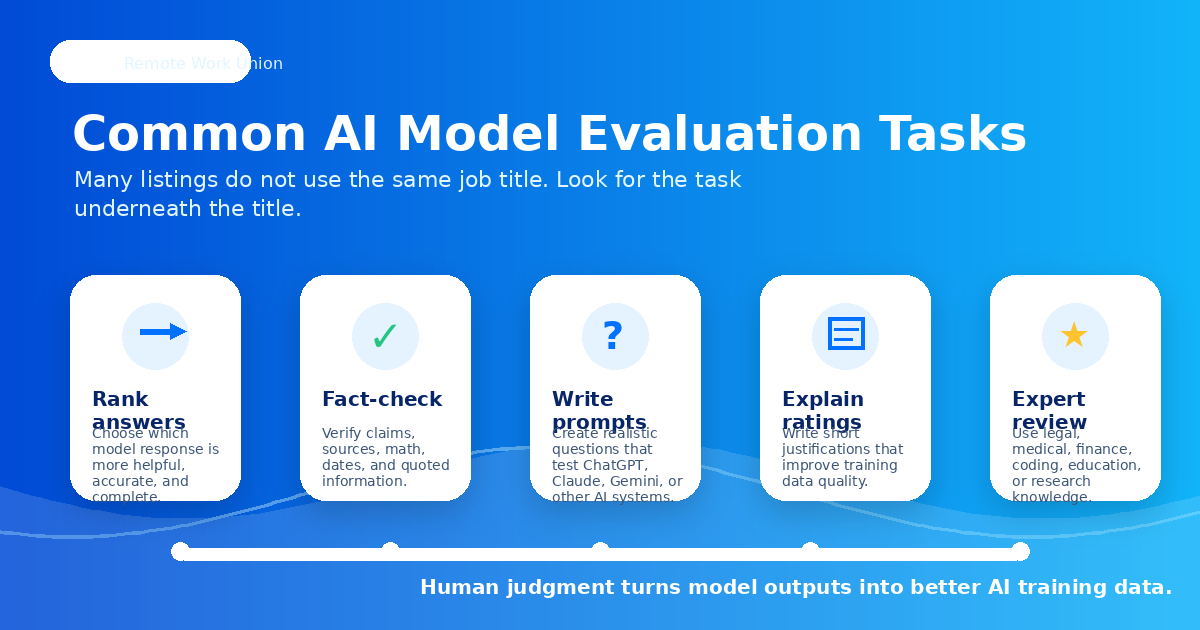
AI model evaluation work is the process of reviewing artificial intelligence outputs and giving structured feedback. You might compare two AI answers and choose the better one. You might check whether an answer follows the prompt, cites facts correctly, avoids unsupported claims, or handles a sensitive topic safely. You might write sample prompts that test a model's reasoning, creativity, coding ability, legal understanding, medical caution, or business judgment.
The work is often connected to RLHF, which stands for reinforcement learning from human feedback. In practical terms, that usually means a human reviewer is helping a company understand what good and bad AI responses look like. The reviewer may rank responses, label mistakes, explain quality differences, or rewrite an answer so it becomes more useful.
The best candidates are not always programmers. Many projects need strong English, careful reading, clear explanations, and domain-specific judgment. A lawyer may review legal reasoning. A finance analyst may review accounting or investment explanations. A teacher may review tutoring answers. A software engineer may evaluate code. A writer or editor may evaluate tone, structure, accuracy, and clarity.
Why United States Applicants Should Search Differently
US-based applicants should search differently because location can matter in AI evaluation. Some projects are open globally, while others prefer or require workers in the United States because of English fluency, cultural context, client requirements, time zones, tax setup, identity verification, payment rails, or legal restrictions.
This does not mean every good job is US-only. It means US applicants should make their location clear and use search phrases that match the way companies describe these roles. A listing may say US-based AI trainer, native English AI evaluator, remote contract AI reviewer, AI writing evaluator, search quality analyst, or subject matter expert for model evaluation rather than AI model evaluation work in the United States.
Use Multiple Job Titles When Searching
The biggest mistake is typing one keyword into one job board and assuming nothing exists. AI evaluation jobs are fragmented across platforms, staffing firms, expert marketplaces, remote job boards, direct company listings, and referral programs. Use several title variations.
Search for: remote AI evaluator, AI model evaluator, AI trainer, AI training jobs, AI response evaluator, AI writing evaluator, RLHF reviewer, LLM evaluator, prompt evaluator, AI data annotator, AI fact-checker, AI safety evaluator, chatbot evaluator, search quality rater, and subject matter expert AI reviewer.
Then add US-intent modifiers: United States, US-based, USA remote, native English, English evaluator, W2, 1099 contractor, contract remote, part-time remote, flexible remote, and work from home.
Where to Look for AI Evaluation Work
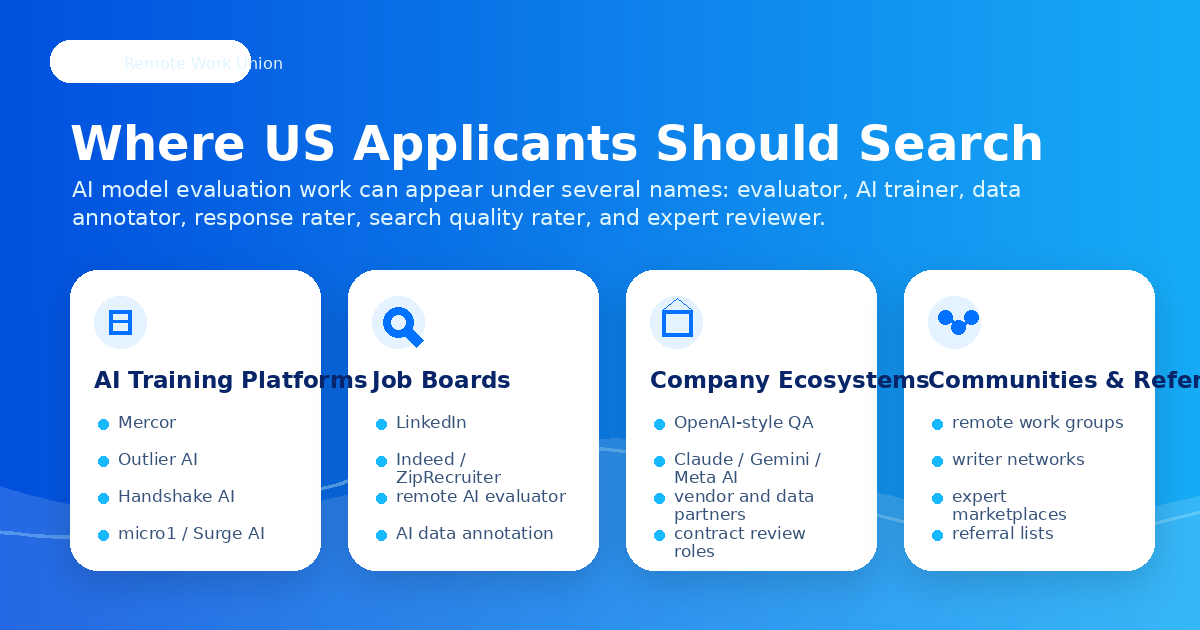
Start with AI training and evaluation platforms, but do not stop there. Platforms such as Mercor, Outlier AI, Handshake AI, micro1, Surge AI, Stellar AI, and other data or expert review marketplaces may list remote AI training projects, model evaluation tasks, expert review work, writing assessments, coding evaluations, or domain-specific projects. Availability can change quickly, so the better strategy is to keep a strong profile across several platforms.
Next, use broad job boards like LinkedIn, Indeed, ZipRecruiter, Wellfound, remote-specific job boards, and university or alumni boards. These sites often surface roles from staffing agencies, AI labs, data vendors, and enterprise clients.
Also search the ecosystems around major AI companies. People often search for OpenAI jobs, Anthropic jobs, Google Gemini jobs, Meta AI jobs, Microsoft AI jobs, Claude AI training jobs, and ChatGPT evaluator jobs. Some roles may be direct jobs, but many are vendor, contractor, research, data quality, content quality, or trust and safety roles that support AI systems indirectly.
What to Put in Your Profile or Resume
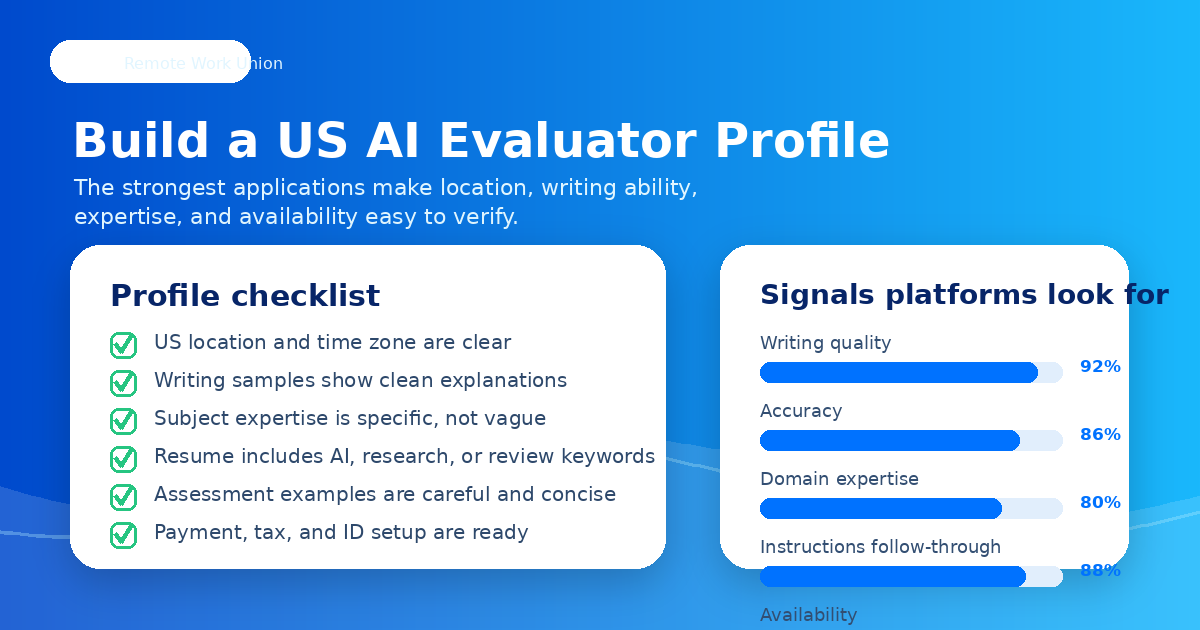
A strong AI evaluator profile should make the platform's decision easy. It should show that you can read carefully, write clearly, follow instructions, and make reasoned judgments. If you have professional expertise, make it specific. Finance is weaker than financial modeling, Excel, accounting, market research, and business analysis. Healthcare is weaker than nursing documentation, patient education, medical writing, and clinical guideline review.
Your resume should include relevant keywords without sounding fake. Useful phrases include AI model evaluation, AI training, response rating, prompt writing, fact-checking, research, content quality, editing, data annotation, LLM evaluation, rubric-based review, accuracy review, and written feedback.
If you have used ChatGPT, Claude, Gemini, Perplexity, Copilot, or other AI tools in serious work, describe what you did with them. Do not oversell yourself as an AI engineer if you are not one. The strongest positioning is honest and specific.
How to Handle Assessments
Most AI model evaluation platforms use assessments because the work requires judgment. These tests usually measure whether you can follow instructions, rank outputs consistently, explain your reasoning, catch hallucinations, and avoid overthinking simple tasks.
Before taking an assessment, slow down. Read the rubric twice. Identify what the task is asking you to evaluate. Is the priority factual accuracy, instruction following, tone, safety, completeness, coding correctness, or writing quality? Do not choose the more impressive answer if it fails the prompt. Do not write a long explanation when the task asks for a concise justification.
Good evaluation feedback is specific. Instead of writing Response A is better, explain why: Response A directly answers the question, includes the requested steps, and avoids the unsupported claim in Response B.
How to Tell If a Listing Is Worth Applying To
A good AI evaluation listing usually gives a clear task category, pay structure, expected skills, location rules, assessment process, and contractor or employee status. It should explain enough for you to understand what you are applying for.
Be cautious with listings that promise guaranteed high income, ask for money upfront, require you to buy training before applying, use fake company names, or avoid explaining the work. Legitimate AI evaluation work may ask for identity verification, tax forms, or payment setup after approval, but it should not require you to pay to access basic work.
Also remember that remote AI contractor income can be inconsistent. One platform may have tasks for weeks and then slow down. A smart applicant builds a pipeline across multiple platforms instead of relying on one dashboard.
A Simple Weekly Search Routine
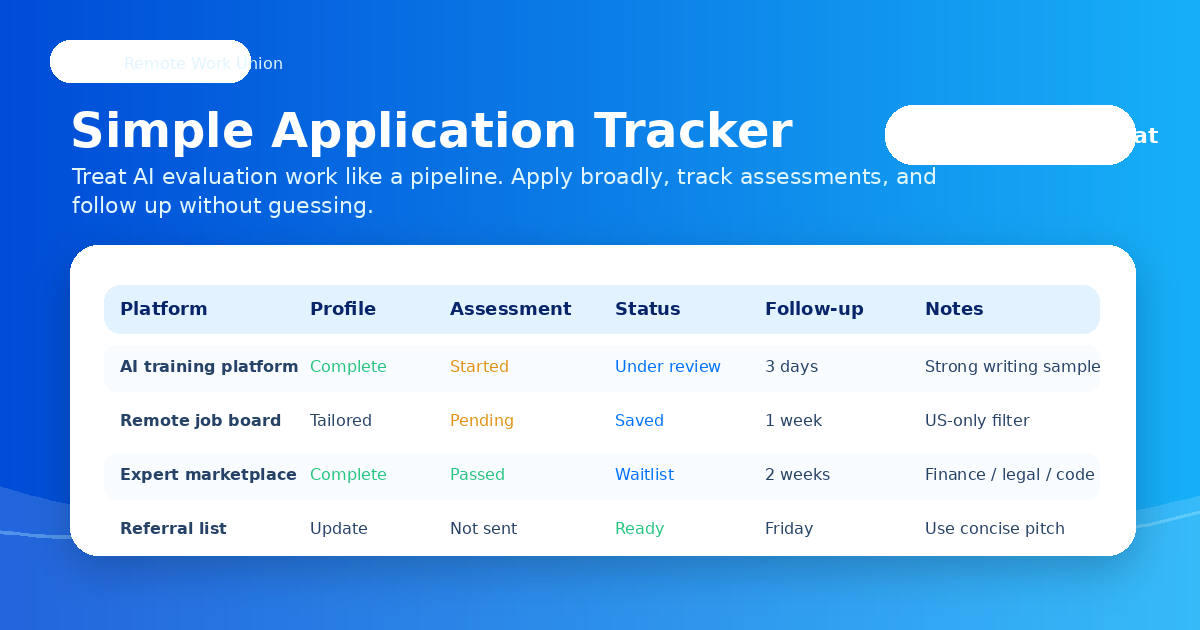
Set aside a recurring block of time each week to search, apply, and update your tracker. Start with five to ten search terms. Save roles that match your skills. Apply to the best ones first. Update your profile when you notice repeated requirements. Track the date, platform, role title, assessment status, response, and follow-up date.
A good target is not to submit as many low-quality applications as possible. The goal is to build a repeatable system: several strong profiles, several assessments completed, several job alerts running, and a clear record of where you stand.
Common Mistakes to Avoid
Do not present yourself as generic. A platform that needs careful reviewers wants to know what you are good at. Show the strongest categories where your judgment is credible.
Do not ignore location wording. If a role says US-based, make sure your location is clear in your profile and resume.
Do not submit sloppy writing. Many applicants are filtered out because their profile, resume, or assessment explanation is unclear. If the job is based on written judgment, every sentence you submit becomes part of your application.
Do not rely on one platform. AI training work can move between vendors, clients, and project queues.
Do not treat every AI job as the same. Data labeling, search quality rating, AI writing evaluation, safety testing, coding review, and expert review are related, but they are not identical.
Final Checklist for US Applicants
Before applying, make sure your profile answers the basic questions a platform or hiring team is likely to have. Are you in the United States? Can you write clearly? Can you follow a rubric? Do you have a degree, work experience, or specialized skill that fits the project? Can you evaluate AI answers without guessing? Can you explain your reasoning in a concise way? Are you prepared for contract work, variable task flow, and assessments?
If the answer is yes, you are not limited to one search or one company. Look across AI training platforms, job boards, expert networks, company ecosystems, and referral communities. Use the right keywords, build a strong profile, take assessments carefully, and track your pipeline like a serious job search.