Ready to apply for AI training and remote work roles? Apply through Remote Work Union.
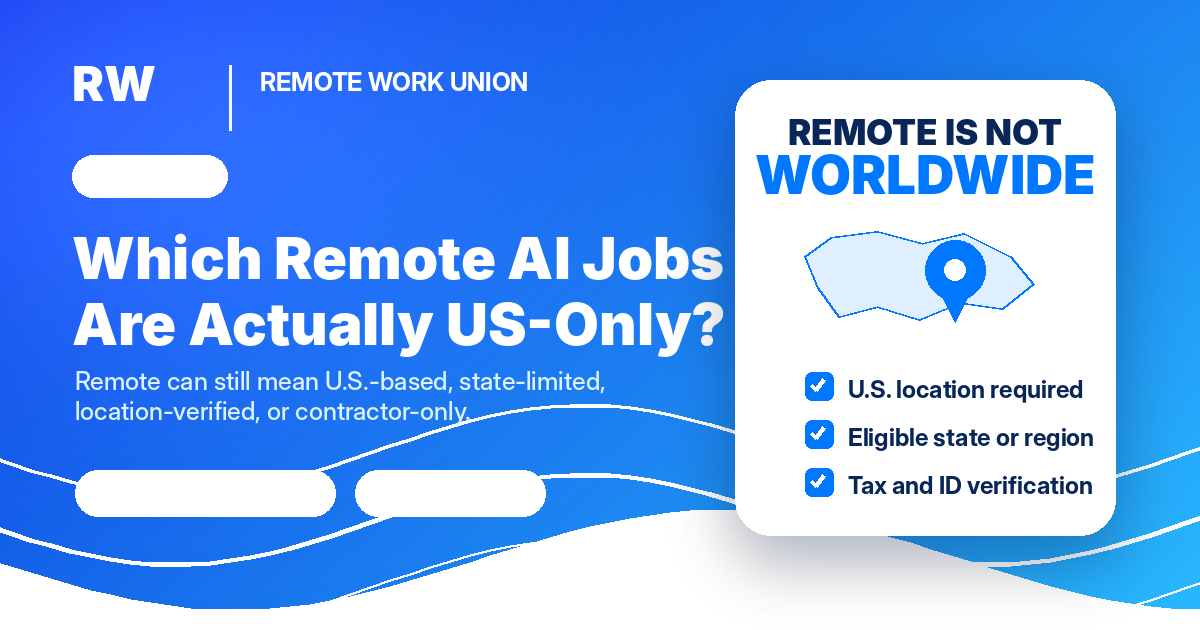
Find Roles Hiring Now →A remote AI job is not always a work-from-anywhere job. That is one of the biggest points applicants miss when they start searching for AI training jobs, AI model evaluation work, data annotation projects, RLHF contracts, and chatbot response review roles.
Some postings really are global. Others are remote only inside the United States. Some are limited to certain states. Some are technically contractor roles, but still require a U.S. tax setup, a U.S. address, a verified U.S. location, or U.S.-specific cultural knowledge. A role can be fully online and still be U.S.-only.
That distinction matters because the best-paying AI evaluator jobs often receive thousands of applications. If you are a U.S. applicant, country-specific roles can be an advantage because the eligible applicant pool is smaller than a worldwide posting. If you are outside the United States, recognizing U.S.-only language early helps you avoid wasting time on roles that will reject you during verification.
This guide explains which remote AI jobs are most likely to be U.S.-only, which roles are usually broader, how to read the wording in a job post, and how to search for remote AI work without falling for vague listings.
What "US-Only Remote" Actually Means
US-only remote usually means the work can be done from home, but the applicant must be physically located in the United States or otherwise eligible under the company or client rules. It does not necessarily mean the company only hires U.S. citizens. It can mean U.S. resident, U.S. work authorization, U.S. tax documentation, U.S. state eligibility, or U.S. location verification.
The wording varies. A posting may say remote - United States, U.S.-based applicants only, must be located in the United States, remote within the U.S., eligible states only, U.S. work authorization required, or contractor must complete U.S. tax forms. In AI training, the location requirement may also be hidden inside the onboarding process rather than the public job title.
The practical rule is simple: remote describes where you work. Eligibility describes where the company is allowed or willing to hire. Always check both.
AI Jobs Most Likely to Be US-Only
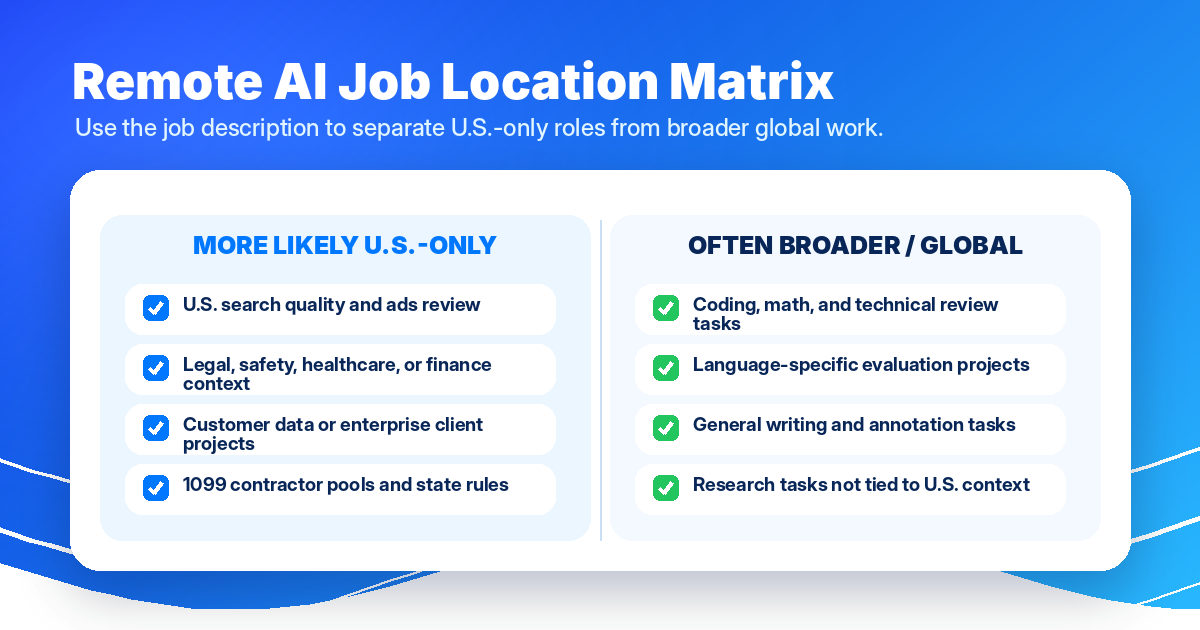
Several categories of remote AI work are especially likely to have U.S. location restrictions. These are not universal rules, but they are strong patterns to watch for.
1. AI model evaluation for U.S. English and U.S. culture. AI labs need reviewers who understand American phrasing, idioms, politics, schools, healthcare, money, sports, local businesses, and everyday search intent. A task asking whether an answer sounds natural to a U.S. audience may prefer U.S.-based reviewers, even if the language is technically English.
2. Search quality, ads quality, and local intent rating. Search and recommendation tasks often depend on location. A query like best dentist near me, how to file state taxes, or return policy Target may need a reviewer who understands U.S. geography, brands, laws, and consumer behavior. These roles are often listed as search quality rater, AI search evaluator, ads quality rater, maps evaluator, or AI answer evaluator.
3. Safety, policy, legal, healthcare, and finance evaluation. Some AI review tasks involve sensitive topics or regulated domains. A company may want reviewers familiar with U.S. rules, U.S. professional standards, or U.S. customer expectations. Lawyers, paralegals, medical writers, nurses, accountants, business analysts, and finance professionals should pay close attention to country wording because expert roles may be tied to a client's compliance needs.
4. Enterprise data annotation projects. Some data labeling and annotation work uses customer-specific datasets. If the client is a U.S. enterprise, the project may limit access to U.S.-based workers for contractual, security, or privacy reasons.
5. 1099 contractor pools. Many AI training roles are contract roles rather than full-time jobs. Some platforms simplify operations by opening certain projects only to U.S.-based contractors who can complete U.S. tax forms.
6. Full-time remote AI jobs with U.S. benefits. Product manager, AI operations, prompt engineering, data quality, trust and safety, and machine learning operations roles may be remote but still employee positions. If the company is not set up as an employer in every country, it may restrict hiring to the United States.
7. Jobs connected to U.S. government, education, public sector, or healthcare clients. A role can involve AI evaluation, data review, content moderation, research, or document classification while still being tied to a client that has strict U.S. location rules.
AI Jobs Less Likely to Be US-Only
Other AI jobs are more likely to be international or country-flexible. Coding evaluation, math reasoning, multilingual data annotation, general prompt writing, translation evaluation, image labeling, audio transcription, and academic-style research tasks may be opened across multiple countries when the client does not need U.S.-specific context.
For applicants in Canada, the UK, Australia, New Zealand, and other English-speaking markets, the best opportunities often sit between these two categories. Some projects want native or near-native English ability, common law or Western business context, and high-quality writing, but they do not always require U.S. residence.
How to Read a Remote AI Job Post
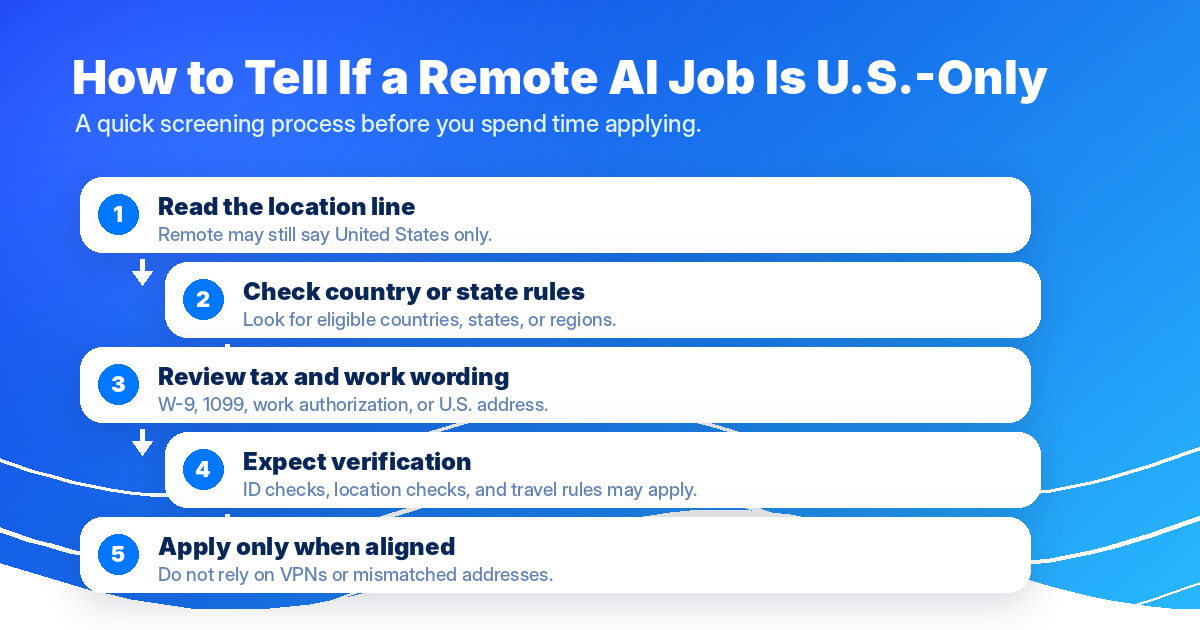
The title is not enough. A posting can say remote AI evaluator and still be U.S.-only. Before applying, scan the posting in this order.
First, check the location line. If it says United States, Remote - U.S., USA, or remote within the United States, treat it as U.S.-only unless the description clearly says otherwise.
Second, check eligibility wording. Look for phrases such as must be located in the U.S., must be authorized to work in the United States, eligible states, U.S. residents only, contractor must be in the U.S., or applicants outside the U.S. will not be considered.
Third, check payment and tax wording. W-9, 1099, and U.S. tax documentation usually point to a U.S. contractor setup. Tax wording does not always decide eligibility by itself, but it is a strong clue.
Fourth, check verification language. AI work platforms may verify identity, address, country, and sometimes the location where work is performed. Using a VPN, borrowed address, or mismatched documentation can create account issues.
Fifth, check task context. If the role requires knowledge of U.S. law, U.S. healthcare, U.S. schools, U.S. finance, American English, local search behavior, or U.S. consumer products, the project may prefer or require U.S.-based reviewers even if the job title is broad.
Why Companies Make Remote AI Jobs US-Only
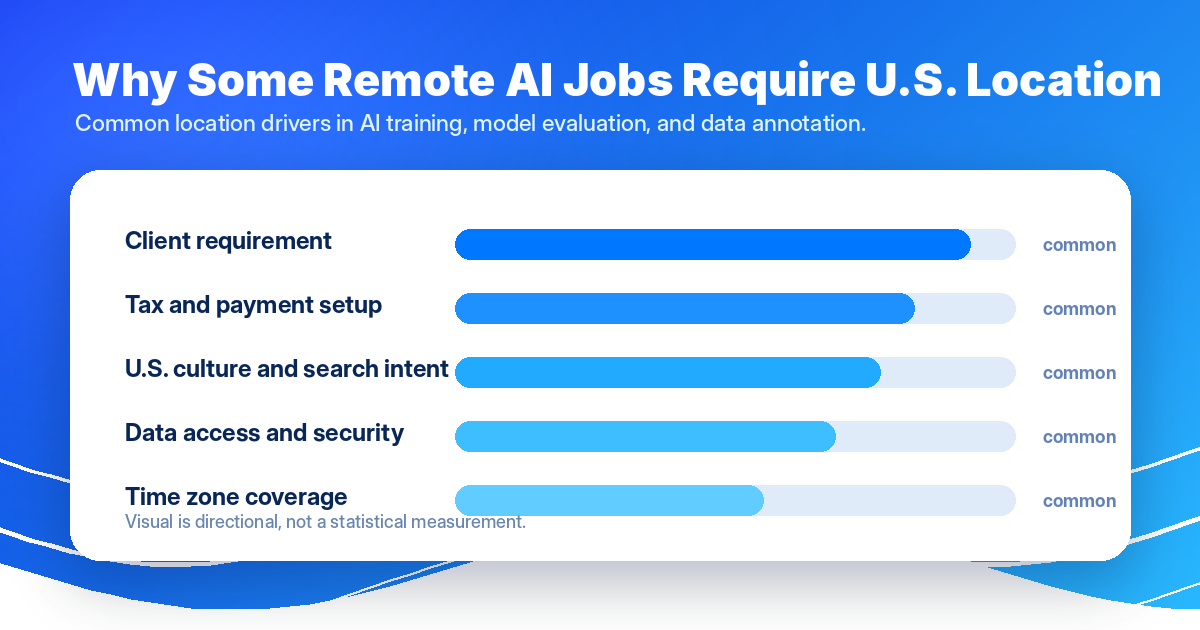
US-only restrictions are not always about nationalism or citizenship. Most of the time, they come from operational constraints.
Tax and payment setup is one reason. A company paying independent contractors in the United States may have a simple U.S. tax workflow. Paying contractors globally can require extra forms, withholding rules, currencies, payout providers, and country-specific compliance reviews.
Client requirements are another reason. Many AI training companies serve enterprise customers, AI labs, research teams, or product teams. If the end client says the data can only be accessed by U.S.-based reviewers, the contractor platform has to follow that rule.
Cultural accuracy is a third reason. AI models used by U.S. customers need answers that make sense in the United States. That includes spelling, tone, laws, retail brands, sports references, education systems, healthcare context, financial language, and local search intent.
Time zone coverage also matters. Many AI projects move quickly. If a team needs reviewers online during U.S. business hours, a U.S.-based applicant may be easier to schedule.
Security and data access can matter as well. Some data annotation, trust and safety, legal review, and enterprise AI tasks involve sensitive material. A company may restrict access by country, state, device, or verified location to satisfy security policies.
Best Searches for U.S. Applicants
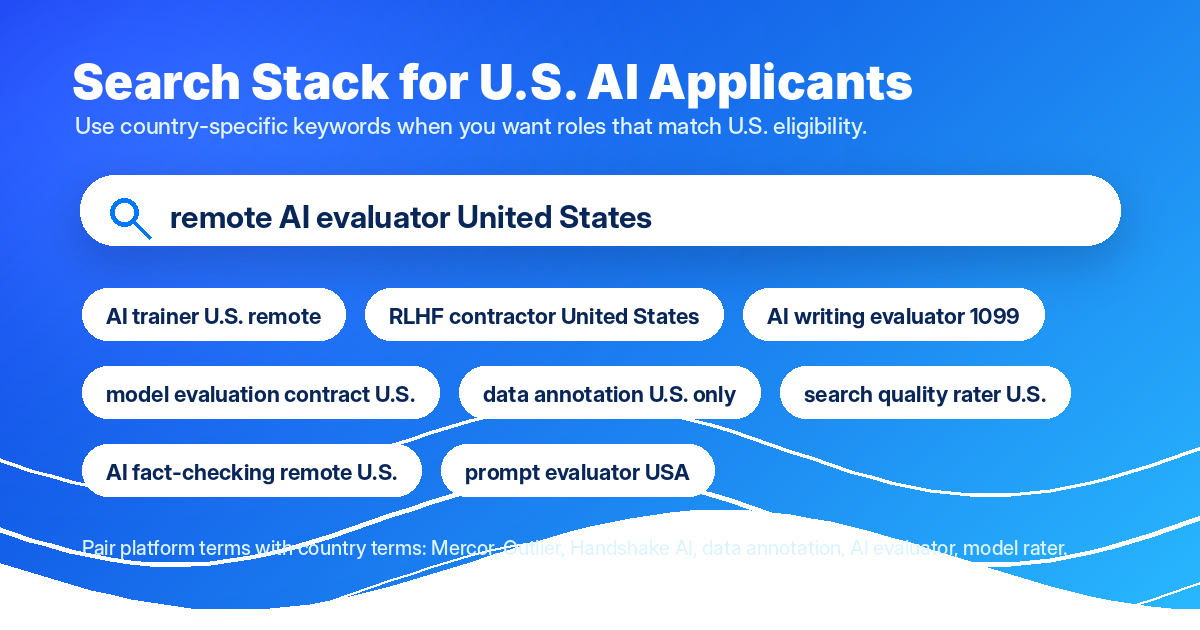
If you are in the United States, do not only search for remote AI jobs. Add location and task keywords to find roles that are more likely to fit you. Good searches include remote AI evaluator United States, AI trainer U.S. remote, RLHF contractor United States, AI writing evaluator 1099, model evaluation contract U.S., data annotation U.S. only, AI fact-checking remote U.S., prompt evaluator USA, search quality rater United States, and AI content reviewer remote U.S.
You can also combine platform and company terms with role keywords. People often search for Mercor, Outlier AI, Handshake AI, DataAnnotation, Surge AI, micro1, Stellar AI, OpenAI, Anthropic, Google, Meta, Microsoft, Claude, Gemini, AI model evaluation, AI data annotation, AI trainer, AI rater, prompt writer, and RLHF.
A stronger search is specific: remote AI writing evaluator U.S. contractor is better than AI jobs. Remote legal AI evaluator United States is better than legal remote work. AI finance model evaluation U.S. is better than work from home finance jobs.
How U.S. Applicants Should Position Themselves
US-only remote AI jobs can be competitive, but U.S. applicants have a real positioning advantage when the project needs American English, U.S. professional context, or U.S. location verification.
Lead with location and availability. If you are U.S.-based and available during U.S. time zones, say so. If the role is contract, mention your ability to work independently, follow written guidelines, and manage async tasks.
Lead with writing and judgment. AI evaluator jobs are not just data entry. Many tasks ask you to compare two AI responses, identify hallucinations, fact-check claims, rate helpfulness, explain why one answer is better, or rewrite a response so it is clearer and safer.
Lead with domain expertise. If you have experience in law, healthcare, finance, education, software, journalism, operations, consulting, marketing, science, math, or research, connect that background directly to AI evaluation.
Resume Language You Can Adapt
Here is a simple positioning block for a U.S.-based AI evaluator profile: U.S.-based remote AI evaluator with strong English writing, research, and fact-checking skills. Experienced in reviewing AI-generated answers for accuracy, clarity, helpfulness, tone, and safety. Comfortable comparing model responses, writing concise feedback, following detailed guidelines, and working independently on asynchronous contract projects.
For a more specialized applicant, replace the middle with your domain: U.S.-based finance professional with experience analyzing business, accounting, and market research content. Comfortable reviewing AI-generated financial explanations, spreadsheet logic, business reasoning, and professional writing for accuracy, clarity, and usefulness.
What Non-U.S. Applicants Should Do Instead
If you are not in the United States, do not waste energy trying to force your way into U.S.-only roles. Apply to global, country-specific, and English-language roles that actually match your location. Search for AI evaluator Canada, AI trainer UK remote, data annotation Australia, English AI evaluator remote, global AI training jobs, multilingual AI data annotation, and remote AI contractor your country.
Be especially careful with location verification. Remote AI platforms can pause or reject accounts when the applicant's claimed location, government ID, tax documents, payout information, or working location do not match.
Red Flags When Searching for US-Only Remote AI Jobs
Be careful with any remote AI job that asks you to pay a fee to access work. Real AI training platforms, staffing companies, and employers should not require applicants to buy access to tasks.
Another red flag is a posting that says remote worldwide but then immediately asks for sensitive U.S. tax information before you have a clear company identity or application process.
A third red flag is advice to use a VPN, fake address, borrowed identity, or mismatched country information. That may temporarily get you past a form, but it can cause payment issues, account pauses, or permanent removal from a platform.
Bottom Line
The remote AI job market is not one single market. It is a mix of U.S.-only contractor roles, global AI training platforms, state-limited employee jobs, English-language evaluator projects, coding and math review tasks, data annotation assignments, and domain expert opportunities. The best applicants do not apply blindly. They read the location rules, match their country to the project, and search with specific keywords.
For U.S. applicants, US-only remote AI jobs can be a strong opportunity because they combine remote flexibility with a smaller eligible applicant pool. Focus on AI model evaluation, AI training, RLHF, data annotation, search quality rating, AI fact-checking, writing evaluation, and domain expert review. Then make your U.S. location, writing ability, professional background, and availability obvious in your application.