US-based AI training jobs have become one of the more interesting remote-work categories for people who can write clearly, compare information, and make careful judgment calls. These roles are not usually traditional engineering jobs. Many are closer to editing, research, tutoring, fact-checking, policy review, content quality review, or subject-matter evaluation.
The basic idea is simple: AI companies and AI training platforms need humans to review model outputs. A contractor might compare two chatbot answers, decide which one better follows the prompt, check whether a claim is accurate, rewrite a weak response, label data, or explain why an answer is helpful, incomplete, unsafe, or misleading. This work can appear under many names, including AI evaluator, AI trainer, AI model reviewer, AI rater, RLHF reviewer, data annotator, search quality rater, AI writing evaluator, prompt response reviewer, or AI fact-checker.
For applicants in the United States, the search process is partly about finding remote AI work and partly about identifying which jobs are actually open to US-based workers. Some roles are global. Some are country-restricted. Some are US-only because the project requires American English, US legal or cultural context, US time-zone overlap, or client requirements. That location filter is one of the most important things to understand before applying.
What "US-Based AI Training Job" Usually Means
A US-based AI training job is usually a remote contract role where the applicant works from the United States and helps improve AI systems. It does not always mean the company is based in the United States. It also does not always mean the work is full-time, permanent, or salaried. In many cases, the worker is an independent contractor assigned to projects as they become available.
The phrase can describe several different types of work. Generalist roles may involve judging writing quality, following instructions, or rating whether an answer is helpful. Specialist roles may require expertise in law, medicine, finance, coding, education, business, math, science, or another professional field. Some tasks are short and repetitive. Others are closer to consulting, where the platform wants a highly qualified person to review difficult answers in a specific domain.
The common thread is human review. The model produces something; the human evaluates it. The better the human judgment, the more useful the training signal becomes. That is why strong writing, careful reading, and clear explanations matter so much.
Common Job Titles to Search For
One reason people miss good opportunities is that they search only one phrase. A role that looks like an AI training job may not use that exact wording. Search broadly, then filter carefully.
Useful keywords include AI training jobs, AI model evaluation jobs, AI evaluator jobs, AI reviewer jobs, AI rater jobs, AI trainer jobs, data annotation jobs, AI data annotation, RLHF jobs, AI feedback jobs, prompt evaluation, chatbot evaluator, AI writing evaluator, search quality rater, AI fact-checking jobs, AI content reviewer, LLM evaluator, and AI response reviewer.
It also helps to search by skill set. Writers can search for AI writing evaluator jobs, editing AI responses, content quality evaluator, and English language evaluator. Lawyers can search for legal AI evaluator, legal data annotation, or AI legal review. Software engineers can search for code evaluator, coding AI trainer, or programming model evaluation. Finance professionals can search for finance AI trainer or accounting AI evaluator. Teachers and tutors can search for education AI evaluator or AI tutoring review.
Why US Applicants May Have an Advantage for Certain Projects
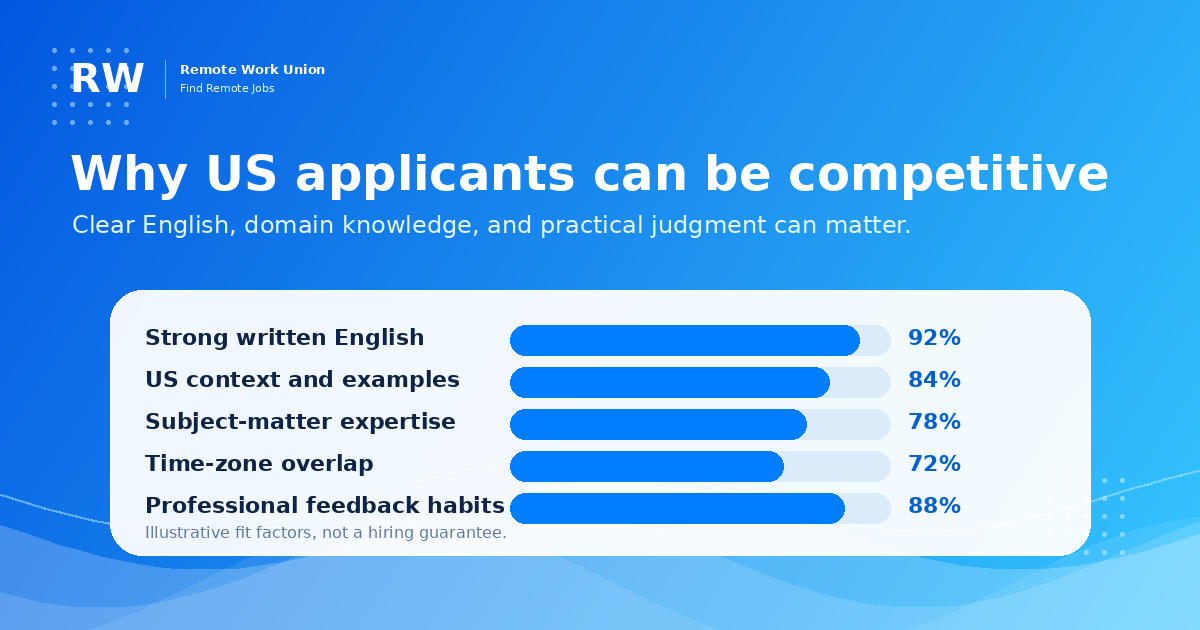
Not every AI training role prefers US applicants, but some projects do. This is usually not because the task is physically tied to one location. It is because the model being evaluated must perform well for a specific audience, context, language style, or market.
A US-based reviewer may be useful when the project requires American English, US cultural references, US workplace norms, US education examples, local search intent, regional terminology, or familiarity with how Americans phrase questions. A reviewer in the United States may also match the time-zone needs of a US client team, which can matter for onboarding, feedback cycles, and urgent quality reviews.
For specialist work, the country requirement can matter even more. Legal, healthcare, tax, financial, and compliance projects often depend on jurisdiction-specific context. A general AI evaluator can judge whether an answer is clear. A qualified US lawyer, nurse, CPA, teacher, or software engineer may be better positioned to judge whether a domain-specific answer makes sense for a US user.
Where to Find Remote Work Reviewing AI Models
The best search strategy is to use several channels at once. AI training work is fragmented. A platform may have strong project flow one month and fewer tasks later. A job board may show a promising role under a strange title. A company career page may list something that looks like research, quality evaluation, content policy, data annotation, or AI operations rather than remote AI training.
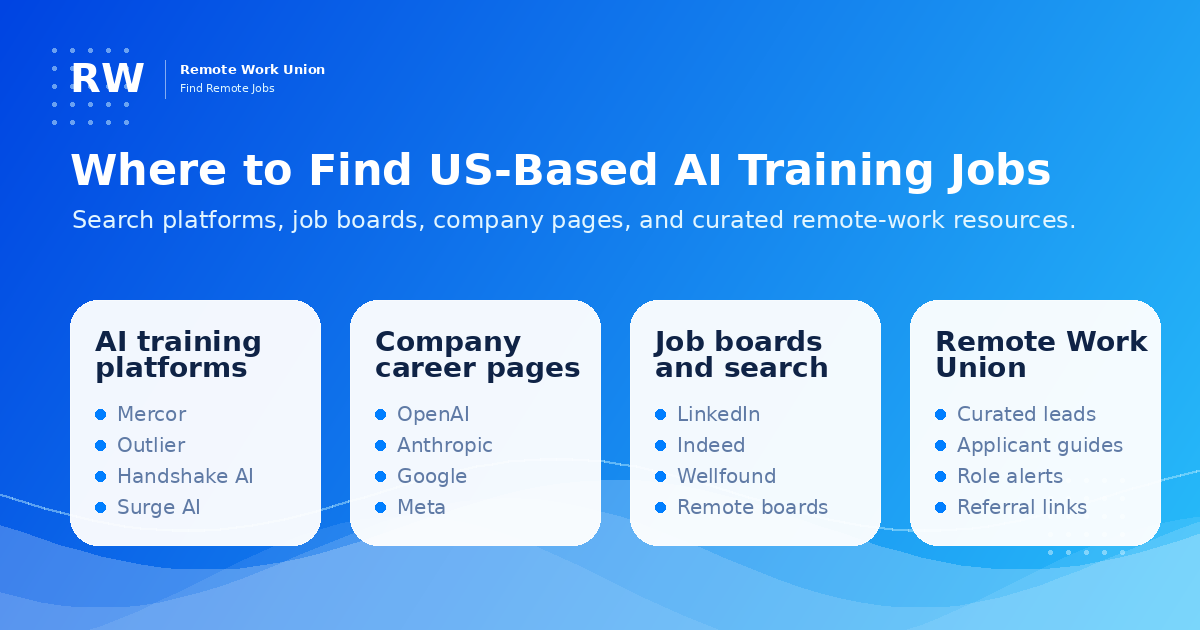
Start with AI training platforms and contractor marketplaces. Search for platforms that specialize in model evaluation, RLHF, data annotation, expert review, and AI feedback. Names people often search include Mercor, Outlier AI, Handshake AI, Surge AI, micro1, Stellar AI, and other AI data companies. Availability changes, so the goal is not to rely on one platform. The goal is to build a list, apply where there is a fit, and keep checking for new projects.
Next, search broad job boards. LinkedIn, Indeed, FlexJobs-style remote boards, Wellfound, and niche AI job boards can surface roles under terms like AI evaluator, model response evaluator, LLM judge, search quality analyst, content quality reviewer, data annotation specialist, or prompt engineer contractor. Use filters for remote, contract, part-time, United States, and work from home, then read the role carefully.
You can also search the career pages of major AI companies and large technology companies. OpenAI, Anthropic, Google, Meta, Microsoft, xAI, and other AI labs may not always list simple contractor evaluator roles directly, but their ecosystems create demand for safety evaluation, research operations, data quality, policy review, language evaluation, and domain expert feedback.
How to Tell Whether a Role Is Actually US-Based or US-Only
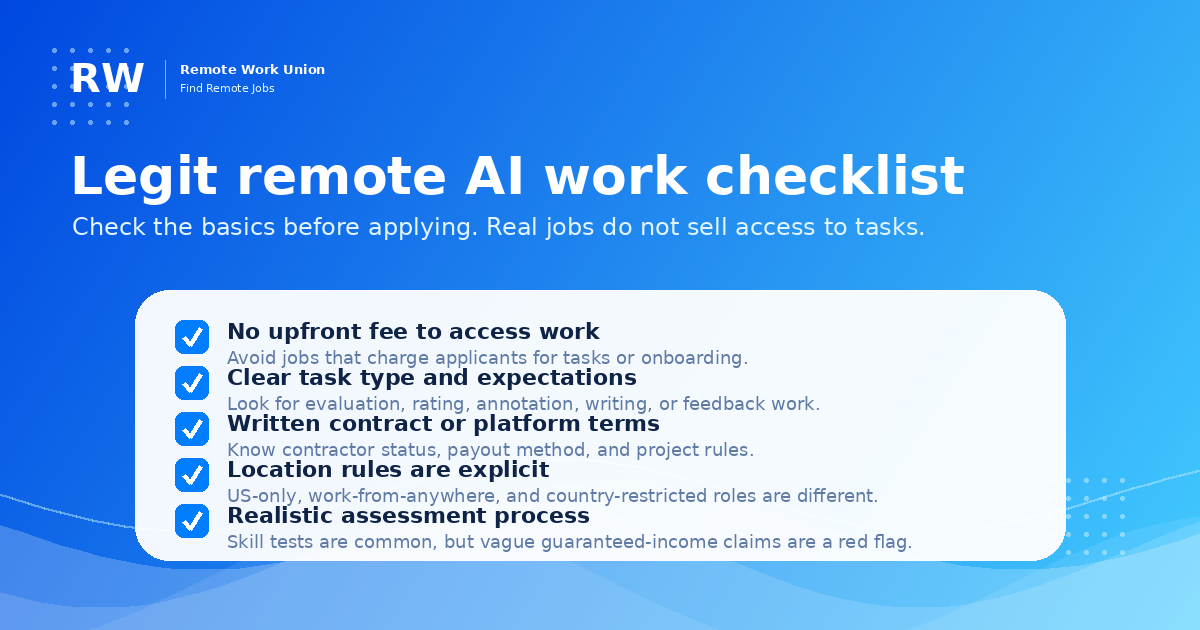
Do not assume that remote means work from anywhere. Remote job postings can still have location rules. A role might be remote within the United States, remote in certain states only, remote in North America, remote in English-speaking countries, or global. The difference matters because many platforms screen applicants by country, tax status, identity verification, payment availability, and project eligibility.
Look for phrases such as United States only, US-based applicants, must be located in the United States, authorized to work in the US, North America preferred, native English, American English, US time zones, or country-specific onboarding. Also check whether the platform asks for a location during application.
A practical rule: apply only when you can honestly satisfy the location requirement. Do not use a VPN, false address, borrowed identity, or inaccurate country information. AI training platforms often verify identity and payment details.
What Strong US Applicants Should Prepare
A good AI training application is usually not a generic remote-work application. It should show that you can read carefully, write clearly, follow instructions, and explain your judgment. For generalist roles, emphasize writing, editing, research, critical thinking, online work discipline, attention to detail, and experience with tools like ChatGPT, Claude, Gemini, Google Docs, and spreadsheets. For specialist roles, put the domain expertise near the top: law, healthcare, finance, accounting, programming, math, education, science, business, consulting, journalism, or academic research.
Prepare a short writing sample that proves you can explain a decision. For example, take two sample AI answers to the same prompt and write a few sentences explaining which is better and why. Focus on instruction-following, factual accuracy, completeness, clarity, tone, and safety. Many assessments test this exact ability.
How to Pass AI Model Evaluation Assessments
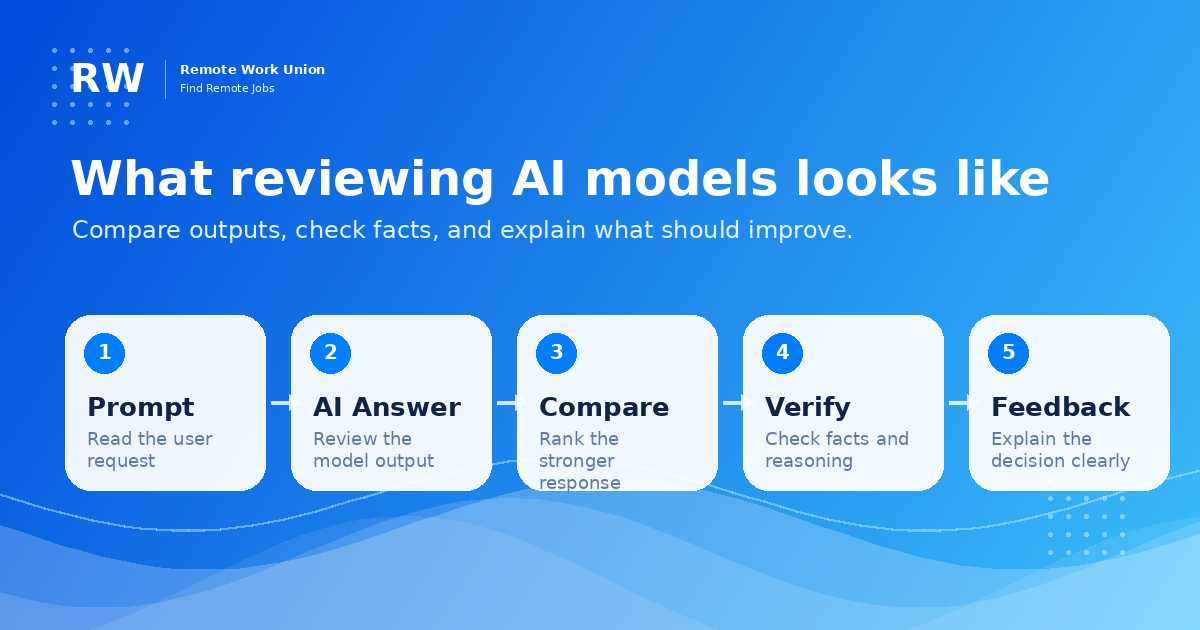
Most AI evaluator tests are not trying to see whether you sound clever. They are testing whether you can follow a rubric. Read the instructions first. Then read the prompt. Then read the model responses. Only then make a decision.
A strong evaluator usually checks five things. Did the answer follow the user's request? Is the answer accurate? Is it complete enough to be useful? Is the tone appropriate? Does it avoid unsafe, misleading, or unsupported claims? When comparing two answers, the better answer is not always the longer one. It is the answer that best satisfies the prompt under the rubric.
When writing feedback, be specific. Instead of saying Response A is better, explain that Response A follows the requested format, includes the key limitation, avoids unsupported claims, and gives a clearer next step.
Looking for US-based remote AI training and evaluation roles? Apply through Remote Work Union.
Browse Roles Now →How to Avoid Scams and Low-Quality Listings
Legitimate remote AI training jobs do not require you to pay money to access work. Be careful with any listing that asks for an upfront fee, paid certification, paid equipment package, crypto payment, gift card, or private message outside a normal application process.
Read the payment terms before you invest time. Is the role hourly, task-based, project-based, or bonus-based? How often are contractors paid? What happens if work is rejected for quality? Treat AI training work as project income until the platform proves consistent.
Can AI Training Work Become Real Income?
AI training can become meaningful remote income for some workers, but it should be approached realistically. Many roles are contract-based. Work volume may rise or fall. Assessments can be selective. Platforms may pause projects. That is why experienced contractors often apply to multiple platforms instead of depending on one source.
The strongest applicants usually combine three things: a valuable skill, clear written communication, and persistence across platforms. A US-based applicant with strong English writing may qualify for general AI evaluator roles. A US-based applicant with professional expertise may also qualify for higher-skill work in law, medicine, finance, coding, business, education, or research.
Final Takeaway
US-based AI training jobs are best understood as remote review work for AI systems. The worker is not usually building the model from scratch. The worker is helping the model improve by judging answers, checking facts, comparing outputs, labeling data, writing feedback, and applying domain expertise.
To find these roles, search beyond one keyword. Look for AI evaluator, AI trainer, AI reviewer, AI rater, RLHF reviewer, data annotation specialist, search quality rater, AI writing evaluator, prompt response reviewer, and subject-matter expert AI trainer. Check platform sites, job boards, company career pages, and curated remote-work resources. Always read location requirements carefully, especially when a role is remote but US-only.