UX researchers and designers are in one of the better positions to build a serious work from home career because their skills already fit remote collaboration. A good UX professional knows how to understand users, organize messy information, test assumptions, document findings, and explain design decisions. Those are the same abilities needed in remote product teams, AI research workflows, usability testing programs, design systems, content design, and model evaluation work.
The important point is that remote UX work is broader than a single job title. You do not have to search only for "UX designer" or "UX researcher." You can also search for product designer, UX/UI designer, usability analyst, content designer, conversation designer, accessibility reviewer, research operations specialist, product insights analyst, AI response evaluator, and model evaluation specialist.
Why UX Researchers and Designers Are Strong Remote Candidates
UX work is built around evidence. Remote companies need people who can look at a product, workflow, interface, answer, or user journey and say what is confusing, what is useful, what needs to change, and why. That judgment is valuable even when the team is distributed across different cities or countries.
Those skills also translate well into AI work. Companies building AI products need humans to evaluate whether responses are clear, accurate, useful, safe, and aligned with user intent. AI labs and platforms connected to companies like OpenAI, Anthropic, Google, Meta, xAI, Grok, and other major AI teams often rely on human reviewers, evaluators, and researchers to improve model behavior. UX professionals are naturally suited for this because they already think in terms of user goals, edge cases, clarity, friction, and real-world outcomes.
1. Remote UX Researcher
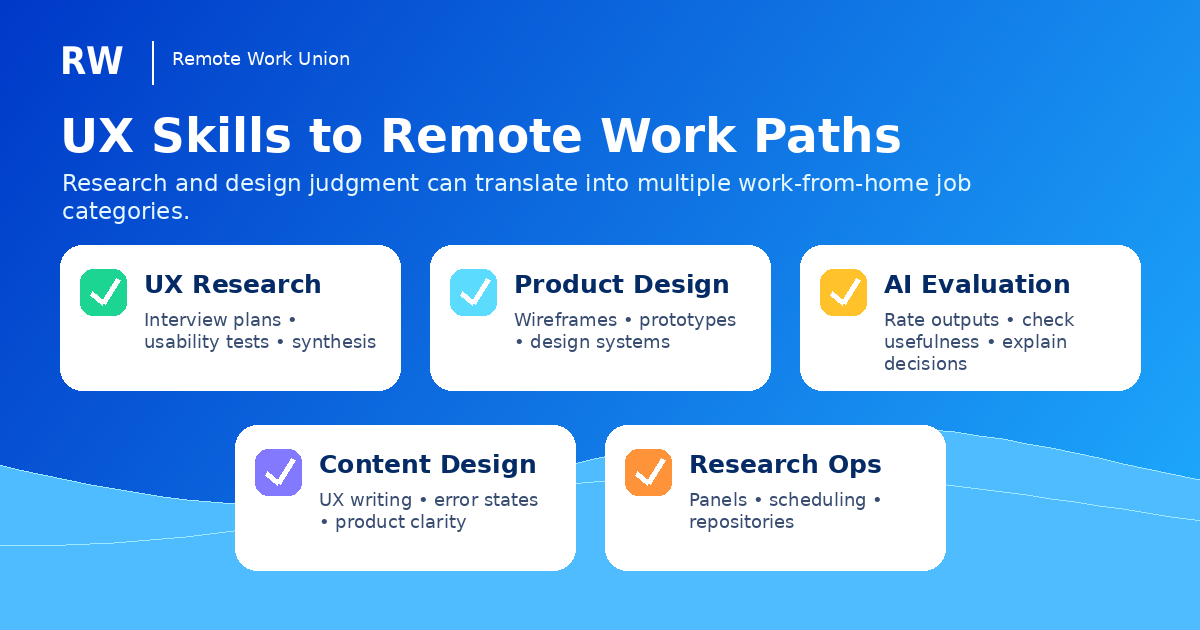
A remote UX researcher studies how people interact with products, websites, apps, tools, or workflows. This can include user interviews, usability tests, surveys, diary studies, competitive research, concept testing, and research synthesis. This is one of the strongest work from home jobs for people who are good at asking questions, listening carefully, noticing patterns, and turning qualitative information into practical recommendations.
Search terms to use include remote UX researcher, user researcher, product researcher, mixed methods researcher, usability researcher, qualitative researcher, customer insights researcher, and UX research contractor. A strong application should show examples of research plans, interview guides, synthesis boards, usability findings, and recommendations.
2. Remote Product Designer
Product designer is often the broadest and most valuable design title. A product designer may work on user flows, wireframes, prototypes, UI systems, feature design, onboarding, dashboards, checkout flows, internal tools, mobile screens, or SaaS products. In many remote teams, the product designer is expected to think beyond visuals and understand the product goal.
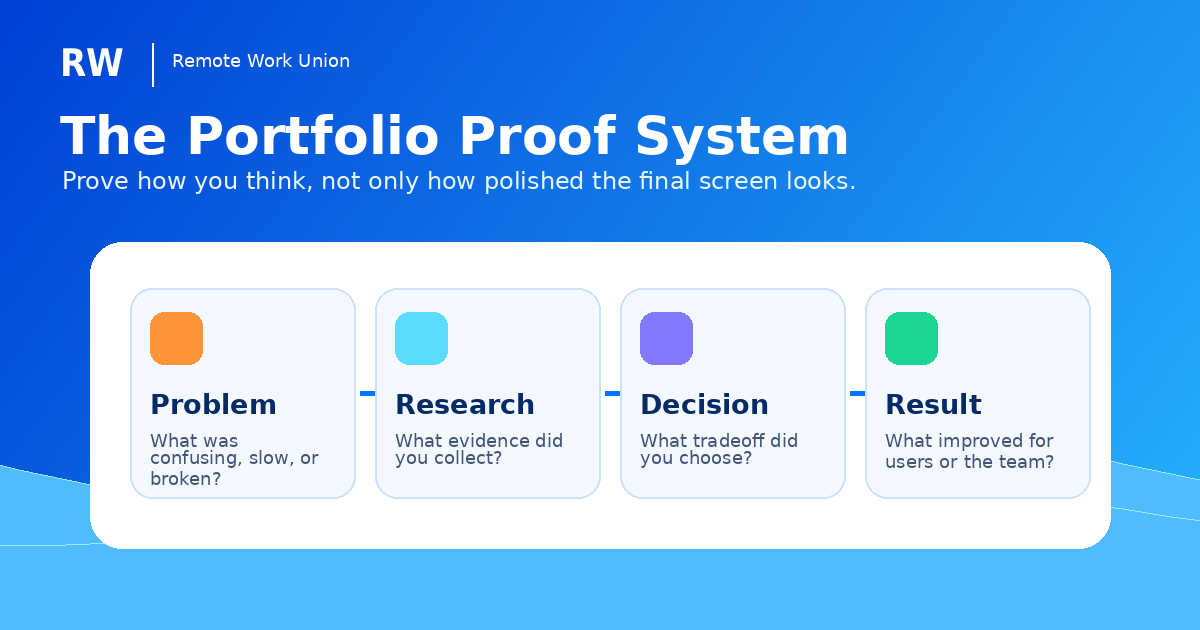
Search terms include remote product designer, product designer contract, UX product designer, SaaS product designer, mobile product designer, web product designer, growth designer, and product design consultant. Your portfolio should not only show final screens — it should show why the design changed.
3. Remote UX/UI Designer
UX/UI design roles usually combine user experience and visual interface design. These jobs are common at startups, agencies, software companies, e-commerce brands, and AI tools that need clearer product experiences. A remote UX/UI designer may redesign landing pages, improve dashboards, create mobile screens, build Figma components, design onboarding flows, or create responsive layouts.
Search terms include remote UX/UI designer, UI designer, visual product designer, web app designer, landing page designer, Figma designer, interface designer, and remote design contractor.
4. Remote Usability Testing Specialist
Usability testing is a practical and underrated remote job category. A usability testing specialist helps teams find friction before a product reaches more users. The work can include writing test plans, recruiting participants, moderating sessions, analyzing recordings, tagging issues, and summarizing usability problems. This is a strong option for UX researchers, designers, QA-minded professionals, and product managers who are good at noticing where users get stuck.
Search terms include usability tester, usability testing moderator, remote usability analyst, user testing specialist, website tester, product testing researcher, and UX evaluator.
5. Remote AI Response Evaluator for UX and Product Quality
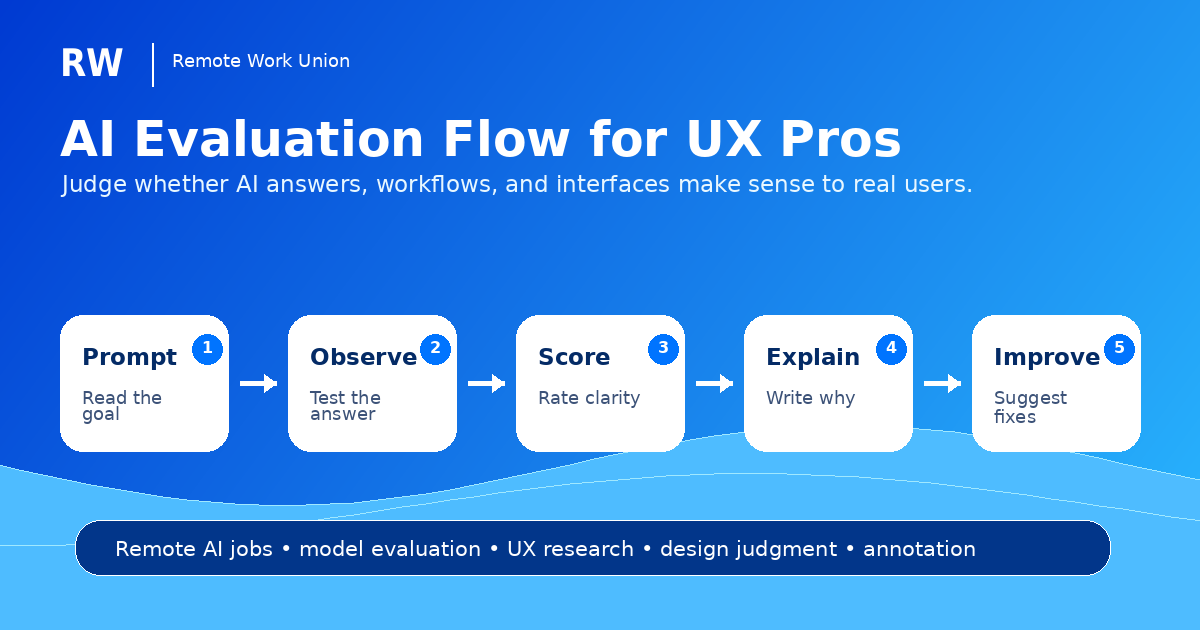
AI evaluation is one of the most relevant new work from home paths for UX researchers and designers. These roles may be called AI evaluator, AI trainer, model evaluator, response reviewer, data annotator, AI content reviewer, prompt evaluator, human feedback specialist, or AI quality analyst. The work usually involves reviewing AI responses, comparing outputs, rating helpfulness, checking instruction-following, identifying confusing answers, and writing explanations.
Key insight: For UX professionals, the advantage is obvious — you already know how to judge whether something helps a user complete a goal. A designer might evaluate whether an AI-generated interface suggestion is usable. A researcher might judge whether an AI answer addresses the user's actual intent.
Search terms include remote AI jobs, AI training jobs, AI evaluator, model evaluation, AI response evaluator, prompt evaluator, data annotation, AI annotation, human feedback, AI research contractor, and AI content evaluation. This category is especially useful for UX professionals who want flexible work.
6. Remote Content Designer or UX Writer
Content design is a strong work from home job for people who care about clarity. A content designer improves the words inside a product: buttons, onboarding screens, error messages, tooltips, help pages, forms, empty states, support flows, and AI product instructions. This role is especially relevant as more companies add AI features that need instructions, prompts, warnings, and user guidance.
Search terms include content designer, UX writer, product writer, conversation designer, AI content designer, technical content designer, and product content strategist. A strong portfolio should show before-and-after examples with explanations of why the revision is better.
7. Remote Conversation Designer
Conversation design sits between UX, writing, research, and AI. These roles involve designing chatbots, AI assistants, support flows, voice interfaces, onboarding assistants, and interactive help experiences. AI companies, customer support platforms, education tools, healthcare tools, finance apps, and software products all need better conversational experiences.
Search terms include conversation designer, chatbot designer, AI conversation designer, voice UX designer, conversational AI designer, assistant design, prompt designer, and AI UX designer. To apply, show examples of flows, intents, fallback states, error recovery, and tone rules.
8. Remote Design Systems Specialist
Design systems work is a strong remote path because it depends heavily on documentation, consistency, reusable components, and cross-functional collaboration. A design systems specialist may maintain Figma libraries, write component guidelines, document patterns, review implementation quality, or help product teams ship faster. This role is best for designers who like structure.
Search terms include design systems designer, design systems specialist, UI systems designer, Figma library manager, component designer, design operations, and product systems designer.
9. Remote Accessibility Reviewer
Accessibility is a valuable remote specialization for UX researchers and designers. Accessibility reviewers evaluate whether digital products can be used by people with visual, motor, cognitive, hearing, or other access needs. This role can overlap with UX research, QA testing, product design, and AI evaluation. AI products also need accessibility review because chat interfaces, generated content, and multimodal tools can create new usability barriers.
Search terms include accessibility reviewer, accessibility specialist, inclusive design consultant, WCAG reviewer, accessibility tester, digital accessibility analyst, and remote accessibility consultant.
10. Remote Research Operations Specialist
Research operations supports the systems behind UX research. This can include participant recruiting, panel management, consent forms, scheduling, incentive tracking, research repositories, templates, compliance processes, and study logistics. This is a good remote job for organized people who understand research but may not want to lead every study.
Search terms include research operations specialist, UX research coordinator, participant recruiting coordinator, research panel manager, and user research operations. A strong profile should emphasize organization, confidentiality, documentation, scheduling, and attention to detail.
11. Remote Product Insights or Customer Insights Analyst
Product insights roles turn feedback, interviews, support tickets, surveys, usage data, reviews, and user behavior into recommendations. These roles can be a bridge between UX research, product management, marketing, and customer success. They are a good fit for people who can combine qualitative and quantitative thinking.
Search terms include product insights analyst, customer insights analyst, user insights specialist, voice of customer analyst, product research analyst, and customer research specialist.
12. Remote Design QA and Product Review
Design QA is another underrated work from home job category. A design QA reviewer checks whether a shipped product matches the intended design, whether interactions behave correctly, whether the layout breaks on different devices, and whether the final experience is clear. This can be a good fit for detail-oriented UX/UI designers, QA testers, product managers, and AI evaluators.
Search terms include design QA, product QA, UI reviewer, UX QA analyst, visual QA tester, product review specialist, and remote quality analyst.
Ready to find remote UX, design, and AI evaluation roles that match your background?
See Roles Hiring Now →How UX Professionals Should Position Themselves for Remote Work
The mistake many UX applicants make is applying with a profile that is too generic. A stronger profile says something like: "UX researcher and product designer experienced in usability testing, interview synthesis, Figma prototypes, design systems, accessibility review, and AI response evaluation. Strong at identifying user intent, documenting friction, and explaining product decisions clearly."
For remote AI jobs, add language around evaluation and annotation. Examples include model evaluation, prompt review, response scoring, instruction-following, content quality, user intent, helpfulness, clarity, safety, hallucination detection, rubric-based review, and written explanations.
What to Include in a Remote UX Portfolio
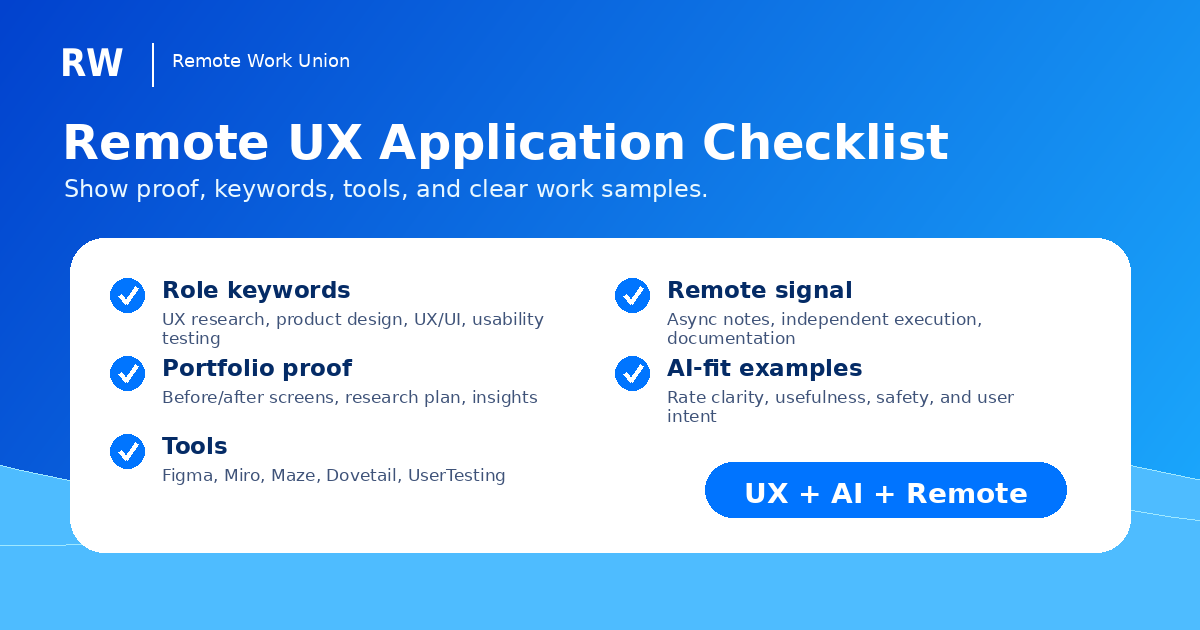
Your portfolio does not have to be huge. Three strong case studies are better than ten confusing ones. A useful remote UX case study should include the problem, the users, the constraints, the research or evidence, the design decisions, the final solution, and the result.
For AI evaluation roles, you can create sample evaluation writeups. Use a fictional prompt, compare two fictional responses, score them against a rubric, and explain which response better serves the user. This shows that you can do the work even before you are accepted onto a platform.
Frequently Asked Questions
Can UX researchers and designers find fully remote work?
Yes. UX research and design are among the most naturally remote-friendly jobs because the work is delivered through documents, presentations, Figma files, and written communication. Remote companies need designers and researchers who can work asynchronously, document clearly, and collaborate across time zones.
What AI training jobs are available for UX professionals?
UX researchers and designers can apply for AI response evaluator, AI content reviewer, model evaluation specialist, AI quality analyst, and conversation designer roles. These jobs use UX judgment to rate whether AI responses are clear, useful, accurate, and aligned with user intent — skills UX professionals already have.
Do UX jobs always require an in-person office?
No. Most UX work can be done remotely. User interviews, usability tests, research synthesis, wireframing, prototyping, design review, and stakeholder communication can all happen asynchronously or via video call. Remote-first companies rely on strong documentation to make this work.
How should UX professionals position themselves for AI evaluation roles?
Highlight skills like user intent analysis, helpfulness evaluation, clarity review, instruction-following assessment, and written feedback. These are the same skills AI training platforms use to evaluate model responses. Add keywords like model evaluation, AI evaluator, prompt reviewer, data annotation, and response quality to your profile.