Remote AI work can be a short-term side gig, or it can become the foundation of a durable remote career. The difference is not only which platform accepts you first. The difference is how you treat the work after you get access.
Many people start by applying to AI training platforms, AI evaluation roles, data annotation projects, prompt writing jobs, content review tasks, or work-from-home AI jobs because they want flexible income. That is a valid reason to start. But the bigger opportunity is learning how to turn those first assignments into a long-term remote work path.
AI companies and AI training platforms need people who can judge quality. They need workers who can read carefully, compare answers, identify mistakes, follow instructions, explain reasoning clearly, and understand what makes an AI response useful or unsafe. That kind of human judgment does not disappear just because tools get more advanced. If anything, better AI systems create more demand for better evaluation.
A long-term remote AI career is built around one idea: become useful in the parts of AI work where trust, accuracy, communication, and domain knowledge matter.
What This Article Covers
- Think Beyond One Platform
- The Remote AI Career Flywheel
- Start With the Easiest Proof: Quality
- Move From General Tasks to Specialist Tasks
- Build a Simple AI Work Portfolio
- Learn the Language of AI Work
- Use Multiple Platforms With One Clear Strategy
- Protect Your Accounts and Reputation
- Turn Feedback Into a Promotion System
- Build Income Stability Before Chasing Maximum Pay
- Create a Weekly Operating System
- Keep Your Remote AI Career Flexible
- Frequently Asked Questions
Think beyond one platform
It is easy to think of remote AI work as a list of platforms: micro1, Mercor, Handshake AI, Outlier, DataAnnotation-style marketplaces, AI reviewer programs, expert networks, and direct contract roles with companies building or testing AI products. Platforms matter because they give you access to paid work. But platforms should not be the entire strategy.
A platform can pause projects. A client can change budgets. Your task queue can slow down. Your application can sit unanswered. A project can end without much warning. These issues are common in remote AI training and remote evaluation work, even when the platform itself is legitimate.
That is why the long-term strategy is not "get accepted once and wait." The long-term strategy is to build a profile, skill set, and proof base that can travel across platforms.
That means you should treat every project as evidence. What types of tasks can you complete well? What subjects can you evaluate? Are you strongest at writing, research, coding, finance, law, medical content, education, marketing, customer support, policy, creative work, language review, or general reasoning? Which tasks do you finish accurately without needing constant clarification?
Those answers become your career story.
The remote AI career flywheel
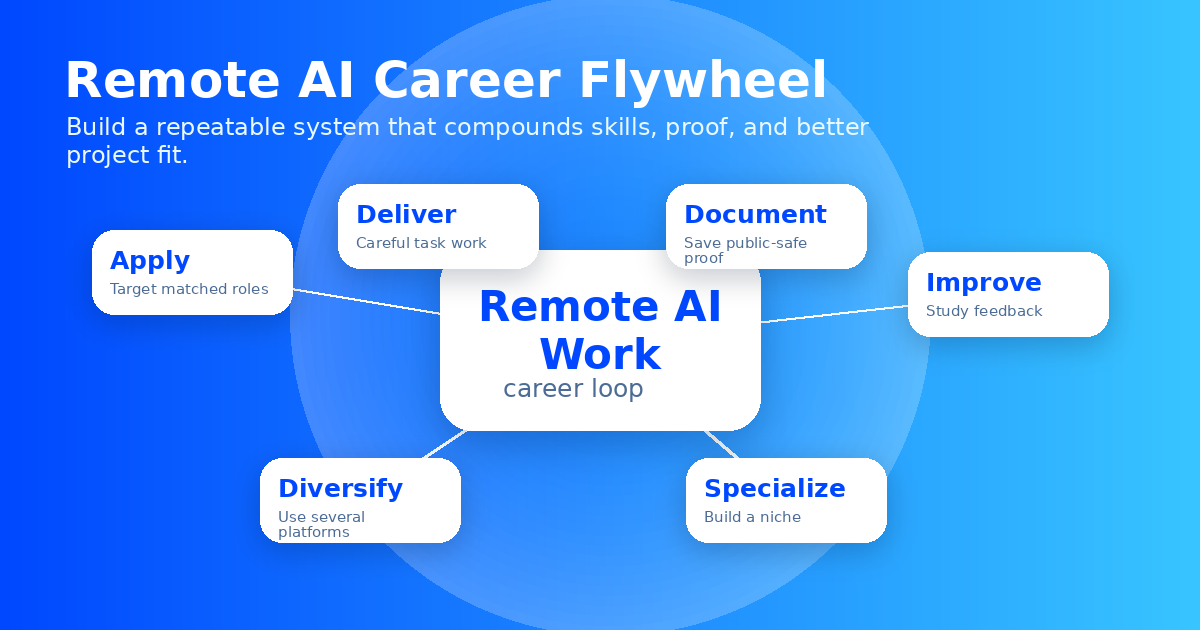
The strongest remote AI workers usually do not rely on random applications forever. They build a flywheel:
- Apply to roles that match their skills.
- Complete tasks carefully.
- Learn from platform feedback.
- Document what they are good at.
- Improve weak areas.
- Use that proof to qualify for better projects.
- Repeat the process across multiple opportunities.
The first loop may be small. You might start with AI response rating, basic data annotation, search result evaluation, transcription cleanup, content moderation, or simple prompt testing. The goal is not to stay there forever. The goal is to use entry-level remote AI work to prove reliability.
Reliability is underrated. If a platform or client can trust you to read instructions, meet deadlines, follow rubrics, and explain your decisions, you become easier to assign to higher-value work.
Start with the easiest proof: quality
In remote AI training jobs, quality matters more than speed at the beginning. Many beginners try to maximize hours before they understand the task. That can backfire. A better approach is to treat your first 10 to 20 task hours as training.
Read the instructions twice. Save examples. Notice edge cases. Track what confuses you. Compare your answers to any feedback you receive. When a platform gives you a rubric, learn the rubric before trying to be fast.
This is especially important for AI evaluator jobs, AI content reviewer jobs, AI data annotation projects, and prompt evaluation tasks. These roles often look simple from the outside because the interface is easy to use. The hard part is applying consistent judgment.
A strong reviewer can answer questions like:
- Did the AI actually follow the user's request?
- Is the answer factually grounded?
- Is the response useful for the user's real goal?
- Did it miss an important constraint?
- Is the tone appropriate?
- Is the model hallucinating, overpromising, or making unsupported claims?
- Is one response clearly better, or are both flawed in different ways?
That judgment is the product you are selling.
Move from general tasks to specialist tasks
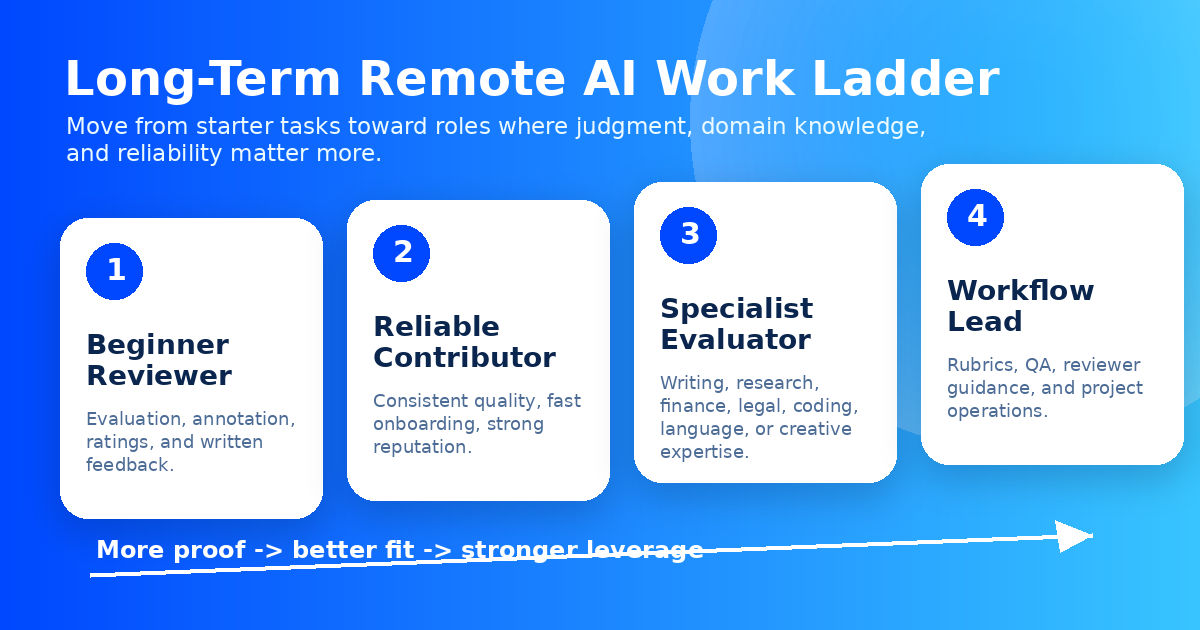
General remote AI jobs are useful because they help you start. Specialist AI work is where many people build longer-term leverage.
Specialist work may include legal AI evaluation, finance and accounting review, coding assessment, medical content review, scientific research checking, creative writing evaluation, marketing content analysis, UX research support, education content review, language translation evaluation, or business operations tasks.
You do not need to be an engineer to build a career around AI work. You do need to understand which part of the AI workflow fits your background.
A writer can evaluate style, clarity, originality, structure, and whether an answer sounds natural. A marketer can judge ad copy, audience fit, SEO intent, and conversion logic. A paralegal can spot legal reasoning issues and risky phrasing. A teacher can evaluate explanations, lesson plans, and student-facing content. A customer support professional can test whether a chatbot actually solves user problems. A data-minded worker can review labels, categories, consistency, and edge cases.
The more specific your value becomes, the less you look like a generic applicant.
Key insight: Expert-tier AI evaluation roles that match your professional background — law, finance, medicine, marketing, education, operations — can pay $50–$200/hr. Specialist work is where the flywheel pays off.
Build a simple AI work portfolio
Many remote AI platforms do not ask for a traditional portfolio, but you should still build one for yourself. A portfolio helps you apply faster, write stronger profiles, and explain your value when a better opportunity appears.
Your portfolio does not need confidential client work. Do not save or share private platform tasks. Instead, create public-safe examples that show the same skills.
Useful portfolio examples include:
- A before-and-after AI response critique.
- A sample prompt evaluation with a short explanation.
- A research fact-checking example using public information.
- A writing sample that shows clarity and structure.
- A rubric you created for judging answer quality.
- A short case study explaining how you would test a customer support chatbot.
- A subject-specific sample, such as finance, legal, education, marketing, or technical review.
The point is not to make a huge website. The point is to create proof that you understand AI quality.
Learn the language of AI work
A long-term remote AI career becomes easier when you can describe the work correctly. Many beginners only say, "I want AI jobs from home." That is too broad.
Learn the phrases that platforms, recruiters, and hiring teams use:
- AI trainer
- AI evaluator
- AI response reviewer
- AI data annotator
- AI content reviewer
- prompt evaluator
- prompt writer
- model evaluator
- search quality rater
- human feedback reviewer
- RLHF contributor
- data quality analyst
- LLM evaluation specialist
- AI safety evaluator
- subject matter expert reviewer
These keywords matter in profiles, resumes, LinkedIn pages, platform applications, and remote job searches. Companies like OpenAI, Anthropic, Google, Meta, Grok, and other AI labs may not always use the same titles, but the underlying work often revolves around evaluation, feedback, data quality, safety, and domain expertise.
Do not stuff every keyword into your profile. Use the terms that match your real skills. A focused profile is stronger than a bloated one.
Ready to apply for remote AI roles? Find opportunities matched to your background on RemoteWorkUnion.com.
Find Roles Hiring Now →Use multiple platforms with one clear strategy
Joining multiple AI training platforms can help stabilize your income. It can also create chaos if you apply randomly and forget where you stand.
A practical setup is to keep a simple tracker with columns for platform, application date, role type, rate, status, assessment notes, project access, payment method, and follow-up date. This lets you see your pipeline clearly.
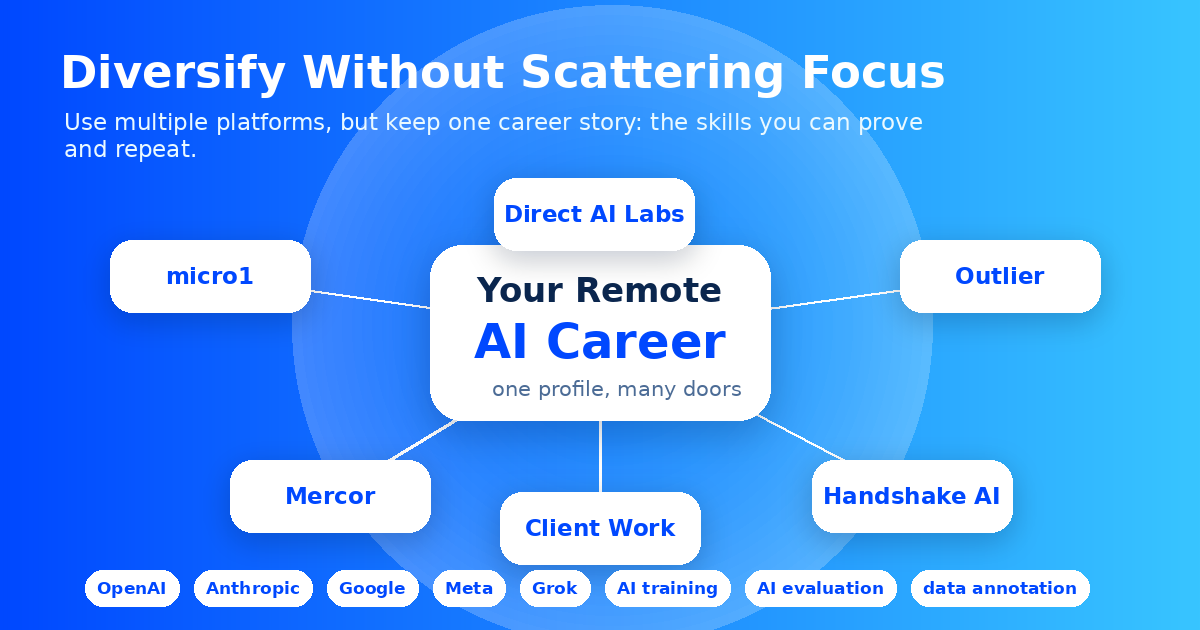
For example, you may apply to micro1 for AI interview-based roles, Mercor for expert or creative evaluation opportunities, Handshake AI for remote AI tasks and projects, Outlier for AI training work, and other platforms for data annotation or subject-specific contracts. You may also apply directly to AI companies, startups, research vendors, and remote contractor networks.
The goal is not to chase every posting. The goal is to create a steady flow of opportunities that match your strengths.
When you diversify, be careful with time management. Do not accept more work than you can complete well. A reputation for quality is worth more than a crowded dashboard.
Protect your accounts and reputation
Remote AI work is often platform-based, which means your account reputation matters. Follow the rules closely.
Do not use prohibited tools if a platform says not to. Do not share confidential tasks. Do not create duplicate accounts. Do not rush through assessments. Do not submit work you do not understand. Do not misrepresent your location, experience, or credentials. Do not treat platform instructions as optional.
A long-term remote career depends on trust. One careless mistake can cost more than one project.
Also be careful with scams. Legitimate remote AI work platforms should not charge you to apply, buy training, unlock tasks, or receive payment. Real companies may require assessments, identity verification, tax forms, and onboarding steps. They should not ask you to pay them to start working.
Turn feedback into a promotion system
Feedback is one of the most valuable parts of AI training work. Many workers ignore it because they are focused only on the next task. A better approach is to create a personal feedback log.
Track mistakes by category:
- Missed instruction
- Weak explanation
- Overlooked factual issue
- Inconsistent rating
- Rubric misunderstanding
- Formatting error
- Speed-related mistake
- Subject knowledge gap
After a few weeks, patterns appear. Maybe you are strong at writing but weak at research verification. Maybe you are fast but miss subtle instruction constraints. Maybe you are good at general evaluation but need a niche to earn better projects.
This turns feedback into a training plan. That is how you move from beginner remote AI jobs to more valuable AI reviewer, AI trainer, or subject matter expert work.
Build income stability before chasing maximum pay
Some remote AI jobs advertise very high hourly rates. Those roles usually require stronger expertise, harder assessments, limited project availability, or specialized skills. It is fine to aim for them, but do not build your entire plan around the highest number you see online.
A more stable path is to build layers:
- A base layer of flexible remote platforms.
- A skill layer of stronger writing, research, prompt evaluation, and quality review.
- A specialist layer based on your professional background.
- A relationship layer with repeat clients, recruiters, or platform teams.
- A career layer that can include operations, QA, training, project management, or AI workflow design.
This approach makes you less dependent on one dashboard.
Create a weekly operating system
Long-term remote workers need systems. Motivation is not enough.
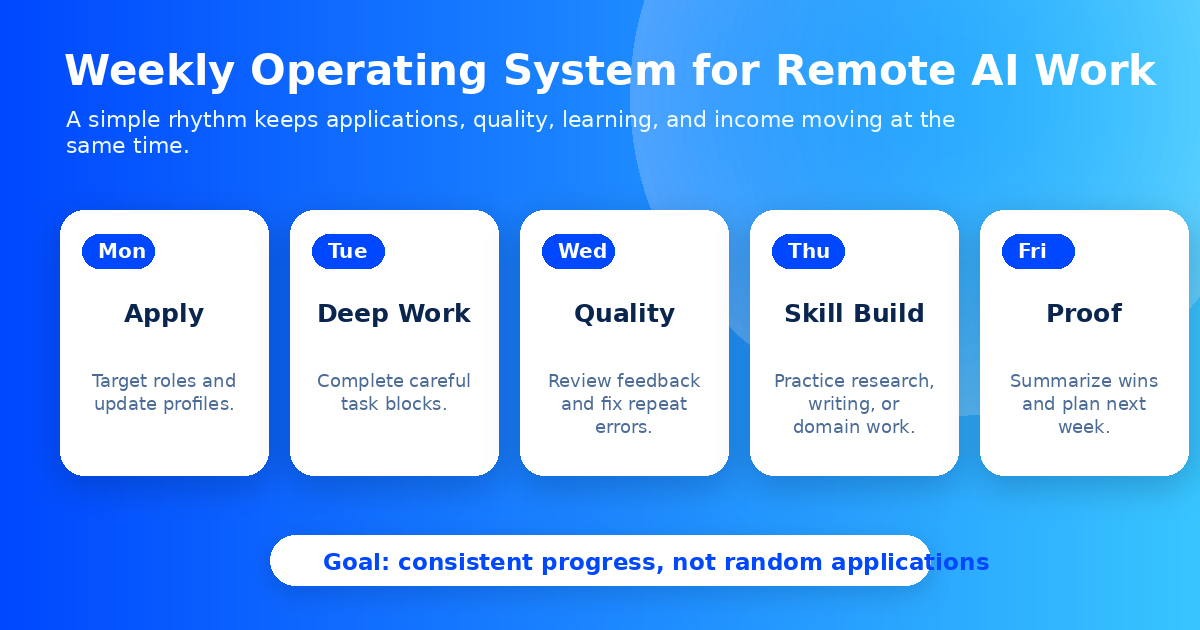
A simple weekly system might look like this:
- Monday: apply to new roles, follow up, refresh profiles.
- Tuesday: complete deep work blocks for active tasks.
- Wednesday: review feedback and improve task quality.
- Thursday: build one skill, sample, or portfolio asset.
- Friday: update your tracker, summarize wins, and plan next week.
This system does not need to be complicated. It just needs to keep your pipeline, performance, and skill growth moving at the same time.
Keep your remote AI career flexible
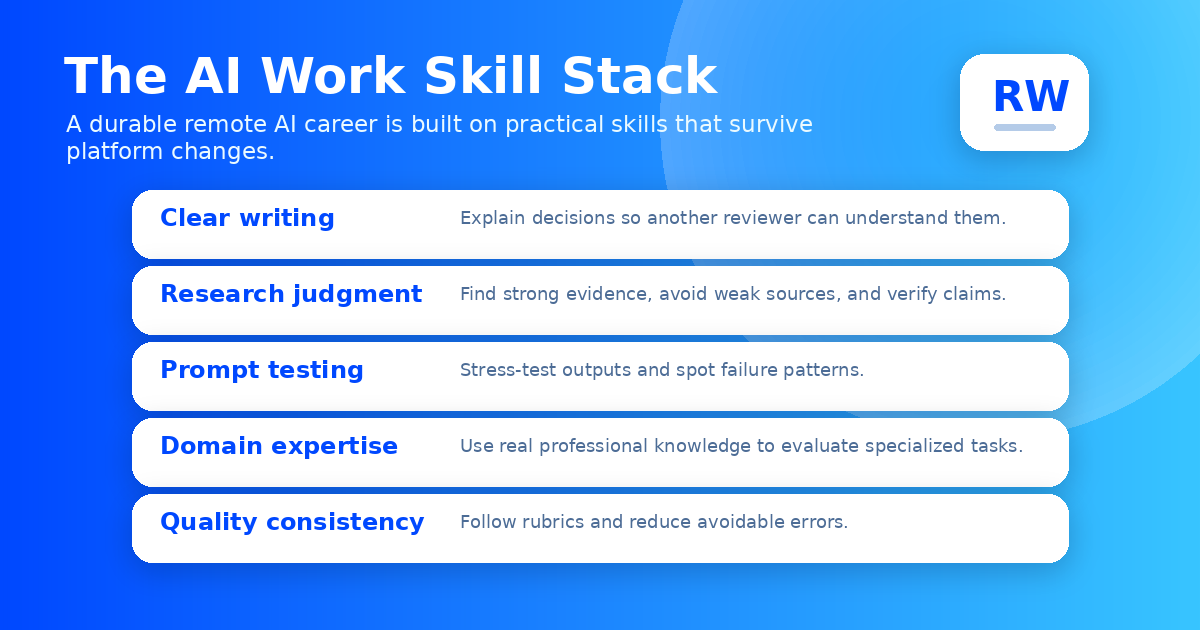
AI work changes quickly, but the human skills underneath it are stable. Clear writing, careful reading, accurate research, sound judgment, domain expertise, and reliable communication will continue to matter.
The tools will change. The platforms will change. The project names will change. But companies building AI systems will still need people who can evaluate whether those systems are useful, safe, accurate, and aligned with real user needs.
That is the long-term opportunity.
Do not think only in terms of "getting tasks." Think in terms of building a remote career around AI quality. Start with accessible work. Improve your judgment. Track your proof. Specialize when you can. Diversify carefully. Protect your reputation. Keep applying.
A remote AI career is not built in one application. It is built by repeating the right actions long enough that your skills, proof, and opportunities compound.
Frequently Asked Questions
Can remote AI training jobs turn into a long-term career?
Yes. Remote AI training, evaluation, and annotation work can form the foundation of a durable work-from-home career. The key is treating early assignments as proof-building, improving your judgment over time, diversifying across platforms, and specializing in areas where your professional background adds value.
What skills matter most for a long-term remote AI career?
Clear writing, careful reading, accurate research, consistent judgment, domain expertise, and reliable communication are the core skills. These apply across AI evaluation, prompt review, data annotation, content review, and expert-tier AI training roles. Tools and platform names change, but these underlying skills remain valuable.
How do I move from entry-level AI tasks to higher-paying expert roles?
Focus on quality in your first 10–20 task hours, track feedback by category, identify your strongest domains, and document your results. As you demonstrate reliability and accuracy, you become eligible for specialist work in areas like legal AI evaluation, finance review, medical content, coding assessment, and other expert-tier projects that pay $50–$200/hr.
How many AI training platforms should I use for stable income?
Most experienced remote AI workers use three to five platforms to create income stability. Apply to micro1, Mercor, Handshake AI, and Outlier to start, then add others based on your specialty. Keep a simple tracker with platform, status, role type, and follow-up date. Diversify carefully — accept only what you can complete well.
What does a long-term remote AI career actually look like?
It typically involves building layers: a base layer of flexible platforms, a skill layer of evaluation and writing ability, a specialist layer based on your professional background, a relationship layer with repeat clients or platform teams, and a career layer that can expand into operations, QA, training design, or AI workflow roles. Income stabilizes as platforms, skills, and opportunities compound over time.