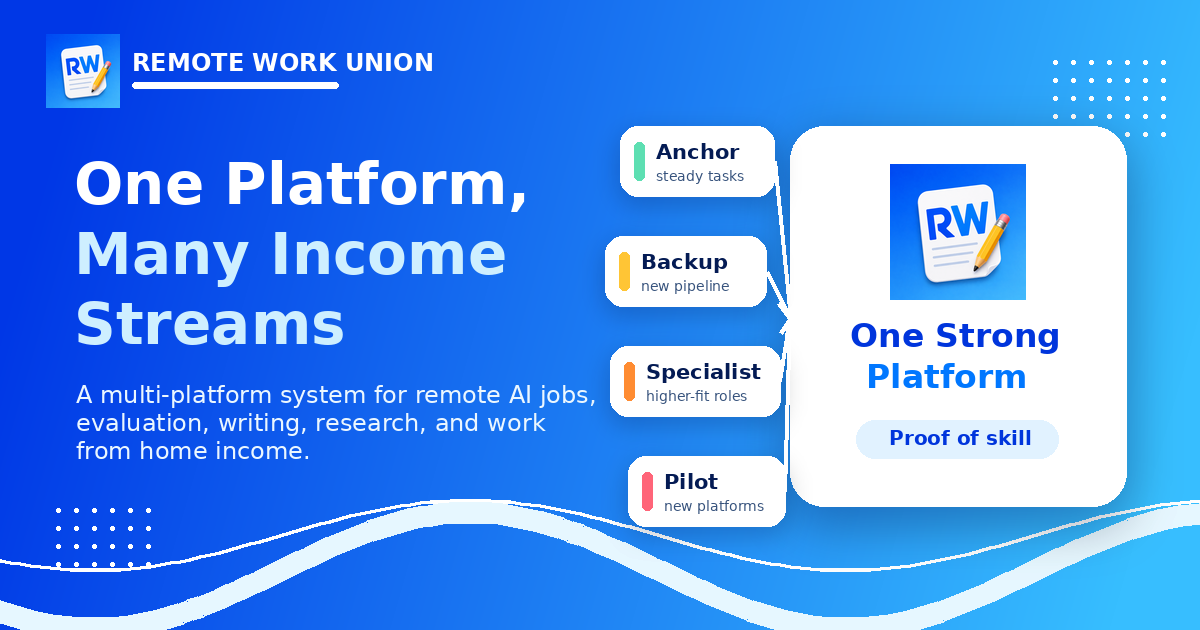
A lot of people treat remote AI work like a single account. They apply to one platform, wait for tasks, complete whatever appears, and panic when the dashboard goes quiet. That is risky. Remote work is more stable when one platform becomes the proof, practice, and application engine that helps you qualify for several others.
This matters especially in AI training, AI evaluation, data annotation, prompt writing, research review, content quality, and work from home jobs where task volume can change quickly. A platform may have plenty of projects one week and almost nothing the next. That does not always mean you did something wrong. It often means the client paused work, a project filled, a queue moved to another group, or your profile is waiting for a better match.
The goal is not to chase every remote job on the internet. The goal is to build a platform stack: one strong account, one or two backup accounts, one higher-upside specialist path, and a simple weekly system that keeps new opportunities moving.
What This Article Covers
- Why One Platform Is the Best Starting Point
- The Platform Stack Model
- Step 1: Extract Your Transferable Skills
- Step 2: Build a Master Remote Work Profile
- Step 3: Turn Task History Into Application Proof
- Step 4: Apply Sideways, Not Randomly
- Step 5: Keep the Anchor Platform Clean
- Step 6: Create a Weekly Pipeline Routine
- Step 7: Track Payouts, Task Volume, and Account Status
- Step 8: Move From Generalist to Specialist Over Time
- Common Mistakes to Avoid
- Frequently Asked Questions
Why One Platform Is the Best Starting Point
One platform gives you information that a beginner does not have yet. It shows you which task types you can pass, what kinds of instructions you handle well, how fast you work without sacrificing quality, and what kinds of remote AI jobs fit your background.
For example, a person who starts on a general AI training platform may discover that they are better at factual research than creative writing. Someone else may learn that they are faster at editing AI responses than rating long technical answers. Another person may find that their finance, legal, healthcare, marketing, coding, education, or customer support background makes them more valuable than they expected.
That first platform becomes your laboratory. It helps you identify your strongest category before you apply everywhere else. This is how remote workers move from random applications to targeted applications.
The Platform Stack Model
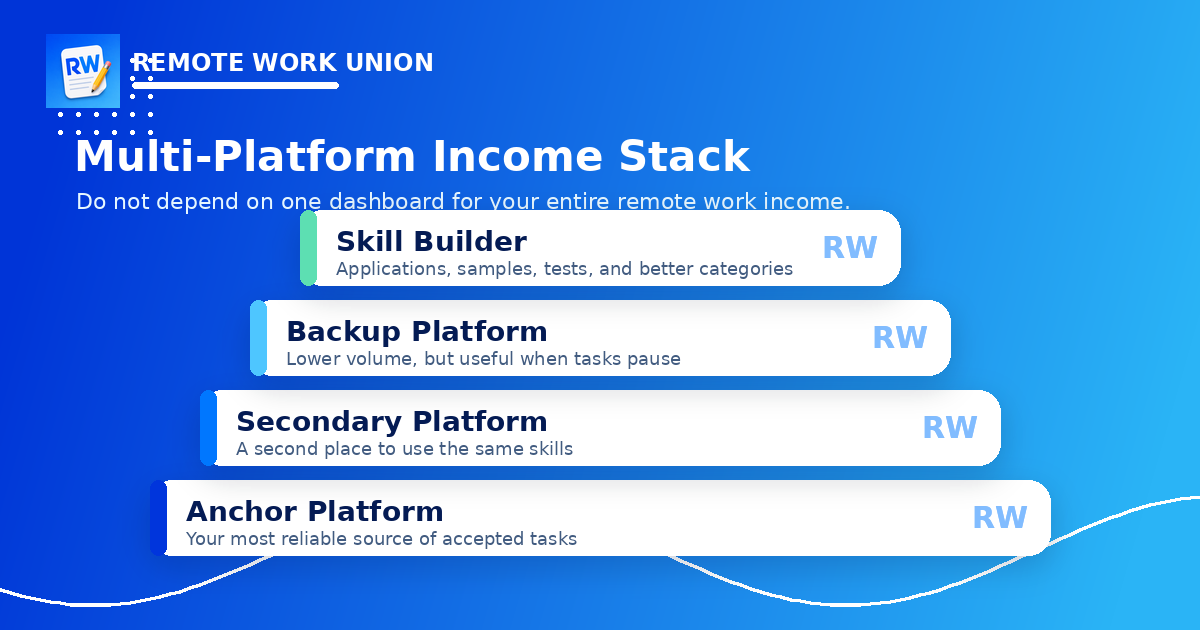
A multi-platform remote income system should not be messy. It should be organized around roles. Each platform has a purpose.
Your anchor platform is the account that currently gives you the most reliable work. This is where you protect your quality score, complete tasks carefully, and learn what strong performance looks like.
Your secondary platform is the next best fit for the same skill set. If your anchor platform uses you for AI content review, your secondary applications should emphasize editing, writing, research, and model evaluation. If your anchor uses you for data labeling, your next applications should emphasize attention to detail, classification, consistency, and quality control.
Your backup platform is there for gaps. It may not pay the most or offer the most interesting work, but it keeps you from depending entirely on one queue.
Your specialist path is where higher income can come from over time. This could be domain expert AI work, legal review, coding evaluation, finance analysis, medical-adjacent review, technical writing, research evaluation, or another category where your real-world experience matters.
Your experiment slot is for new platforms, new job boards, and new remote work opportunities. This keeps your pipeline alive without letting applications take over your whole week.
Step 1: Extract Your Transferable Skills From the First Platform
Do not describe your first platform experience as simply "I did tasks online." That undersells it.
Break the work into skills that other platforms understand: following detailed instructions, comparing AI outputs, rating accuracy, checking factual claims, improving prompt responses, editing unclear writing, reviewing tone, labeling data, identifying policy issues, evaluating reasoning, researching unfamiliar topics, and giving structured feedback.
These phrases matter because they match how AI companies and remote work platforms describe the work. Teams building products around OpenAI, Anthropic, Google, Meta, Grok, and other AI systems need people who can review model outputs, identify mistakes, and explain what better answers should look like. You do not always need to be a software engineer. Many remote AI jobs rely on judgment, clarity, patience, and subject knowledge.
Make a short skills inventory after your first week or two. Write down the task types you completed, the categories you passed, the instructions you handled well, and the mistakes you learned to avoid. This becomes the foundation for your next applications.
Key move: After your first platform gives you real task experience, your applications to other platforms should describe specific skills — not just "I did AI work." Specificity is what gets you matched.
Step 2: Build a Master Remote Work Profile
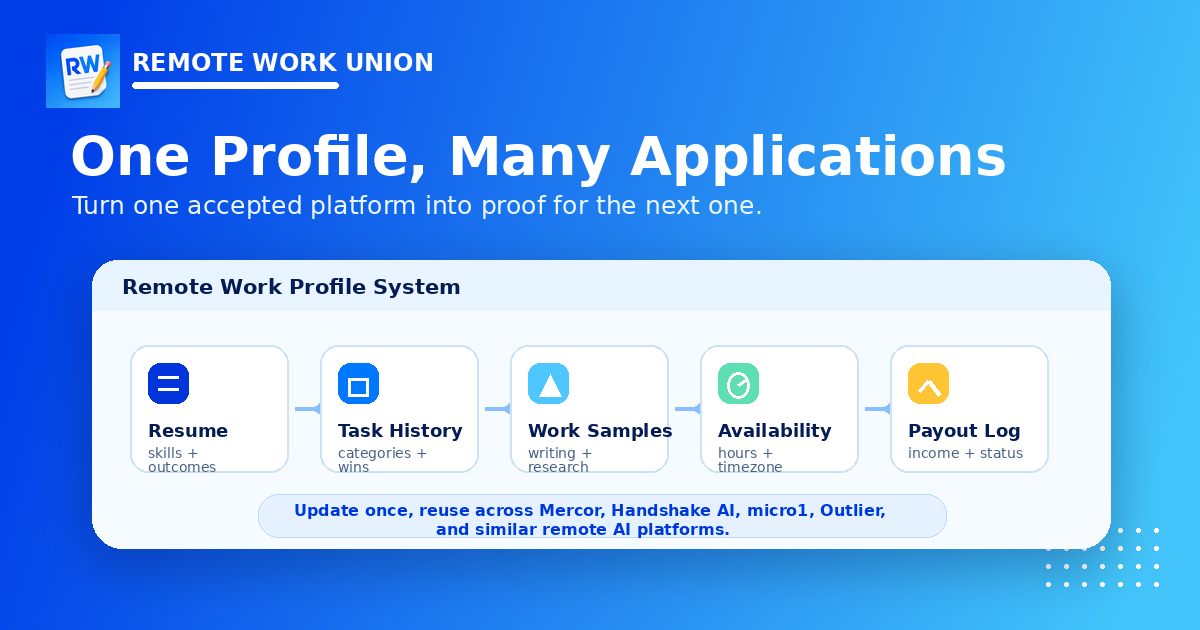
A master profile is a reusable source document. It should include your short bio, work history, education, skills, task categories, sample answers, availability, preferred work types, and payout notes. You should not rebuild your application from scratch every time you apply to Mercor, Handshake AI, micro1, Outlier, or any similar remote AI platform.
Your master profile should have several versions of the same story. One version should be broad: remote AI evaluator, content reviewer, research-focused worker, or AI training generalist. Another version should be specialized: finance evaluator, legal researcher, coding reviewer, marketing analyst, UX researcher, language expert, or writing specialist.
This makes applications faster and better. When a platform asks about your background, you can answer clearly. When a test asks why you are a good fit, you already know which skills to mention. When a profile field asks for categories, you can choose them based on real work rather than guessing.
Step 3: Turn Task History Into Application Proof
Most remote AI platforms will not let you share private task content, and you should respect confidentiality rules. But you can still describe your experience in general terms.
Instead of saying, "I worked on AI tasks," say: "I reviewed AI-generated responses for accuracy, clarity, instruction-following, and completeness." Instead of saying, "I did annotation," say: "I applied detailed guidelines to classify outputs consistently and flag quality issues." Instead of saying, "I wrote prompts," say: "I created and revised prompts to test reasoning, tone, factual accuracy, and user intent."
That kind of wording helps you look like a serious remote worker. It also matches common search keywords for remote AI jobs, AI model evaluation, AI training jobs, data annotation, prompt writing, AI content review, and human feedback work.
Step 4: Apply Sideways, Not Randomly
The biggest mistake is applying to every remote job with the same generic profile. A better strategy is to apply sideways.
If your first platform gives you writing evaluation tasks, apply to roles involving AI writing review, AI content editing, search quality, grammar evaluation, chatbot response scoring, and prompt testing. If your first platform gives you research tasks, apply to roles involving fact-checking, web research, source evaluation, data quality, and AI response verification. If your first platform gives you domain expert tasks, apply to platforms that ask for that subject area directly.
This creates a cleaner story. You are not just trying to find work from home jobs. You are building a specific remote work profile that platforms can understand.
Step 5: Keep the Anchor Platform Clean
A multi-platform strategy only works if you protect the account that is already working. Do not rush tasks on your anchor platform because you are distracted by five new applications. Do not take categories you do not understand just to increase volume. Do not ignore feedback, hidden instructions, formatting rules, or project-specific quality standards.
For most AI training work, quality matters more than raw speed. A platform may give more opportunities to workers who are consistent, careful, and easy to trust. That means reading instructions fully, keeping notes on confusing rules, checking your work before submitting, and avoiding shortcuts that could damage your account.
The anchor platform should fund your time while the rest of the stack grows. Treat it like the base of the system, not a disposable stepping stone.
Ready to build a more stable remote income system? Start with roles hiring now on RemoteWorkUnion.com.
Find Roles Hiring Now →Step 6: Create a Weekly Pipeline Routine
Multi-platform income requires a routine. Without one, you either ignore new opportunities or spend the whole day applying instead of earning.
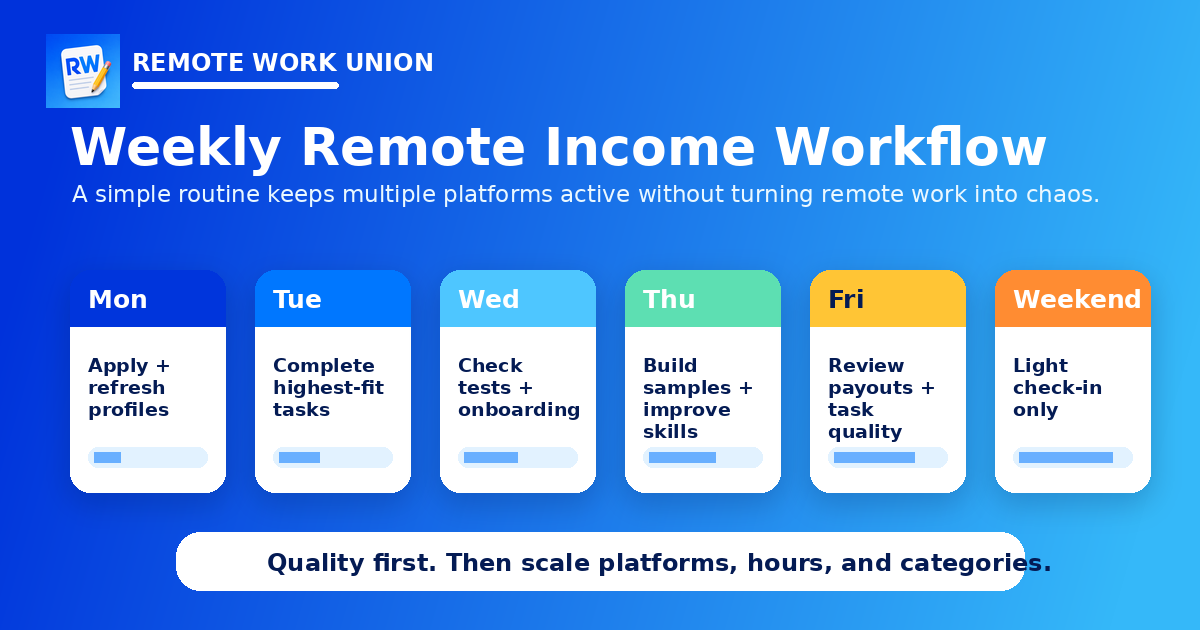
A simple weekly routine works better: Monday is for checking new roles and refreshing profiles. Tuesday and Wednesday are for completing the highest-fit tasks. Thursday is for tests, onboarding, and improving samples. Friday is for reviewing payouts, task volume, and account status. The weekend can be a light check-in, not a full job search unless you want it to be.
This routine keeps the pipeline active while preserving the quality of your current work. It also helps you notice patterns. If one platform is slowing down for several weeks, you can shift more time to applications. If one platform starts giving steady work again, you can reduce the application window and focus on earning.
Step 7: Track Payouts, Task Volume, and Account Status
Remote income becomes more stable when you track it. You do not need a complicated spreadsheet. Track the platform name, application status, accepted categories, task volume, estimated earnings, payout timing, and notes about quality feedback.
This prevents confusion. It also shows you which platforms are actually worth your attention. Some platforms may look exciting but rarely produce work. Others may look boring but pay consistently. Some may be best for expert projects. Others may be best for entry-level AI annotation or short work from home tasks.
The point is to make decisions from evidence rather than emotion. A quiet dashboard feels less stressful when you can see that two other platforms are in progress and one backup account is still active.
Step 8: Move From Generalist to Specialist Over Time
Many beginners start as generalists. That is fine. General AI evaluation, writing review, research, and annotation work can help you learn the market. But over time, higher-quality opportunities often come from specificity.
A marketing professional can position themselves for AI ad review, brand voice evaluation, SEO content review, and social media quality tasks. A paralegal can look for legal research, contract review, policy evaluation, and compliance-related AI work. A teacher can apply for education content review, curriculum evaluation, tutoring AI review, and child-safe content categories. A finance professional can focus on spreadsheet reasoning, business analysis, accounting review, and financial explanation tasks.
Specialization does not mean locking yourself into one niche forever. It means giving platforms a reason to match you to better work.
Common Mistakes to Avoid
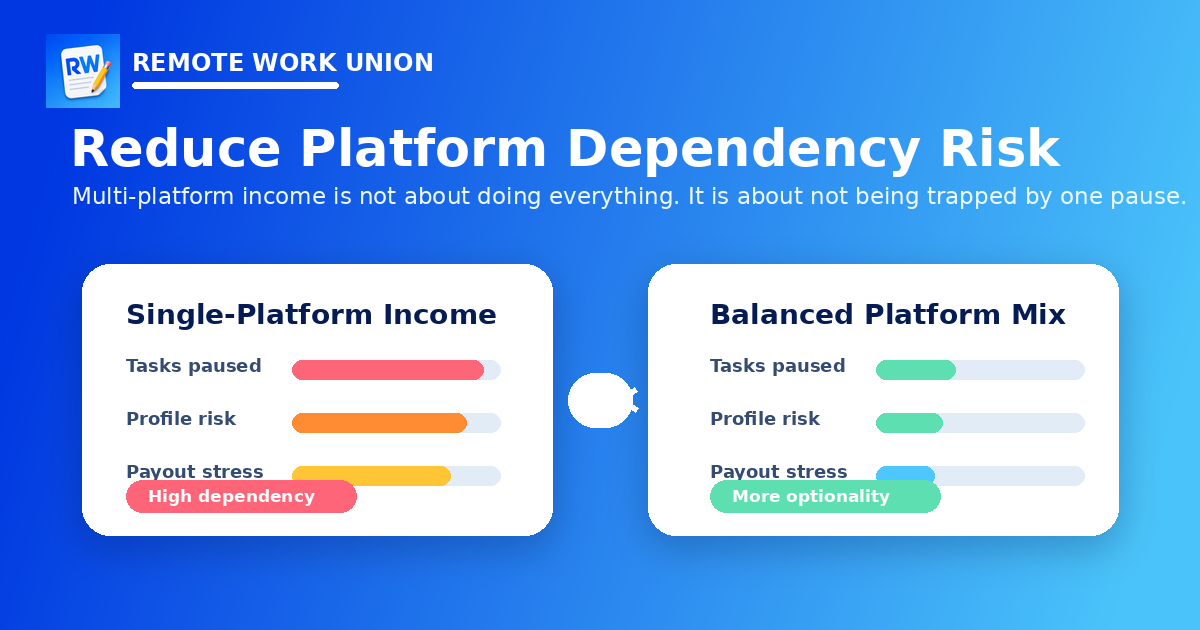
The first mistake is depending on one platform forever. Even a strong account can slow down.
The second mistake is applying to too many platforms with low-quality applications. A rushed profile can make you look less qualified than you are.
The third mistake is exaggerating experience. Remote AI platforms often test your claims quickly. It is better to be accurate and strong in a smaller category than vague and inflated everywhere.
The fourth mistake is ignoring non-technical strengths. Many AI training jobs are not coding jobs. Writing clarity, research ability, careful reading, customer support judgment, subject knowledge, editing, and attention to detail can all matter.
The fifth mistake is treating task pauses as personal failure. Sometimes tasks stop because of project volume, client changes, review cycles, or platform matching. The right response is to improve quality, update your profile, and keep the pipeline moving.
Bottom line: A multi-platform remote income is not built in a day. It is built by treating your first platform as the starting point of a system — not the whole system itself.
Frequently Asked Questions
How many platforms should a beginner join?
Start with one or two serious applications, then build toward three to five active options over time. Too many accounts at once can create confusion if you are still learning how AI training work operates.
Should I apply to platforms before I have experience?
Yes, but your application should be honest. Emphasize relevant skills from school, jobs, freelancing, writing, research, customer support, analysis, editing, tutoring, coding, or subject expertise.
Can one platform help me get accepted elsewhere?
It can help indirectly. You usually cannot share private task details, but you can use the experience to understand your strengths, improve your profile, and describe your skills more clearly.
What if my first platform stops giving me tasks?
Review your quality, check whether new profile fields or tests are available, apply to nearby platforms, and avoid making your income dependent on one queue.
Is multi-platform remote work only for AI jobs?
No. The same strategy works for remote writing, editing, research, virtual assistance, customer success, data quality, operations, UX research, and other work from home jobs. AI training is just one of the strongest examples because the skill transfer is so direct.