Remote AI work is easier to understand when you stop treating every platform like a lottery ticket.
A beginner often applies to one platform, waits, refreshes email, gets frustrated, and assumes the whole category is dead. That is the wrong workflow. Handshake AI, Mercor, micro1, and similar remote AI work platforms should be treated like separate lanes in one larger pipeline. One lane helps you find openings. One lane helps you match your expertise to projects. One lane may ask you to prove your skills through a structured AI interview or assessment. When you use them together, you reduce the chance that one slow account controls your entire remote income.
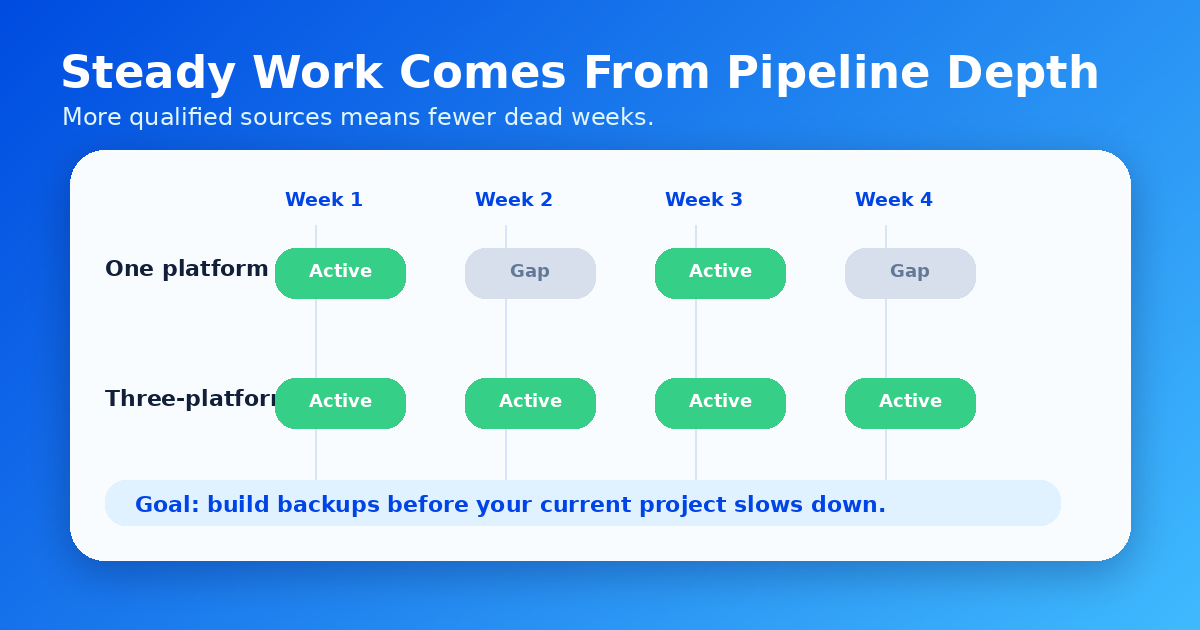
This does not mean every applicant will get steady work every week. No remote work platform can guarantee that. AI training jobs, model evaluation tasks, expert review projects, and data annotation contracts move in waves. Projects open, fill, pause, restart, and change requirements. The goal is not to force one platform to behave like a full-time employer. The goal is to build a system where you always know where to apply next, which profile needs improvement, what assessment is pending, and which opportunity deserves your attention today.
For remote workers, this matters because the AI economy is broad. Major AI companies and labs such as OpenAI, Anthropic, Google, Meta, and Grok need better model behavior, safer outputs, stronger reasoning, cleaner data, and more accurate evaluations. Much of that work depends on humans who can read carefully, judge quality, explain mistakes, compare answers, write prompts, review research, check facts, and apply subject matter expertise. Platforms like Handshake AI, Mercor, and micro1 can help connect people to pieces of that market, but they should not be used passively.
The simple rule: do not depend on one platform
The biggest mistake new remote AI workers make is relying on a single account.
If you only apply to one platform, every normal delay feels like a crisis. No response feels personal. A paused project feels like the end of the opportunity. A missing task queue feels like failure. But remote AI work is not always linear. You can pass an assessment and still wait for matching. You can complete an interview and still need human review. You can do strong work on one project and still have a quiet week when client demand changes.
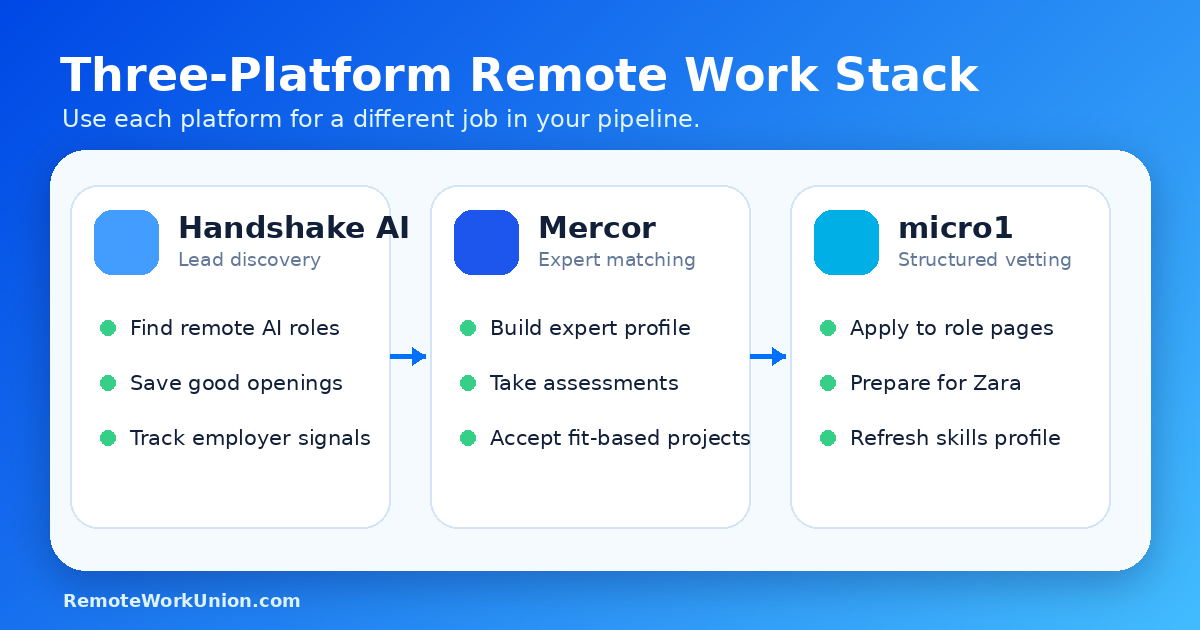
A stronger strategy is to use three lanes at the same time:
1. Discovery lane: where you find new remote AI jobs, work from home jobs, AI training roles, and research tasks. 2. Qualification lane: where you build a profile, complete assessments, and prove your ability. 3. Execution lane: where you accept tasks, deliver high-quality work, track pay, and protect your account reputation.
Handshake AI, Mercor, and micro1 can fit into those lanes differently depending on what roles are open at the time. The exact platform process can change, so always verify current instructions directly on the platform. The strategy stays the same: keep more than one qualified source active.
What each platform should do in your system
Handshake AI: use it as a lead source and opportunity scanner
Handshake AI is useful when you treat it as a place to discover roles and signals. Do not only search once and leave. Search repeatedly for remote AI work, AI evaluator jobs, model training jobs, data annotation jobs, prompt writing jobs, research assistant jobs, content review jobs, and subject matter expert roles.
Save jobs that match your background. Study the language used in the listings. Look for repeated phrases like "AI training," "model evaluation," "human feedback," "LLM evaluation," "annotation," "expert review," "quality assurance," "research," "writing," "coding," "math," "legal," "finance," or "medical." Those phrases tell you how companies describe the work.
Your goal is not to apply to everything. Your goal is to learn the market and identify roles where your existing skills are relevant. A former teacher may fit education evaluation. A copywriter may fit response review or prompt writing. A paralegal may fit legal reasoning tasks. A bookkeeper may fit finance and spreadsheet review. A customer support rep may fit chatbot evaluation or conversation quality analysis. Many remote AI jobs do not require coding, but they do require clear judgment.
Mercor: use it as an expertise-matching platform
Mercor is best treated like a profile and matching system. A weak profile can bury you even if you are capable. A strong profile makes it easier for the platform to understand what you should be considered for.
Do not make your profile generic. "Hard worker looking for remote work" is not enough. The profile should tell the platform what you can evaluate. Examples include writing, editing, software engineering, math, law, medicine, finance, sales, marketing, operations, customer support, research, recruiting, teaching, product management, data analysis, or design.
A good Mercor-style profile usually answers four questions quickly: What field do you actually know? What kind of work can you judge better than an average person? What tools, documents, workflows, or customers have you worked with? Can you explain your reasoning clearly in writing?
That last point matters. AI training work often rewards people who can explain why an answer is good or bad. If you can only say "this looks wrong," you are less useful than someone who can say, "This answer misses the user's constraint, invents a fact, ignores the requested format, and fails to compare the two options."
micro1: use it as a structured assessment and role-application lane
micro1 should be treated as a place where preparation matters before the interview or assessment. Many candidates make the mistake of entering an AI interview casually, as if it is a simple formality. Do not do that.
For micro1-style applications, prepare concise examples from your background. Be ready to explain how you solve problems, how you check your work, how you handle ambiguity, and how you communicate when something is unclear. If the role is writing-focused, prepare examples of editing, tone, fact-checking, and following instructions. If the role is operations-focused, prepare examples of workflow management, spreadsheets, customer records, or process improvement. If the role is technical, prepare to explain tradeoffs, edge cases, testing, debugging, and system design in plain language.
The point is not to memorize fake answers. The point is to make your real experience easy to evaluate.
Build one master profile, then tailor it for each platform
You should not create three completely different identities. That creates confusion and can look inconsistent. Instead, create one master remote work profile and tailor the emphasis for each platform.
Your master profile should include: a clean one-paragraph summary of your background; a list of your strongest skill areas; specific tools you know; work samples or short descriptions of relevant projects; a few proof points; and a short explanation of why you are useful for AI training or model evaluation.
Then tailor the profile: on Handshake AI, emphasize search keywords and role fit; on Mercor, emphasize subject matter expertise and assessment readiness; on micro1, emphasize clear communication and interview examples.
The same person can be positioned in multiple ways without lying. For example, a marketing manager could apply as a content evaluator, social media expert, sales copy reviewer, customer research analyst, brand safety reviewer, or AI marketing prompt writer. The background is the same. The angle changes based on the role.
Use a simple tracker or you will lose control
Once you apply across multiple platforms, memory is not enough. You need a tracker.
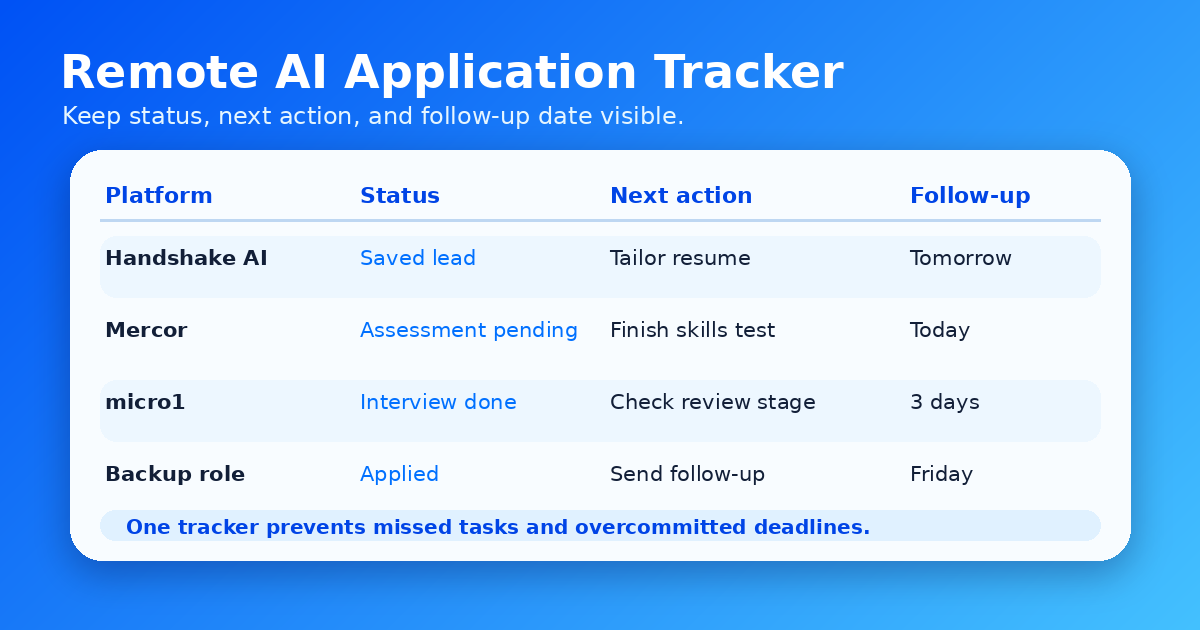
A basic tracker should include: platform name; role name; date applied; status; assessment or interview required; next action; follow-up date; pay range if listed; notes about requirements; and login email used.
This sounds boring, but it prevents the most common mistakes. People forget which role they applied for. They miss assessment deadlines. They take interviews without reviewing the listing. A tracker also helps you see patterns. If writing roles respond but data roles do not, lean harder into writing. If expert roles respond but generalist roles do not, strengthen your expertise positioning.
Create a weekly remote AI work routine
You do not need to spend all day applying. You need consistency.
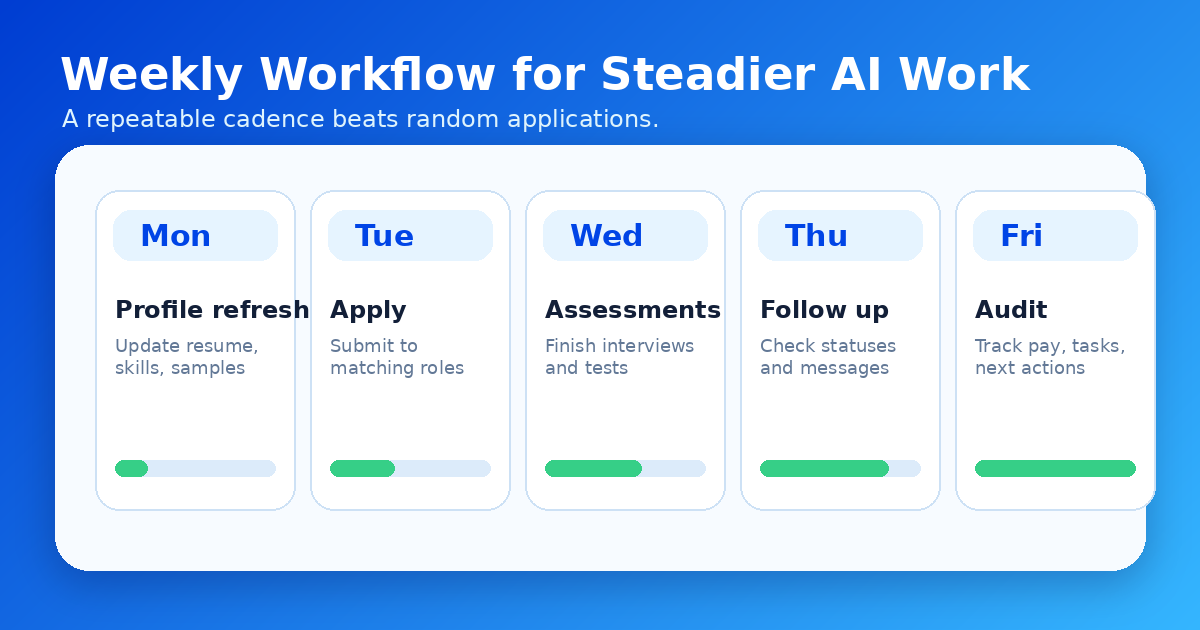
A practical weekly workflow: Monday, refresh profiles — update resume, platform summaries, skills, and availability; Tuesday, apply to new roles — search Handshake AI, Mercor, micro1, and other platforms and apply only to roles where your background has a clear connection; Wednesday, complete assessments — handle AI interviews, writing tests, skill checks, and onboarding tasks while your attention is fresh; Thursday, follow up and check statuses — review emails, platform dashboards, pending tasks, and incomplete steps; Friday, audit the pipeline — track what moved, what stalled, what paid, what needs follow-up, and what to apply for next.
This routine matters because remote AI work rewards people who operate like contractors, not passive applicants. Contractors manage their pipeline before they are desperate.
Apply to Handshake AI, Mercor, and micro1 in one place and build a stronger remote AI work pipeline from day one.
Find Roles Hiring Now →Do not overapply without improving your materials
More applications can help, but only when your materials are strong enough.
If you apply to 50 roles with a vague profile, you may simply create 50 weak applications. A better plan is to improve your profile after every 10 to 15 serious applications. Look at the roles you are targeting. Add missing keywords honestly. Tighten your summary. Replace vague claims with evidence. Prepare better examples for interviews.
Remote AI platforms often need people who can follow instructions exactly. Your application should prove that before you ever get a task. If the role asks for research experience, mention research. If it asks for editing, mention editing. A strong application is not long. It is specific.
Protect your account quality
Steady work does not come only from getting accepted. It comes from staying trusted.
Once you get tasks, your priority changes. You are no longer just an applicant. You are building a work record. That means: avoid rushing through tasks just to increase volume; do not use AI tools when a platform forbids them; do not submit work you do not understand; do not copy confidential material; do not accept deadlines you cannot meet; and do not ignore instructions because you think your way is better.
The remote workers who last are not always the fastest. They are usually the ones who are accurate, consistent, clear, and easy to assign work to.
Use downtime correctly
Downtime is normal. What matters is what you do with it.
If one platform gets quiet, do not spend the whole week refreshing it. Use the time to strengthen another lane. Apply to new roles. Take pending assessments. Update your portfolio. Improve your resume. Add a sample that demonstrates your judgment. Research the language used in current AI training jobs. Build a list of roles that match your expertise.
You can also use downtime to expand your category. A writer can learn basic AI evaluation rubrics. A customer support rep can move into chatbot response quality. A recruiter can evaluate job descriptions and candidate summaries. A finance professional can review spreadsheet reasoning. A teacher can evaluate educational explanations. A software engineer can evaluate code, debugging, and architecture responses.
When using three platforms becomes too much
There is a limit. The point is not to join every platform on the internet. The point is to maintain enough active options that you are not dependent on one.
Three platforms is a good starting number because it is manageable. Once you have active work, you may not need to apply as aggressively. But you should still keep your profiles current. A project can pause without warning. A client can change scope. A role can fill. A platform can shift requirements. Your backup plan should already exist before you need it.
Use a simple rule: if you have no active work, apply and assess aggressively. If you have part-time work, keep one backup lane warm. If you have full-time-level work, maintain your profiles and track the best future opportunities, but do not overcommit.
The best strategy for beginners
A beginner should not try to look like an expert in everything. That is a common mistake.
Start with your strongest real background. Then connect it to remote AI work. If you are good at writing, target writing evaluation, prompt writing, editing, and response comparison. If you are good at research, target fact-checking, source review, and AI research tasks. If you are good at operations, target workflow analysis, spreadsheet review, process documentation, and administrative AI tasks. If you are good at customer service, target conversation evaluation, support chatbot testing, and quality assurance. If you are technical, target coding, debugging, data, engineering, and model evaluation roles.
The long-term view
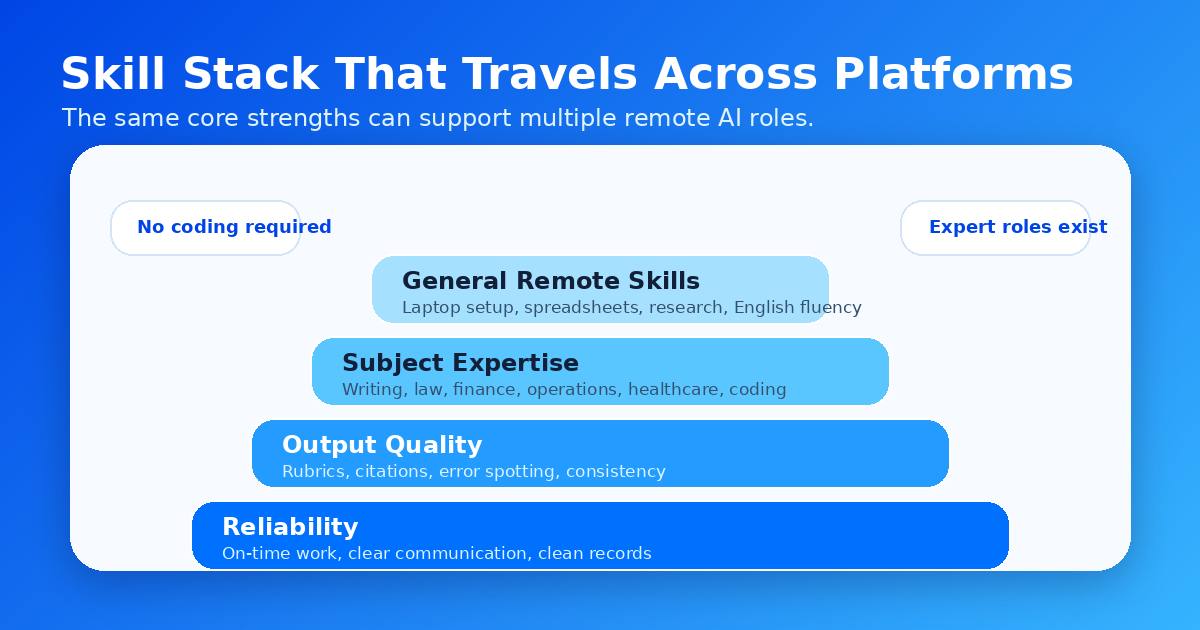
The remote AI job market will keep changing. Some roles will disappear. New ones will appear. Pay will vary. Requirements will get more specific. Platforms will adjust their interviews, dashboards, and matching systems. That is why the best strategy is not platform dependence. The best strategy is skill portability.
If you can evaluate quality, explain reasoning, follow instructions, manage deadlines, and apply your real-world expertise, you can move across platforms more easily. Handshake AI, Mercor, and micro1 are not the whole market. They are entry points into a bigger category of AI training jobs, AI model evaluation, data annotation, human feedback, expert review, and remote research work.
Treat them like a pipeline. Keep your profile sharp. Track every application. Complete assessments carefully. Follow up without obsessing. Protect your work quality. Build backups before you need them.
Frequently Asked Questions
Can I apply to Handshake AI, Mercor, and micro1 at the same time?
Yes. Applying to multiple platforms simultaneously is a stronger strategy than applying sequentially. Use a tracker to manage each application, assessment, and follow-up across platforms.
What if one platform never responds?
No response often means the role paused, the platform has more applicants than projects, or your profile did not match the current need. Improve your profile, keep your other applications active, and check back periodically for new openings.
How do I manage multiple platform accounts without getting overwhelmed?
Use a simple spreadsheet tracker with one row per platform or application. Track status, next action, and follow-up date. Check your tracker weekly rather than checking every platform every day.
Which platform is best for beginners?
Each platform is suited for different strengths. Handshake AI is useful for discovering job types. Mercor rewards specific domain expertise and strong profiles. micro1 uses an AI interview that rewards clear communication and preparation. Start with whichever platform aligns best with your strongest skill.