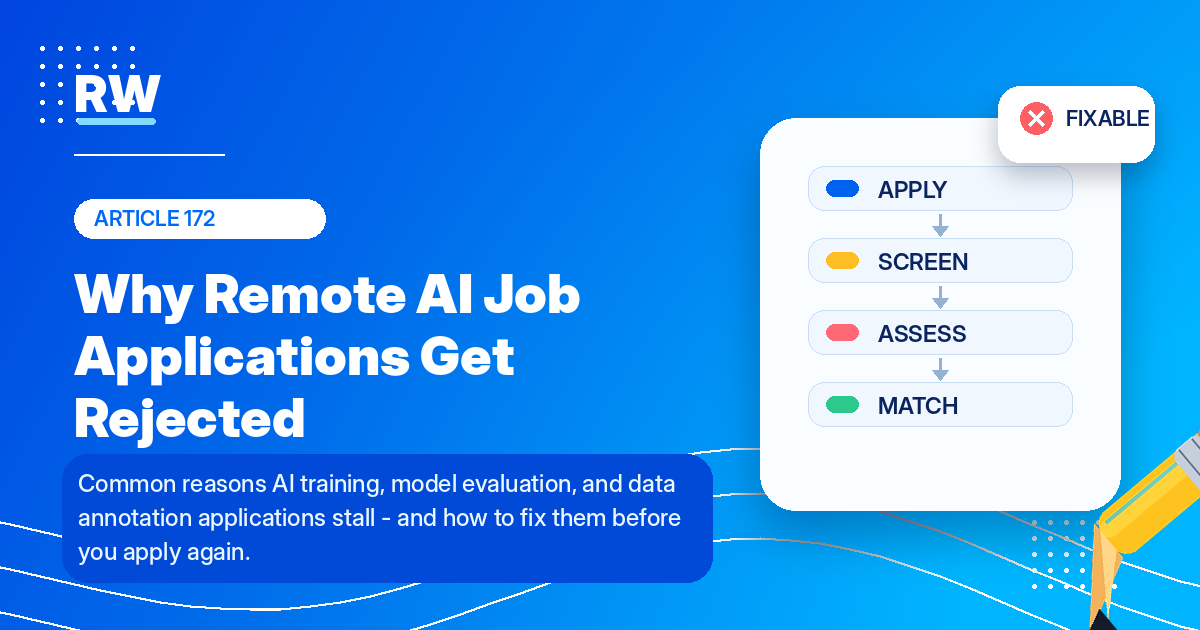
Remote AI jobs can look simple from the outside. You apply online, list your skills, maybe take a writing test or subject matter assessment, and wait for a project. But many applicants never hear back, get rejected quickly, or pass one step and still do not receive work.
That does not always mean the applicant is unqualified. Remote AI job applications get rejected for several different reasons: the resume is too generic, the profile does not match an active project, the assessment is weak, the applicant chooses the wrong skill lane, or the platform simply does not have enough work in that category at that moment.
This matters because AI training jobs, AI model evaluation roles, RLHF projects, data annotation work, prompt response writing, search quality rating, and chatbot review jobs are not all the same. A platform may be hiring for writers one week, coders the next week, legal reviewers after that, and multilingual evaluators in another country at the same time.
If your application gets rejected, the goal is not to panic or send the same profile everywhere. The goal is to understand what likely went wrong and improve the parts you can control before applying again.
Rejection Does Not Always Mean You Are Bad at the Work
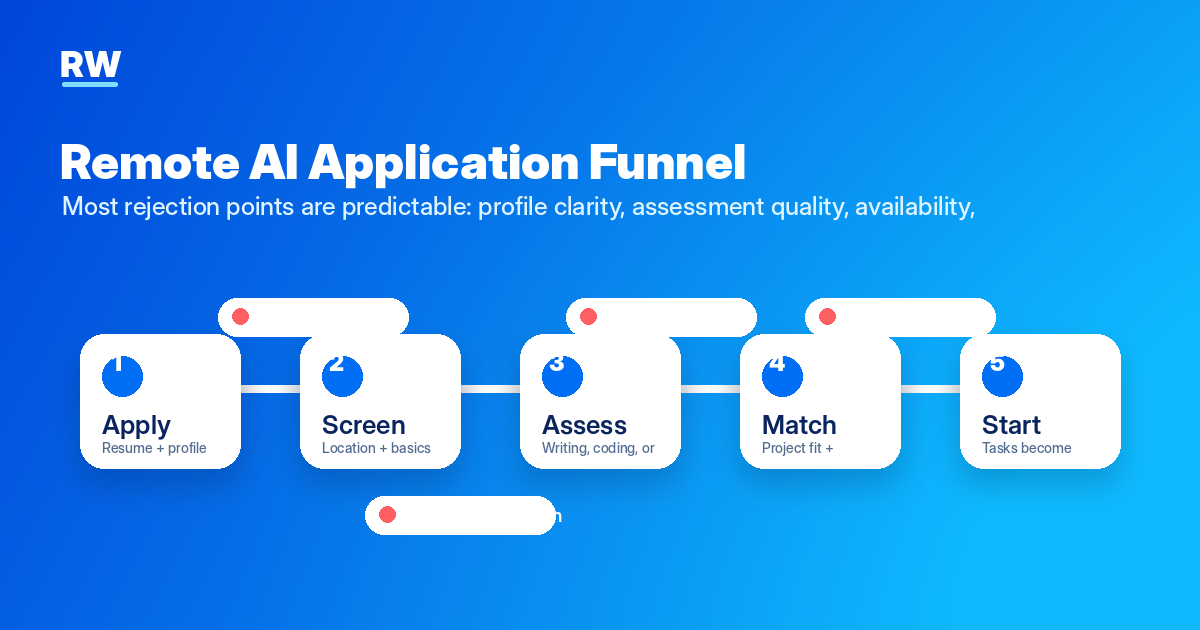
The first thing to understand is that remote AI hiring is project-based. A traditional company hires for a job opening, fills that opening, and moves on. AI training platforms often recruit pools of contractors for changing client needs. That means rejection can happen for reasons that have little to do with your intelligence or work ethic.
For example, a platform may need U.S.-based English writers, Canadian French evaluators, legal experts, finance reviewers, medical annotators, Python coders, or people with strong Excel and data analysis skills. If you apply as a general remote worker without showing one of those lanes clearly, your profile may not get matched to anything.
The same person could be rejected from one AI training platform and accepted by another. They could even be rejected once, improve their profile, and get accepted later when a better-fit project opens.
The key is to treat rejection as information. It usually points to one of three problems: the platform could not verify your fit, the assessment did not prove your judgment, or there was no active project for your background.
The Most Common Reasons Remote AI Applications Get Rejected
1. The Resume Is Too Generic
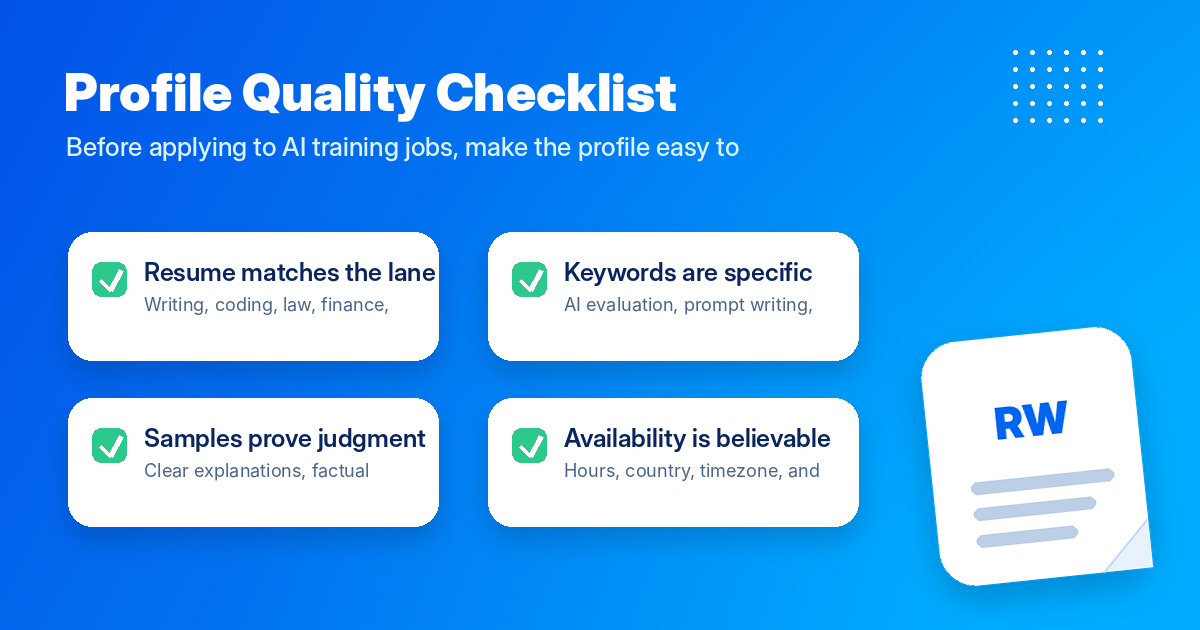
Many applicants use a standard remote work resume for AI training jobs. It says they are organized, reliable, detail-oriented, and good with computers. Those qualities help, but they are not enough.
AI model evaluation platforms are usually looking for evidence that you can review outputs, compare answers, explain reasoning, fact-check claims, write clearly, follow instructions, and spot weak or unsafe responses. If your resume only says "customer service," "administrative work," or "freelance writing," the reviewer may not immediately see why you fit an AI evaluator role.
A stronger resume connects your experience to the actual work. A writer should mention editing, research, content quality, prompt writing, tone matching, factual accuracy, and clear feedback. A business applicant should mention analysis, strategy, spreadsheets, market research, operations, or consulting. A legal applicant should mention legal research, issue spotting, citations, compliance, or document review. A coder should mention languages, debugging, code review, testing, and explaining technical concepts.
The goal is not to fake AI experience. The goal is to translate your real experience into the language of AI training work.
2. The Application Does Not Show a Clear Skill Lane
Remote AI jobs are often advertised broadly, but the work itself is specific. You may see job posts for AI trainer, AI evaluator, data annotator, model response reviewer, search quality rater, AI writing evaluator, coding expert, or subject matter expert. Those titles overlap, but the projects behind them can be very different.
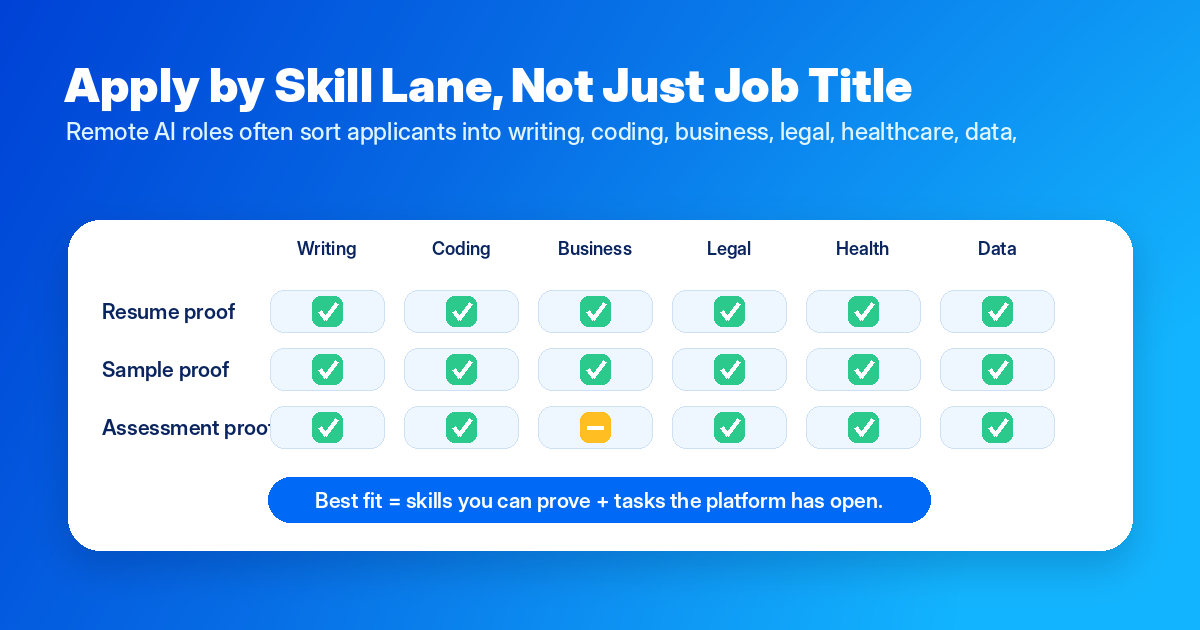
If your profile tries to be everything at once, it can become harder to match. A platform may not know whether to route you toward writing tasks, math tasks, coding tasks, law tasks, healthcare tasks, finance tasks, data tasks, or general annotation.
Choose a primary lane and one or two secondary lanes. For example:
- Strong writer and editor with research experience.
- Business analyst with Excel, market research, and strategy experience.
- Software engineer who can review Python and JavaScript answers.
- Legal researcher comfortable reviewing legal reasoning.
- Teacher or tutor who can explain mistakes clearly.
- Data analyst who can evaluate charts, spreadsheets, and quantitative reasoning.
This makes your application easier to screen. It also helps platforms understand where to place you if multiple projects are open.
3. The Assessment Response Is Too Vague
Many AI training applications include a test. The test may ask you to compare two AI answers, write a prompt response, correct a flawed answer, rank responses, identify hallucinations, or explain why one output is better than another.
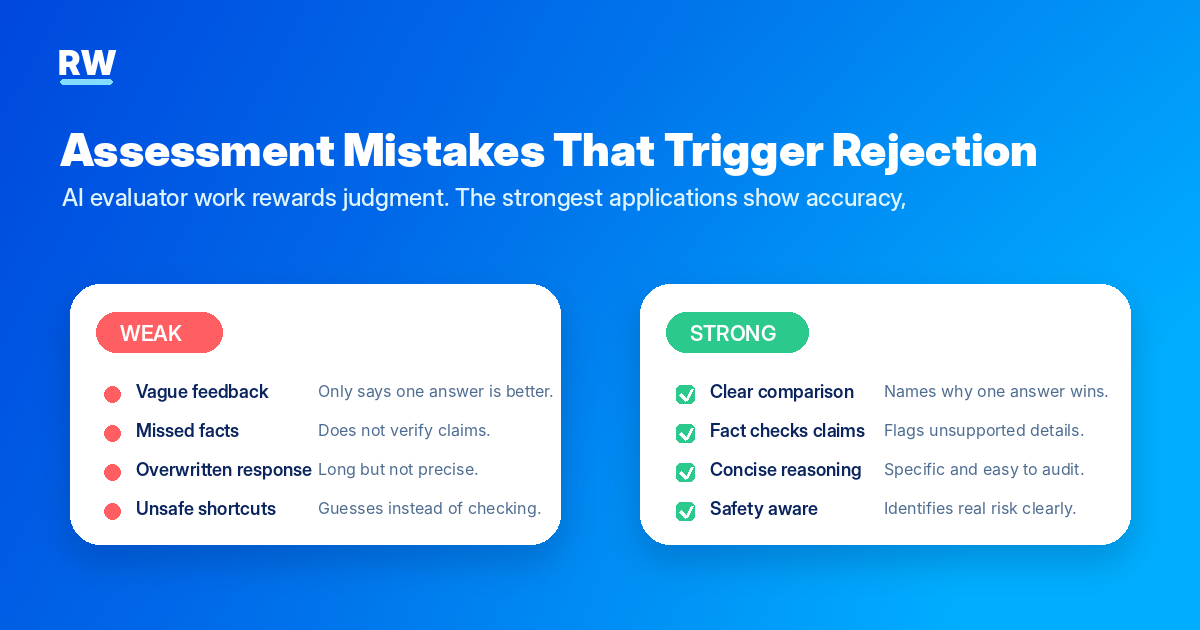
A common rejection reason is vague feedback. Writing "Response A is better because it is more helpful" is usually not enough. AI evaluation work requires specific reasoning. The reviewer wants to see that you can identify accuracy issues, missing context, unsupported claims, formatting problems, instruction-following errors, and safety concerns.
A stronger explanation sounds more like this: "Response A is stronger because it directly answers the user's question, includes the required steps, and avoids the unsupported claim that appears in Response B. Response B is more fluent, but it fails the instruction to provide a concise answer and introduces a factual detail that is not established in the prompt."
That type of answer shows judgment. It is specific, auditable, and useful for model improvement.
4. The Applicant Does Not Follow Instructions Exactly
AI training work is instruction-heavy. If the application says to write three sentences, do not write seven. If it asks for a rating and a short explanation, give both. If it asks you to choose the better answer and explain why, do not only rewrite the answer.
Platforms reject applicants who appear careless with instructions because the real work depends on consistency. Even strong writers can fail if they over-explain, ignore constraints, use the wrong format, or answer a different question than the one being asked.
Before submitting any assessment, reread the prompt like a checklist. Did you answer every part? Did you stay within the requested length? Did you use the required format? Did you avoid adding unsupported claims? Did you explain your reasoning clearly?
5. The Profile Has Inconsistent Information
Remote AI platforms may ask for your location, timezone, education, skills, work history, language ability, and availability. If those details conflict, the application can look risky.
Examples of inconsistencies include listing full-time availability while also showing a full-time job, claiming native-level fluency but making repeated language errors, applying for U.S.-only work from a different country, using a resume that does not match the profile, or claiming expert-level skills without any supporting background.
This does not mean you need a perfect career path. It means your information should be coherent. If you are changing industries, explain the bridge. If you are applying for writing evaluator work, show writing proof. If you are applying for coding review, show technical proof. If your location matters, be accurate.
Remote Work Union connects you to legitimate remote AI training and evaluation roles across multiple platforms. Apply for free.
Find Roles Hiring Now →6. The Platform Is Not Hiring for Your Country or Timezone
Some remote AI jobs are work-from-anywhere, but many are not. AI companies and AI training platforms may need applicants from specific countries because of language, tax, legal, client, data, or market requirements. Searches like "remote AI jobs near me" and "work from anywhere AI jobs" can lead to different types of opportunities.
This is especially common for English-language AI evaluation jobs. Some projects may need U.S., Canadian, UK, Australian, or other native-level English reviewers. Other projects may need bilingual or multilingual reviewers in specific regions. A rejection may simply mean your country did not match that project.
When applying, look for location language. Terms like U.S.-based, Canada only, UK applicants, Australia remote, work from anywhere, global contractors, native English, bilingual, or region-specific are important. Do not ignore them.
7. The Platform Already Has Enough Applicants
AI training work can become crowded quickly. A popular remote AI job post can attract thousands of applicants. Even if you are qualified, you may apply after the platform has already filled the current pool.
This is why applicants often see "application under review," "no projects available," or no response after applying. It may not be a hard rejection. It may mean the platform has your profile but does not have an immediate task allocation.
This is one reason it is smart to apply to multiple legitimate platforms instead of depending on one. Someone looking for remote AI work might explore platforms and job boards related to AI evaluation, data annotation, model training, search quality, writing review, coding review, and subject matter expert projects.
8. The Applicant Overclaims Expertise
AI training platforms value expertise, but they also test it. If you claim to be an expert in law, medicine, finance, machine learning, Python, statistics, or academic research, the assessment may be harder. Overclaiming can backfire if your test response does not match the level you selected.
It is better to be precise than inflated. Instead of saying you are an expert in every business topic, say you are strongest in market research, sales operations, spreadsheets, finance writing, or startup strategy. Instead of claiming full-stack engineering expertise, list the languages and frameworks you can actually review. Instead of claiming healthcare expertise without credentials, describe your relevant writing, research, or administrative background accurately.
Trust matters. A platform would rather place you in the right lane than discover later that you cannot handle the work you selected.
9. The Writing Sample Is Hard to Read
Even non-writing AI evaluation jobs require clear communication. Human reviewers often need to explain why an AI answer is accurate, incomplete, unsafe, confusing, too verbose, or not helpful enough.
Applications can be rejected when the writing sample is messy, overly casual, too short, too long, filled with grammar errors, or difficult to follow. You do not need to sound academic. You do need to sound clear.
Use short paragraphs. Avoid filler. Make a direct claim, then support it. If you are comparing two AI answers, discuss accuracy first, then instruction-following, then helpfulness or clarity. If you are correcting an answer, explain what changed and why.
Strong AI evaluator writing is not fancy. It is specific and controlled.
10. The Applicant Applies Once and Stops
Remote AI work is inconsistent by nature. A single rejection should not end the search. The better approach is to build a repeatable application system.
Create a core resume for AI training jobs, then customize it for the lane. Keep a short profile summary ready. Save examples of your best writing, research, coding, analysis, or subject matter work. Track which platforms you applied to, which assessments you completed, and which skills each platform requested.
Then keep improving. If one assessment felt difficult, practice that task type before the next one. If one platform rejected your writing profile, try a more specific writing sample. If one job required a country you do not match, look for global or region-appropriate roles instead.
How to Improve Your Application Before Trying Again
Start with your profile headline or opening summary. It should make your lane obvious within a few seconds.
After that, revise your resume bullets. Add proof. Instead of only listing duties, show the type of judgment you used. Good phrases include reviewed, evaluated, compared, edited, researched, verified, analyzed, categorized, documented, explained, audited, tested, and improved.
Then practice assessment-style responses. Take any AI answer and ask yourself: Is it accurate? Did it follow the prompt? Is it complete? Is it concise? Is it safe? Is it useful for the user's real intent? What would a better answer do differently?
That is the mindset behind much of AI model evaluation work.
Tip: The most effective profile revision focuses on three things: a clearer skill lane headline, evaluation-language resume bullets, and one concrete writing sample that shows specific judgment. Start there before changing anything else.
Should You Reapply After Being Rejected?
Sometimes yes, but not immediately with the same materials. Reapplying only makes sense if you can improve the profile, apply to a different lane, wait for a new project, or use a different platform with a better match.
If a platform has a formal cooldown period or says not to reapply, follow that rule. If it allows new applications for different projects, treat the new application as a fresh match. Do not copy and paste the same generic summary. Make the skill lane obvious.
You can also widen your search. Use keywords like remote AI jobs, AI training jobs, AI model evaluation jobs, AI evaluator, AI writing evaluator, data annotation, RLHF, chatbot evaluator, prompt response writer, search quality rater, AI fact-checking jobs, and subject matter expert AI jobs. Search by platform names, job boards, and company ecosystems as well. People often search for terms related to Outlier AI, Mercor, Handshake AI, micro1, and other AI products, but the actual contractor work may appear through partner platforms, staffing firms, or specialized AI training companies.
A Simple Pre-Application Checklist
Before your next remote AI job application, ask five questions:
- Does my resume clearly show the type of AI work I want?
- Does my profile match the location and language requirements?
- Do I have proof of the skill lane I selected?
- Can I complete an assessment with specific, evidence-based reasoning?
- Am I applying to enough platforms to avoid depending on one result?
If the answer to any of those is no, fix that before submitting more applications.
Frequently Asked Questions
Why do remote AI job applications get rejected?
Most rejections come from generic profiles, weak assessments, location or language mismatches, or no active project match. The resume may not clearly show a skill lane, the assessment may lack specific reasoning, or the platform may simply not have work available in the applicant's category at that time.
Can I reapply after a remote AI job rejection?
Yes, but only after making the application materially stronger. Reapplying with the same generic materials is unlikely to produce a different result. Improve your profile, choose a more specific skill lane, and practice assessment-style tasks before submitting again.
What is the most common mistake in AI training job applications?
A profile that is too generic and does not show clear domain expertise or evaluation skills. Platforms need to understand quickly where you fit. A vague profile that does not map to a specific project category is easy to skip over in favor of more focused applicants.
How do I improve my profile for remote AI training jobs?
Narrow your expertise lane, add AI evaluation keywords, and provide concrete proof of skill. Replace generic summaries with specific evaluation language: what you can review, what domain you know, and what type of AI work you can do consistently.