New applicants often hear the same three names when they start looking for remote AI training work: Handshake AI, Mercor, and micro1. All three can sit in the same broad category — paid remote work helping AI systems improve through human judgment — but they are not identical platforms. The differences matter because the same applicant can look strong on one platform, average on another, and poorly positioned on a third.
The basic work can overlap. A project may ask you to compare two AI responses, review an answer for accuracy, write a better response, annotate data, create examples, grade model reasoning, fact-check claims, or apply expert judgment to a specialized task. Large AI companies and model builders such as OpenAI, Anthropic, Google, Meta, Grok, and others need human feedback to improve model quality. Platforms like Handshake AI, Mercor, and micro1 help organize that labor into projects.
The mistake beginners make is treating these platforms like normal job boards. They are closer to talent marketplaces. Getting accepted does not always mean you will immediately have tasks. Passing an interview does not always mean the project is still hiring. A strong advertised pay rate does not mean every applicant will qualify. The best approach is to understand how each platform thinks, then position yourself accordingly.
The simplest way to compare the three
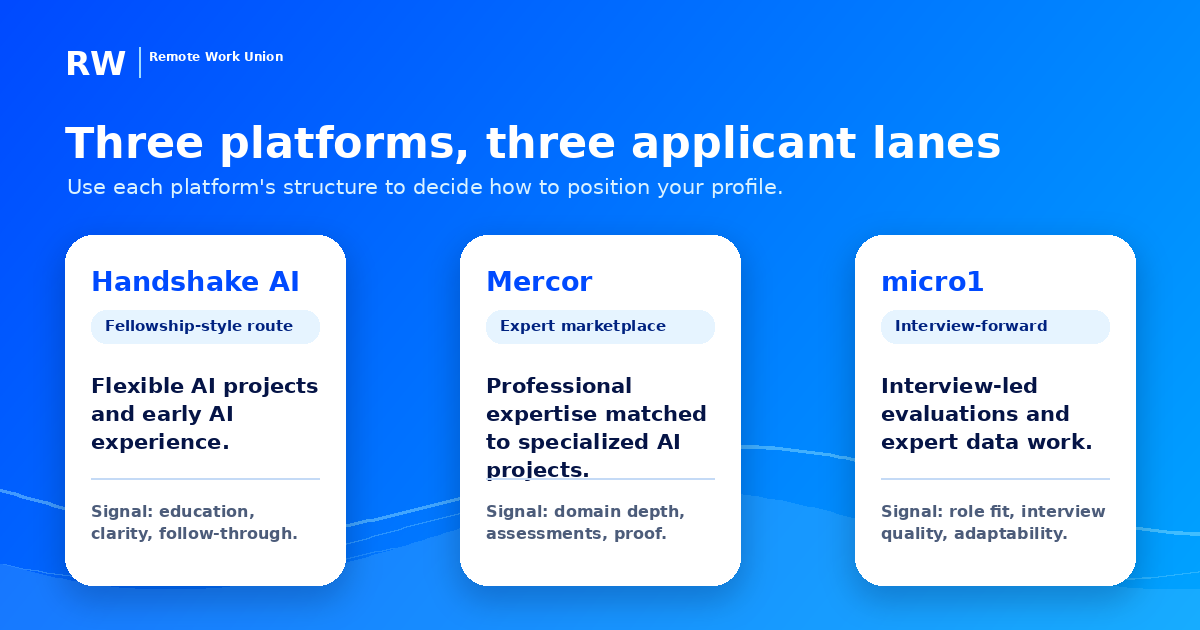
Handshake AI is easiest to understand as a broad AI fellowship and project-work route. It is especially relevant for students, recent graduates, early-career professionals, and people who want a more structured entry point into AI training work. That does not mean only beginners use it. Professionals and subject matter experts can also be a fit. But the positioning is friendlier to applicants who are trying to turn education, writing ability, research judgment, and early work experience into paid AI work.
Mercor is easiest to understand as an expert-talent marketplace. It is built around matching professional backgrounds to AI training and AI evaluation projects. Applicants with clear domain expertise — finance, law, medicine, engineering, consulting, operations, research, sales, writing, education, data analysis, or another field — should think carefully about how to present that expertise. On Mercor, your best asset is usually not that you are available. It is that you can show credible judgment in a specific category.
micro1 is easiest to understand as an interview-forward talent platform for expert data, model evaluation, and AI improvement work. New applicants often notice micro1 because its process can involve role-specific applications and AI-driven interview steps. That makes communication quality important. You need to explain what you know, how you think, and why your background fits the role you selected.
What they have in common
All three platforms are part of the same remote AI work trend: AI labs need people to evaluate, correct, rank, annotate, and improve model outputs. These jobs are often remote, flexible, contract-based, and project-based. They can be excellent for people who want work from home income, but they should not be treated like guaranteed full-time employment.
The strongest applicants usually share a few traits. They write clearly. They follow instructions closely. They can explain their reasoning. They do not rush through assessments. They understand that quality scores matter. They keep their profile updated. They apply to roles that match their real background instead of applying randomly to every high-paying listing.
The weakest applicants usually make the opposite mistakes. They submit a generic resume. They describe themselves as hard-working without showing a skill. They pick roles only because the pay looks high. They fail to prepare for AI interviews. They answer assessment questions casually. They assume no response means the platform is fake, when it may simply mean there is no current project demand for their profile.
Tip: All three platforms pay in the $20–$200/hr range depending on role type and expertise level. The gap between generalist and expert rates is wide — the more specific your background, the more you can earn.
Handshake AI: best for structured entry into AI work
Handshake AI is attractive to new applicants because it frames AI work as a fellowship-style opportunity. That positioning is useful for people who want to gain AI experience without already having a long AI resume. A strong Handshake AI profile should make your education, communication skills, subject knowledge, and reliability easy to understand.
Applicants should pay attention to eligibility. Some opportunities may depend on location, work authorization, student status, degree level, or role-specific requirements. Do not assume every listing is worldwide. Do not assume every role is no-degree. Do not assume every project is available forever. Read the listing and apply while the role is active.
Handshake AI may be a strong first platform if you are a current student, recent graduate, early-career worker, researcher, writer, analyst, educator, or professional who wants a recognizable bridge into AI. It can also be useful if you want a profile that connects your academic or professional background to frontier AI work without needing to present yourself as a coder.
Mercor: best for proving expertise
Mercor is usually strongest for people who can name a field and prove they know it. The platform's opportunity structure often rewards applicants who can demonstrate expertise, pass assessments, and match into specialized projects. That is why a generic profile is a problem. A profile that says "I can do anything" is usually weaker than a profile that says "I can evaluate financial analysis, legal reasoning, medical documentation, software architecture, sales strategy, or research quality."
New applicants should not be intimidated by the word expert. Expert does not always mean famous, senior, or PhD-level. It means your knowledge is useful enough to help evaluate AI outputs in a specific context. A bookkeeper may understand accounting workflows better than a generalist. A paralegal may understand legal document quality better than a random applicant. A project manager may understand operations tradeoffs. A writer may recognize tone, structure, and factual weakness quickly.
Mercor may be a strong first platform if your resume already has a clear professional lane. The more specific your background, the easier it is to match you to AI evaluation or AI training projects. Your goal is to make the assessment feel like a natural extension of your real work experience.
micro1: best for applicants who can interview well
micro1 tends to stand out because applicants may encounter a more interview-driven experience. That can help people who communicate well, but it can hurt people who are vague, unprepared, or too casual. If an AI interviewer asks about your background, it is not enough to say you are interested in remote work. You need to connect your experience to the work: reviewing AI-generated content, evaluating logic, checking facts, following rubrics, annotating data, or applying domain expertise.
A good micro1 answer is specific. Instead of saying, "I am good at writing," say, "I can evaluate whether an AI answer is accurate, complete, and written at the right level for the user. I can identify missing context, unsupported claims, weak reasoning, and unclear structure." Instead of saying, "I know finance," say, "I can review financial explanations for assumptions, calculation errors, terminology misuse, and misleading conclusions."
micro1 may be a strong first platform if you are comfortable with AI interviews, can explain your skills clearly, and are willing to apply to role-specific opportunities. It is also useful for applicants who want to practice presenting their skills in a structured way.
The biggest difference: how each platform reads your value
Handshake AI may read your value through a combination of eligibility, education, role fit, flexible availability, and your ability to contribute to AI training projects. A student, graduate, writer, researcher, or early-career professional can often build a credible case by showing that they can learn guidelines quickly and produce careful work.
Mercor may read your value through specialization. If you are a lawyer, accountant, consultant, engineer, teacher, clinician, marketer, analyst, editor, designer, or operations professional, the key question is whether your judgment is useful to an AI lab. Your profile should make that answer obvious.
micro1 may read your value through interview performance, role fit, and how well you translate your background into evaluation work. It is not just what you have done. It is whether you can explain your reasoning under structured questions.
Want to compare these platforms and start with the right one? Find opportunities on RemoteWorkUnion.com.
Find Roles Hiring Now →Which platform should beginners apply to first?
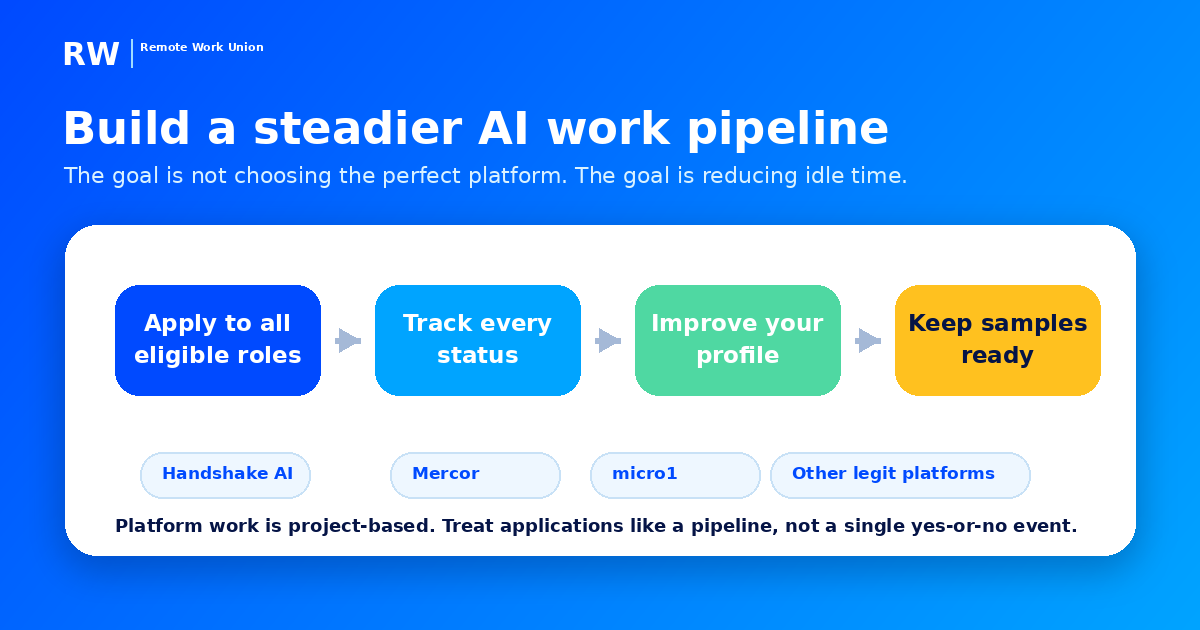
For most serious applicants, the answer is not to choose only one. Apply to all three if you are eligible and the roles match your background. Remote AI work is project-based. Demand changes. A platform that is quiet this month may become active later. A platform that rejects one role may match you to a different one. A platform that accepts you may still have no immediate tasks.
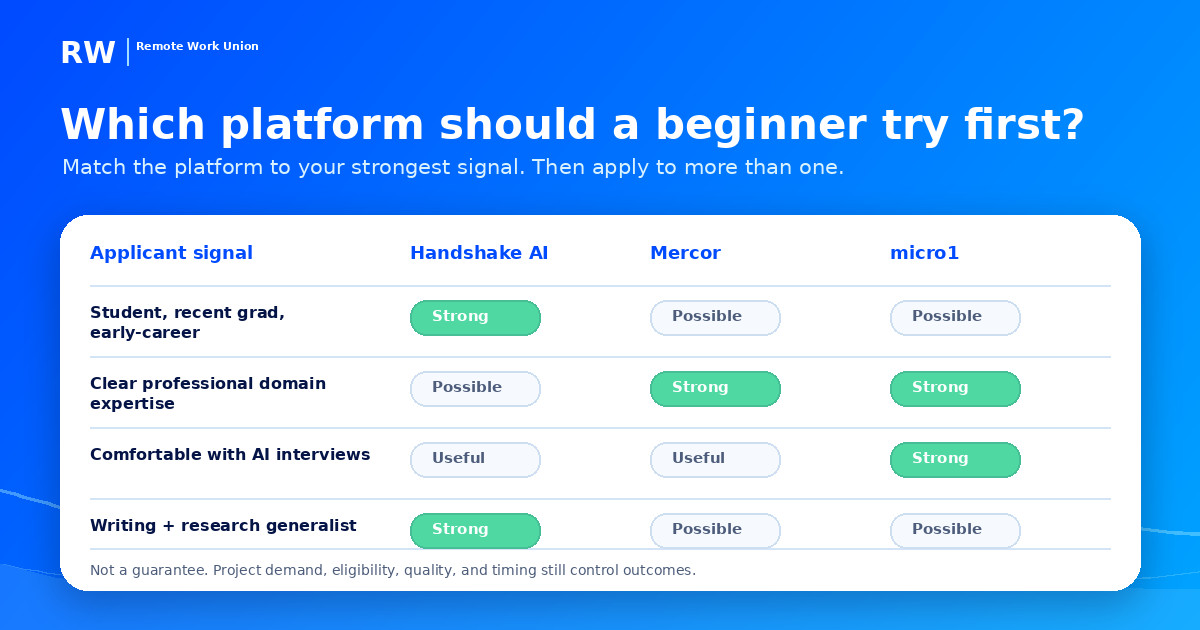
If you need a starting order, use your strongest signal. If your strongest signal is education or early-career potential, start with Handshake AI. If your strongest signal is professional expertise, start with Mercor. If your strongest signal is communication and interview performance, start with micro1. Then apply to the others instead of waiting.
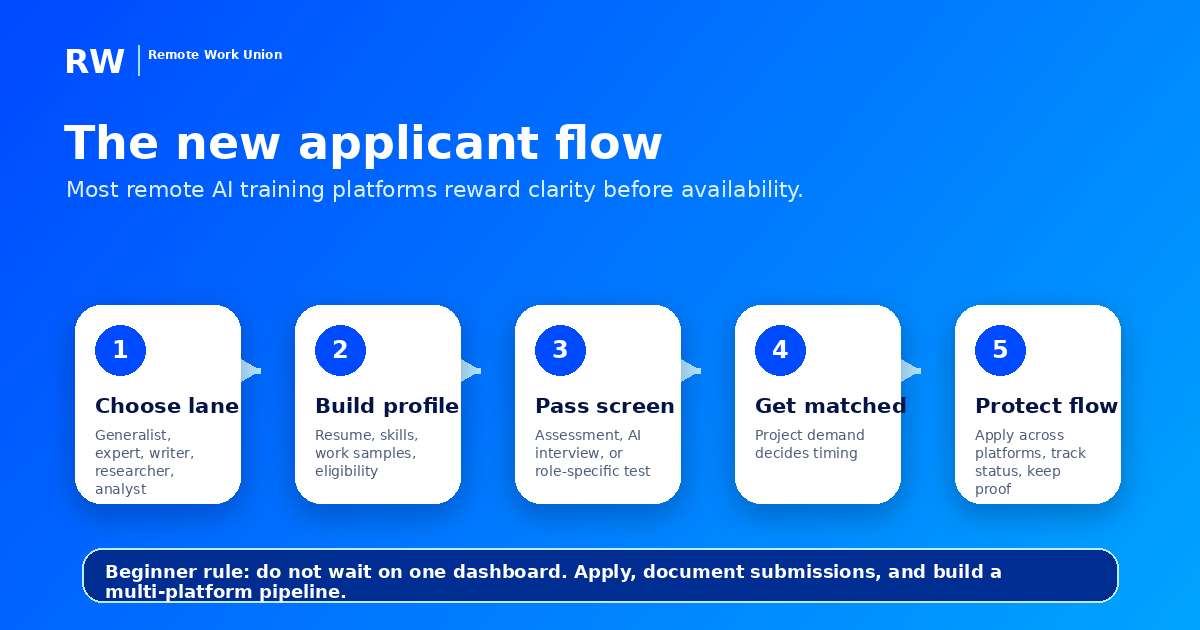
Do not let one stalled application stop your entire search. A beginner should build a remote work pipeline: apply, record the date, save the role title, note the status, prepare for assessments, follow up when appropriate, and keep applying to relevant roles.
How to position your resume for all three
Your resume should not look like a normal office-job resume only. It should translate your background into AI training value. Add language that shows you can evaluate AI outputs, follow guidelines, review written responses, fact-check information, compare answer quality, edit for clarity, annotate data, create examples, and apply domain knowledge. The resume should still be truthful. The goal is not to pretend you have AI experience you do not have. The goal is to show why your existing experience is useful for AI evaluation work.
A strong resume bullet for a writer might say: "Reviewed long-form content for accuracy, clarity, structure, tone, and reader intent." A strong bullet for an analyst might say: "Evaluated business data, identified inconsistencies, and summarized findings for non-technical stakeholders." A strong bullet for a teacher might say: "Explained complex topics clearly, assessed student responses, and created structured feedback." These are not random work history details. They are signals that map directly to remote AI evaluation jobs.
The same resume can be adapted slightly for each platform. For Handshake AI, emphasize education, adaptability, communication, and learning ability. For Mercor, emphasize professional domain expertise and measurable proof. For micro1, emphasize concise explanations, interview readiness, and role-specific judgment.
How to prepare for assessments and AI interviews
Do not treat assessments as personality quizzes. They are usually trying to measure whether you can follow instructions and make consistent quality judgments. Read the prompt carefully. Identify the exact task. Separate facts from opinions. Explain your reasoning. Avoid overconfident answers when a claim needs verification. If the task provides a rubric, use the rubric instead of inventing your own standard.
For AI interviews, practice answering three types of questions. First, background questions: what have you done, what do you know, and what roles fit you? Second, reasoning questions: how would you evaluate a response, identify a mistake, or improve an answer? Third, reliability questions: can you follow guidelines, work independently, and maintain quality over time?
The best answers are specific but not bloated. Use simple structure: context, skill, example, result. For example: "I worked in customer support, so I am used to reading messy user requests and figuring out what the person actually needs. In AI evaluation work, that helps me judge whether a model answered the real question, missed important context, or gave a response that sounds correct but is not useful."
Common beginner mistakes
Mistake one is applying only to the highest posted pay rate. High rates usually require a strong match between the role and the applicant. A beginner with no legal background should not spend all day applying to senior legal expert roles. A non-technical applicant should not apply to advanced software engineering projects unless they actually have the skill. Use pay as one signal, not the only signal.
Mistake two is waiting too long after submitting one application. Remote AI platforms can be slow because project demand changes. If you do not hear back, keep applying to relevant roles and improve your profile. Do not spam support. Do not create duplicate accounts. Do not submit low-quality applications just to increase volume.
Mistake three is writing vague answers. "I am passionate about AI" is weak. "I can compare AI responses for accuracy, completeness, reasoning quality, tone, and instruction following" is stronger. "I want flexible remote work" is weak. "I have experience reviewing documents, catching errors, and explaining revisions clearly" is stronger.
A practical multi-platform strategy
Start with a single master profile. Write down your strongest work categories, your best proof points, your preferred roles, your available hours, and your technical comfort level. Then adapt that profile for Handshake AI, Mercor, and micro1 instead of starting from scratch each time.
Create a simple tracking sheet with columns for platform, role, date applied, status, assessment completed, interview completed, pay range, follow-up date, and notes. This matters because remote AI applicants often forget what they submitted. A tracking sheet also keeps you from confusing one platform's status with another.
Finally, keep improving your proof. Save writing samples, anonymized work examples, relevant certifications, portfolio links, and concise explanations of your domain expertise. The more evidence you have, the easier it is to apply quickly when a matching role appears.
Bottom line
Handshake AI, Mercor, and micro1 all sit inside the growing remote AI work economy, but they are not interchangeable. Handshake AI is often the clearest entry point for applicants who want a fellowship-style path into AI work. Mercor is often strongest for people with clear professional expertise. micro1 is often strongest for applicants who can handle a role-specific, interview-forward process.
The best platform depends on your background, eligibility, communication ability, and timing. The best strategy is to apply where you fit, avoid exaggerated claims, prepare carefully, and build a multi-platform pipeline instead of relying on one dashboard.
Frequently Asked Questions
Which platform is best for beginners — Handshake AI, Mercor, or micro1?
It depends on your background. Handshake AI is often the clearest entry point for students, recent graduates, writers, and early-career professionals. Mercor is strongest for people with clear professional domain expertise. micro1 is strongest for applicants who communicate well and can handle a role-specific, interview-forward process. Applying to all three while you are eligible is usually the best approach.
Do you need coding skills to apply to Handshake AI, Mercor, or micro1?
Not for most roles. All three platforms have opportunities for writers, researchers, analysts, legal professionals, finance experts, educators, marketers, and generalists. Coding skills help for technical evaluation roles, but many AI training and model evaluation tasks do not require them.
How do Handshake AI, Mercor, and micro1 screen applicants differently?
Handshake AI tends to evaluate eligibility, education, role fit, and communication ability. Mercor places heavier emphasis on professional domain expertise and assessment performance. micro1 often uses an AI-driven interview step, making communication quality and role-specific reasoning especially important.
Can you apply to all three platforms at the same time?
Yes, and most serious applicants should. Remote AI work is project-based and demand changes across platforms. One platform may be slow while another is actively hiring. Applying to Handshake AI, Mercor, and micro1 simultaneously increases your chances of getting matched to paid work sooner.
What should a beginner's resume say when applying to AI training platforms?
Your resume should translate your existing experience into AI training value. Add language that shows you can evaluate AI outputs, follow guidelines, fact-check information, compare answer quality, and apply domain knowledge. Strong bullets mention reviewing content for accuracy, identifying errors, explaining reasoning clearly, or applying professional judgment in a specific field.