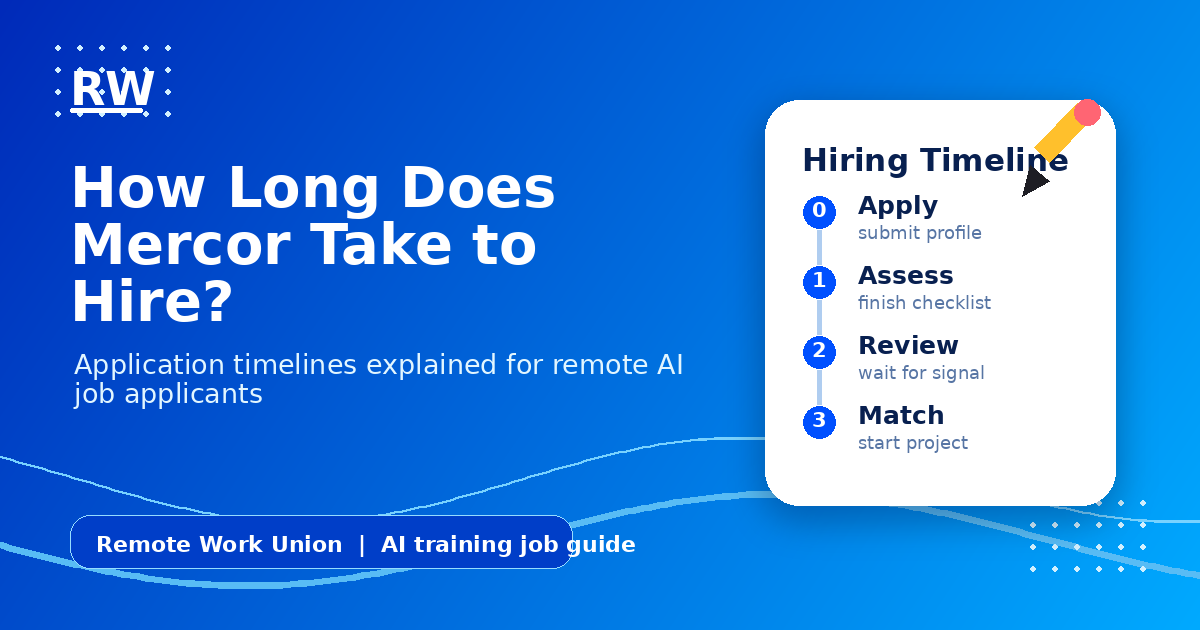
If you applied to Mercor and are wondering how long it takes to get hired, the most accurate answer is: it depends on the role, the assessment, the project capacity, and how closely your background matches the work.
Some applicants move through the early steps quickly. Others finish an AI interview or assessment and then wait with no clear update. That does not always mean something is wrong. Remote AI training platforms often review applicants by project, skill category, and client demand. A strong application can still sit in review if the current batch is full, if the role needs a narrower expert profile, or if the hiring team has not opened the next group of contractors.
This guide explains the Mercor application timeline in practical terms: what usually happens after you apply, what each delay can mean, how long to wait before moving on, and what to do while your application is under review.
The Short Answer: Mercor Can Move Quickly, But Hiring Is Not Guaranteed
Mercor is not a traditional job application where every applicant goes through a fixed sequence with a recruiter, phone screen, final interview, and offer letter. For many remote AI jobs, the process is closer to a contractor marketplace. You apply to a specific listing, complete the required steps, and wait to see whether your profile, assessment, interview, and timing match the project.
A realistic way to think about the timeline is this:
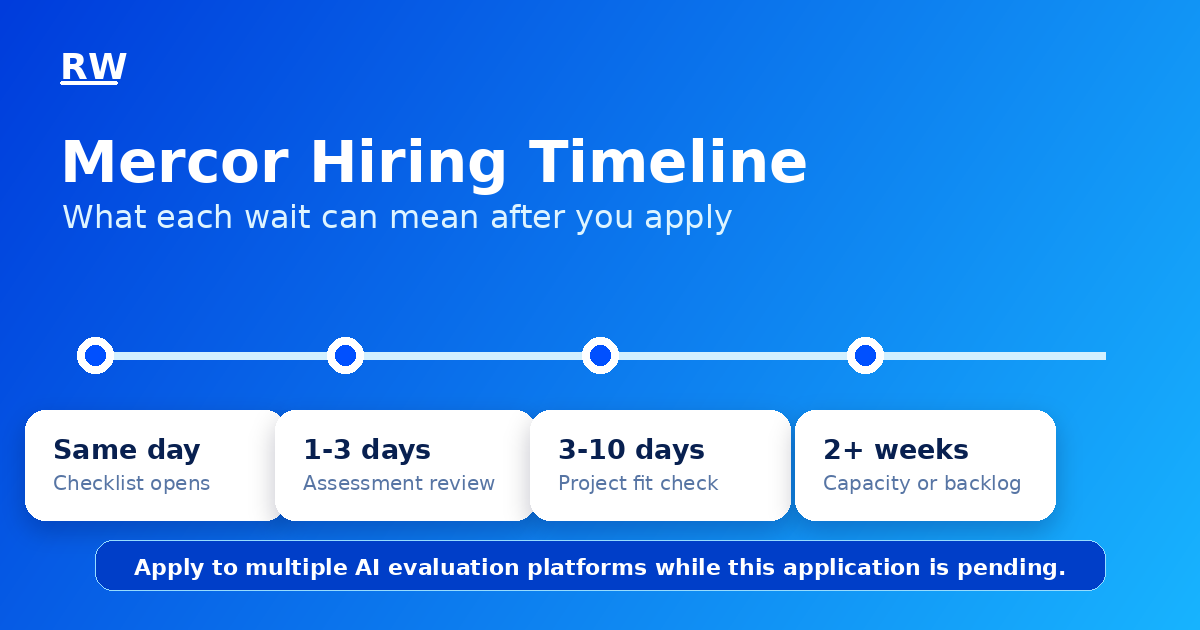
- Same day: You may be able to create a profile, upload a resume, start an application, and see required steps.
- Within a few days: You may complete forms, assessments, work authorization steps, or an AI interview, depending on the listing.
- Several days to a couple of weeks: Your application may remain under review while the platform evaluates fit, compares applicants, or fills project slots.
- Longer than two weeks: You should not treat silence as your only plan. Continue applying to other AI training jobs, model evaluation jobs, and remote contractor roles.
The key point is simple: completing the application does not automatically mean you are hired. It means you are in the pool for that listing or a similar opportunity.
What Happens After You Apply to Mercor
The exact checklist can change by role, but most applicants should expect some version of the same process.
First, you choose a listing and begin the application. Then you complete the required steps. These may include uploading a resume, answering assessment questions, verifying work authorization, and completing an AI interview. Mercor's own candidate documentation describes applications as listing-specific and notes that required steps can differ by role. It also describes assessments, resume upload, application confirmation, and AI interview setup as part of the application experience.
For applicants, that means the hiring timeline does not start only when you click "apply." It starts when every required step is finished. If one assessment, device check, interview, form, or authorization item is incomplete, your application may not be ready for review.
Before worrying about how long Mercor is taking, check the basics:
- Did you submit the application completely?
- Did every required checklist item show as finished?
- Did you complete the AI interview if the role required one?
- Did you use the correct resume for the specific role?
- Did you apply to a listing that matches your actual expertise?
- Did the role require a country, location, credential, or work authorization requirement?
A surprising number of delays come from incomplete steps, weak role fit, or applicants applying to broad AI jobs without matching the listing closely enough.
A Practical Mercor Hiring Timeline by Stage
There is no universal timeline that applies to every Mercor role. But remote AI applicants can use the following framework to understand what might be happening.
Stage 1: Profile and Application Setup
This can often be completed quickly. You create or update your profile, upload a resume, select a role, and begin the application checklist.
This stage is usually not the bottleneck. The bigger issue is quality. A rushed profile can hurt you later because AI training work is often skill-specific. If the role is for legal reasoning, finance analysis, healthcare writing, coding, math, education, or business analysis, your resume should make that expertise obvious.
Do not use a generic resume that only says you are interested in remote work. Use the resume to show the exact skills the listing is asking for.
Stage 2: Forms, Assessments, and Screening Questions
Some listings ask for written answers, multiple-choice questions, samples, or domain-specific screening. This stage can take longer because your answers need to show judgment, not just enthusiasm.
For AI model evaluation jobs, companies are often looking for people who can compare answers, explain reasoning, catch hallucinations, follow rubrics, and write clear feedback. For expert AI training jobs, they may be looking for credentials, work history, or subject-matter depth.
If you fail or rush an assessment, the application may stop there. If you pass, you may still wait for the project team to decide whether they need more people with your background.
Stage 3: AI Interview
Mercor uses AI interviews for many roles. The interview may ask about your background, your experience, and how you would approach work in your field. Mercor's support documentation says AI interviews are role-specific and that many take around 20 minutes, though some may be shorter or longer.
This is an important stage because it gives the platform more information than a resume alone. Treat it seriously. Use a quiet room, a desktop browser, a stable internet connection, and concise answers with examples.
The goal is not to sound like you memorized a script. The goal is to make your experience easy to evaluate. If you are applying for AI business analysis work, talk about business problems you have analyzed. If you are applying for AI writing evaluation, talk about editing, research, clarity, and accuracy. If you are applying for coding evaluation, talk through how you reason about bugs, tests, and tradeoffs.
Stage 4: Under Review
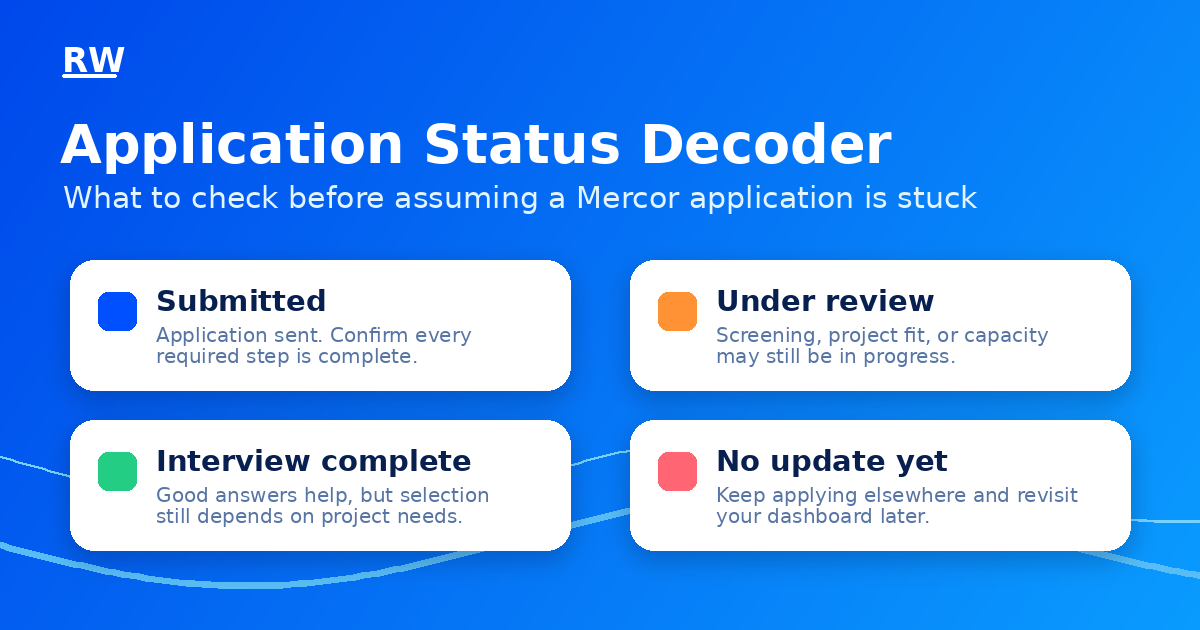
This is where many applicants get stuck. "Under review" can mean several things:
- Your application is complete and waiting for evaluation.
- Your assessment is being compared against other applicants.
- The project has enough applicants but has not finalized the group.
- The role requires a more specific background than your resume shows.
- The listing changed or project capacity shifted.
- You are qualified, but not selected for the current batch.
This is why applicants should avoid reading too much into one status label. A delay is not always a rejection. But it is also not a reason to stop applying elsewhere.
Stage 5: Matching, Onboarding, or No Response
If you are selected, you may receive instructions for next steps. Depending on the role, that could mean onboarding, additional verification, project instructions, a trial task, or access to work.
If you are not selected, you may receive a rejection, or you may simply see no meaningful update. That can be frustrating, but it is common in high-volume remote AI work. These platforms may receive more qualified applicants than they can place immediately.
The right response is not to wait forever. Keep your application active, improve your profile, and apply to additional relevant roles.
Why Mercor May Take Longer Than Expected
A slow Mercor timeline does not always mean the company is ignoring you. Remote AI hiring can be uneven because the demand is project-based.
A platform may need 50 finance experts one week, 200 writing evaluators the next week, and a smaller group of legal reviewers after that. Hiring speed depends on what clients need, how quickly a project starts, how many qualified applicants already applied, and whether your background fits the current task.
Here are the most common reasons an application takes longer than expected.
The Project May Be Full
Many AI training projects have limited seats. Even if you are qualified, the platform may fill the first batch before your application is reviewed. In that case, you may be held for a later round, redirected to another role, or left without a fast update.
Your Profile May Be Too General
Remote AI jobs attract writers, teachers, students, consultants, coders, editors, analysts, and researchers. A general profile can get lost. The strongest applications usually show a clear category: finance expert, legal researcher, coding reviewer, healthcare writer, math tutor, business analyst, editor, teacher, data analyst, or domain specialist.
If your resume could apply to any remote job, it may not be specific enough for expert AI training work.
The Role May Require a Narrow Background
Some AI evaluation roles are broad. Others are highly specific. A listing may want native English writing ability, US work authorization, medical credentials, legal research experience, coding fluency, math expertise, or a particular professional background.
If the role is narrow, the hiring timeline may depend on how well you match that exact requirement.
The Assessment May Matter More Than the Resume
For AI model evaluation work, your test answers can matter as much as your credentials. Companies want workers who can follow instructions, judge answer quality, explain their reasoning, and avoid careless mistakes.
A strong resume may get you into the process. A strong assessment may get you closer to paid work.
The Platform May Be Balancing Demand Across Applicants
AI training work can be seasonal, bursty, and inconsistent. A project can slow down, pause, or change requirements. This is why applicants should not depend on one platform as their only income source.
Mercor, Outlier, Handshake AI, Surge AI, micro1, Stellar AI, and similar platforms can all have different availability at different times. The smartest job seekers build a pipeline instead of waiting on one dashboard.
Remote Work Union connects you to legitimate remote AI training and evaluation roles across multiple platforms. Apply for free.
Find Roles Hiring Now →How Long Should You Wait Before Applying Somewhere Else?
You should apply somewhere else immediately.
That does not mean abandoning Mercor. It means treating Mercor as one platform in a broader remote AI job search. If you wait for one company to respond before applying elsewhere, you lose time.
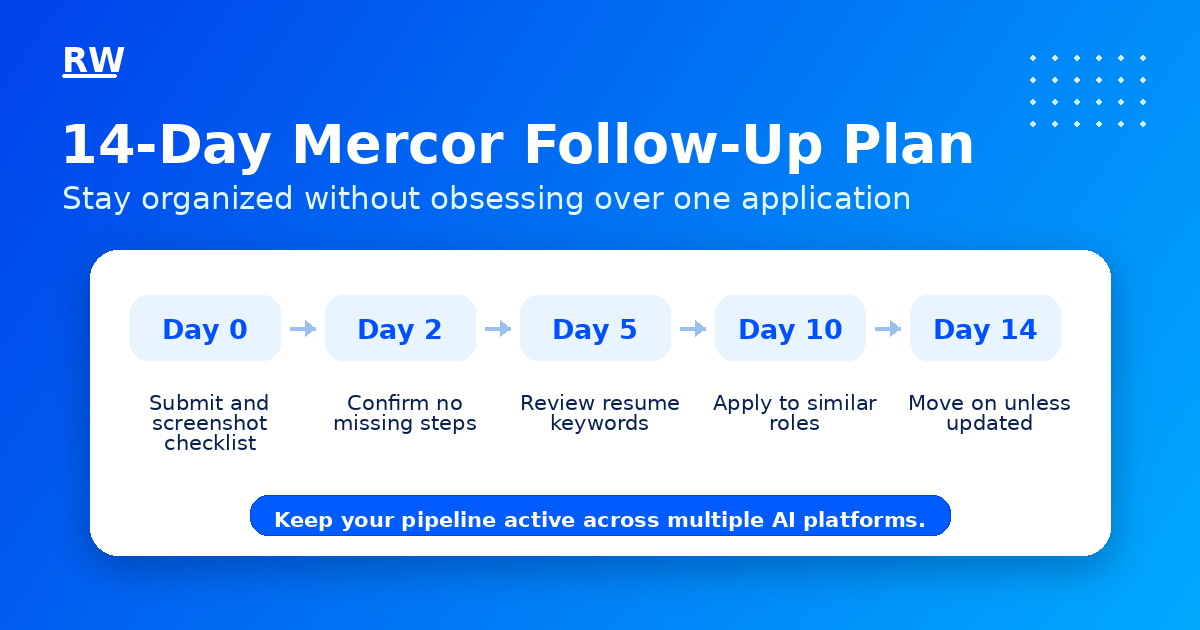
A reasonable approach:
- Day 0: Submit the application and confirm every required step is complete.
- Day 2: Recheck the dashboard for missing steps or changed requirements.
- Day 5: Review your resume and profile for role-specific keywords.
- Day 7–10: Apply to similar roles on other platforms if you have not already.
- Day 14: Assume the application may not convert soon unless you receive a new update.
For high-volume AI training jobs, two weeks of silence is enough reason to move your attention elsewhere. You can still keep the application open, but your energy should go toward more applications, better role targeting, and stronger assessments.
What to Do If Your Mercor Application Is Under Review
If your Mercor application is under review, do not panic and do not spam support. Instead, use the waiting period productively.
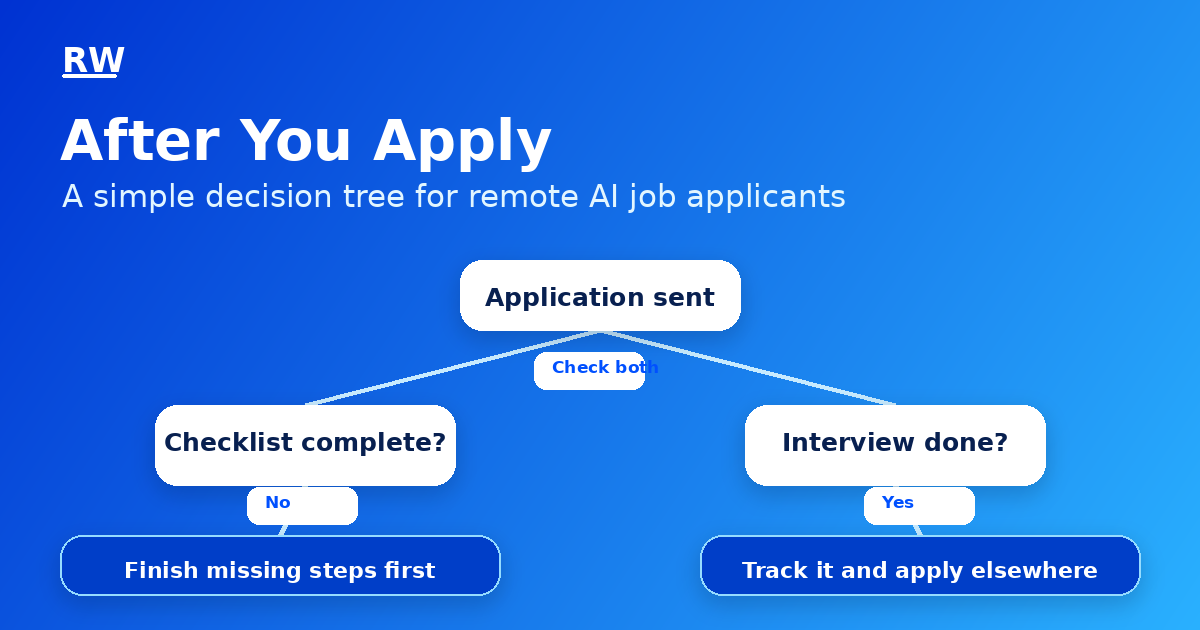
1. Confirm the Application Is Actually Complete
Open the application and check every item. If a role has a checklist, every required item should be done. If an interview, assessment, or work authorization step appears incomplete, finish it before assuming Mercor is delaying.
2. Improve Your Resume for AI Training Keywords
Your resume should include the kind of work you want to do. For AI model evaluation, useful keywords may include:
- AI training
- model evaluation
- response ranking
- rubric-based review
- prompt writing
- fact-checking
- editing
- research
- data annotation
- quality assurance
- subject matter expertise
- domain analysis
- technical writing
For expert roles, include the relevant domain: law, finance, healthcare, coding, math, education, business strategy, product management, marketing, or research.
3. Apply to Better-Matched Listings
Do not apply only to the highest-paying listing if it does not fit your background. A lower-paying role that matches your actual skills may convert faster than a premium expert role where you are one of thousands of weak-fit applicants.
4. Practice Explaining Your Expertise Clearly
AI interviews reward clarity. You should be able to answer:
- What is your strongest professional skill?
- What kind of problems have you solved?
- How do you check your work?
- How do you compare two answers?
- How do you handle unclear instructions?
- Why are you a fit for this specific role?
Strong answers use examples. Weak answers stay vague.
5. Keep a Simple Application Tracker
Track the platform, role, date applied, assessment status, interview status, pay range, and next follow-up date. This prevents you from checking the same dashboard too often and helps you see which platforms are actually moving.
What If Mercor Never Responds?
If Mercor never responds, treat it as a non-conversion and keep going.
That may sound blunt, but it is the most practical way to handle remote AI hiring. High-volume platforms do not always provide detailed feedback. You may not know whether the issue was timing, assessment score, role fit, capacity, location, resume quality, or a changed project requirement.
Instead of trying to decode silence, improve the parts you control:
- Apply to roles that match your real background.
- Make your resume more specific.
- Practice AI interview answers.
- Write clearer assessment responses.
- Apply across multiple platforms.
- Revisit the dashboard periodically, not constantly.
One unanswered Mercor application does not mean you are not qualified for AI training work. It means that one application did not turn into work yet.
Can You Speed Up the Mercor Hiring Process?
You cannot control the platform's internal timeline, but you can reduce avoidable delays.
The fastest applicants usually do four things well.
First, they apply to roles that match their actual experience. Second, they complete every required step quickly. Third, they make their resume easy to scan for the role's keywords. Fourth, they answer interviews and assessments with concrete examples.
You should also avoid mistakes that slow applicants down:
- Applying with a vague resume.
- Leaving checklist items incomplete.
- Giving generic AI interview answers.
- Applying to roles that require credentials you do not have.
- Ignoring country, location, or work authorization requirements.
- Waiting on one platform instead of applying widely.
How Mercor Compares to Other Remote AI Platforms
Mercor is one option in a larger market for remote AI work. Applicants also search for Outlier AI, Handshake AI, Surge AI, micro1, Stellar AI, LinkedIn AI jobs, data annotation jobs, AI evaluator jobs, and remote model evaluation work.
The same principles apply across most platforms. You need a clear profile, a relevant resume, strong assessment answers, and patience with project-based hiring. Work can start quickly when demand is high, but it can also slow down without much warning.
This is especially true for roles connected to AI model quality, chatbot evaluation, AI search, writing review, code review, expert feedback, and data annotation. The market is growing, but the work is still contractor-driven and inconsistent.
If you are serious about remote AI jobs, do not think like a one-application job seeker. Think like a pipeline builder.
Best Timeline Strategy for Mercor Applicants
Here is the simplest strategy:
Apply to Mercor. Complete every step. Take the AI interview seriously. Check your dashboard for missing items. Then keep applying.
Do not let one pending application freeze your job search. The applicants who do best in remote AI work are usually the ones who stack opportunities across multiple companies and stay ready when a project opens.
Mercor may respond quickly. It may take days. It may take weeks. It may not respond at all. Your job is to keep improving your profile and keep finding roles that match your skills.
For many applicants, the real win is not getting one Mercor application approved. It is building a repeatable system for finding remote AI training jobs, applying cleanly, and converting your expertise into paid online work.
Tip: The applicants who succeed long-term in remote AI work are the ones who treat rejection and silence as data. They track what worked, improve what did not, and keep building their pipeline instead of waiting on any single platform.
Frequently Asked Questions
How long does Mercor take to hire?
There is no fixed timeline. Some applicants receive responses within days when their background closely matches an active project. Others may wait two or more weeks. Remote AI training work is project-based, so hiring speed depends on current demand, role fit, and application completeness.
What does under review mean on Mercor?
Under review means your application has been submitted and is being evaluated, but a final decision has not been made. It may mean the platform is still comparing applicants, evaluating your assessment, or waiting for project capacity to open.
How can I speed up the Mercor hiring process?
Complete every required application step, match the role's expertise requirements closely, submit a strong AI interview with concrete examples, and apply at the right time for the project type. You cannot control the platform's timeline, but you can reduce avoidable delays.
Should I contact Mercor if my application is taking too long?
Contact support only if there is a technical problem such as a broken interview, failed resume upload, or dashboard error. For a normal review delay, improving your profile and applying to other relevant roles is more productive.