In This Article
- Short Answer: Start With 3 to 5 Platforms
- Why One Platform Is Usually Not Enough
- Why Too Many Platforms Can Hurt Beginners
- The Best Beginner Formula: Primary, Backup, and Testing Platforms
- A Practical Number by Situation
- How to Choose Which Platforms Deserve Your Time
- The Remote AI Platform Tracker Beginners Should Use
- Quality Beats Quantity in Remote AI Applications
- How Major AI Companies Fit Into This
- A 30-Day Plan for Beginners
- Red Flags When Joining Remote AI Platforms
- The Best Long-Term Strategy
- Final Recommendation
- FAQ
Short Answer: Start With 3 to 5 Platforms
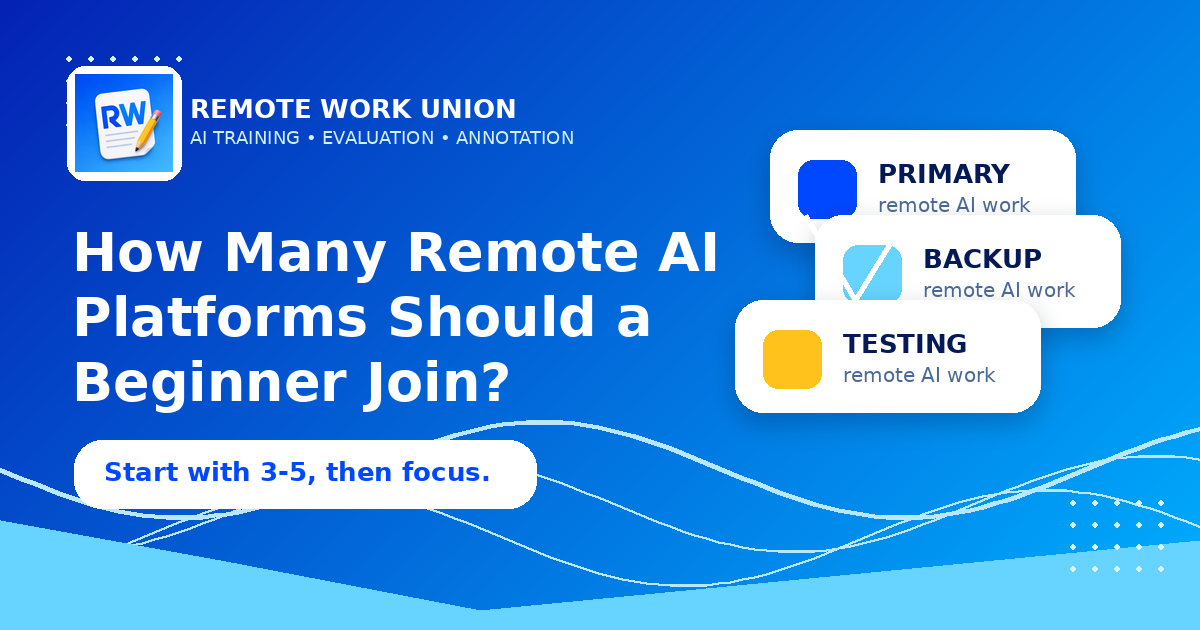
A beginner should usually join 3 to 5 remote AI platforms, not one and not twenty. A strong starting setup is simple: two serious platforms where you put real effort into the profile and screening process, one or two backup platforms, and one experimental platform you are still learning about.
That number is enough to protect you from silence, slow onboarding, paused tasks, waitlists, and project gaps. It is also small enough that you can still write thoughtful applications, complete assessments carefully, remember what each platform expects, and avoid turning your remote work search into a messy spreadsheet of half-finished profiles.
Remote AI work can include AI training, AI evaluation, AI data annotation, prompt response rating, fact-checking, research review, writing evaluation, coding review, legal review, finance review, safety evaluation, and other work that helps AI systems improve. Some roles are technical. Many are not. The beginner mistake is assuming that the right strategy is to apply everywhere at once. The better strategy is to build a small platform portfolio and then improve it based on where you actually get traction.
Why One Platform Is Usually Not Enough
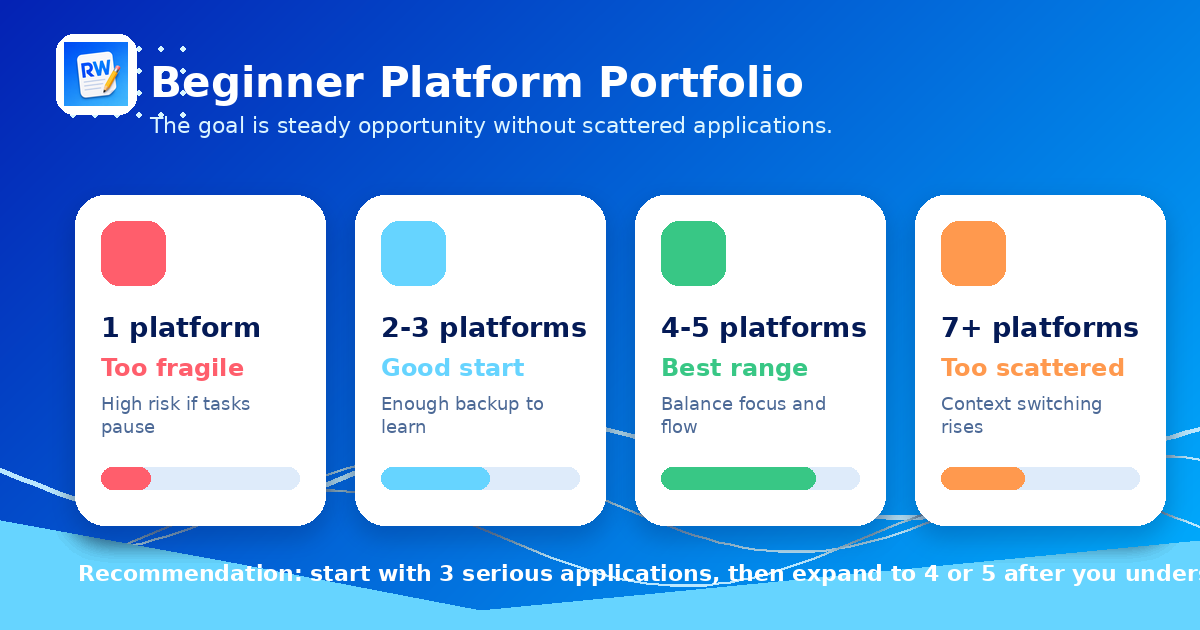
Joining only one platform feels organized, but it creates a fragile remote work setup. A platform can approve your account and still have no active projects that fit your skills. A dashboard can show tasks one week and go quiet the next. You can pass an initial screen and then wait for a team match. You can apply to a strong remote AI training company and hear nothing for reasons that have nothing to do with your ability.
This is why beginners should not build their entire plan around one account. Remote AI work is often project-based. Demand changes by language, subject matter, task type, client need, review quality, region, and platform capacity. Even strong applicants can experience slow periods. One platform gives you one chance at timing. Three to five platforms give you a small pipeline.
The goal is not to collect logos. The goal is to create enough opportunity that you are not emotionally or financially stuck waiting for a single application response. If one platform pauses, another may still be screening. If one platform has only writing tasks and you are stronger at research, another may be a better fit. If one platform rejects you, that does not mean remote AI work is over.
Key insight: One platform gives you one chance at timing. Three to five platforms give you a small pipeline — and a rejection from one does not close the door on remote AI work entirely.
Why Too Many Platforms Can Hurt Beginners
The opposite mistake is joining every platform you can find in one weekend. That sounds aggressive, but it often produces worse results. Remote AI applications are not like clicking easy-apply buttons. Many platforms ask for a resume, work history, writing samples, skills, availability, language ability, location, domain expertise, and timed assessments. Some also test your ability to follow instructions. If you rush, your quality drops.
Too many platforms also create context switching. One platform may want short, direct judgments. Another may want long explanations. Another may focus on coding, another on factual research, another on creative writing, another on safety, and another on data labeling. A beginner who jumps between ten dashboards before understanding any of them can easily make avoidable mistakes.
There is also a practical tracking problem. You need to know where you applied, what email you used, which tests you completed, what rates or task types were mentioned, whether you need to follow up, and which platforms are worth more time. Without that system, more applications do not mean more opportunity. They mean more confusion.
The Best Beginner Formula: Primary, Backup, and Testing Platforms
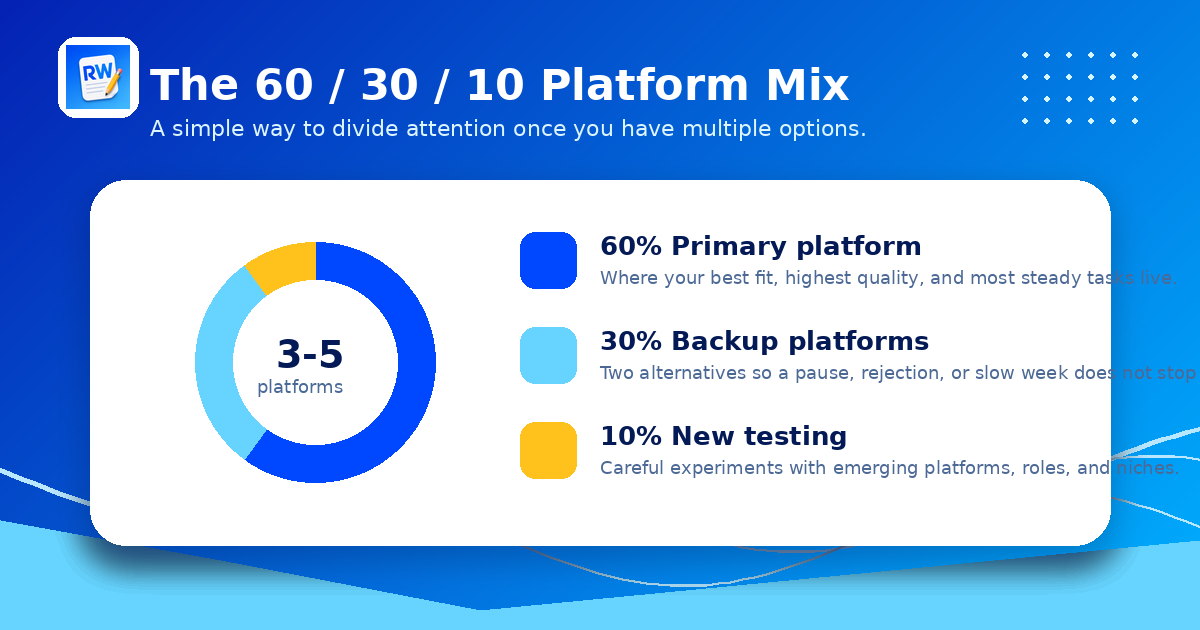
Think of your remote AI work search as a platform portfolio. You do not need equal attention on every platform.
Your primary platforms are the ones that seem closest to your skills. If you are a writer, that may mean AI response evaluation, creative writing review, editing, or prompt evaluation. If you are analytical, it may mean research, fact-checking, data quality, or evaluation tasks. If you code, it may mean code review, debugging, test generation, or technical AI training. If you have professional expertise in law, medicine, finance, education, marketing, operations, science, or engineering, your strongest platform may be one that routes expert tasks to subject matter experts.
Your backup platforms are not throwaways. They are legitimate options that may not be your first choice, but they give you protection. A backup platform is useful when your primary platform is slow, when you are waiting for review, or when you want to compare task quality and pay structure.
Your testing platform is where you learn. This could be a newer platform, a role outside your normal niche, or a marketplace you are still evaluating. You do not give it your entire week. You use it to gather information without letting it distract from stronger opportunities.
A Practical Number by Situation
The right number depends on your time, experience, and urgency.
If you have less than five hours per week, start with 2 or 3 platforms. Your main constraint is application quality. It is better to complete two strong profiles than six weak ones.
If you have five to fifteen hours per week, start with 3 to 5 platforms. This is the best range for most beginners. It gives you enough exposure to different remote AI jobs without overwhelming your schedule.
If you are actively replacing income, you may eventually track 5 to 8 platforms, but you should not treat all of them equally. Keep your serious attention on the ones with real traction. Use the rest as backups or occasional checks.
If you already have a strong niche — such as coding, law, finance, advanced math, scientific research, bilingual evaluation, or high-level writing — you may need fewer platforms because your best opportunities may be concentrated in a smaller set of expert-focused roles. If you are a generalist with no obvious niche, you may need to test more platforms to discover where you perform best.
How to Choose Which Platforms Deserve Your Time
Do not pick platforms only because someone posted a high hourly rate. Pay matters, but fit matters more. A beginner should evaluate platforms by asking six questions.
First, does the platform match your skills? A platform full of coding tasks is not useful if you cannot code. A platform focused on legal review is not useful if you have no legal background. A platform with writing evaluation, research, general knowledge, customer support, marketing, or operations may be better for a non-technical applicant.
Second, does the platform explain the work clearly? Real remote AI work should have a reasonable application process, task instructions, and quality standards. Vague promises are not enough.
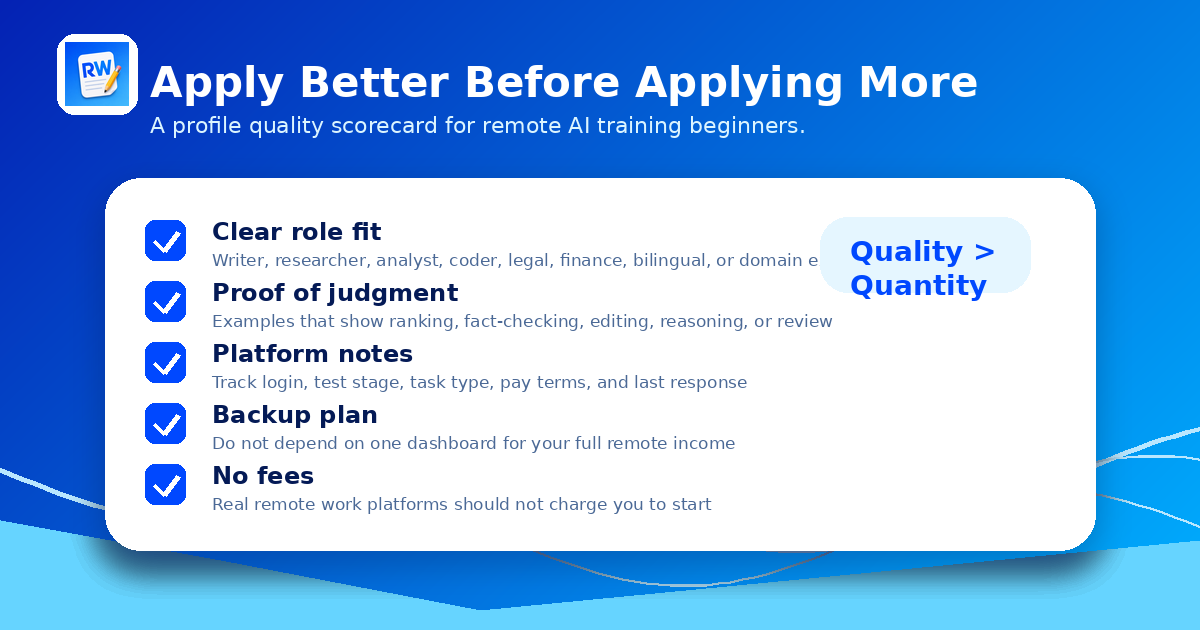
Third, does the platform charge you to begin? Be careful with any remote work opportunity that asks applicants to pay for access, training, equipment, or a guaranteed job. Legitimate AI training and evaluation work should not require a startup fee.
Fourth, can you actually complete the screening process well? Some platforms use timed tests, writing samples, interviews, or qualification tasks. If you are too tired or rushed, wait until you can give the test proper attention.
Fifth, does the platform fit your country, payment method, and availability? Some remote AI jobs are worldwide. Some are country-limited. Some require native-level English. Some need specific time zones or tax documentation. Check fit before spending hours on an application.
Sixth, can you track it? If you cannot remember where you applied, you are applying too randomly. A simple tracker can make a major difference.
The Remote AI Platform Tracker Beginners Should Use
You do not need a complicated system. A beginner tracker can be a spreadsheet, note, or table with the following columns: platform name, website, email used, role type, skills selected, application date, current stage, test status, expected pay range if shown, country eligibility, last response, next action, and notes.
This tracker prevents the most common beginner mistakes. You will know when you applied. You will know whether you finished the test. You will know which platforms were worth the time. You will know which ones went silent. You will know where to follow up. You will also be able to compare platform categories: AI evaluator jobs, AI training jobs, data annotation, prompt writing, research review, coding tasks, bilingual tasks, and expert review roles.
A tracker also keeps you from reusing weak applications. If one platform responds to your research background, that is a signal. If another ignores the same generic profile, revise it. If you pass writing screens but fail technical screens, stop pretending your best angle is coding. The point of joining multiple platforms is not just more chances. It is better feedback.
Tracker tip: Track every platform with these columns: platform name, email used, role type, application date, test status, last response, and next action. This one habit alone separates organized applicants from scattered ones.
Quality Beats Quantity in Remote AI Applications
Remote AI platforms are often looking for judgment. They want people who can read instructions, compare responses, notice mistakes, explain reasoning, evaluate accuracy, identify weak outputs, and provide consistent feedback. That means your application should show judgment before you ever receive a task.
A strong beginner profile is specific. Instead of saying you want remote work, explain what kind of remote AI work fits you. Are you good at writing clear explanations? Are you good at spotting factual errors? Can you compare two answers and explain which one is better? Do you have experience in customer support, marketing, sales, operations, accounting, tutoring, research, law, coding, healthcare, finance, or content editing? Have you used AI tools responsibly? Can you follow detailed guidelines?
The strongest applicants do not simply say, "I am interested in AI." They connect their background to the work. A social media manager can evaluate tone, clarity, engagement, and brand safety. A teacher can review explanations for learning quality. A paralegal can evaluate legal reasoning within appropriate boundaries. A software engineer can review code. A researcher can fact-check answers. A customer support rep can evaluate whether an AI response actually solves a user's problem.
This is why joining twenty platforms with a weak profile is less effective than joining four platforms with a focused one.
Ready to apply to remote AI platforms with a strong, focused profile? RemoteWorkUnion.com matches you with roles based on your background and availability.
Find Roles Hiring Now →How Major AI Companies Fit Into This
Beginners often search for remote AI jobs using the names of major AI companies because they want to work on technology connected to OpenAI, Anthropic, Google, Meta, Grok, and other AI labs or model builders. That is understandable, but most remote AI training work does not look like a traditional full-time job at a major AI lab.
Many opportunities appear through AI training platforms, data annotation companies, evaluation marketplaces, contractor networks, research task platforms, and specialized expert review systems. These platforms may support model improvement, response evaluation, safety testing, quality review, or domain-specific feedback. The applicant experience is usually closer to a remote contractor marketplace than a standard corporate job application.
That means beginners should search broadly using terms like remote AI evaluator, AI trainer, AI data annotation, AI response reviewer, prompt evaluator, AI content reviewer, AI fact-checking jobs, AI writing evaluator, AI research tasks, AI coding evaluator, and work from home AI jobs. The best keyword is not always the company name. Often, the best keyword is the task you can actually do well.
A 30-Day Plan for Beginners
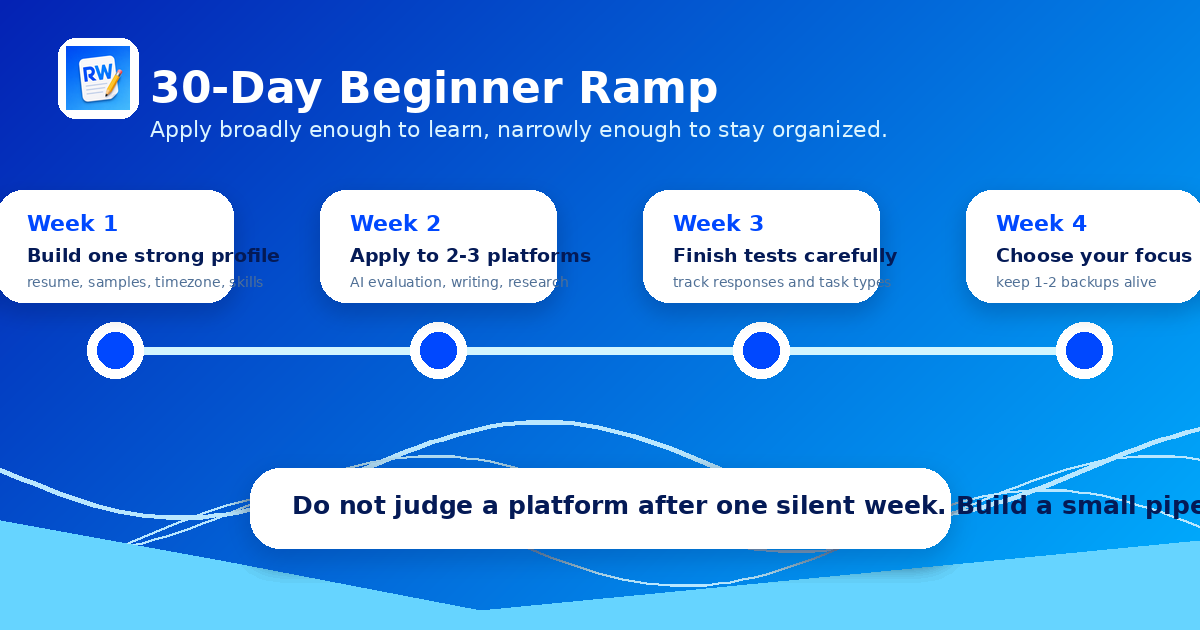
In the first week, build your base profile. Update your resume so it clearly shows remote-friendly skills, writing ability, research ability, analysis, subject matter expertise, software tools, and any experience with AI outputs. Prepare one clean writing sample or work sample if relevant. Create a simple tracker.
In the second week, apply to 2 or 3 platforms that match your strongest skills. Do not apply when distracted. Read the instructions. Use consistent information. Take assessments seriously. If the platform asks why you are qualified, answer with specific skills, not generic motivation.
In the third week, add 1 or 2 backup platforms. This is also when you should review your tracker. Which applications were smooth? Which tests were confusing? Which platforms matched your skills? Which ones felt like a bad fit?
In the fourth week, choose your focus. Keep checking the platforms where you have traction. Finish any pending qualification tasks. Improve your profile language based on what you learned. Add one experimental platform only if your current applications are complete.
After 30 days, you should not just have more applications. You should understand your category. You should know whether you are strongest in writing, research, coding, general evaluation, domain expertise, bilingual tasks, or data annotation. That clarity is more valuable than a long list of accounts.
Red Flags When Joining Remote AI Platforms
Be careful with any platform or opportunity that promises guaranteed income, asks for money upfront, hides what the work is, pressures you to buy training, requires unusual financial information before a real application process, or claims that everyone gets accepted. Remote AI work can be flexible and well-paid, but it is still work. Platforms screen people because task quality matters.
Also be careful with fake remote job posts that impersonate legitimate companies. Use official websites when possible. Avoid sending sensitive documents through random forms. Do not pay for access to a job list that promises guaranteed AI work. Do not assume a social media post with a high hourly rate means the role is easy or available in every country.
A real remote AI opportunity should make sense. You should understand what the task category is, why your skills fit, and what the next step is.
Safety rule: Legitimate AI training and evaluation platforms never charge you to apply, access tasks, or start working. If a platform asks for payment before you can begin, that is a red flag.
The Best Long-Term Strategy
The long-term strategy is not to stay a beginner forever. Start with 3 to 5 platforms, learn where you get accepted, then specialize. Specialization is where remote AI work becomes more stable. General tasks can be useful, but expert tasks are often more defensible.
If you discover that you are good at factual research, build that profile. If you are strong at creative writing evaluation, build that profile. If you are technical, improve your coding review samples. If you have finance, legal, healthcare, education, engineering, science, marketing, or operations experience, look for AI evaluation tasks that need that judgment. If you speak multiple languages fluently, search for bilingual AI evaluation and localization work.
Over time, your platform count may matter less than your platform quality. One strong platform with steady tasks can beat ten weak accounts. But beginners usually do not know which platform will become the strong one. That is why the right first move is controlled diversification.
Final Recommendation
A beginner should join 3 to 5 remote AI platforms. Start with three if you want a clean, focused process. Expand to five if you have enough time and you are still waiting for traction. Avoid depending on one platform, but also avoid applying to every platform in sight.
Use the portfolio model: primary platforms, backup platforms, and one testing platform. Track every application. Improve your profile before adding more accounts. Search by task type, not just company name. Treat AI training, AI evaluation, and data annotation as real work that rewards clarity, accuracy, patience, and judgment.
Remote AI work is not about having the most dashboards. It is about finding the platforms where your skills are valuable and then doing high-quality work consistently.
Frequently Asked Questions
Should I join micro1, Mercor, Handshake AI, and Outlier at the same time?
You can compare several platforms, but do not rush every application in one day. If you are new, apply to the platforms that best match your skills first, then add backups once your main profiles and tests are complete.
Is one remote AI platform enough?
Usually no. One platform can pause tasks, reject your application, or have no matching projects. One platform can work later, but beginners should build a small pipeline first.
Is joining ten AI platforms better?
Not usually. Ten platforms can become scattered unless you already have a system. Most beginners are better off with 3 to 5 serious applications.
What if I have no AI experience?
Focus on transferable skills: writing, research, fact-checking, editing, customer support, teaching, analysis, coding, bilingual ability, or professional expertise. Many remote AI evaluation roles care more about judgment than formal AI experience.
How often should I check each platform?
Check active platforms regularly, but do not let dashboards consume your day. Prioritize platforms where you have active tasks, pending assessments, or recent communication.