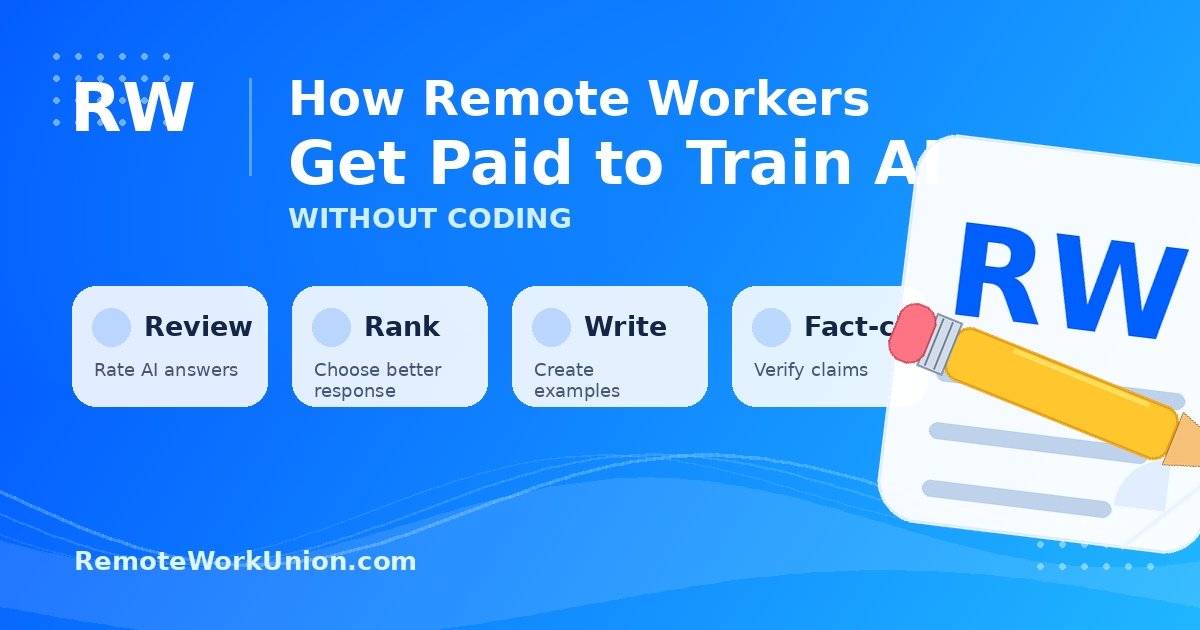
Most people who want to work in AI assume they need to code. That assumption excludes a large portion of the AI training market. AI companies — including those building systems connected to OpenAI, Anthropic, Google, Meta, xAI, and others — need human reviewers who can read, write, research, evaluate, and explain. None of that requires a software engineering background.
This is not a workaround. Non-coding human judgment is a core part of how modern AI models are built and improved. AI systems need human feedback to get better at writing clearly, reasoning accurately, following instructions, avoiding mistakes, and producing useful answers across every domain. The people providing that feedback are often not engineers — they are writers, teachers, researchers, customer service professionals, lawyers, accountants, sales reps, marketers, healthcare workers, and domain experts of every kind.
What "Training AI" Really Means for Non-Coders
When AI companies talk about training their models, they are describing a broad process that includes building datasets, reinforcing good behavior, correcting mistakes, and teaching the model to produce useful responses. A significant portion of that process depends on human feedback — comparing answers, labeling data, writing prompts, reviewing outputs, and explaining what is right or wrong about a model response.
The people doing that work are called AI trainers, AI reviewers, AI evaluators, data annotators, prompt writers, content quality raters, search evaluators, and subject matter experts. None of those roles require a computer science background. They require human judgment, which is something that writers, researchers, educators, professionals, and other non-technical workers already have.
Important distinction: "Training AI" for non-coders means providing the human feedback that teaches a model to perform better — not writing the code that builds the model.
Why AI Companies Pay People Who Cannot Code
AI models learn from human feedback. A model that only gets feedback from engineers will be good at technical tasks and bad at everything else. AI labs need diverse human reviewers because their models are used by diverse people: students asking questions, executives researching decisions, patients reading health information, customers seeking help, writers asking for creative input, and professionals checking specialized knowledge.
To evaluate whether an AI answer is good for those use cases, the reviewer needs to understand the user's real-world context — not the model's architecture. That is why subject matter expertise, professional experience, domain knowledge, and strong communication skills can all be more relevant than coding ability for many AI training roles.
The Six Types of Non-Coding AI Training Work
1. AI Response Reviewer
AI response reviewers compare two or more model outputs and decide which is better based on specific criteria. The criteria may include accuracy, helpfulness, safety, completeness, tone, and clarity. You do not need to understand the model to judge whether the final answer actually works for a real user. This is the most beginner-accessible AI training role and does not require technical background.
2. AI Data Annotator
Data annotators label or organize text, images, audio, or structured data so AI systems can learn from it. For text-based annotation — the most common type for non-coders — you might label sentiment, identify intent, classify topics, flag issues, compare statements, or tag content against specific criteria. Accuracy and consistency matter more than technical knowledge.
3. Prompt Writer
Prompt writers create questions, instructions, or scenarios that test how an AI model responds. A good prompt writer knows how to ask questions that reveal whether a model can reason, follow instructions, handle ambiguity, refuse unsafe requests, or adapt its tone to context. This role is ideal for writers, teachers, researchers, and professionals who ask precise, structured questions in their regular work.
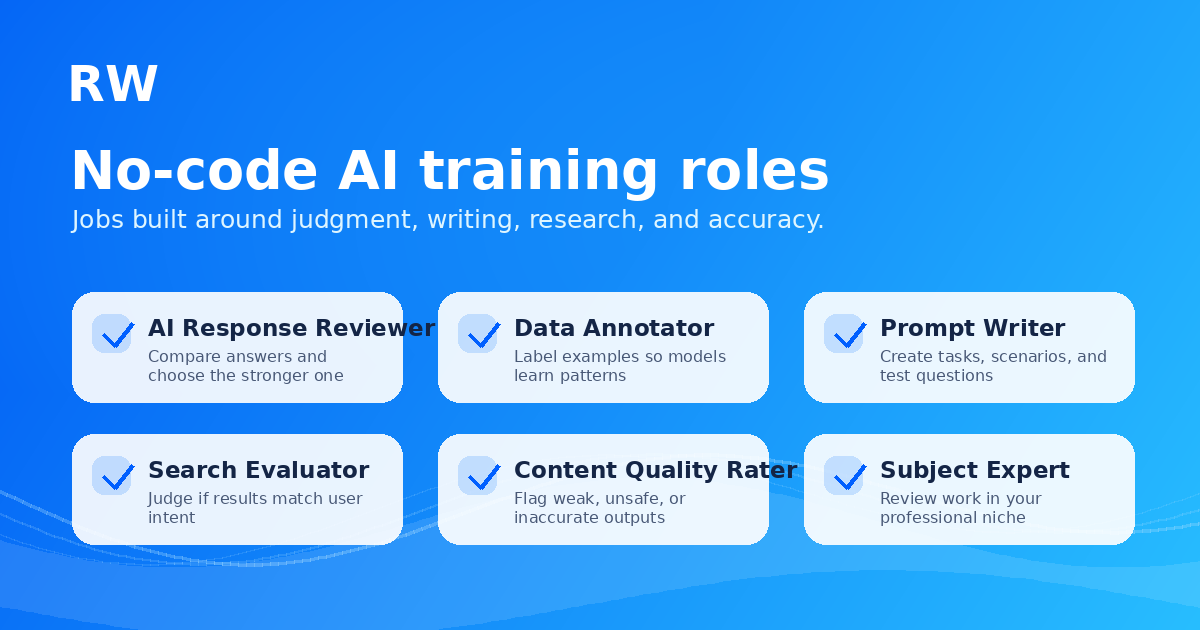
4. Search and Research Evaluator
Search evaluators review search results, web pages, AI-generated summaries, or answer boxes and judge whether they satisfy a user's real intent. This role rewards curiosity, online research skill, and the ability to notice whether a result actually answers the question. Many search evaluation projects also overlap with AI content quality — judging whether AI-generated answers are trustworthy and complete.
5. Content Quality Rater
Content quality raters evaluate AI-generated or human-written content for usefulness, accuracy, tone, safety, and format. This can include rating blog posts, product descriptions, customer service responses, educational content, marketing copy, and many other content types. Writing and editing experience is a strong advantage for this role.
6. Subject Matter Expert Reviewer
This is the highest-tier non-coding AI training role. Subject matter experts evaluate AI outputs in specialized domains — law, finance, medicine, accounting, real estate, education, sales, marketing, engineering, or other professional fields. Because the judgments require real expertise, these roles often command the highest rates: $50–$200/hr for expert-tier reviewers. Platforms like micro1, Mercor, Handshake AI, and Outlier match professionals to these roles based on their stated expertise.
What the Work Actually Looks Like Day to Day
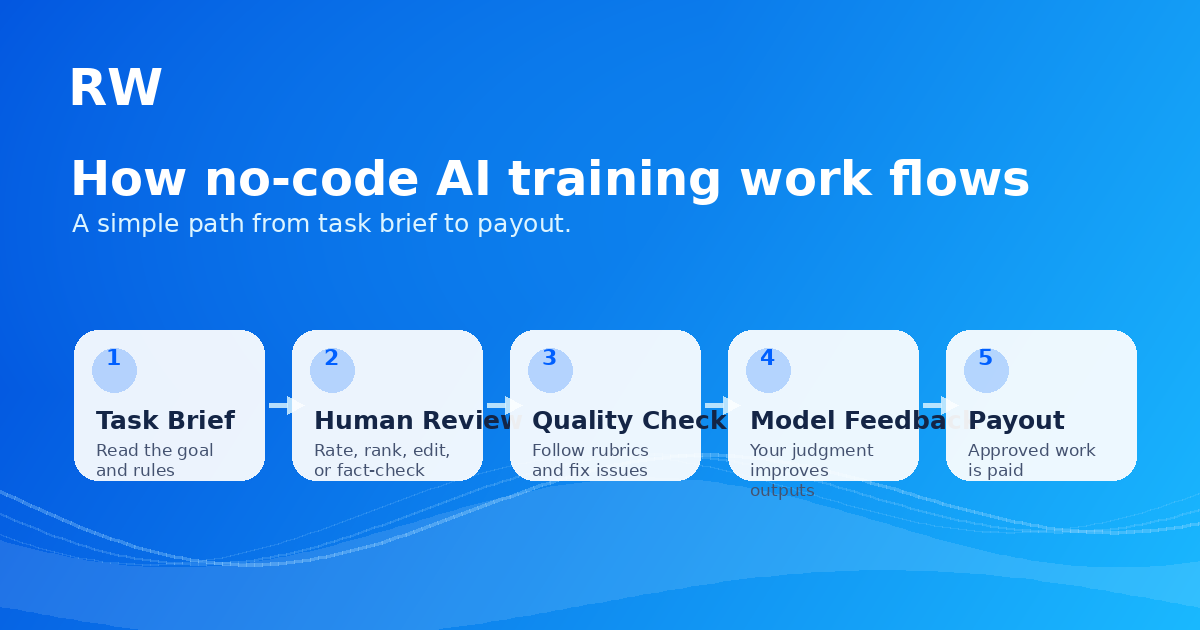
A typical AI training session may look like this: you log into the platform, see a task queue, open a task, read a prompt or question, see one or two AI responses, evaluate them based on a rubric, choose the better one, write a short explanation of your choice, and submit. Repeat. Some platforms pay by task, some by hour, some by deliverable.
The work requires sustained attention to detail and the ability to follow multi-step instructions consistently. Some tasks are short (two minutes), some are longer (fifteen to thirty minutes). Some projects are repetitive and fast. Others require careful research and a longer written rationale. The key is to read the task guidelines carefully before starting and to follow the rubric even when your instincts might say something different.
How Remote Workers Get Paid for AI Training
Pay structures vary by platform and project. Most AI training platforms are contract-based and pay via Stripe, Wise, PayPal, Deel, ACH, or Airtm. Some pay weekly after approved work is processed; others allow withdrawals when a balance threshold is reached.
Entry-level AI training and annotation work typically pays $15–$30/hr. Writing evaluation and intermediate research roles often pay $30–$60/hr. Expert-tier roles with domain credentials can pay $50–$200/hr. The rate reflects both the difficulty of the task and the scarcity of qualified reviewers. The $20+/hr general floor means non-coding AI training usually pays better than surveys, gig apps, or simple data entry.
Be aware that platforms may have an approval window between when you complete work and when you get paid. Income can also be project-based and variable — some weeks may be busy and others quiet depending on demand.
Skills That Matter More Than Coding
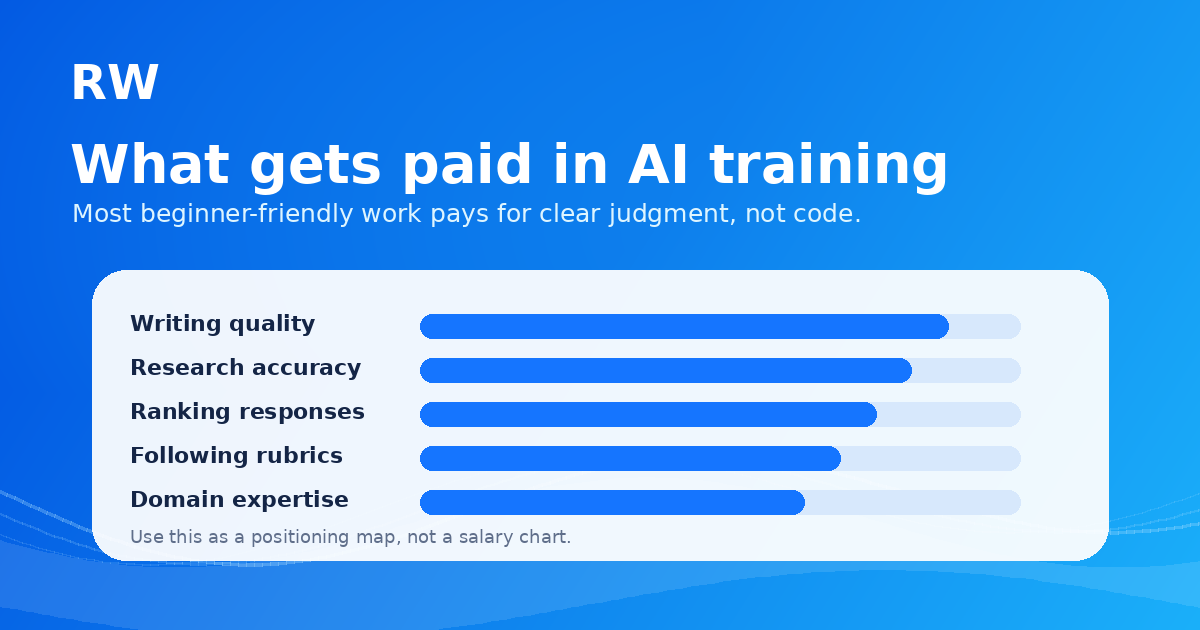
The skills AI training platforms actually screen for in non-coding roles are reading comprehension, written communication, attention to detail, research ability, fact-checking skill, ability to follow detailed guidelines consistently, and the capacity to explain reasoning clearly.
Domain expertise in any professional area adds significant value. A sales professional reviewing AI answers about negotiation or CRM workflows, a teacher reviewing educational content quality, a customer service manager reviewing AI chatbot responses, or a marketing specialist reviewing ad copy quality can all provide more useful feedback than a generalist who lacks that context.
Remote Work Union connects non-coders to legitimate AI training and evaluation roles. Apply for free.
Find Roles Hiring Now →How to Position Yourself With No AI Background
You do not need prior AI experience to apply. You need to show that you have the underlying skills. Write a profile headline like: "AI Response Reviewer and Content Quality Evaluator — Writing, Research, Fact-Checking, Rubric-Based Scoring." Then describe the real skills that match the work: clear writing, strong research, attention to detail, professional domain knowledge, and comfort with online task systems.
Your prior experience matters more than you may think. Describe it in AI-relevant terms. Instead of "answered customer emails," write: "Reviewed customer messages, identified intent, and wrote clear responses that matched company guidelines for tone, accuracy, and helpfulness." That language connects directly to what AI evaluation platforms look for.
What to Put in Your Profile
- Headline: Your strongest evaluation skill + the domain area you know best
- Summary: Clear statement of your background, what types of AI work you can do, and why your judgment is useful
- Skills list: AI response evaluation, data annotation, prompt writing, fact-checking, research, writing, editing, rubric-based scoring, and any subject matter expertise
- Proof sample: A short example showing you can compare two AI responses and explain which is better — even fictional or self-created
How to Avoid Low-Quality Work
Low-quality AI training opportunities often promise high pay for very simple tasks with no screening process. Legitimate platforms have clear application steps, quality standards, rubrics, and some form of evaluation before you access work. A platform that lets anyone start immediately with no assessment is often a low-paying, high-volume task farm rather than a serious AI evaluation role.
Also avoid any platform requiring you to pay to access work, buy training materials, or pay a fee before you can start earning. Real AI training platforms do not charge workers.
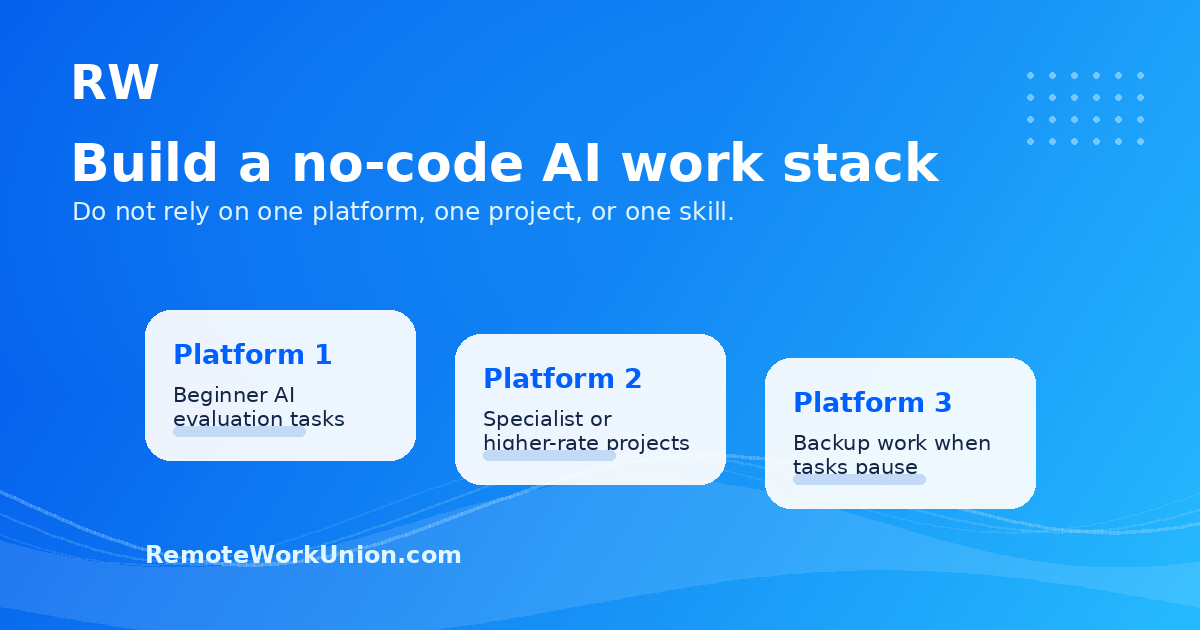
Why One Platform Is Not Enough
AI training platforms run project-based work. A single platform may have abundant tasks one week and very little the following week, depending on client demand, project timelines, and how many workers are currently active. Relying on one platform means your income is fully tied to that project's schedule.
Apply to multiple platforms at once: micro1, Mercor, Handshake AI, and Outlier are all worth applying to in parallel. Once you have active profiles across platforms, you can fill quiet periods on one with active work from another.
Beginner Plan
Day 1: Choose your strongest non-coding lane — writing evaluation, research, domain expertise, or general AI review. Write one sentence describing what you can do.
Day 2: Build a focused profile. Use AI evaluation keywords honestly. List your strongest skills and domain areas.
Day 3: Create a short proof sample — compare two AI responses and explain your rating.
Day 4: Apply to micro1, Mercor, Handshake AI, and Outlier. Track all applications in a spreadsheet.
Day 5: Complete assessments carefully. Read every instruction. Prioritize accuracy over speed.
Days 6–7: Apply to additional platforms, improve your profile based on what applications asked for, and follow up where appropriate.
Frequently Asked Questions
Can you get paid to train AI without knowing how to code?
Yes. A large portion of AI training work does not require coding. Tasks like AI response reviewing, data annotation, prompt writing, search quality rating, content rating, and subject matter expert review all reward reading, writing, research, and judgment rather than programming skills. Platforms like micro1, Mercor, Handshake AI, and Outlier all hire non-coders for these roles.
What does AI training work actually involve for non-coders?
Non-coding AI training work can include comparing two AI responses and choosing the better one, checking whether an answer is factually accurate, flagging unsafe or unhelpful responses, writing prompts to test a model, categorizing text or search results, rating content for quality, and providing expert feedback on outputs in fields like law, medicine, finance, education, writing, or customer support.
How do AI training platforms pay without coding?
Pay is typically hourly or per task. Rates vary by role and project complexity: basic annotation and rating work may pay $15–$25/hr at the entry level, while writing evaluation, research, and expert-tier roles can pay $50–$200/hr. The highest rates go to subject matter experts in fields where AI makes costly errors — legal, medical, financial, coding, science, and specialized research.
What skills do AI training jobs require if not coding?
The most important non-coding skills are strong reading comprehension, clear writing, attention to detail, ability to follow detailed instructions consistently, research skill, fact-checking ability, and the capacity to explain reasoning clearly. Subject matter expertise in any professional domain — law, medicine, business, finance, education, marketing, customer service, or creative fields — can also command higher rates.
How do I start getting paid to train AI without coding experience?
Start by applying to multiple platforms at once: micro1, Mercor, Handshake AI, and Outlier. Build a profile that highlights your strongest skills — writing, research, domain knowledge, or evaluation ability. Create a short writing sample that demonstrates you can compare AI responses or check factual accuracy. Take assessments carefully and track all applications. Begin with beginner-friendly tasks and build toward better-paying expert review work over time.