Ready to apply for AI training and remote work roles? Apply through Remote Work Union.
Find Roles Hiring Now →Remote contract work in AI has become one of the most practical ways for educated professionals to turn writing ability, research skill, subject knowledge, and clear judgment into online income. Many people search for AI jobs and assume they need to be machine learning engineers, software developers, or data scientists. That is not always true. A large part of the AI economy depends on human reviewers who can test prompts, compare chatbot answers, verify facts, judge reasoning quality, and explain why one response is better than another.
For college-educated US applicants, this can be a strong fit. Many remote AI training jobs reward the same skills that show up in college work and professional knowledge: reading carefully, evaluating evidence, explaining decisions, following detailed instructions, and communicating in polished English. These roles may be listed as AI evaluator jobs, AI model evaluation work, AI training jobs, prompt evaluator roles, data annotation projects, RLHF work, search quality review, or expert review contracts.
This guide explains what remote AI contract work actually is, why college-educated applicants in the United States may be competitive, how to search for legitimate projects, and how to apply without wasting time on low-quality listings.
What Remote Contract Work in AI Actually Means
Remote AI contract work is usually project-based work done as an independent contractor rather than as a traditional employee. Instead of joining a company full time, you may complete paid tasks for a platform, vendor, lab partner, or AI data company. The work may be flexible, but it is still professional work. You are expected to follow instructions, meet quality standards, protect confidential task details, and submit consistent reviews.
The common thread is human judgment. AI companies and AI platforms need people to help improve systems like ChatGPT-style assistants, Claude-style assistants, Gemini-style assistants, code models, search tools, writing tools, and specialized business models. Human reviewers help identify which answers are useful, accurate, safe, complete, well-written, and aligned with the user request.
A task might ask you to compare two AI answers and decide which is stronger. Another might ask you to fact-check a response. Another might ask you to write a prompt, rate an answer, identify a hallucination, or review whether an AI output follows a policy.
Why College-Educated US Applicants Can Be Strong Candidates
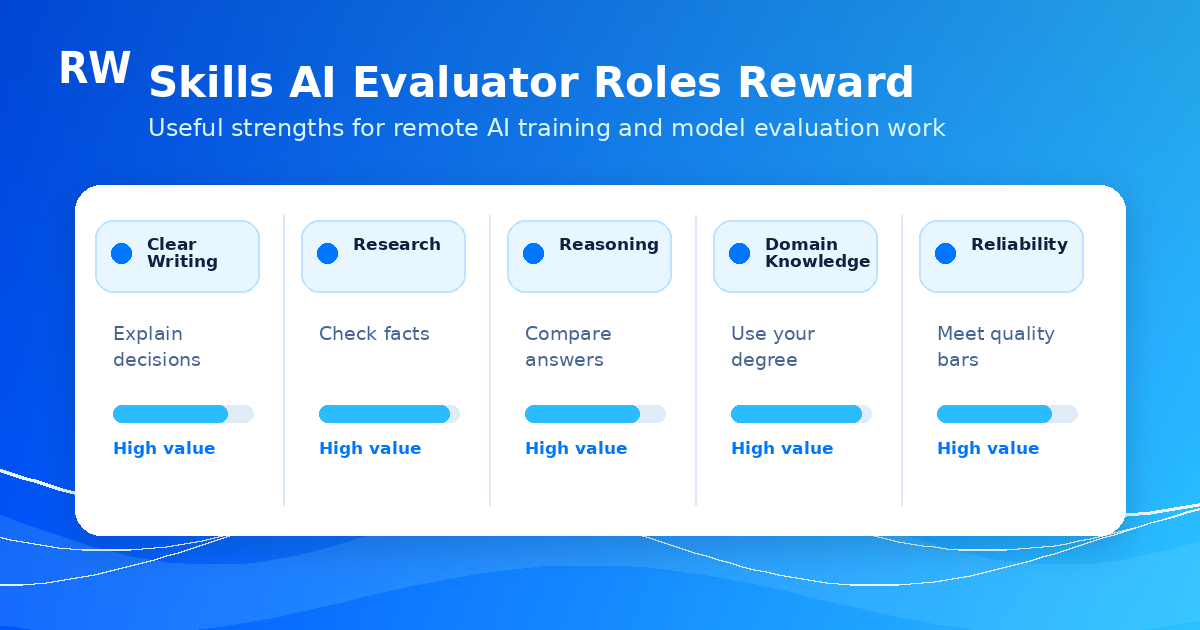
A college degree does not automatically qualify someone for every AI training job. It also does not replace the need to pass assessments. But it can help signal that you are comfortable with reading, writing, analysis, and structured assignments. Many AI evaluation projects are not looking for casual internet browsing. They are looking for people who can understand instructions, apply criteria, and explain their reasoning in a way another reviewer could audit.
US applicants may also see more location-restricted opportunities than applicants in many other countries. Some AI training platforms separate projects by country because of client requirements, language expectations, tax setup, legal restrictions, data access rules, or payment operations. That does not mean every role is US-only. It means applicants should pay close attention to location eligibility.
College-educated US applicants often have several advantages: strong English writing skills, familiarity with academic research, experience explaining complex ideas, domain knowledge from a major or career, and the ability to work independently.
The Main Types of Remote AI Contract Work
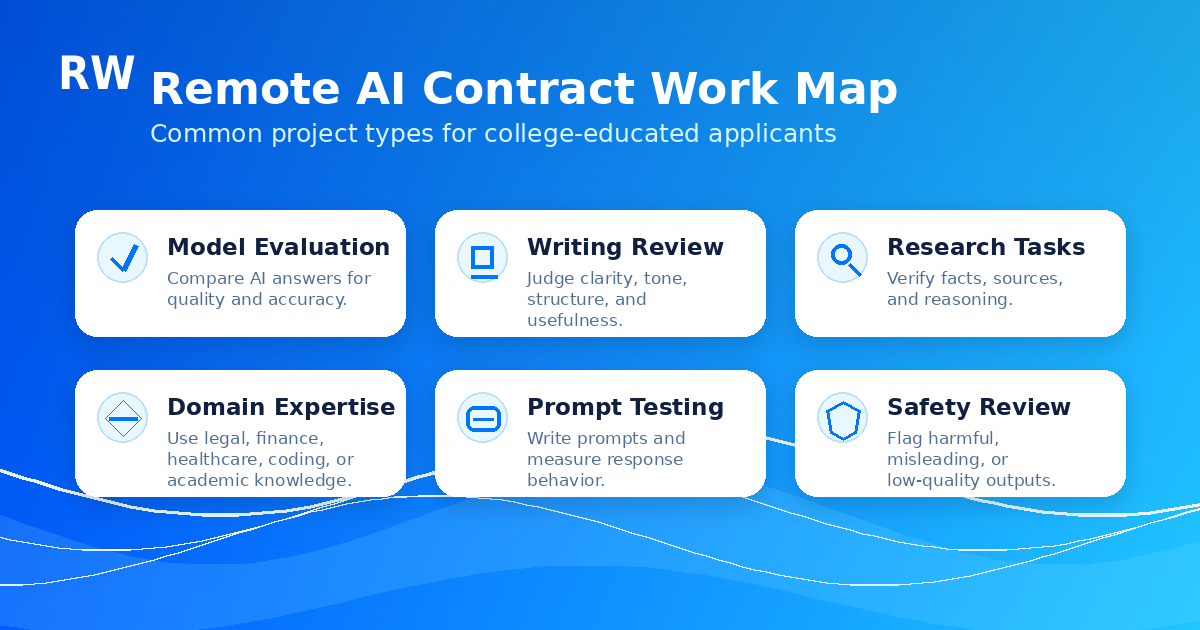
AI model evaluation usually means reviewing AI-generated answers and judging them against a rubric. You may compare two responses, rate one answer on helpfulness and accuracy, or explain why an answer failed. Good evaluators are not just picking the answer they personally like. They are applying criteria.
Prompt writing and response review — some projects need people to write prompts that test AI systems. Others ask reviewers to rewrite weak responses, identify missing steps, or create examples of high-quality answers.
AI fact-checking and research review — AI systems can sound confident even when they are wrong. Fact-checking tasks ask contractors to verify claims, detect hallucinations, inspect sources, and decide whether an answer is supported.
Subject matter expert review — some remote AI work is designed for people with advanced or specialized knowledge. A business analyst might review strategy answers. A lawyer might evaluate legal reasoning. A nurse or doctor might assess health-related content. A finance professional might review accounting or market explanations. These roles can pay more because the work is harder to source.
Data annotation and labeling — some annotation work is simple and lower paid. Other annotation projects require judgment, language skill, technical understanding, or domain context. College-educated applicants should look for higher-skill annotation work.
AI safety and policy evaluation — these projects ask reviewers to test whether an AI system handles sensitive or risky prompts appropriately. They reward reviewers who can stay calm, precise, and consistent while applying a detailed rule set.
What Makes a Strong Applicant Profile
A strong AI contractor profile is specific, evidence-based, and easy to match to projects. The goal is not to look like a generic remote worker. The goal is to show why you are useful for AI model evaluation, AI training, prompt review, or expert feedback.
Lead with your strongest domain: writing, research, finance, law, healthcare, education, coding, consulting, business analysis, science, math, or editing. Mention concrete tools and skills: ChatGPT, Claude, Gemini, Excel, Google Sheets, Python, SQL, legal research, academic writing, citation review, tutoring, technical writing, or content editing. Show proof of clear communication: published writing, research projects, teaching experience, analyst work, documentation, consulting decks, or client-facing communication. Use job-specific language: AI evaluator, model evaluation, prompt engineering, AI training, data annotation, fact-checking, RLHF, response rating, search quality, and expert review.
Many applicants under-sell themselves because they describe their background too broadly. A political science graduate should not only say they have a BA. A stronger profile says they can evaluate persuasive writing, policy analysis, government explanations, legal-adjacent reasoning, source quality, and long-form research. A finance graduate should not only say they studied finance. They should mention Excel, accounting, business analysis, valuation concepts, market research, and quantitative reasoning.
Where to Look for Remote AI Contract Work
The best search strategy is to use multiple search angles. Some job listings use the phrase AI training jobs. Others use AI evaluator, model evaluator, data annotator, prompt evaluator, search quality rater, AI response reviewer, AI fact-checker, RLHF contractor, language model evaluator, or subject matter expert.
You may see opportunities through AI work platforms, remote job boards, LinkedIn, company career pages, staffing vendors, university networks, and professional communities. Platforms and vendors can change over time, so do not rely on one name. Search broadly for roles connected to Mercor, Outlier AI, Handshake AI, Surge AI, micro1, Stellar AI, data annotation companies, AI labs, and AI vendors that support companies building tools around OpenAI, Anthropic, Google, Meta, Microsoft, and other major AI systems.
How to Avoid Scams and Low-Quality Listings
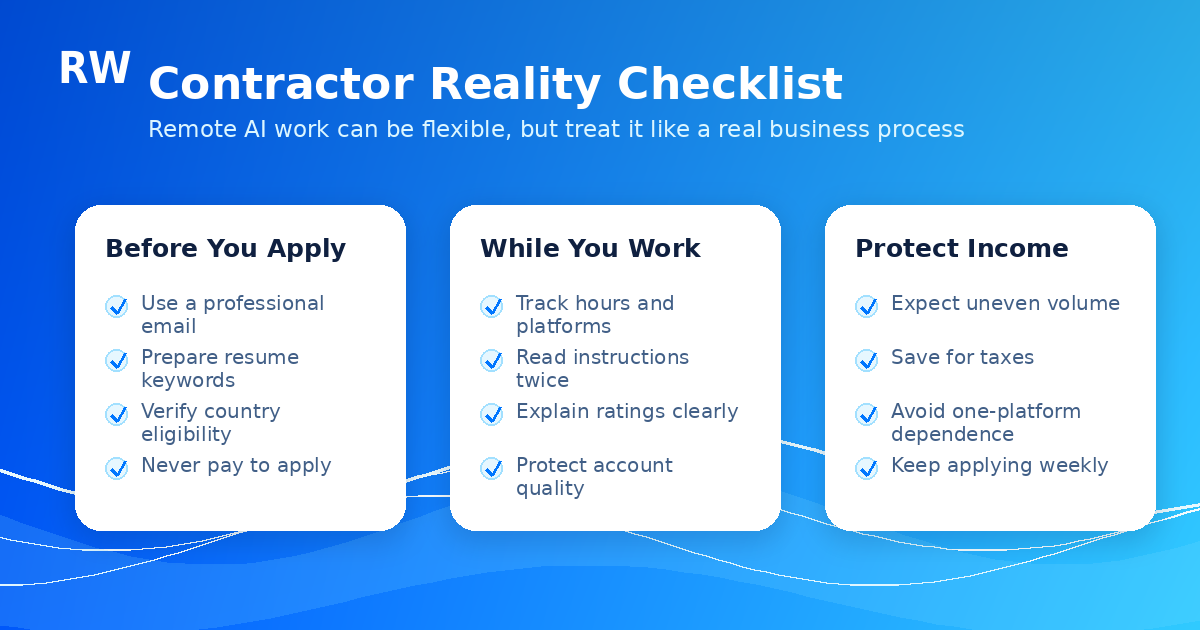
Legitimate remote AI contract work should not require you to pay to apply. Be careful with any listing that promises guaranteed income, asks for upfront fees, requests unusual financial information before a formal onboarding process, or hides the company behind vague claims.
Do not pay for a job application or a guaranteed placement. Check whether the company has a real website, clear hiring process, and consistent public presence. Be cautious with listings that advertise unrealistic daily earnings without mentioning assessments, quality standards, or task availability. Read contractor agreements, confidentiality rules, and payment terms before starting work.
Contractor Realities US Applicants Should Understand
Remote AI contract work is different from a full-time job. Contractors may not receive benefits, paid time off, unemployment coverage, equipment reimbursement, or guaranteed hours. Task volume can rise and fall. That is why experienced contractors often apply to more than one platform and avoid depending on a single project.
US contractors should also plan for taxes. Platforms may pay through systems like direct deposit, Stripe, PayPal, or other payout providers, but tax withholding may not work the same way as a W-2 job. Keep records of payments, hours, business expenses, and platform names.
The upside is flexibility. Many AI contractor roles can be done from home, outside normal office hours, and alongside school, consulting, creative work, parenting, or another job.
How to Do Well on AI Evaluation Assessments
Most assessments are testing whether you can follow instructions and explain judgment. Read the rubric first. Look for constraints in the prompt. Ask whether the AI response directly answered the user, whether it made unsupported claims, whether it missed important context, and whether it was safe and useful.
Your written explanation matters. A weak explanation says Response A is better because it sounds better. A stronger explanation says Response A is better because it directly answers the user request, includes the requested comparison, avoids unsupported claims, and uses clearer step-by-step reasoning. Response B gives a general answer but misses the user-specific constraint.
The goal is not to be clever. The goal is to be consistent, evidence-based, and easy to audit.
A Simple Application Workflow
The fastest way to make progress is to use a repeatable system instead of randomly applying to whatever appears first.
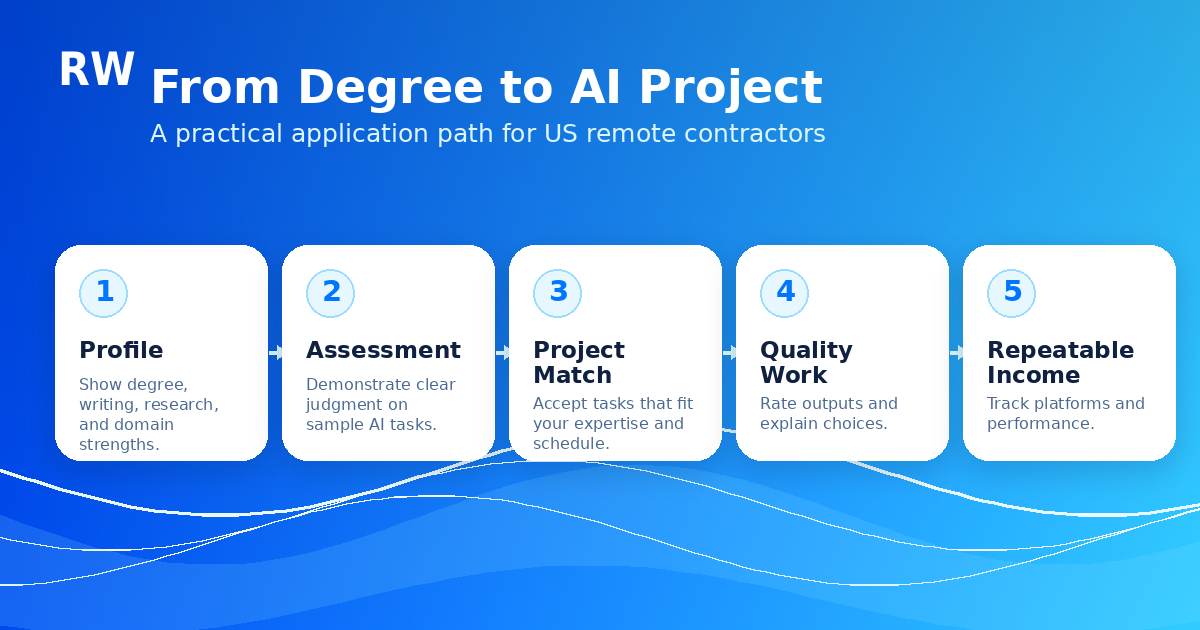
Step 1: Pick your strongest lane — writing, research, finance, law, healthcare, coding, education, business analysis, data, or editing.
Step 2: Build a one-page resume or profile that uses AI work keywords without sounding spammy.
Step 3: Search for remote AI evaluator jobs, model evaluation work, AI training jobs, prompt evaluator roles, and subject matter expert projects.
Step 4: Apply to multiple legitimate platforms rather than waiting on one application.
Step 5: Take assessments slowly. Most rejections happen because applicants rush instructions or give vague explanations.
Step 6: Track which platforms respond, which assessments you passed, when you applied, and what expertise each platform requested.
Step 7: Reapply or update profiles when allowed, especially when you add new proof of expertise.
Who This Work Fits Best
Remote contract work in AI is a strong fit for people who like quiet, independent work and can tolerate variable income. It can be especially attractive for college-educated applicants who have strong writing skills but do not want customer support, sales calls, or a traditional office schedule.
It can fit recent graduates, graduate students, teachers, editors, consultants, analysts, lawyers, paralegals, nurses, medical writers, software engineers, product managers, researchers, and people with strong general reasoning skills. It is less ideal for people who need guaranteed hours, immediate income, or a highly social work environment.
Final Takeaway
Remote contract work in AI is not only for engineers. A large part of AI improvement depends on educated people who can read carefully, write clearly, research accurately, compare answers, and explain judgment. For college-educated US applicants, the best opportunities are often the ones that connect your existing knowledge to model evaluation, prompt review, AI training, fact-checking, data annotation, or expert feedback.
The winning strategy is simple: choose your strongest lane, build a clear profile, apply to multiple legitimate platforms, take assessments carefully, and treat the work like a professional contracting business. The more specific your expertise and the stronger your written judgment, the better your chances of finding remote AI projects that are worth your time.