Applying to remote AI work is different from applying to a normal office job. Platforms such as Handshake AI, Mercor, and micro1 may review your resume, score your profile, match your background to open projects, invite you to an assessment, ask for an AI interview, or simply keep your application in the system until the right project opens. That means a quiet inbox does not always mean rejection. It often means your application is sitting between steps: submitted, screened, waiting for project fit, waiting for review capacity, or missing a stronger signal about what you can actually do.
The mistake many applicants make is treating every platform like a traditional recruiter. They apply once, wait in silence, then either panic or send repeated follow-up messages. A better strategy is to follow up once, improve your profile in the meantime, and keep building a wider pipeline of remote work opportunities. The goal is not to annoy a hiring team into responding. The goal is to make it easier for a platform to understand your fit for remote AI training, AI model evaluation, data annotation, prompt writing, expert review, research, writing, editing, coding support, legal review, finance review, customer support, operations, or other work from home roles.
Why Follow-Up Matters for Remote AI Platforms
Remote AI work platforms are usually matching people to projects, not just filling one static job posting. A person applying for an AI evaluator role, a prompt writer role, a research reviewer role, or a subject matter expert role may be considered for several different projects over time. This is why follow-up matters, but only when it is done correctly.
A strong follow-up can remind the platform what you applied for, clarify your strongest skills, point to an updated resume or portfolio sample, and show that you are still available. It can also help if your original application was too vague. For example, "remote work" is not a skill by itself. Platforms need clearer signals: writing quality, analytical judgment, domain expertise, language ability, fact-checking ability, coding knowledge, legal reasoning, finance knowledge, math ability, medical knowledge, customer support experience, or prompt evaluation experience.
The best follow-up does not beg for a decision. It gives the reviewer a useful update. If your application was for Handshake AI, Mercor, or micro1, your message should be short, specific, and tied to the type of AI training work you can do.
The Best Time to Follow Up After Applying
A good follow-up schedule is calm and simple. Do not send a message a few hours after applying unless there was a technical issue. Most applicants should wait at least several business days before reaching out.
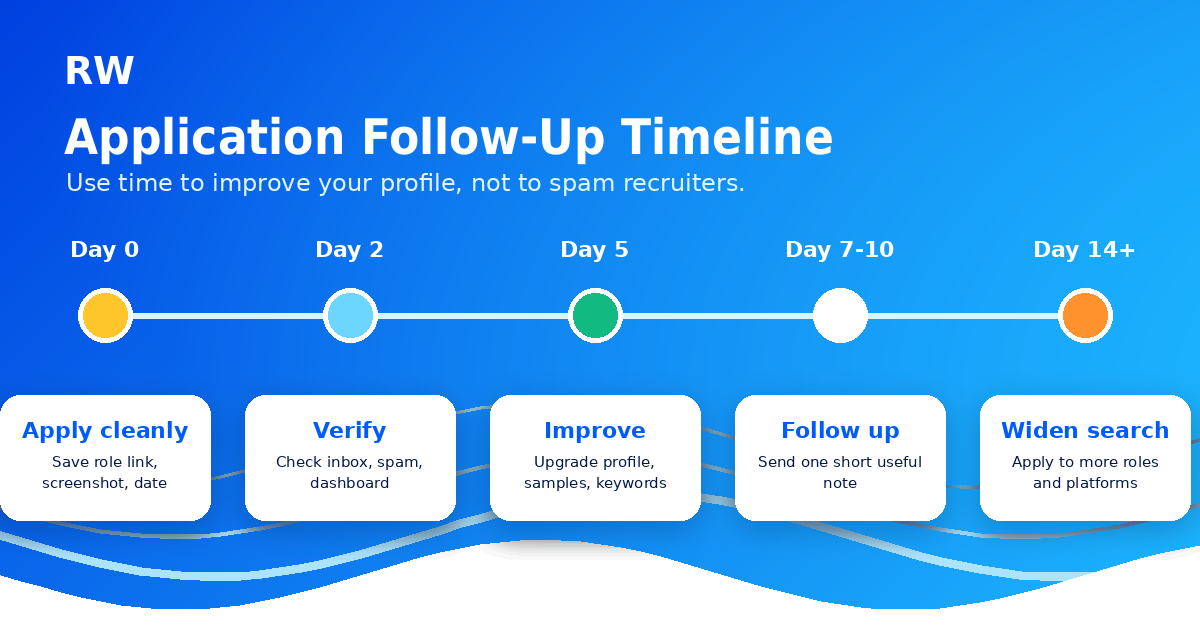
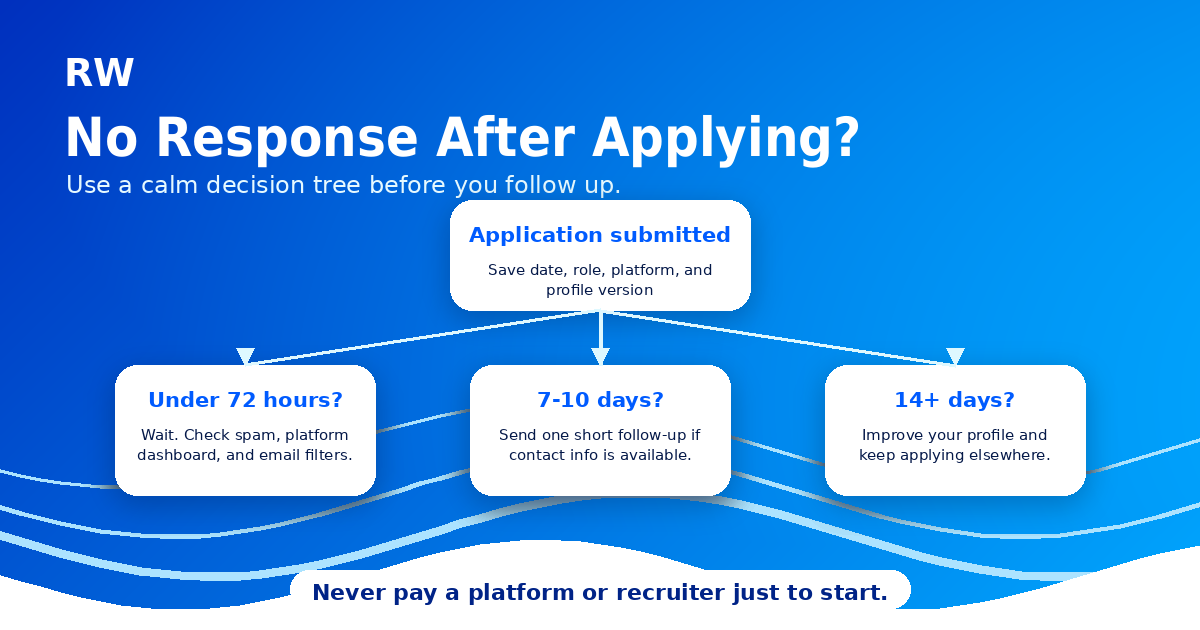
Use this simple timeline:
Day 0: Apply carefully. Save the role title, platform name, email used, resume version, profile link, and application date.
Day 2: Check your inbox, spam folder, platform dashboard, and any assessment links. Make sure you did not miss an email verification request or AI interview invitation.
Day 5: Improve your profile. Add clearer skills, update your resume, add writing samples or work samples if the platform allows it, and make your strongest remote work keywords visible.
Day 7 to Day 10: Send one professional follow-up if there is a reasonable contact channel. If there is no contact channel, do not force it. Improve your profile and keep applying.
Day 14 and beyond: Move from waiting mode to pipeline mode. Apply to additional roles on multiple platforms, continue checking your dashboard, and keep your profile updated.
What to Do Before You Send a Follow-Up
Before you write anything, make sure the issue is not on your side. Many remote work applicants miss simple steps because they apply quickly and then forget to check the places where platforms actually communicate.
First, confirm that you used the right email address. If you have multiple emails, search all of them for Handshake AI, Mercor, micro1, assessment, interview, verification, AI training, onboarding, or project invite. Second, check spam, promotions, updates, and filtered folders. Third, log in to the platform dashboard if one exists. Some platforms show status updates or tasks inside the account before they send a clear email. Fourth, make sure your profile is complete. A half-empty profile can make you look unavailable or unqualified even if your resume is strong.
Then review your original application. Did it clearly say what you are good at? Did it include your strongest skills? Did it show your work from home availability? Did it explain why you are useful for AI model evaluation, prompt writing, annotation, research, or expert review? If the answer is no, your follow-up should mention that you have updated your profile or attached a stronger resume.
How to Follow Up With Handshake AI
For Handshake AI, focus your follow-up on clarity and availability. If you applied through a role listing, reference the role title and the date you applied. If you completed an assessment or interview, mention that as context. Then make your strongest fit obvious in one or two sentences.
A good Handshake AI follow-up might say that you are still interested in remote AI training or AI evaluation work, that your background is strongest in writing, research, customer support, marketing, coding, finance, legal analysis, operations, or another relevant area, and that you are available for assessments, sample tasks, or onboarding.
Do not send a long autobiography. Do not send multiple messages in a row. Do not ask, "Did I get rejected?" Ask a cleaner question: whether there is anything else needed to complete your application or improve matching for relevant projects.
The practical move is to update your resume and profile before you follow up. That lets your message say something useful: "I also updated my profile to better reflect my experience with research, writing, and evaluating AI responses." That is stronger than simply asking for a status update.
How to Follow Up With Mercor
For Mercor, follow-up should emphasize your expertise and the types of remote work you are qualified to perform. Mercor-style opportunities may involve matching candidates to AI training, expert review, technical tasks, writing, research, business analysis, language work, or other skill-specific projects. The stronger your skill signal, the easier it is for a platform to understand where you belong.
Before following up, make sure your profile does not read like a generic resume. "Hard worker" is weak. "Finance graduate with experience evaluating business writing, checking factual accuracy, and writing clear explanations" is stronger. "Writer with experience editing long-form content, comparing answers, and identifying errors in reasoning" is stronger. "Operations manager with experience building processes, documenting workflows, and reviewing outputs for quality" is stronger.
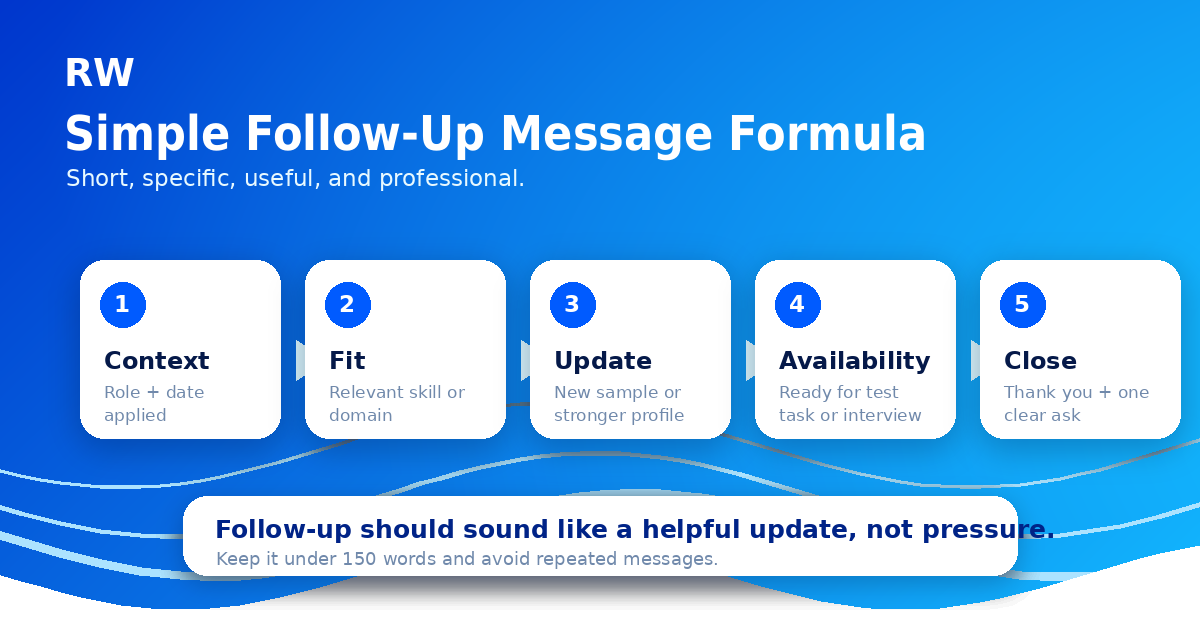
Your follow-up should be short: mention when you applied, what type of work you are most qualified for, and that you are available for new AI training or remote reviewer projects. If you have added a better resume, portfolio, GitHub, writing sample, LinkedIn profile, or work sample, mention that update.
Do not try to game the system by applying with inconsistent information. Platforms that match people to AI projects often care about reliability. Keep your profile truthful, specific, and consistent.
How to Follow Up With micro1
For micro1, your follow-up should respect the application process. If you completed a resume submission, AI interview, assessment, or profile step, reference that specific step. If you have not heard back, the best next move is usually to check your dashboard, confirm your email, improve your resume, and send one concise follow-up only if there is a proper channel.
micro1 applicants should avoid sounding impatient. A better tone is: "I wanted to confirm my application is complete and share that I am still available for remote AI evaluation, prompt writing, or reviewer work." That gives the platform context without demanding an immediate answer.
If you are new to AI work, emphasize transferable skills. Many people qualify for entry-level or generalist AI training tasks because they can write clearly, follow instructions, compare two answers, spot mistakes, research facts, explain reasoning, or review content carefully. You do not always need to be a coder. But you do need to show evidence that you can think clearly and produce reliable work.
Stop waiting and start building a stronger pipeline. Find remote AI roles that match your background and are actively hiring now.
Find Roles Hiring Now →Follow-Up Email Template You Can Use
Subject: Follow-up on [role or platform] application
Hi [Name or Team],
I applied for [role/project type] on [date] and wanted to confirm that my application is complete. I am still interested in remote AI training, AI evaluation, and reviewer work, especially projects involving [your strongest skills: writing, research, coding, legal analysis, finance, customer support, operations, bilingual review, etc.].
I also updated my profile/resume to better reflect my experience with [specific skill or domain]. Please let me know if there is anything else I should complete for consideration.
Thank you,
[Your Name]
This works because it is specific, low-pressure, and useful. It tells the platform what changed and what kind of work you can do.
What Not to Say When You Follow Up
A bad follow-up can make you look less professional. Avoid messages that sound angry, desperate, entitled, or vague.
Do not write: "Why have you not responded?" Do not write: "I need this job immediately." Do not write: "I applied yesterday and still have not heard back." Do not write: "Can you just approve me?" Do not write: "I will work for anything."
Those messages create pressure without adding useful information. A better follow-up gives the reviewer a reason to look again. It says what you applied for, what you are qualified to do, what you updated, and that you are available.
Also avoid over-following-up. One good follow-up is enough. If you send three or four messages, you are not increasing your odds in a meaningful way. You are just spending attention that should be going into more applications, better samples, and stronger profiles.
What to Update While You Wait
Waiting passively is the worst strategy. While you wait for Handshake AI, Mercor, micro1, or any remote AI platform to respond, improve the assets that affect matching.
Update your resume headline so it matches the work you want. Instead of "Looking for remote work," use something more specific like "AI Content Reviewer | Research and Writing" or "Remote AI Evaluator | Customer Support and Operations Background."
Add skill keywords naturally. Useful keywords may include AI training, AI model evaluation, prompt writing, prompt evaluation, data annotation, content review, fact-checking, research, search quality, response ranking, rubric scoring, writing evaluation, editing, technical writing, customer support, operations, finance, legal research, coding, Python, SQL, spreadsheets, bilingual review, localization, and quality assurance.
Create a small portfolio if you can. This does not need to be complicated. A writing sample, analysis sample, research sample, coding sample, edited document, spreadsheet example, or short case study can help show the kind of work you do. For remote AI jobs, proof of clear thinking is often more useful than a flashy design.
Build a Multi-Platform Pipeline Instead of Waiting on One Company
The biggest mistake beginners make is depending on one application. You should not apply to Handshake AI, wait two weeks, then apply to Mercor, wait two weeks, then apply to micro1. That stretches a normal job search into months.
A better strategy is to build a pipeline. Apply to several legitimate remote work platforms, track every application, improve your profile weekly, and keep your best skills consistent across your materials. This gives you more chances to get matched when AI companies, research labs, model evaluation vendors, and data platforms need workers.
Remote AI work can connect to the broader AI ecosystem, including companies and projects associated with OpenAI, Anthropic, Google, Meta, Grok, and other major AI organizations. But you should still treat each application professionally. The platforms that connect workers to projects need people who can follow instructions, protect confidentiality, meet deadlines, and produce accurate work from home.
How to Track Your Applications
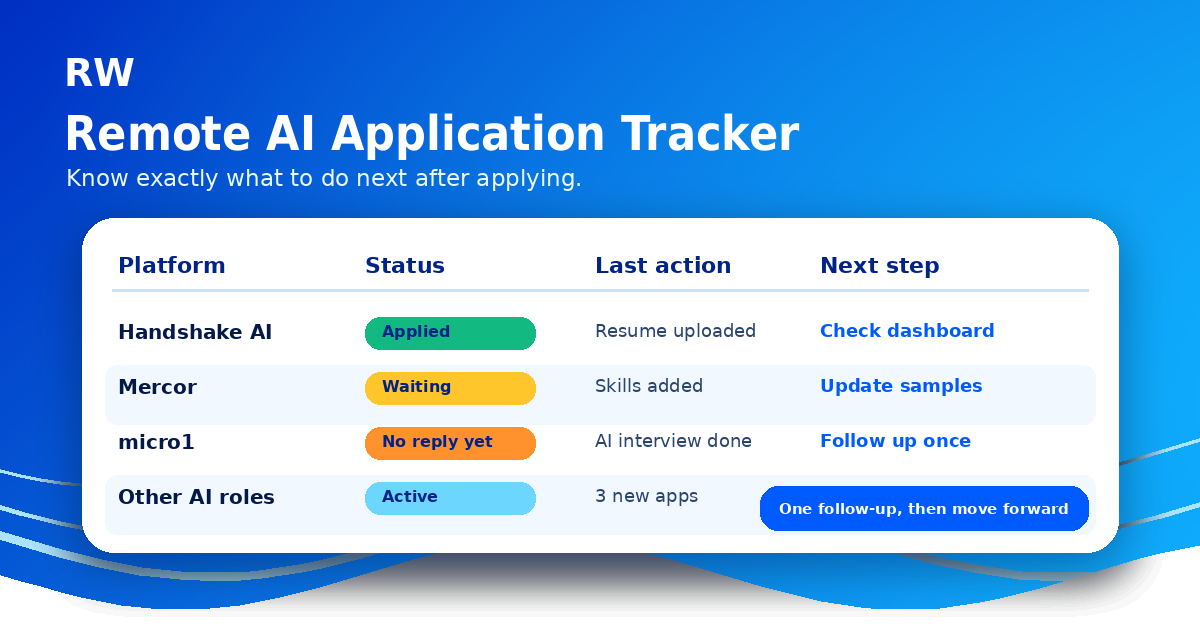
Use a simple tracker. A spreadsheet is enough. Include these columns: platform, role title, email used, date applied, status, assessment completed, last action, next action, resume version, strongest skill keywords, and notes.
Your tracker should answer one question: what is the next useful action? If the next action is "wait," write the date when you will check again. If the next action is "update profile," list exactly what you need to improve. If the next action is "send follow-up," prepare one concise message. If the next action is "apply elsewhere," add more platforms and roles to the list.
This turns remote work searching into a system. You stop guessing. You stop checking your email every ten minutes. You know which applications are fresh, which ones need a follow-up, and which ones should be treated as inactive.
If You Get No Response at All
No response is common in remote work. It does not always mean you are unqualified. It can mean the role paused, the project filled, the platform has too many applicants, your profile did not match a current project, or your application did not contain enough detail.
If you get no response after two weeks, do three things. First, improve your profile and resume. Second, apply to more roles that fit your actual skills. Third, keep checking for new tasks or project openings without relying on one platform.
Do not pay anyone who promises guaranteed acceptance. Legitimate remote work platforms do not need you to pay a fee just to start applying. Be careful with fake recruiters, copied job posts, upfront training fees, crypto payment requests, and messages that push you off-platform too quickly. Real remote work should pay you for work, not charge you for hope.
A Better Mindset for Remote AI Work
Remote AI work rewards patience, accuracy, and consistency. The person who wins is not always the person who sends the most messages. It is usually the person who keeps applying, keeps improving, follows instructions, and presents a clear fit for the work.
Your follow-up should be part of a bigger system: apply, track, verify, improve, follow up once, and keep moving. That system works whether you are applying for AI training, prompt writing, model evaluation, data annotation, expert review, content editing, research, operations support, or other work from home jobs.
Handshake AI, Mercor, and micro1 are only part of the remote AI job market. Treat them as important opportunities, not your entire plan. Keep your profile sharp, keep your application tracker current, and keep building a pipeline.
Final Takeaway
The best follow-up after applying to Handshake AI, Mercor, or micro1 is short, specific, and useful. Wait a reasonable amount of time, check your dashboard and inbox first, update your profile, then send one professional message if there is a proper channel. After that, move forward. Apply to more roles, improve your materials, and keep your remote work pipeline active.
Frequently Asked Questions
How long should I wait before following up after applying to Handshake AI, Mercor, or micro1?
Wait at least five to seven business days before sending a follow-up. Before reaching out, check your spam folder, platform dashboard, and any assessment links to make sure you have not missed a communication step. Use the waiting period to update your profile and add work samples.
What should I say in a follow-up message after applying for a remote AI job?
Keep your follow-up short and specific. Mention when you applied, what type of AI work you are qualified for, and whether you have updated your resume or profile. Avoid demanding a decision or sounding impatient. One professional message is enough.
What does it mean if I get no response from Handshake AI, Mercor, or micro1?
No response often means the role paused, the project filled, the platform had too many applicants, or your profile did not contain enough detail to match a current project. It is not always a final rejection. Improve your profile, apply to more roles, and continue checking your dashboard.
How many times should I follow up after applying for an AI training job?
Once. One professional follow-up is enough. Sending three or four messages does not increase your chances in a meaningful way. Spend the extra effort on improving your profile, adding work samples, and building a wider pipeline of remote work applications.