Getting accepted by micro1 is not about writing the most dramatic resume or pretending to be an AI engineer. The strongest applicants make one thing very clear: what they know, what they can evaluate, and why their judgment is useful for AI training work.
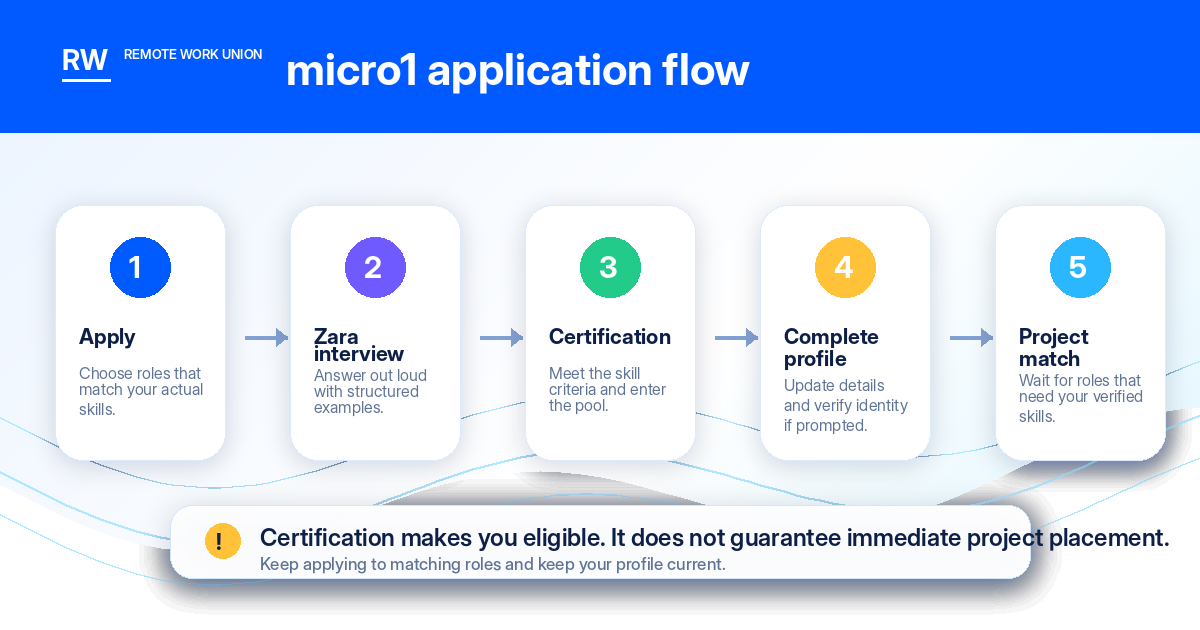
micro1 is one of the better-known platforms connecting domain experts with remote AI projects. Its opportunities can include AI training, model evaluation, data annotation, writing, research, coding, legal reasoning, finance, healthcare, language work, and other expert review tasks. For applicants, the process usually comes down to three core pieces: choosing the right role, completing a strong profile, and performing well in the AI interview process.
This guide explains how to improve your odds without overcomplicating the process. No one can guarantee acceptance, certification, or a project match. But you can make your application easier to understand, easier to evaluate, and more aligned with the work micro1 is actually hiring for.
What micro1 Looks For in Remote AI Workers
The best way to think about micro1 is this: AI companies need human judgment. Models can generate answers, but people still need to review outputs, catch mistakes, compare responses, evaluate reasoning, write examples, judge quality, and apply subject-matter knowledge. That is why platforms in this space recruit people with different backgrounds, not only software engineers.
A strong applicant usually has at least one of these signals:
- A clear professional field, such as writing, law, finance, healthcare, education, engineering, customer support, operations, marketing, design, or research.
- Strong communication skills, especially the ability to explain decisions clearly.
- Experience reviewing, editing, analyzing, fact-checking, grading, comparing, or improving work.
- Comfort working independently online.
- Evidence that they can follow instructions and produce consistent output.
Start by Choosing the Right micro1 Role
A common mistake is applying to every remote AI job because the work is online and flexible. That usually weakens your application. micro1 roles often have specific skill requirements. Some may require coding, some may require legal reasoning, some may require finance knowledge, some may require strong writing, and some may require multilingual ability.
Before applying, read the opportunity description carefully and ask three questions:
- Do I have real experience in this subject?
- Can I give examples of work that prove it?
- Can I explain my reasoning out loud if asked in an interview?
If the answer is yes, that role is worth applying for. If the answer is no, look for a better fit. A beginner with a clear fit is stronger than a general applicant who applies to everything.
For example, a customer success professional might be a better fit for tasks involving support conversations, user intent, escalation judgment, CRM workflows, or communication quality. A paralegal might be better for legal reasoning and document review. A copywriter might be better for response quality, tone, factuality, and editing. A finance analyst might be better for spreadsheet reasoning, investment concepts, business analysis, or accounting tasks.
Build a Profile That Makes Your Expertise Obvious
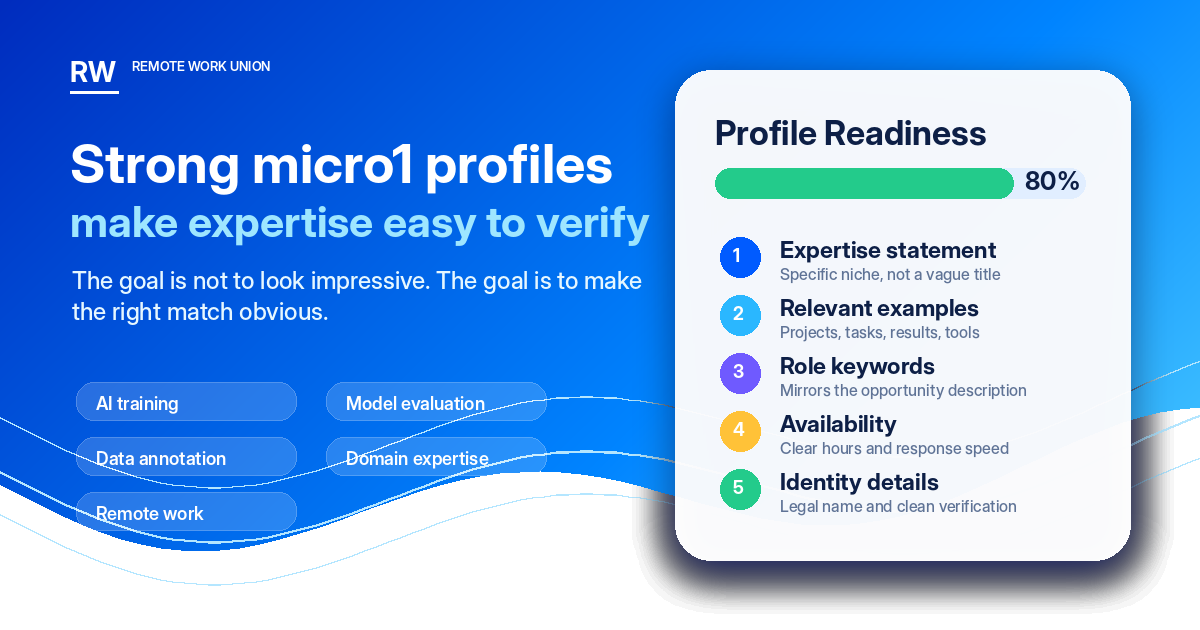
Your micro1 profile should not read like a generic job board profile. It should help a reviewer or matching system understand exactly where you belong.
A weak profile says: I am hardworking, detail-oriented, and interested in AI.
A stronger profile says: I have three years of customer success experience reviewing support tickets, identifying user intent, writing clear replies, documenting bugs, and escalating complex account issues. I can evaluate chatbot answers for accuracy, helpfulness, tone, and policy compliance.
The difference is specificity. micro1 and similar platforms need to match workers to projects. Your profile should make that match easy. Include these elements where possible:
- Your domain: the field or subject where you have real knowledge.
- Your task experience: writing, reviewing, researching, coding, editing, analyzing, teaching, troubleshooting, auditing, or explaining.
- Your tools: spreadsheets, CRMs, CMS platforms, SQL, Python, legal databases, design tools, medical terminology, accounting software, research databases, or AI tools.
- Your outputs: reports, briefs, tickets, articles, lesson plans, datasets, QA notes, audits, summaries, evaluations, or client deliverables.
- Your judgment: how you decide whether work is correct, helpful, safe, complete, or high quality.
Remember: Remote AI work rewards judgment, so your profile should show judgment. This is where many applicants underperform. They list job titles but do not explain the actual judgment they used on the job.
Use the Right Keywords Without Keyword Stuffing
Keywords matter because platforms need to understand what kind of work you match. But keyword stuffing makes a profile feel fake. Use terms that actually describe your experience.
Useful keywords for micro1 and remote AI work include: AI training, AI model evaluation, data annotation, response rating, fact-checking, content quality, prompt evaluation, research, editing, writing, reasoning, domain expertise, legal analysis, financial analysis, medical review, coding review, language evaluation, customer support quality, user intent, and policy compliance.
The best use of keywords is inside real sentences. For example: I have experience fact-checking long-form articles, comparing source claims, and editing AI-generated drafts for accuracy, tone, and completeness.
That sentence is stronger than a random keyword list because it explains what you can actually do. It also connects directly to work that matters across AI labs and AI products from companies like OpenAI, Anthropic, Google, Meta, Grok, and other major model builders.
Prepare for the Zara AI Interview
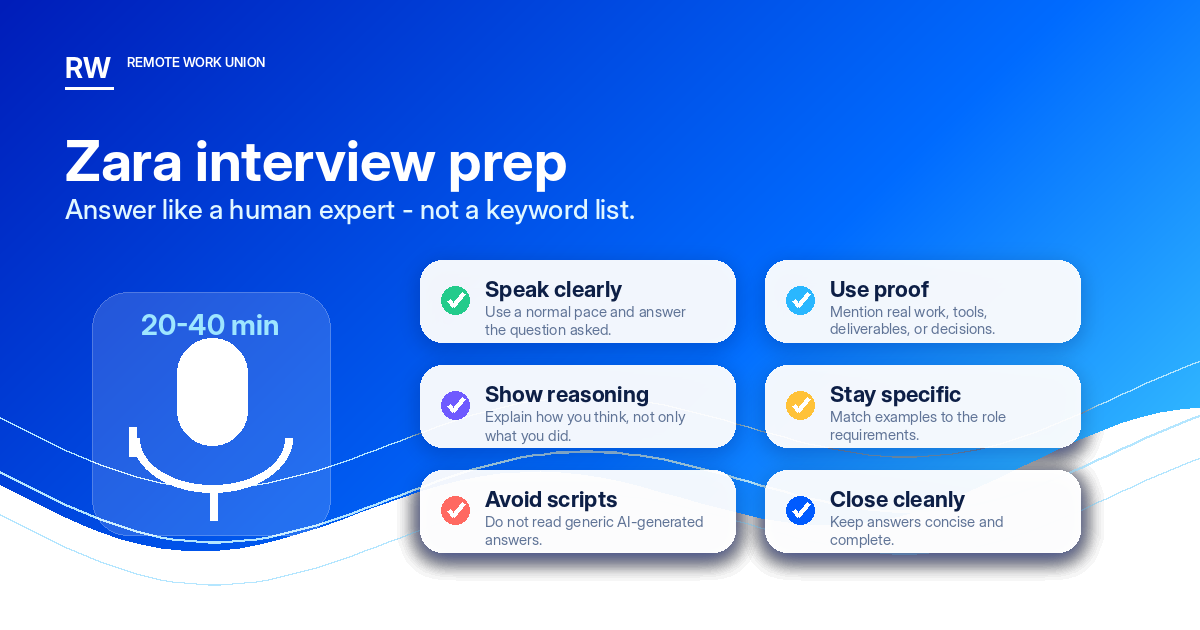
micro1 uses Zara, an AI recruiter, to conduct interviews for candidates applying to roles. The interview is not just a resume screen. It is designed to let candidates demonstrate how they think, communicate, and solve problems in their field.
That means you should prepare differently than you would for a normal written application. You need to be ready to answer out loud. You should not sound like you are reading a script. You should sound like a person who knows the work.
Before the interview, prepare five examples from your background:
- A time you reviewed or improved someone else's work.
- A time you caught a mistake that mattered.
- A time you explained a complex idea clearly.
- A time you made a judgment call with incomplete information.
- A time you followed detailed instructions or quality standards.
For each example, know the situation, the action you took, and the result. Keep the answer concise. A good answer usually explains what happened, what you considered, what you did, and why it worked.
How to Answer micro1 Interview Questions
When Zara asks an open-ended question, answer with structure. The easiest structure is:
- Context: what was the task or problem?
- Decision: what did you need to judge?
- Action: what did you do?
- Reasoning: why did you do it that way?
- Result: what improved or what was resolved?
For example, instead of saying "I am detail-oriented and good at editing," say: In my content role, I reviewed articles before publication. I checked whether each claim matched the source, whether the headline matched the body, and whether the tone fit the audience. When I found unsupported claims, I either removed them or added a stronger source. That process made the final article more accurate and easier to trust.
That answer shows concrete judgment. It also maps naturally to AI training tasks like response evaluation, factuality review, and content quality assessment.
If you are applying for a finance role, use finance examples. If you are applying for a legal role, use legal examples. The role should shape the answer.
Do Not Pretend to Be More Technical Than You Are
One of the biggest mistakes applicants make is pretending they are technical because the job involves AI. Many AI training roles do not require coding. Some do, and those roles should go to people who can actually code. But many remote AI jobs need writers, researchers, teachers, analysts, lawyers, linguists, editors, accountants, support professionals, and other non-technical experts.
If you do not code, do not claim coding experience. Instead, position yourself around the work you can actually do. You might be able to evaluate writing quality, judge whether a chatbot answer is helpful, test a support workflow, review policy compliance, compare two AI responses, or write examples in your domain.
Honesty is an advantage. A clear non-technical expert profile is better than a vague technical profile that falls apart during the interview.
Complete Your Profile After Certification
Getting certified or passing a skill screen does not always mean immediate work. Your profile may remain active while micro1 matches certified experts to project needs. This is normal on remote AI platforms because project availability changes, client requirements change, and different tasks need different skills.
If you are prompted to complete your profile, do it carefully. Use your legal name consistently, keep your resume current, add relevant experience, and update your availability. If identity verification is required, make sure the document is valid, visible, and matches the name on your application.
After you are certified, do not assume the process is over. Keep applying to roles that match your skills. Add certifications or verified skills when available. Treat your profile like a living remote work profile, not a one-time form.
What to Do If You Are Not Accepted Right Away
Not getting accepted immediately does not always mean you are permanently rejected. It can mean the role was competitive, the project did not need your exact background, your profile was unclear, or your interview did not demonstrate the required skill strongly enough.
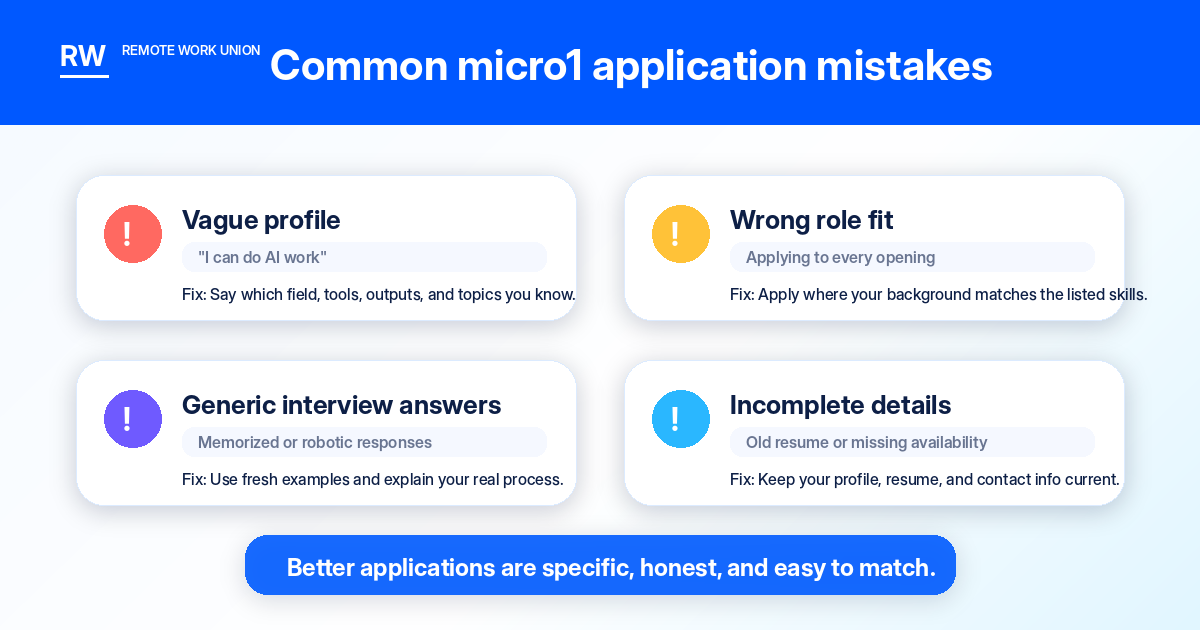
Review your application with these questions:
- Did I apply to the right role?
- Was my profile specific enough about what I can do?
- Did my interview answer show real judgment or just general claims?
- Is my profile complete, up to date, and easy to match?
If you want to try again, update your profile before reapplying. Add stronger descriptions of your experience. Replace generic claims with specific skill signals. Then apply to additional roles that match your real background. Also consider applying to other remote AI platforms such as Mercor, Handshake AI, Outlier, and similar platforms so you are not waiting on one decision.
Apply to AI training jobs and expert review work across multiple platforms.
Find Roles Hiring Now →Frequently Asked Questions
What does micro1 look for in remote AI workers?
micro1 looks for people with a clear professional field, strong communication skills, experience reviewing or improving work, comfort working independently online, and evidence they can follow instructions and produce consistent output. The key is showing judgment, not just claiming availability.
What is the Zara AI interview on micro1?
Zara is micro1's AI recruiter that conducts interviews for candidates applying to roles. It is designed to let candidates demonstrate how they think, communicate, and solve problems in their field. You should speak clearly, use real examples, show your reasoning, stay specific, avoid scripts, and close answers cleanly. The interview runs approximately 20–40 minutes.
How should I build my micro1 profile to get accepted?
Your profile should make your expertise easy to understand. Include your domain (the field where you have real knowledge), your task experience, your tools, your outputs, and your judgment approach. Avoid vague claims and use specific, truthful language. The goal is to make a matching system see exactly where you belong.
What should I do if I am not accepted by micro1 right away?
Review whether you applied to the right role, whether your profile was specific, and whether your interview demonstrated real judgment. Update your profile with stronger skill signals. Apply to roles that better match your actual background. Also apply to other remote AI platforms — Mercor, Handshake AI, and Outlier — so you are not waiting on one decision.
Do I need coding experience to get accepted by micro1?
Not for many roles. Some projects require coding, and those should go to people who can actually code. But many micro1 opportunities use writing, research, editing, language, business, legal, finance, customer support, or general reasoning skills. Honesty about your actual skills is an advantage, not a weakness.