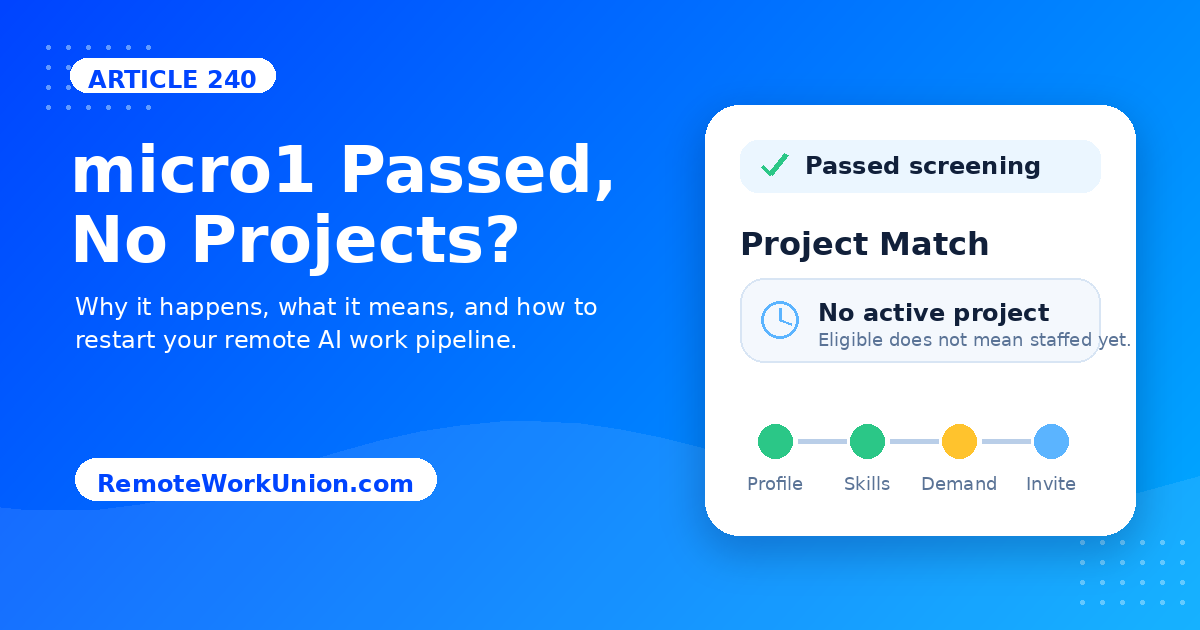
Passing micro1 can feel like the hard part is over. You completed the application, handled the interview or assessment, and reached the point where your profile appears approved, certified, or eligible. Then nothing happens. No active projects. No task queue. No invite email. No clear timeline.
That can be frustrating, but it does not always mean you failed. On remote AI work platforms, passing a screening step is often different from being staffed on a paid project. The platform may have confirmed that you are eligible for certain AI training jobs, but actual project access still depends on client demand, project requirements, your verified skills, your location, your availability, and the timing of open work.
Passing Is Not the Same as Being Staffed
A common mistake is assuming that passing micro1 means you have been hired into a specific job. In many cases, that is not how AI training platforms work. Remote AI training work is often project-based. A company or AI lab may need people to evaluate model answers, compare responses, write prompts, judge factual accuracy, review code, rate reasoning, annotate data, or provide expert feedback in a specialized field. The platform then matches qualified workers to those projects.
That creates two separate steps. First, qualification: you pass an assessment, interview, certification, or screening process. Second, placement: you are invited to an active project that matches your skills and the client's current needs. The first step can happen before the second step exists. You can be qualified and still have no current projects.
That is why an empty micro1 dashboard is not always a rejection. It may mean you are in a talent pool, waiting for a project that fits your profile.
Why micro1 May Show No Projects After You Pass
There are several normal reasons this happens. Some are outside your control, but others can be improved.
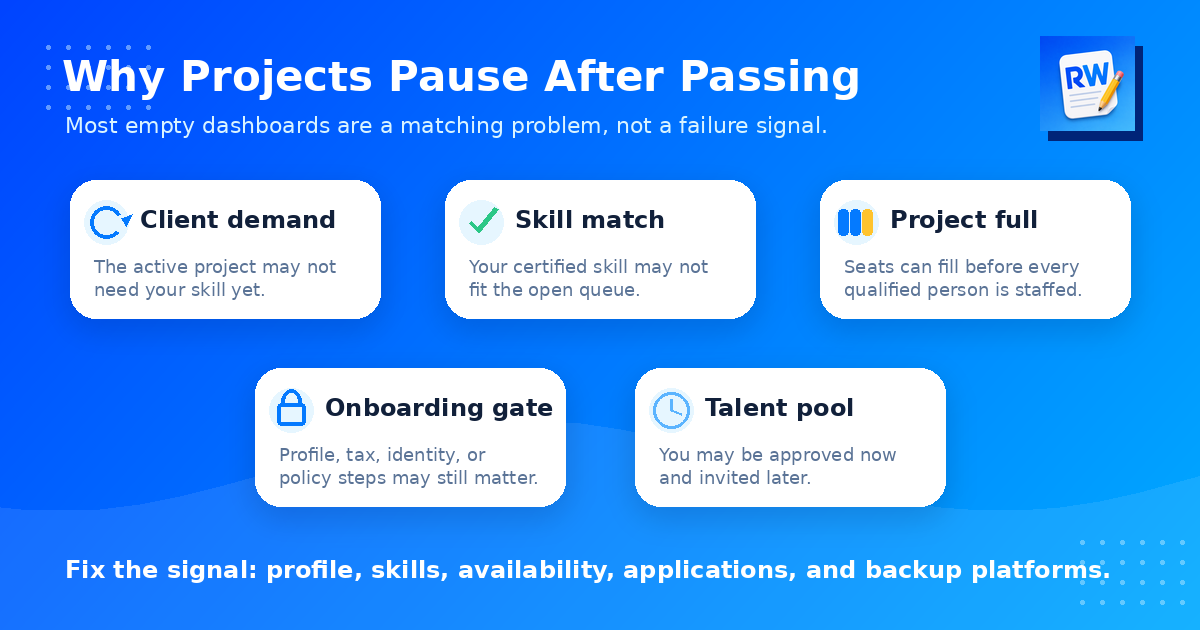
The active projects do not match your verified skills. AI training jobs are not all the same. One project may need legal reviewers. Another may need finance experts. Another may need bilingual speakers. Another may need software engineers. Another may need strong general writers. If you passed a general screening but the available work needs a different background, you may not see projects yet.
The project filled before you were assigned. Project seats can fill quickly. A platform may approve hundreds of people for a category while only a smaller number are needed for a specific batch. This does not mean the approval was fake — it means project staffing is dynamic.
The client paused or changed the project. AI data projects change fast. A client may pause a batch, shift the task instructions, reduce budget, or decide they need a different skill mix. When that happens, qualified workers can be left waiting even after passing.
You passed one step but still need another step. Some platforms have multiple gates. You may pass an interview but still need to complete identity verification, tax forms, payment setup, policy training, confidentiality agreements, or a project-specific assessment. Look carefully for status labels, onboarding tasks, unread emails, dashboard notifications, or missing profile sections.
Check your email carefully: Search your inbox, spam, promotions, and trash for terms like micro1, project, onboarding, next steps, assessment, dashboard, verification, payment, and contract. A missed email can cost you a project invite — remote AI work often moves quickly and delayed responses can matter.
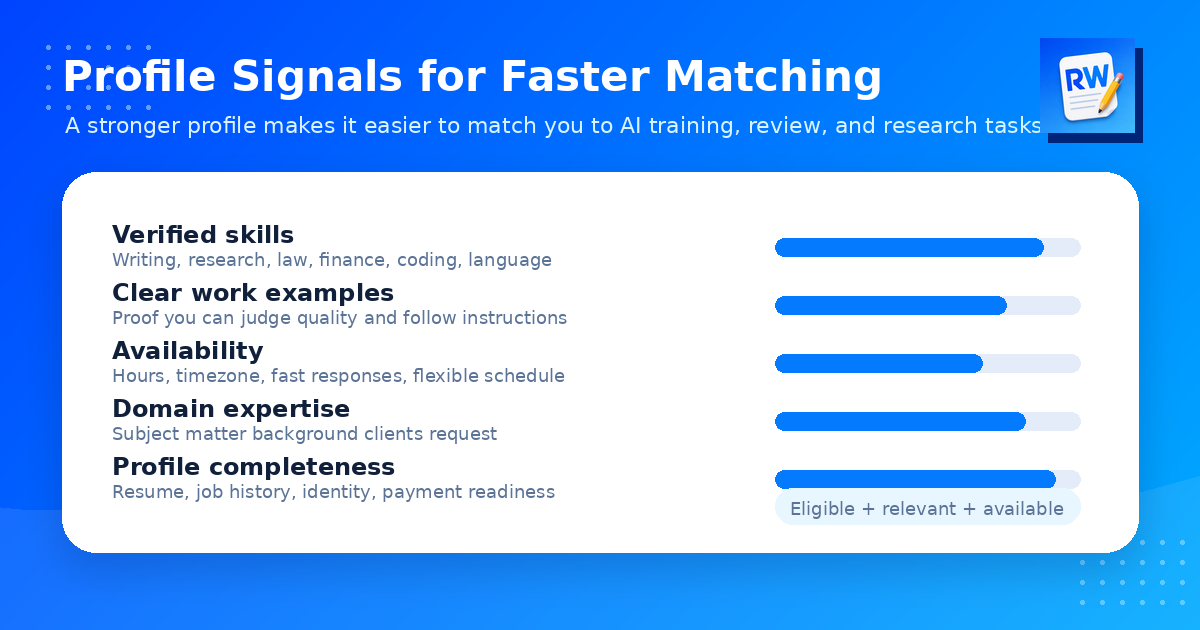
Your profile does not give enough matching signal. A thin profile can make matching harder. If your profile only says "writer" or "analyst," the platform has less information to connect you with specific work. Better profiles include specific skills, work examples, availability, domain expertise, and remote work readiness.
The platform is prioritizing certain regions, languages, or schedules. Some remote AI jobs are worldwide. Others are limited by country, tax setup, client requirements, language, or time zone. You may pass the general process but not match the location or language requirements of the active work.
What to Do in the First 24 Hours
If you passed micro1 but have no projects, do not panic and do not create duplicate accounts. Start with a basic audit. Check your dashboard carefully for status labels. Click into every relevant role or application — sometimes the next step is hidden inside an application page. Search your email thoroughly. Confirm that your profile is fully complete with accurate skills, location, languages, availability, and payment details.
If there is an opportunities page or jobs portal, apply to roles that fit your background. Use each application to send stronger signals about your exact skill set. If enough time has passed and your status is unclear, send one short, professional follow-up. Daily messages usually do not help and can make you look disorganized.
A 7-Day Plan If You Still Have No Projects
An empty dashboard should trigger action, not panic. Use the next week to improve your odds.
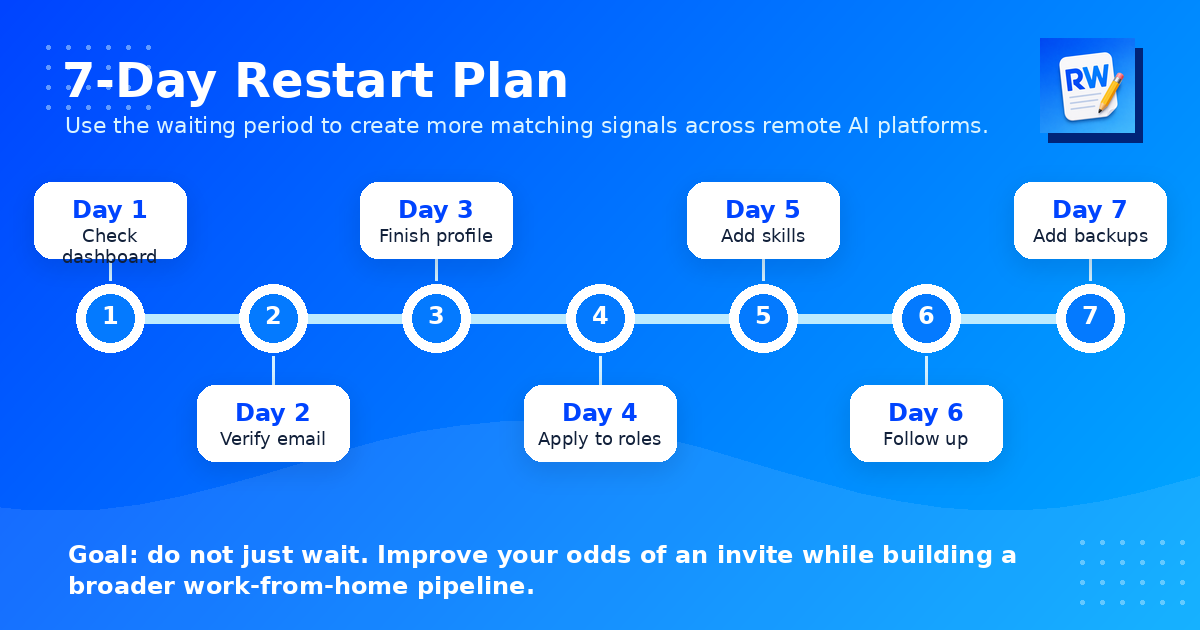
Day 1: Document your exact dashboard status, application status, date you passed, and any emails received. This keeps you from guessing and makes follow-up easier.
Day 2: Clean up your profile. Replace generic claims with specific skill signals. Instead of "good writer," use "experienced in editing, factual research, response ranking, and clear written feedback." Instead of "business background," use "finance, sales, operations, or accounting experience," if accurate.
Day 3: Add or certify additional skills. If the platform allows additional role applications, complete the ones that genuinely match your background. More verified skills can increase the number of projects you are eligible for.
Day 4: Apply to specific opportunities. Search for open roles that fit your real experience — writing, legal, finance, research, bilingual, coding, operations, or generalist tracks.
Day 5: Prepare a simple work sample bank — a research summary, editing sample, prompt-writing example, quality review, or explanation of how you evaluate a bad AI answer. Do not submit confidential work.
Day 6: Send one clear, professional follow-up if appropriate. Keep it simple: confirm your profile is complete, state you are available, and ask if any additional steps are needed.
Day 7: Apply to other remote AI platforms and work-from-home roles. Waiting on one dashboard is not a strategy.
Build your backup pipeline while you wait — find AI training and remote work roles hiring now.
See Roles Hiring Now →How to Improve Your Profile for Project Matching
Project matching is about relevance. Your profile should make it obvious what kind of work you can do. Use specific role language — platforms search for skills. Use accurate keywords: AI training, AI model evaluation, data annotation, response ranking, prompt writing, factual research, model safety review, content evaluation, legal analysis, finance analysis, coding review, English evaluation, bilingual evaluation, subject matter expert, remote reviewer.
AI companies such as OpenAI, Anthropic, Google, Meta, and xAI need human feedback because models still require evaluation. Human reviewers help determine whether an answer is accurate, safe, useful, well-written, and aligned with instructions. Your profile should show that you can compare two answers, notice subtle mistakes, follow a rubric, explain your reasoning, and stay consistent over many tasks.
If you have a background in law, accounting, medicine, education, engineering, finance, marketing, operations, research, writing, translation, or customer support, make that visible. Expert-tier AI training projects often pay more because they require judgment that a general applicant cannot provide. Keep your availability current — project invites may go to people who are not just qualified but ready.
What Not to Do When Projects Do Not Appear
Do not create duplicate accounts — this can create compliance issues and may get you removed from consideration. Do not fake credentials — AI training work depends on trust, and mismatches between your profile and your assessment performance can cost you access. Do not use AI to fake assessments that are meant to measure your own ability. Do not pay anyone for access — legitimate remote work platforms should not charge you to unlock jobs. Do not wait on one company — even if micro1 is legitimate and your profile is strong, project volume can still fluctuate.
Build a Broader Remote AI Work Pipeline
The smartest approach is to treat micro1 as one platform in a wider remote work system. Consider building profiles on multiple AI training and expert-work platforms, including options such as Mercor, Handshake AI, Outlier, and direct AI company job boards.
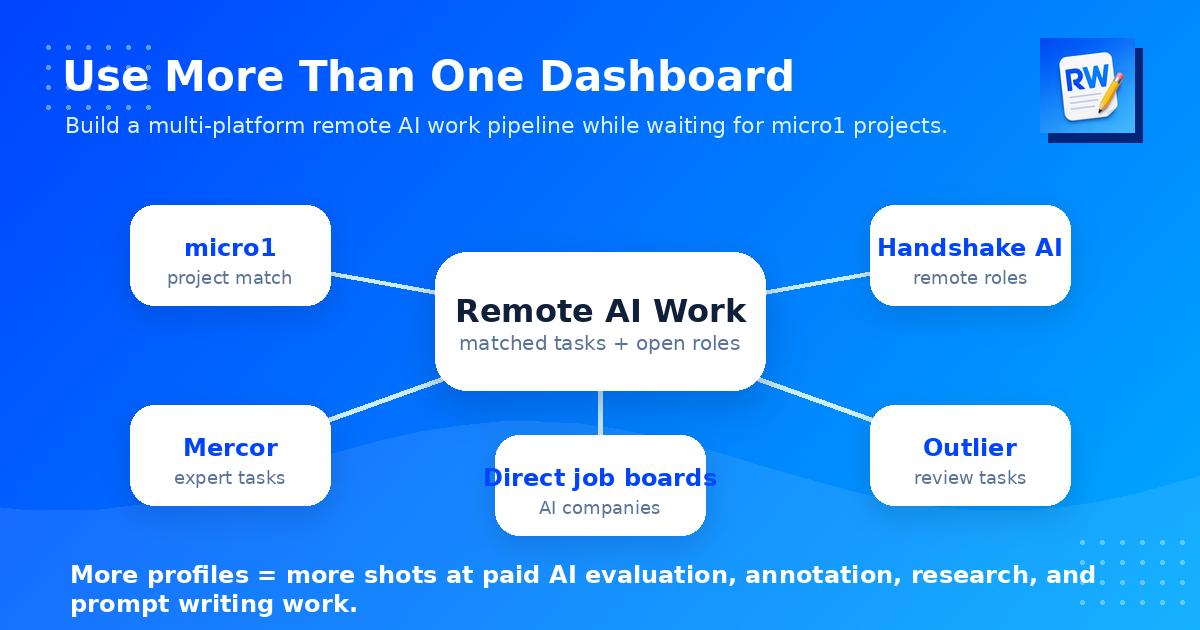
A broad pipeline gives you more chances to find AI model evaluation jobs, prompt writing jobs, response ranking tasks, data annotation work, AI research assistant roles, expert review projects, remote writing and editing work, bilingual evaluator roles, and legal, finance, coding, or domain-specific AI tasks.
Remote AI work can be inconsistent at the platform level but more stable at the pipeline level. Your goal is not to depend on one approval. Your goal is to keep enough qualified applications active that one pause does not stop your income.
How to Tell Whether the Delay Is Normal or a Problem
A delay is usually normal when: you recently passed, your dashboard says you are awaiting next steps or under review, there are no missing profile tasks, you have not received a rejection, you can still apply to other roles, and your profile appears active.
A delay may be a problem when: you missed an onboarding email, your identity, tax, or payment setup is incomplete, your email address is wrong, your dashboard has an error, you cannot access applications you previously submitted, or a role says you need to complete an interview or assessment and you have not done it.
If it is a technical or account issue, contact support with the exact problem. If it is simply no project availability, the better move is to strengthen your profile and apply more broadly.
Frequently Asked Questions
Does passing micro1 guarantee paid projects?
No. Passing usually means you are eligible or qualified for certain opportunities. It does not guarantee immediate placement. Project access depends on active client demand, project availability, and matching requirements for your skill set, location, and availability.
Does no projects after passing mean I was rejected?
Not necessarily. It can mean there is no current project that matches your profile, the project filled before you were assigned, the client paused the work, or you are waiting for the next open batch. Check your dashboard carefully for unfinished onboarding steps or missing profile sections before assuming rejection.
How long should I wait for micro1 projects after passing?
There is no universal timeline. Wait long enough to confirm there is no missing task or incomplete step, then keep applying to other platforms and roles. Do not stop your remote job search while waiting on any single platform.
Should I apply to other AI training platforms too?
Yes. Building a multi-platform pipeline is usually the smarter strategy. Platforms like Mercor, Handshake AI, and Outlier can provide AI training and model evaluation work when one platform is slow. Project availability changes constantly, and a broader pipeline gives you better odds of steady remote income.
Do I need coding experience for micro1 projects?
Not always. Some projects require coding, but many remote AI jobs use writing, research, editing, language, business, legal, finance, customer support, or general reasoning skills. The specific projects available depend on current client demand.
Should I apply to more micro1 roles?
Yes, if they match your real skills. Applying to relevant roles creates stronger matching signals. Avoid applying randomly to jobs that do not match your background — focus on roles where your experience or expertise is a genuine fit.