micro1 reviews are usually not simple. Some applicants describe the platform as one of the cleaner ways to apply for remote AI training work. Others say the process feels automated, confusing, or frustrating when they pass an interview and still do not see projects right away. Both reactions can be true at the same time.
That is the first thing remote workers should understand about micro1 in 2026: a review is usually a snapshot of one person's stage in the funnel. Someone who just completed the AI interview may review the interview experience. Someone who has been paid may review the work itself. Someone who applied and heard nothing may review the silence. Those are different experiences, even though they all get grouped under the same search term.
For people trying to find remote work jobs, work from home jobs, AI training jobs, data annotation jobs, AI model evaluation projects, prompt evaluation work, or flexible AI reviewer roles, micro1 is worth understanding. The platform sits in the same broad category as other AI training and expert marketplaces that help companies evaluate model outputs, create high-quality training data, review responses, test reasoning, and apply human judgment to AI systems.
Quick Verdict on micro1 Reviews
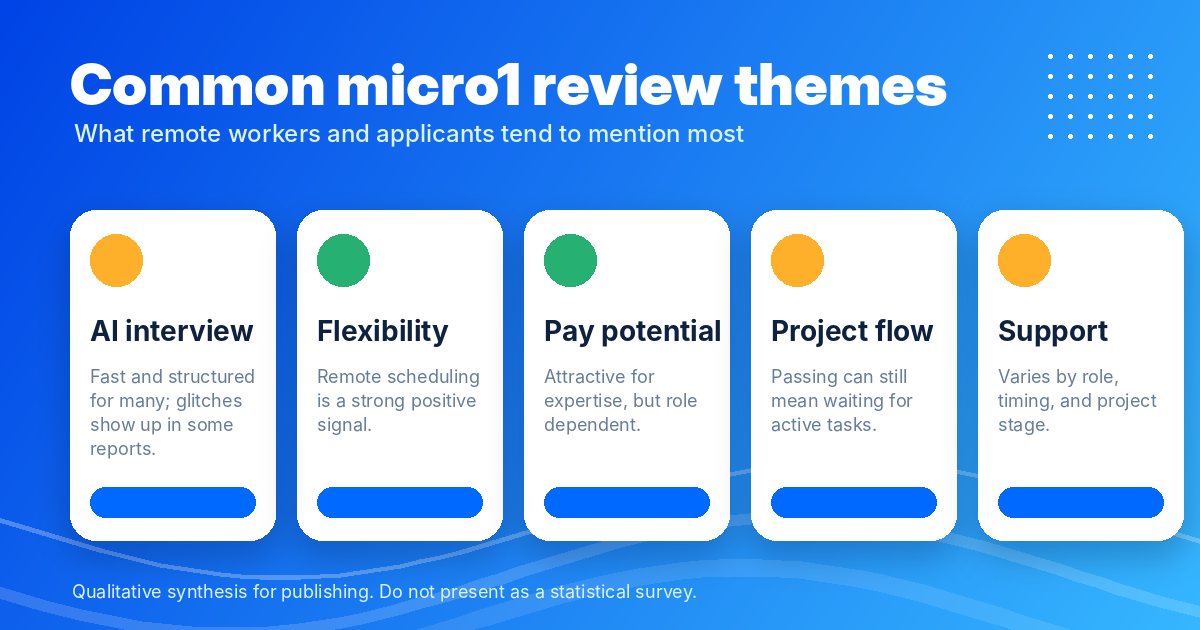
The fair summary is that micro1 appears to be a real AI training and expert-work platform, but it should not be treated like a guaranteed job offer. Reviews tend to be most positive around the smoothness of the AI interview, the flexibility of remote work, the chance to earn higher hourly rates for specialized expertise, and the feeling that the platform is more professional than low-quality gig apps.
The negative or cautious reviews usually focus on four issues: no response after applying, uncertainty after passing an interview, limited project availability, and the discomfort some applicants feel when an AI interviewer screens them before a human does. That does not automatically make the platform a scam. It does mean applicants should treat it like remote contract work, not like a normal full-time job with guaranteed hours.
What micro1 Is
micro1 is commonly discussed as a platform for remote AI training, expert review, and human data work. Depending on the role, applicants may be evaluated for tasks such as response rating, model evaluation, prompt writing, expert feedback, data annotation, content review, coding evaluation, writing assessment, research review, sales judgment, legal analysis, finance analysis, healthcare-adjacent reasoning, or other subject-matter tasks.
The exact work can vary. One person may be applying for a general AI training expert role. Another may be applying for a specialized writing, software engineering, sales, math, law, medicine, finance, or operations-related project. That is why micro1 reviews can sound inconsistent — the platform is not one job. It is a marketplace of possible projects, and each project can have its own screening, rate, workload, and timeline.
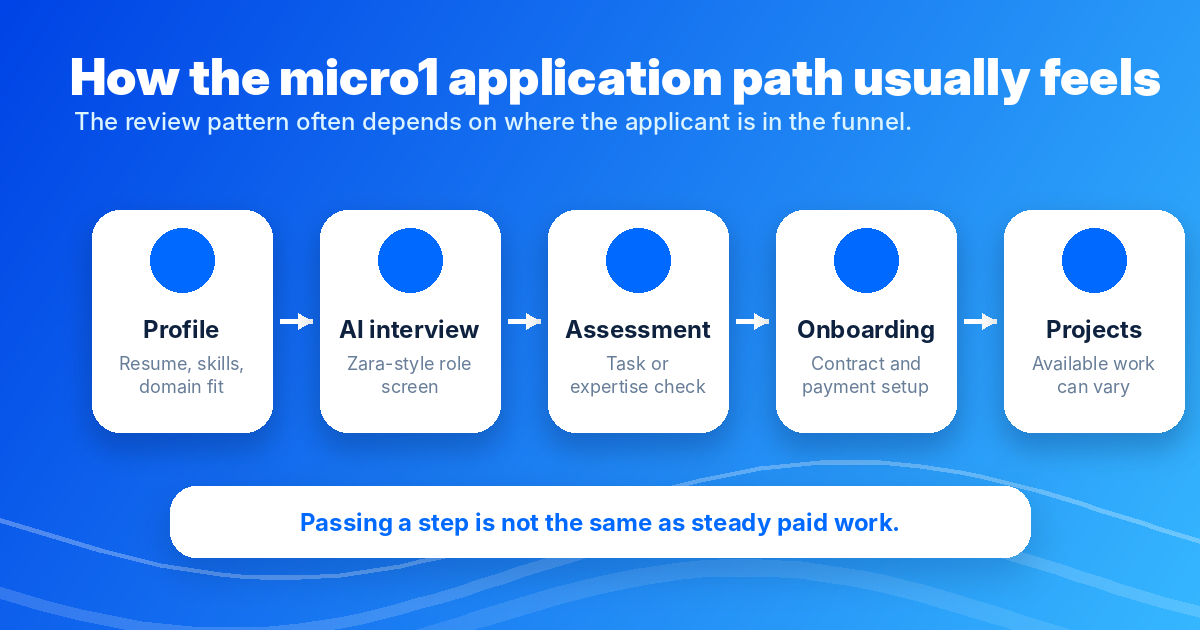
The most distinctive part of the application process is the AI interview. Many applicants mention Zara, micro1's AI interviewer or interview system. A typical applicant may create a profile, upload a resume, identify skills, complete an AI-led interview, answer domain questions, and then wait for next steps. Some roles may also include written assessments, work samples, additional checks, onboarding documents, or payment setup before paid work begins.
What Remote Workers Like About micro1
The most positive reviews generally cluster around flexibility. Applicants are attracted to micro1 because they are not looking for another commute, another office job, or another phone-based customer service role. They want remote work that pays for writing skill, reasoning, judgment, research ability, subject knowledge, or attention to detail. For that audience, micro1 feels more serious than surveys, rewards apps, or low-paid microtasks.
Workers also tend to like that some projects are expertise-based. AI training is not only coding. Companies need humans to evaluate whether a model's answer is accurate, helpful, safe, well-reasoned, clearly written, and aligned with the task. That can create opportunities for writers, editors, teachers, analysts, researchers, lawyers, accountants, sales professionals, marketers, operations managers, customer success professionals, and other people with strong real-world judgment.
Another positive theme is speed. A traditional remote job may require a resume screen, recruiter call, hiring manager call, assignment, panel interview, reference check, and a long wait. By comparison, an AI interview can feel efficient. Some applicants like that they can complete the process on their own schedule rather than waiting for a recruiter to book a call.
Finally, reviews often mention pay potential. Specialized AI training roles can advertise rates that are far higher than general gig work. The important word is potential. A high posted rate does not mean every applicant qualifies, every project has unlimited tasks, or every week will produce the same income. Still, for a remote worker with a strong niche, micro1 can be more attractive than generic online work.
What Remote Workers Complain About
The biggest complaint is uncertainty. Many applicants complete a profile or interview and then wait. Some do not receive a clear rejection. Some receive a positive signal but do not see projects. Some see projects briefly and then watch them pause. This is common in the remote AI work category, not only on micro1. AI training platforms depend on client demand, project budgets, model evaluation cycles, quality thresholds, and location restrictions.
The second complaint is the AI interview itself. Some people like it because it is fast and structured. Others find it impersonal. A few report technical issues, freezing, unclear questions, or discomfort being evaluated by an automated system. That reaction is understandable — AI hiring tools are still unusual for many applicants, especially people who are used to human recruiter calls.
The third complaint is that review sites can blur applicants and workers together. A five-star review from someone who liked the interview is not the same as a five-star review from someone who completed paid projects for three months. A one-star review from someone who never received a reply is not the same as a one-star review from someone who worked and had a payment dispute. When reading micro1 reviews, look at what stage the reviewer actually reached.
The fourth complaint is that contract work does not behave like employment. Remote AI jobs can be real and still unstable. A platform can be legitimate and still not provide benefits, guaranteed hours, paid time off, or predictable task flow. Many negative reviews come from people expecting a job. Many positive reviews come from people expecting a flexible contractor platform.
How to Read micro1 Reviews Correctly
The best way to read micro1 reviews is to sort them by stage. First, applicant reviews tell you about the signup flow, resume upload, AI interview, and communication speed. Second, onboarding reviews tell you whether the platform gave clear documents, payment setup, rate details, and next steps. Third, worker reviews tell you whether tasks appeared, instructions were clear, quality checks were fair, and payments arrived as expected.
A review that does not identify the stage is less useful. For example, a review saying "great process" may only mean the AI interview was smooth. A review saying "no work" may mean the person was accepted into a pool but not matched to an active project. A review saying "high pay" may refer to a specialized role, not a general applicant rate.
Also watch for timing. AI training platforms change quickly. Reviews from 2024, 2025, and 2026 can all be useful, but the most useful reviews explain the role, skill area, location, rate type, and whether the person actually worked. The strongest review signals are specific: look for details like the role type, the interview topic, whether the applicant typed or spoke, what documents were required, how payment was handled, and how long it took to receive a response.
Is micro1 Legit?
Based on public information and the pattern of worker discussion, micro1 should be treated as a real company and a real platform in the AI training and expert-work space. That does not mean every job post, every recruiter message, or every third-party link using the name is safe. Scammers can copy the names of legitimate companies. Applicants should verify the domain, avoid paying fees, and use official application channels.
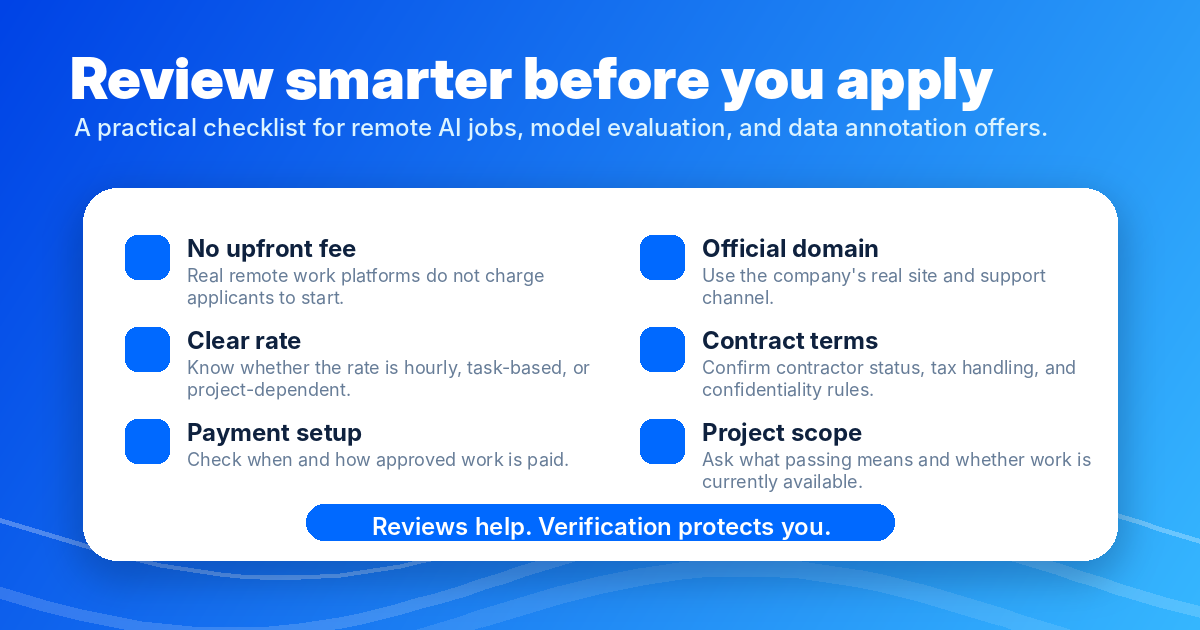
A legitimate remote AI platform should not charge you to apply, should not ask you to buy equipment through a strange vendor, should not move you to a suspicious payment app, and should not send checks for you to deposit and forward money elsewhere. Those are classic remote work scam patterns. If any message claiming to be from micro1 does those things, treat it as a red flag even if micro1 itself is real.
Key point: micro1 appears to be legitimate, but micro1 work is not guaranteed. Legitimacy and predictability are separate issues. A platform can be real while still having selective acceptance, changing project volume, slow replies, and variable income.
What the AI Interview Tells micro1
The AI interview is not just a formality. It is likely meant to evaluate how you communicate, reason, explain tradeoffs, handle domain questions, and respond under structure. For remote AI work, that matters. Many tasks require clear writing, careful judgment, and the ability to explain why one answer is better than another.
Applicants should prepare the same way they would for a serious remote role. Pick one or two core domains before the interview. If you are a writer, be ready to discuss editing, fact-checking, tone, and response quality. If you are a sales professional, be ready to discuss pipeline judgment, objection handling, forecasting, and customer communication. If you are an analyst, be ready to explain how you evaluate evidence.
Do not try to sound like a generic AI expert. The better approach is to sound like a skilled professional who can help evaluate AI output. AI labs need people who can notice mistakes, explain standards, identify hallucinations, compare two answers, and apply domain knowledge. That is true whether the end customer is building systems similar to OpenAI, Anthropic, Google, Meta, Grok, or another AI company.
Remote Work Union connects you to legitimate remote AI training and evaluation roles across multiple platforms. Apply for free.
Find Roles Hiring Now →What micro1 Reviews Suggest About Pay
Reviews and job discussions around micro1 often focus on pay because that is what draws people in. Remote workers are tired of listings that offer low rates, vague bonuses, or unpaid trial work. AI training roles can be attractive because some of them advertise strong hourly compensation — in the range of $50–$200/hr for expert judgment — which is far higher than general gig work.
The problem is that pay is not one universal number. It can depend on the role, domain, client, location, test performance, project difficulty, and whether work is hourly or task-based. A lawyer, software engineer, doctor, finance specialist, bilingual evaluator, or advanced STEM expert may see a different rate than a general writing applicant. A rate posted for one project should not be assumed to apply to every micro1 opportunity.
A practical applicant should ask three questions before starting: What is the approved rate for this specific role? Is the work hourly, task-based, or milestone-based? When is approved work paid? If those answers are clear, the opportunity is easier to evaluate. If they are vague, proceed carefully.
What If You Pass But Get No Projects?
One of the most common frustrations in remote AI work is passing a screen and then seeing no paid tasks. This can happen for several reasons. The project may not have started yet. The client may need fewer workers than expected. Your location may not match the current batch. The platform may be building a bench of qualified experts. Your quality score may be good enough to stay in the pool but not high enough to receive priority. Or the available work may simply be paused.
This is why beginners should not rely on one platform. micro1 can be part of a remote work strategy, but it should not be the whole strategy. Applicants who want steady income should apply to several legitimate remote AI platforms, keep improving their profiles, and continue pursuing remote work jobs outside AI training as well.
The best response to no projects is not panic — it is optimization. Update your profile, add stronger domain keywords, apply to more specific roles, check whether your resume matches the expertise you claim, and keep records of where you applied. If a support channel exists, follow up politely with your role, interview date, and the project you applied for.
Who Should Apply to micro1
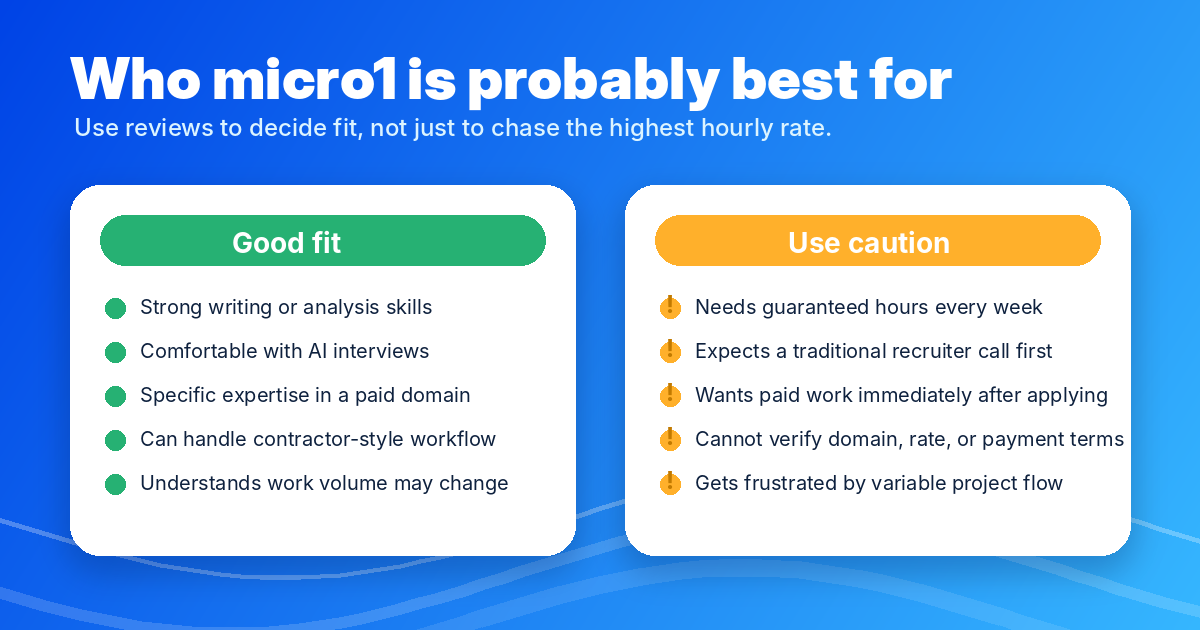
micro1 is a reasonable option for remote workers who have strong communication skills, specific domain knowledge, and the patience to handle a contract-based workflow. It may be especially useful for people who want remote work that uses writing, analysis, fact-checking, research, editing, coding, math, law, medicine, finance, sales, marketing, operations, or customer judgment.
It is also a good fit for people who understand that AI training work rewards precision. The better roles require you to compare model responses, explain quality differences, test instructions, identify subtle errors, and produce clean feedback that can help improve AI systems.
It is not a good fit for someone who needs a guaranteed paycheck next week. It is not ideal for someone who refuses AI interviews on principle. It is not the best option for someone who wants a simple, repetitive, low-effort side hustle. The strongest applicants treat it like skilled remote contract work.
How to Improve Your Chances
Your micro1 profile should be specific. Do not only say you are good at remote work, AI, communication, or problem solving. Those phrases are too broad. Say what you can evaluate. Examples include legal writing, financial analysis, B2B sales calls, customer support quality, software debugging, math reasoning, creative writing, medical terminology, academic research, marketing copy, recruiting judgment, UX research, or bilingual translation quality.
Your resume should also match the role. If you apply for AI model evaluation in finance, your resume should clearly show finance experience. If you apply for writing evaluation, it should show writing, editing, content strategy, journalism, marketing, education, or another relevant communication background.
During the AI interview, answer directly. Give examples. Explain your reasoning. Do not ramble. Do not overuse buzzwords. If asked to compare two answers, identify the exact difference: accuracy, completeness, instruction following, safety, tone, formatting, or reasoning quality. AI training work often rewards clear evaluation more than personality.
After applying, keep applying elsewhere. The remote AI job market is competitive and inconsistent. A smart applicant builds a pipeline across micro1, other AI training platforms like Mercor, Outlier AI, and Handshake AI, plus direct remote work listings and niche roles that match their background.
Red Flags to Watch For
The biggest red flag is any request for money. Do not pay to apply for remote AI work. Do not pay for a guaranteed micro1 placement. Do not buy a course that claims it can force acceptance. Do not trust a recruiter who asks you to send crypto, gift cards, bank login information, or payment to unlock onboarding.
The second red flag is a fake domain. Check the email address, the website, and the application link. Scammers often create lookalike domains that add extra words, hyphens, or unusual endings. If you are unsure, go directly to the official site instead of clicking a message link.
The third red flag is a vague role with unrealistic promises. A legitimate platform may advertise high rates for specialized work, but it should still explain the role, screening process, payment terms, and expectations. If a listing says anyone can make huge money immediately with no skill, no screening, and no quality checks, it is probably not a serious AI training role.
The Bottom Line
micro1 reviews in 2026 are best read as a map of expectations. Positive reviews suggest that some applicants like the AI interview, the remote setup, and the potential for high-value AI training work. Critical reviews warn that the process can feel automated, communication can be uneven, and paid projects are not guaranteed after every application or interview.
For remote workers, the practical conclusion is balanced. micro1 is worth applying to if you have relevant skills and understand the contractor nature of the work. It is not a replacement for a full job search, and it should not be treated as guaranteed income until you have an active project and clear payment terms.
The smartest move is to apply carefully, verify every communication, build a strong profile around real expertise, and keep multiple remote work options open. AI training work is growing, but the winners will be people who treat it professionally rather than casually.
Frequently Asked Questions
Is micro1 legit?
micro1 appears to be a real AI training and expert-work platform, but applicants should still verify official links, avoid upfront fees, and understand that acceptance does not guarantee steady work. Scammers can copy the names of legitimate companies, so always apply through the official site.
Does micro1 use an AI interview?
Yes. Applicants commonly discuss an AI-led interview experience, often associated with Zara. The interview is used to evaluate communication, reasoning, and role fit. Prepare by choosing one or two core domains and being ready to explain your judgment and expertise clearly.
Can beginners apply to micro1?
Beginners can apply, but the best results usually come from applicants who can show a clear skill, domain, or work background that matches a project. The platform rewards specific expertise in areas like writing, finance, law, medicine, sales, marketing, coding, or research.
Why do some people pass micro1 but get no projects?
Project availability can change. Passing a screen may place you in a qualified pool, but active paid work can depend on demand, location, role fit, quality thresholds, and timing. This is common across all AI training platforms and does not necessarily mean your application was unsuccessful.
Should I rely on micro1 for full-time income?
No single AI training platform should be your only income plan. Treat micro1 as one possible remote contract channel and keep applying to other legitimate remote work opportunities. Work availability can fluctuate based on client demand and project cycles.