A remote AI application is not the same as a normal job application. Many applicants treat these roles like a generic work-from-home job: they paste a resume, say they are interested in artificial intelligence, and wait. That is usually not enough.
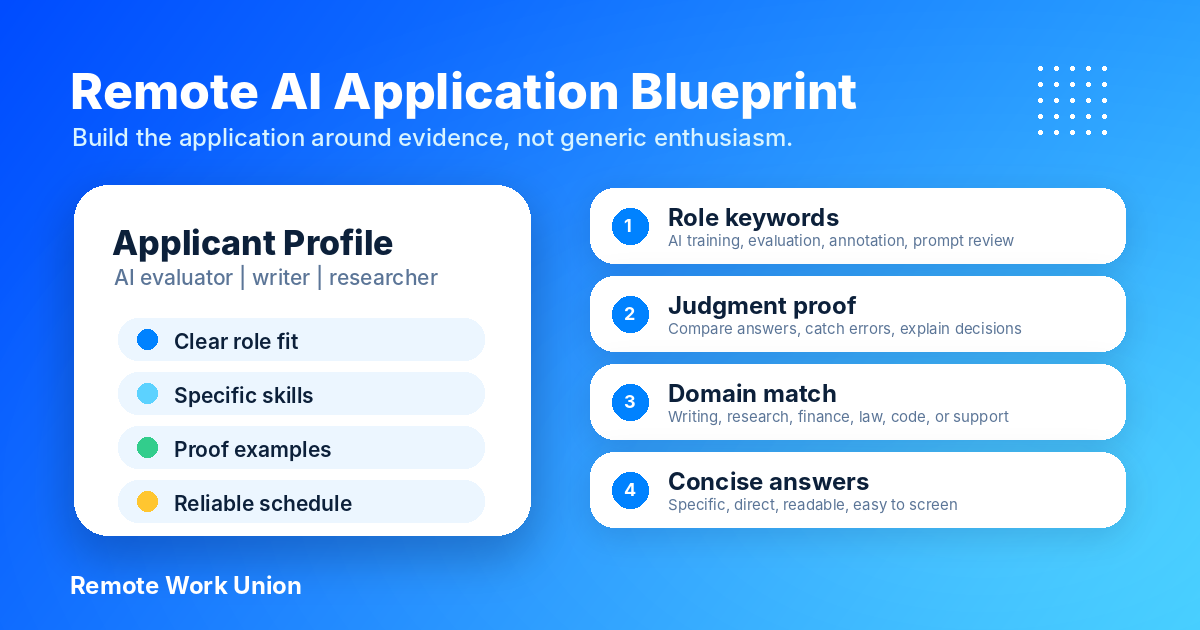
Remote AI platforms are usually looking for people who can make careful judgments. The work may involve AI training, AI evaluation, data annotation, response ranking, prompt writing, fact-checking, search quality review, rewriting, editing, research, or subject matter review. A strong application proves that you can read carefully, follow instructions, explain your reasoning, and produce consistent work without a manager watching over you.
That matters whether you are applying to micro1, Mercor, Handshake AI, or another platform hiring remote reviewers for companies building large AI systems. It also matters if the work is connected to major AI keywords like OpenAI, Anthropic, Google, Meta, Grok, AI assistants, model evaluation, and human feedback.
The goal is not to sound impressive. The goal is to make the screener understand your fit quickly.
Why Remote AI Applications Get Ignored
Most remote AI applications fail for simple reasons. They are too broad, too generic, or too focused on wanting remote work instead of proving ability.
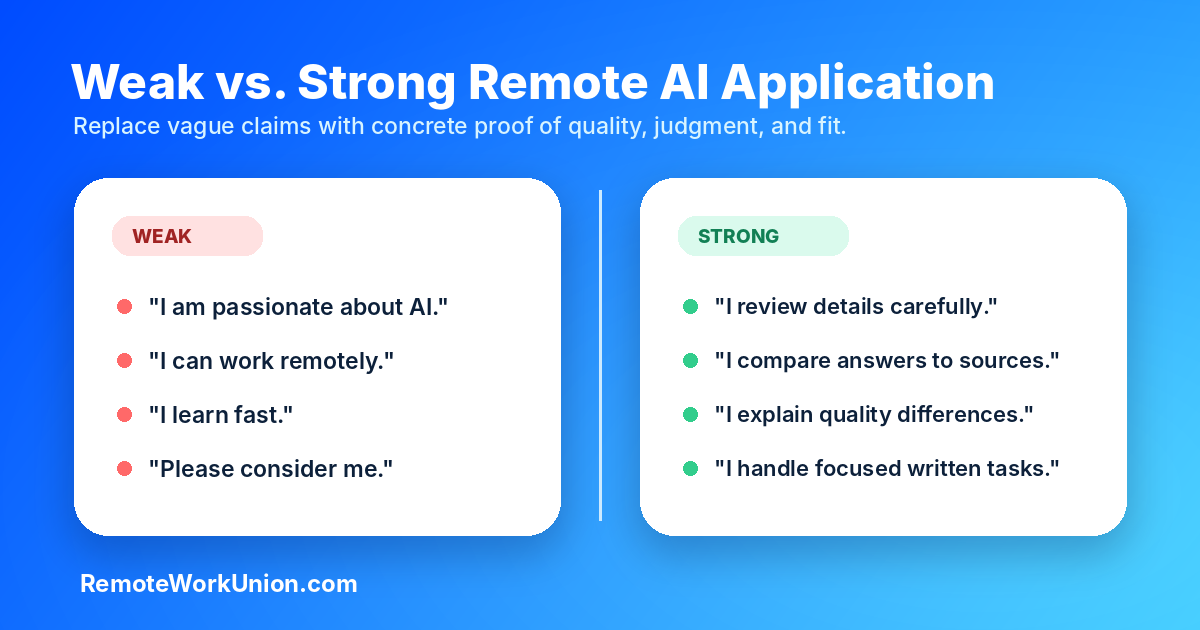
A weak application says: "I am excited about AI and can work from home." A stronger application says: "I have experience reviewing written work, comparing sources, catching inconsistencies, and explaining why one answer is more accurate than another." The second version gives the platform something useful to screen.
AI training platforms do not only need coders. They need people with judgment. That includes writers, editors, researchers, teachers, analysts, lawyers, finance professionals, healthcare professionals, customer support specialists, operations people, bilingual speakers, and strong generalists. But the application has to translate that background into the language of remote AI work.
If your application does not connect your experience to the task, the platform has to guess. Most platforms will not guess in your favor. They will move on to someone who made the fit obvious.
Start by Identifying the Type of AI Work
Before writing anything, identify what kind of remote AI role you are applying for. Different AI jobs reward different proof.
For AI evaluator jobs, emphasize comparison, judgment, clear writing, and instruction-following. For AI data annotation jobs, emphasize accuracy, consistency, labeling, detail, and patience. For prompt writing jobs, emphasize creativity, clarity, task design, and revision. For AI research or fact-checking work, emphasize source evaluation, research habits, and accuracy. For subject matter expert roles, emphasize domain knowledge and the ability to explain complex topics clearly.
This is where many applicants make the first mistake. They apply to every role with the same application. A remote AI application should be adjusted to the role type. You do not need to rewrite your entire background. You do need to move the most relevant evidence to the top.
Lead With Skills, Not Job Titles
Your job title may not match the role. Your skills might.
A customer support rep may have experience explaining policies clearly, spotting user issues, and writing concise responses. That can fit AI response evaluation. A teacher may have experience grading writing, explaining mistakes, and giving structured feedback. That can fit AI training work. A paralegal may have experience reading dense material, checking facts, and following strict instructions. That can fit legal AI review or research evaluation. A marketer may have experience writing, editing, analyzing search intent, and comparing content quality. That can fit content evaluation and prompt review.
Instead of opening with a title like "former office manager," translate your experience into work behaviors:
- I review written material for clarity, accuracy, and completeness.
- I compare multiple pieces of information before making a decision.
- I follow detailed instructions and maintain consistency across repetitive tasks.
- I explain edits or decisions in plain language.
- I can work independently with deadlines and written communication.
Those are the kinds of statements that connect directly to remote AI work.
Use the Right Keywords Naturally
Keywords matter because many platforms screen applications quickly. But keyword stuffing makes an application look weak. The goal is to use the language of the role in a natural way.
Relevant phrases may include remote AI jobs, AI training, AI evaluation, AI evaluator, AI trainer, AI data annotation, response ranking, prompt evaluation, prompt writing, fact-checking, content review, model evaluation, human feedback, research review, search quality, and AI assistant evaluation.
Do not force every keyword into every answer. Pick the ones that match the role. A short, natural line is usually enough:
That sentence is better than a list of buzzwords because it connects keywords to actual ability.
Write a Profile Summary That Sounds Like a Reviewer
Many platforms ask for a short profile, bio, or application summary. This is one of the best places to stand out.
A weak summary says: "I am hardworking, passionate about AI, and looking for remote opportunities."
A strong summary says: "I have experience writing, editing, and reviewing detailed content. I am comfortable comparing answers, checking information against instructions, and explaining quality differences clearly. I am interested in remote AI evaluation and AI training work where careful reading, accuracy, and written feedback matter."
The strong version works because it sounds like the work. It shows the platform what the applicant can do. It also includes relevant keywords without sounding fake.
Your summary should usually include three things: the type of work you can do, the proof behind it, and the kind of AI task you are targeting.
Answer Application Questions With Specific Evidence
When an application asks why you are a good fit, do not answer with motivation alone. Motivation is not proof. Use a simple structure: skill, evidence, fit.
Example: "I am a good fit for AI evaluation work because I have experience reviewing written content for accuracy and clarity. In previous roles, I regularly checked information, edited responses, and made sure written work followed specific guidelines. That background fits remote AI training tasks that require careful reading, consistent judgment, and clear written explanations."
This structure is easy to scan. It shows the skill, gives evidence, and connects the evidence to the role.
Use the same approach for questions about strengths, experience, availability, or why you want the role. Each answer should give the platform a reason to trust you with remote work.
Want to see which AI training platforms are hiring now? Find opportunities on RemoteWorkUnion.com.
Find Roles Hiring Now →Show Proof Even If You Do Not Have AI Experience
You do not need direct AI training experience to write a strong remote AI application. You need transferable proof.
Good proof can come from jobs, school projects, freelance work, writing samples, research projects, editing tasks, customer support tickets, legal documents, spreadsheets, quality assurance work, tutoring, social media content, operations work, or any role where you had to make decisions based on written information.
The key is to describe the proof in a way that matches the task. Instead of saying "I wrote blog posts," say "I researched topics, structured information clearly, edited for accuracy, and made content easier to understand." Instead of saying "I worked in customer service," say "I handled written communication, identified user problems, followed policies, and produced clear responses." Instead of saying "I was a student," say "I completed research-heavy assignments, evaluated sources, and wrote clear explanations under deadlines."
Remote AI work often rewards people who can turn messy information into reliable output. Show where you have already done that.
Mention Tools Without Overdoing It
It can help to mention tools, but tools should not be the center of the application. Platforms are usually hiring for judgment, not just software familiarity.
Useful tools to mention may include Google Docs, Microsoft Word, spreadsheets, search engines, research databases, content management systems, grammar tools, project management tools, and AI tools if you have used them responsibly. If the role involves AI writing, prompt testing, or response evaluation, you can mention experience using AI assistants, but do not make it sound like you will outsource the work to AI.
A good line is: "I am comfortable using AI tools, search tools, documents, and spreadsheets, but I understand that reviewer work depends on human judgment, source checking, and following platform instructions."
That line signals tool comfort without creating a red flag.
Avoid the Biggest Red Flags
Remote AI platforms see many low-effort applications. Avoid anything that makes your application look copied, careless, or risky.
Do not say you are applying only because you want easy remote work. Do not say you have no relevant experience without explaining transferable skills. Do not paste a generic cover letter that could apply to any job. Do not exaggerate technical skills. Do not claim expert knowledge in areas you cannot actually review. Do not write long paragraphs that bury the point. Do not use fake urgency or overpromise your availability.
Also avoid sloppy writing. If the work involves reviewing AI outputs, your application is already a writing sample. Typos, vague answers, and confusing sentences make the platform question your attention to detail.
A strong application is direct, clean, and specific.
Use a Simple Remote AI Application Template
You can adapt this template for most remote AI platforms:
Example for a writer: "My background is in writing and editing, where I have experience improving clarity, checking consistency, and adapting tone for different audiences. I am a strong fit for remote AI evaluation because I can compare responses, identify weak explanations, and explain which answer is more helpful. In past work, I have written and edited long-form content under deadlines. I am comfortable working independently, following detailed instructions, and writing clear explanations of my decisions."
Example for a researcher: "My background is in research-heavy work, where I have experience evaluating sources, organizing information, and checking claims for accuracy. I am a strong fit for remote AI training because I can review answers carefully, identify unsupported statements, and explain what needs to be improved. I am comfortable working independently, following guidelines, and producing consistent written feedback."
The template works because it is specific without being too long.
How Long Your Application Should Be
Short is usually better than long, but not empty. A good remote AI application is long enough to prove fit and short enough to screen quickly.
For a profile summary, aim for one concise paragraph. For application questions, two to five sentences is often enough. For a cover-letter-style response, three short paragraphs is usually better than one giant block of text.
The best applications do not make the reader hunt for the point. They put the strongest fit near the top. They use concrete verbs. They avoid filler. They make it obvious that the applicant understands the work.
What to Do Before You Submit
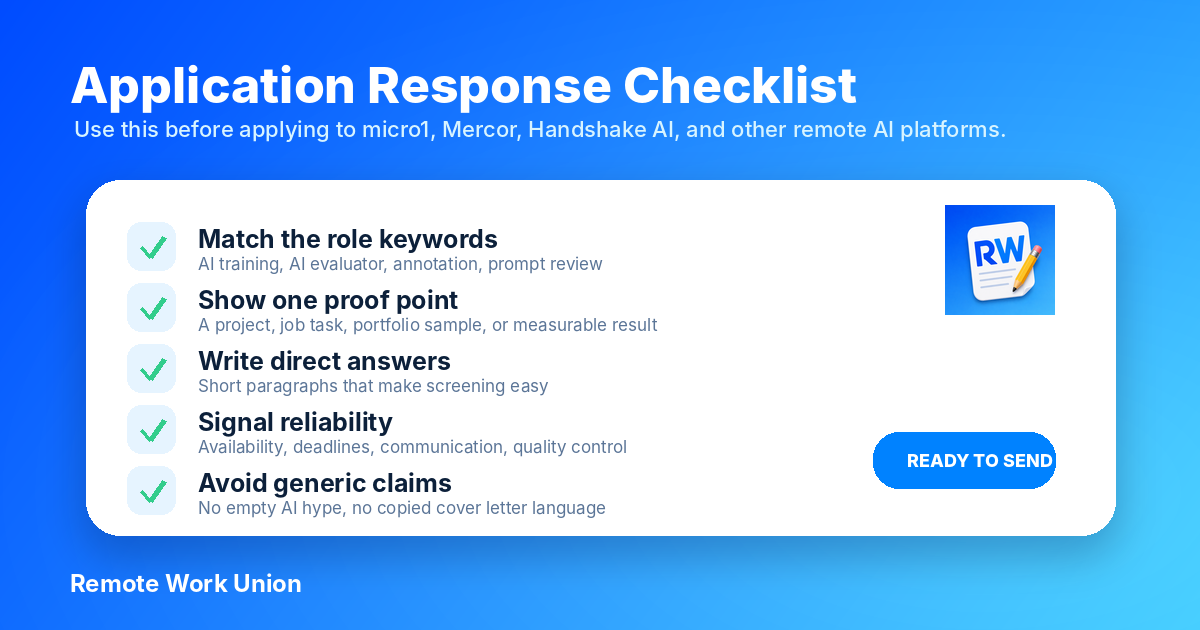
Before submitting, check your application against five questions:
- Does it mention the exact type of remote AI work I want?
- Does it show proof of judgment, accuracy, writing, research, or instruction-following?
- Does it use relevant keywords naturally?
- Does it explain why my background fits the task?
- Is it clean, concise, and easy to scan?
If the answer is yes, the application is much stronger than most generic remote work applications.
You should also make sure your resume or profile matches your written answers. If your summary says you are strong at research, your resume should include research-related proof. If your application says you are strong at editing, your profile should include writing, content, communication, QA, or review experience.
Following Up Without Looking Desperate
Some platforms do not allow traditional follow-up, and many remote AI marketplaces move slowly. If there is a professional way to follow up, keep it short.
Do not send repeated messages every day. Do not argue for a response. Do not ask whether the platform is real after applying. The goal is to remind them of your fit, not pressure them.
Final Takeaway
A remote AI application gets a response when it makes fit obvious. You do not need to pretend to be a machine learning engineer if the role is really about writing, reviewing, ranking, researching, or checking AI outputs. You need to show that you can think clearly, follow instructions, and produce reliable work from home.
The strongest applicants do three things well: they match the role language, they show proof from their background, and they write in a way that demonstrates the quality they are selling.
Remote AI work is still work. Treat the application like your first task. Make it accurate, concise, and useful.
Frequently Asked Questions
What should I include in a remote AI application?
A strong remote AI application should include a clear match to the role type (evaluation, annotation, prompt writing, research), proof of judgment or relevant skills from your background, natural use of role-specific keywords, and concise answers that are easy for a screener to scan quickly.
Do I need AI experience to apply for remote AI training jobs?
No. You need transferable proof, not direct AI experience. Good proof comes from writing, editing, research, customer support, legal work, finance, teaching, QA, or any role where you made decisions based on written information. The key is describing that experience in the language of remote AI work.
How long should a remote AI application be?
Keep it concise. For a profile summary, one focused paragraph is usually enough. For individual application questions, two to five sentences per answer typically works well. For a cover-letter-style response, three short paragraphs is better than a long block of text. The goal is to make your fit obvious without making the screener hunt for it.
What makes a remote AI application get ignored?
Most ignored applications are too broad, too generic, or focused on wanting remote work rather than proving ability. Saying "I am passionate about AI and can work from home" gives the platform nothing to screen. A stronger application names specific skills, gives concrete proof, and connects that proof directly to the type of AI task in the role description.
How should I follow up after applying to a remote AI platform?
If a professional follow-up channel exists, keep it short and role-focused. Mention your background, the specific task you applied for, and your readiness to complete any next step or assessment. Do not send repeated messages or pressure the platform for a response. Many remote AI marketplaces move slowly, and a delayed status does not always mean rejection.