A resume for AI training and model evaluation jobs does not need to be complicated or dramatically different from what you already have. But it does need to be translated — specifically, it needs to make the skills that AI training platforms are looking for immediately visible, even if your background is in a completely different field.
This article gives you the blueprint: the right structure, the keywords that matter, how to translate past experience into the language these platforms speak, and a template you can use to build your resume from scratch or update an existing one.
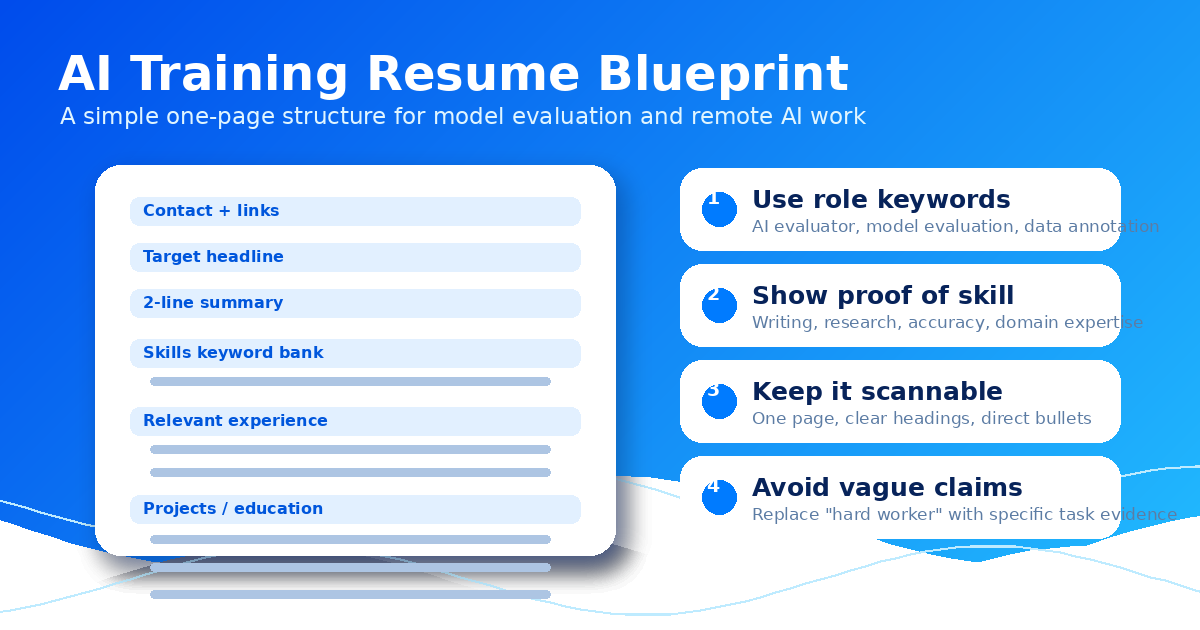
The One-Page Structure
AI training applications are processed quickly. Reviewers scan resumes for skill signals in under thirty seconds. A long resume with many unrelated roles dilutes those signals. A tight one-page resume that leads with what matters gets more results.
The recommended sections for an AI training resume are: headline, summary (two sentences), skills, work experience (three or four relevant roles, two or three bullets each), and education or certifications. That is all. No objective statement, no references, no photos, no elaborate formatting.
The Right Headline
The headline is the first thing a reviewer sees. For AI training jobs, it should communicate the role you are targeting and the most relevant skill cluster. Examples that work:
- AI Model Evaluator | Writing & Research | 5 Years Editing Experience
- AI Trainer Applicant | Legal Background | Document Review & Analysis
- Remote AI Evaluation Specialist | Finance | Data Analysis & Accuracy Review
- AI Response Reviewer | Science Writing | Research & Fact-Checking
The pattern is: role target, domain strength, relevant skill. Keep it to one line. The reviewer should know your value proposition in four seconds.
The Two-Sentence Summary
The summary answers two questions: who are you and why should an AI training platform choose you? It should not be a vague statement about your goals. It should be specific about your background and its value to AI evaluation work.
Example: "Former editor with eight years of experience reviewing complex written content for clarity, accuracy, and logical consistency across finance and business publications. Skilled at providing specific, actionable feedback under deadline with a consistent quality standard."
Notice what this does: it makes the editing experience concrete, names the subject areas (finance, business), and connects past skills to what AI evaluation actually requires (accuracy, consistency, actionable feedback).
Remote Work Union connects you to legitimate remote AI training and evaluation roles. Apply for free to find roles hiring now.
Find Roles Hiring Now →The Keyword Map
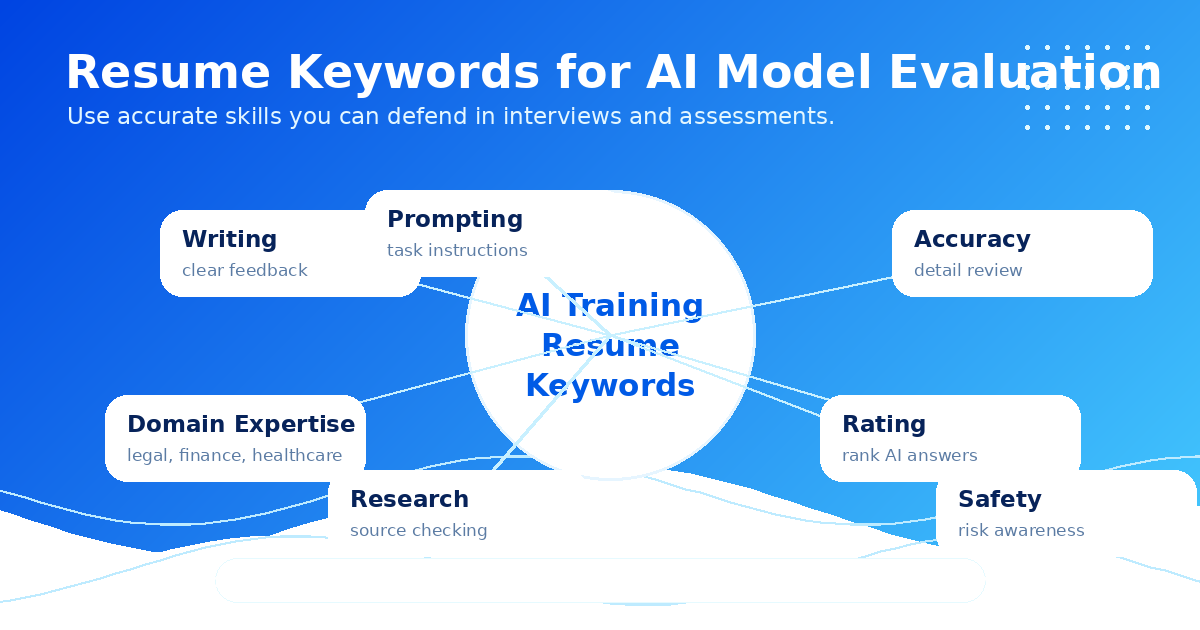
AI training platforms and their vendors use specific language when they search for contractors. Including the right terms in your resume helps you appear in searches and signals familiarity with the work. Key terms to include where relevant:
- AI model evaluation, AI evaluation, AI training
- RLHF, reinforcement learning from human feedback, human feedback
- Data annotation, data labeling, content labeling
- Prompt evaluation, response review, AI response rating
- Quality assurance, QA, accuracy review
- Research, fact-checking, source verification
- Writing, editing, proofreading, content review
- Domain expertise keywords: legal research, financial analysis, medical writing, software development, education, marketing, customer service
Do not force every keyword into your resume. Use the ones that genuinely connect to your background. A resume that misuses every keyword is less effective than one that uses five accurately.
Before-and-After Bullet Transformations
The most common resume failure for AI training applicants is bullets that describe tasks without connecting them to evaluation skills. Here are examples of how to transform existing experience into AI training language:
Writer/Editor example:
Before: "Wrote and edited articles for the company blog on marketing topics."
After: "Reviewed and edited 60+ articles per month for accuracy, clarity, and structural consistency — maintaining measurable quality standards across a high-volume content pipeline."
Customer service example:
Before: "Answered customer questions and resolved complaints."
After: "Evaluated customer communication quality and provided structured feedback to improve response accuracy and consistency — reviewing up to 80 interactions per shift."
Research analyst example:
Before: "Conducted market research and prepared reports."
After: "Assessed information quality and source credibility across market research projects, writing clear analytical summaries that identified errors, gaps, and unsupported claims."
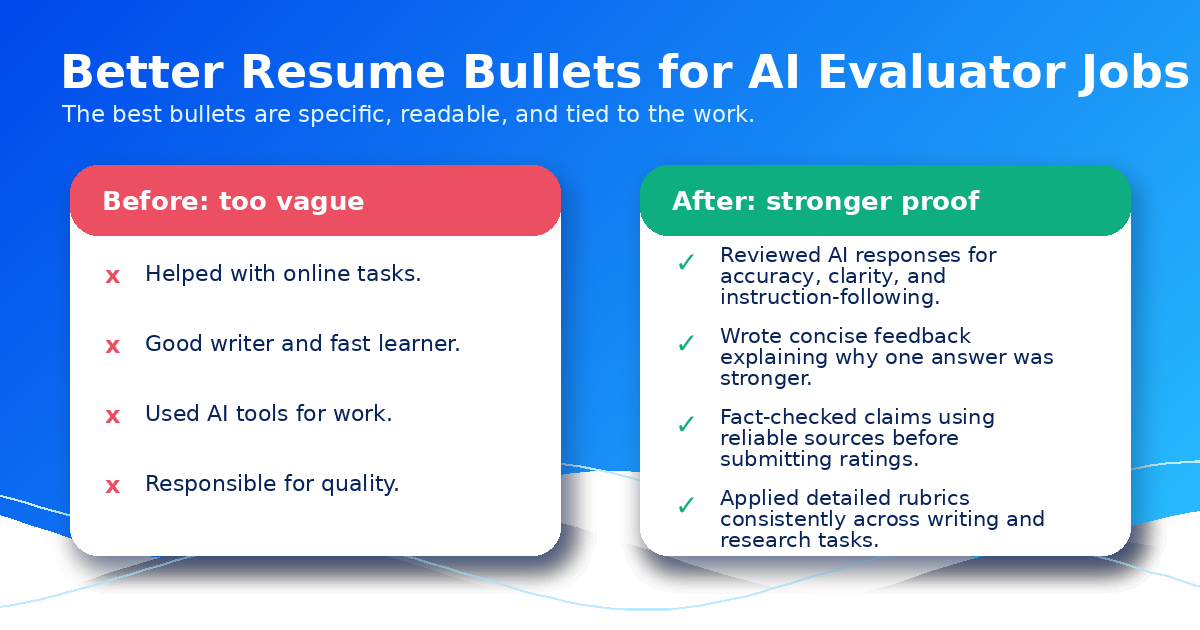
Tip: The "before" version describes what you did. The "after" version describes what your work required and what it produced. AI training platforms are not hiring your job title — they are hiring the skill of evaluating quality, maintaining standards, and writing clear feedback. That is what your bullets need to show.
The Full Application Flow
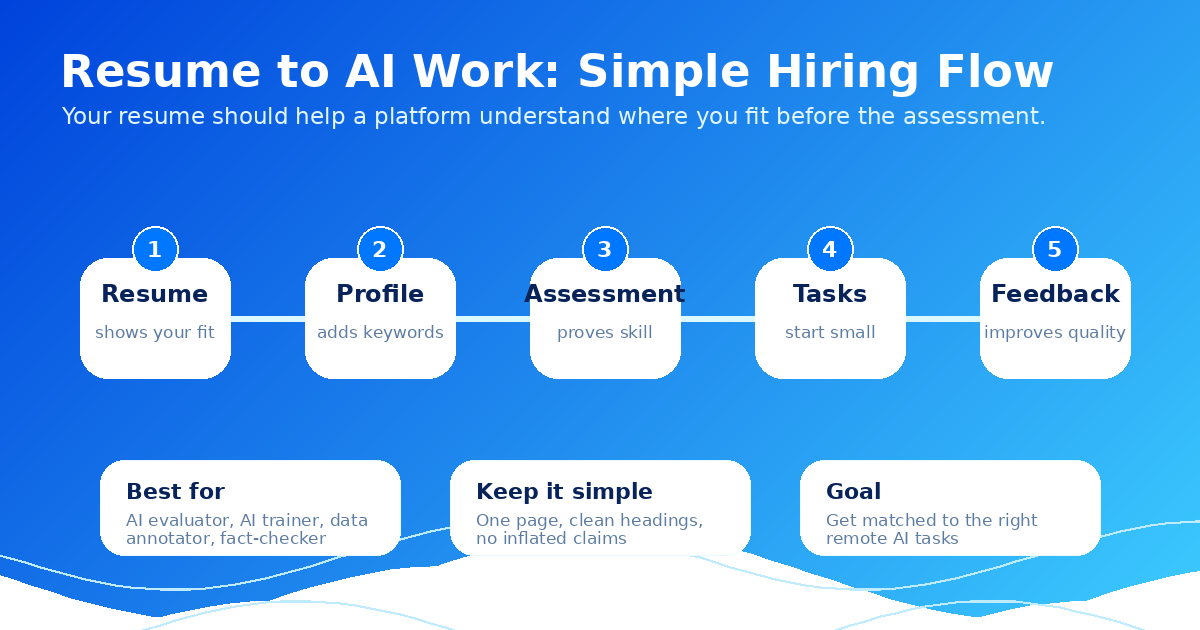
After you have built your resume, the application flow for AI training platforms typically follows this sequence: create an account on the platform, complete profile setup (including skills, education, and domain expertise), submit your resume if required, complete a skills assessment or test task, wait for a match notification or project invitation, and then complete onboarding for your first project.
The assessment is often more important than the resume. Your resume gets you to the assessment. The assessment determines your project access. Treat the assessment as a performance — apply the same quality you would to professional work.
Apply to Outlier AI, Mercor, Handshake AI, and micro1 simultaneously. Processing time varies. Parallel applications mean you are more likely to hear back from multiple platforms in the same window rather than waiting sequentially.
Frequently Asked Questions
What should a resume for AI training jobs include?
A resume for AI training jobs should include a clear headline (AI Model Evaluator or AI Trainer), a two-sentence summary of your skills and background, a skills section with relevant AI evaluation keywords (accuracy, quality review, research, analysis, domain expertise, RLHF, data annotation), work experience bullets that translate past roles into skills relevant to evaluation work, and education or certifications if applicable. Keep it to one page.
Do I need prior AI experience to apply for AI training jobs?
No. Most AI training and model evaluation platforms do not require prior AI-specific experience. They look for people who can think carefully, write clearly, do research accurately, and maintain quality across many tasks. Writing, editing, research, analysis, teaching, legal, finance, and customer service backgrounds can all translate well to AI evaluation work.
What keywords should I include in my AI training resume?
Key terms to include: AI model evaluation, AI training, RLHF, data annotation, quality assurance, research, fact-checking, accuracy review, content review, prompt evaluation, AI response rating, domain expertise (specific to your background), writing, editing, analysis, attention to detail, and independent judgment. Specific domain keywords (legal research, financial analysis, medical writing, software development) also matter for expert-tier projects.
How long should a resume for AI training jobs be?
One page is ideal. AI training platforms and vendors process many applications. A concise, well-organized one-page resume communicates your skills faster and more effectively than a longer document. Focus on what is relevant to evaluation work and remove roles that do not demonstrate the skills platforms are looking for.