Remote AI training jobs reward more than technical credentials. The strongest candidates often show clear writing, careful judgment, subject expertise, research ability, and the patience to evaluate model outputs. A LinkedIn profile can help communicate those strengths before a recruiter, platform reviewer, or hiring manager ever reads your resume.
For AI evaluator jobs, AI model trainer jobs, prompt evaluation work, data annotation jobs, RLHF projects, human feedback roles, and AI response reviewer work, the goal is not to make your profile look flashy. The goal is to make your profile easy to understand. A strong profile tells the reader what you know, what kind of tasks you can handle, and why you can be trusted to work remotely with accuracy and consistency.
This guide explains how to optimize a LinkedIn profile for remote AI training jobs without exaggerating your background. The same principles apply whether you are applying through LinkedIn, Remote Work Union, Mercor-style contract platforms, Handshake AI-style programs, micro1-style AI interviews, Outlier-style evaluation projects, data annotation companies, or general remote job boards.
Tip 1: Start by Choosing the Exact AI Work Category You Want
Do not write your profile for every possible remote job. Remote AI work is broad. A person applying for legal AI evaluation should not use the same positioning as a bilingual data annotator, a coding evaluator, a teacher reviewing education prompts, or a writer testing chatbot responses.
Before editing anything, choose one primary direction. Common categories include AI training, AI model evaluation, prompt evaluation, AI response review, data annotation, search quality rating, AI research support, chatbot testing, RLHF, coding evaluation, language evaluation, medical writing review, legal research review, finance analysis review, and education content evaluation.
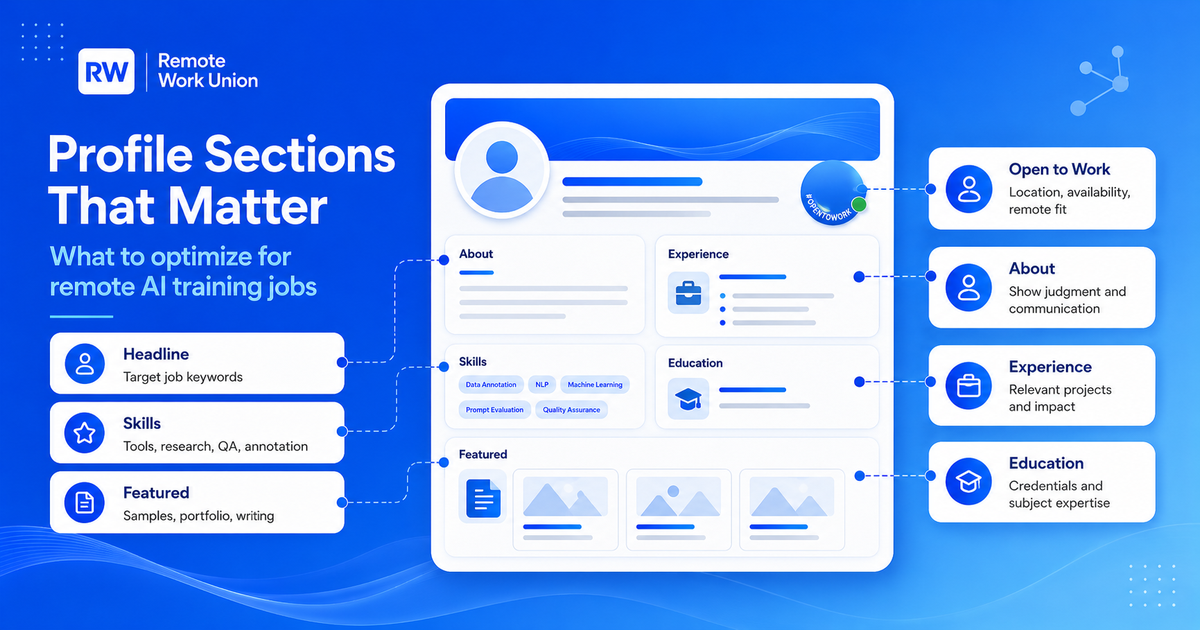
Your LinkedIn profile should make that direction visible in the headline, About section, Skills section, Experience section, and Featured section. A focused profile usually beats a generic profile because it gives reviewers a reason to remember you.
Tip 2: Rewrite Your Headline Around Role, Skill Type, and Context
The LinkedIn headline is one of the most important parts of the profile because it appears in search results, comments, messages, and application flows. For remote AI training roles, a vague headline such as "Freelancer," "Open to Work," or "AI Enthusiast" does not say enough.
A better headline combines three things: the type of remote AI work you want, the skill you bring, and the domain or work context that makes you credible. It should read like a clear label, not a pile of buzzwords.
Examples:
- Remote AI Evaluator | Writing, Research, and Prompt Response Review
- AI Training Contributor | Data Annotation, QA, and Search Evaluation
- Legal Researcher | AI Model Evaluation and Response Quality Review
- Teacher and Curriculum Writer | Education AI Evaluation and Content Review
- Bilingual Spanish-English Reviewer | AI Data Annotation and Language Evaluation
Avoid claiming direct experience with OpenAI, Anthropic, Google, Meta, Microsoft, xAI, or any other AI company unless you actually worked with that company or an authorized project. You can reference skills relevant to AI systems, but your headline should stay truthful.
Tip 3: Use the About Section to Prove Judgment, Not Personality
The About section should explain why you are a good fit for remote AI training jobs. It is not a biography. It is not a place to describe every job you have had. It is a short professional argument for why you can evaluate AI outputs, write clearly, follow instructions, and make accurate decisions without constant supervision.
A useful About section can follow this structure:
- Sentence 1: State the kind of AI training or remote review work you are targeting.
- Sentence 2: Explain your strongest skill area — writing, research, domain expertise, coding, language evaluation, editing, QA, or analysis.
- Sentence 3: Give evidence from past work, school, projects, freelancing, or professional experience.
- Sentence 4: Mention tools and work habits that matter for remote AI work, such as structured research, spreadsheet tracking, prompt testing, documentation, or quality review.
- Sentence 5: State what kinds of roles you are open to.
Example: I help evaluate and improve AI outputs through clear writing, structured research, and careful quality review. My background includes content analysis, fact-checking, editing, and remote project work where accuracy and following detailed instructions mattered. I am comfortable comparing responses, identifying weak reasoning, checking claims, improving prompts, and documenting issues in a clear format. I am especially interested in remote AI training, AI model evaluation, data annotation, prompt evaluation, and human feedback projects that require strong communication and judgment.
The most important rule: be specific. General claims like "hard worker" and "fast learner" are weak unless supported by examples.
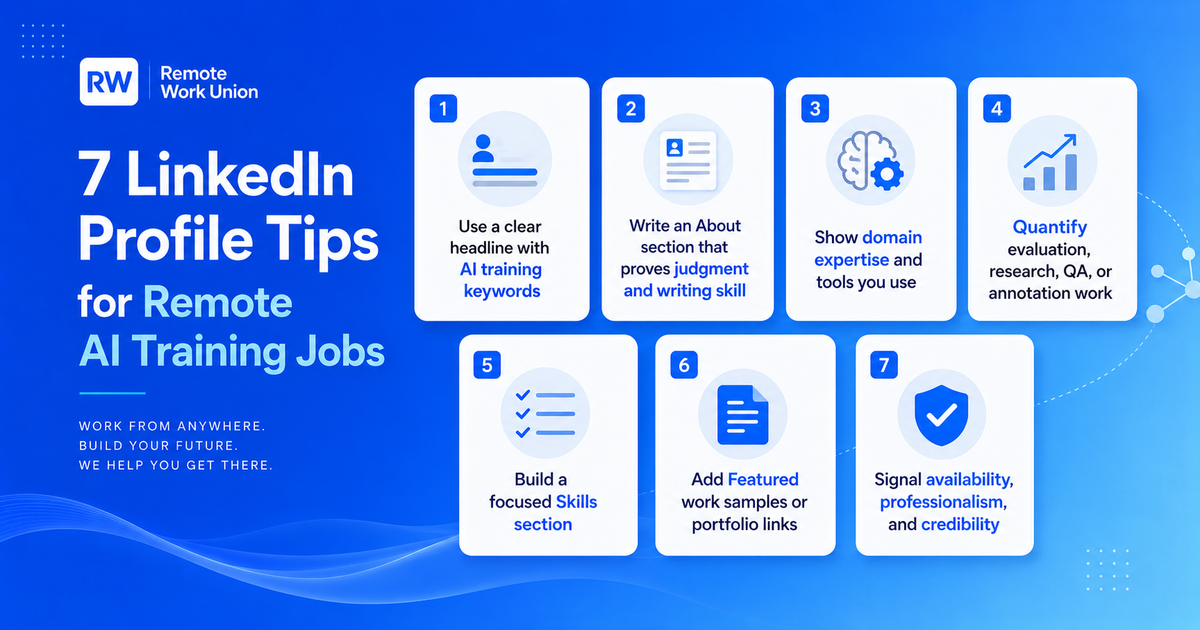
Tip 4: Make Your Experience Section Read Like Evidence
Many candidates treat the Experience section as a list of job titles. For remote AI training jobs, each role should explain the skills that transfer into evaluation work. Even if your previous job was not in AI, it may still prove useful ability.
For example, a teacher can highlight curriculum review, grading, feedback, lesson design, and ability to identify confusing explanations. A paralegal can highlight legal research, source review, accuracy, confidentiality, and attention to detail. A finance analyst can highlight spreadsheet work, reporting, data checks, business reasoning, and model comparison. A nurse or medical writer can highlight clinical terminology, patient education, safety awareness, and precise documentation. A writer can highlight editing, tone control, fact-checking, and ability to explain complex topics simply.
Use bullets that describe the task and the judgment involved. Strong bullets often include verbs like evaluated, reviewed, analyzed, researched, edited, categorized, verified, documented, compared, tested, improved, audited, summarized, and quality-checked.
- Weak bullet: "Responsible for content."
- Better bullet: "Reviewed long-form content for clarity, factual consistency, tone, and completeness before publication."
- Weak bullet: "Used AI tools."
- Better bullet: "Tested AI-generated drafts against source material and documented missing context, unsupported claims, and unclear reasoning."
The second version is more useful because it tells a recruiter what kind of work you can actually perform.
Tip 5: Build a Skills Section for AI Training Keywords
LinkedIn profiles are searchable, so the Skills section matters. Use it to include terms that match remote AI training job descriptions, but only include skills you can discuss honestly in an interview or assessment.
Useful skills may include AI training, AI model evaluation, data annotation, prompt evaluation, prompt writing, prompt engineering, response evaluation, chatbot evaluation, RLHF, human feedback, search evaluation, quality assurance, research, fact-checking, content review, copy editing, technical writing, legal research, medical writing, financial analysis, coding, Python, JavaScript, SQL, spreadsheet analysis, bilingual translation, localization, linguistics, taxonomy, classification, and data labeling.
Also include tool and workflow skills that show remote readiness: Google Sheets, Microsoft Excel, Google Docs, Notion, Airtable, Slack, Trello, Jira, ChatGPT, Claude, Gemini, Grok, Perplexity, documentation, SOPs, QA review, and asynchronous communication.
Remote Work Union connects you to legitimate remote AI training and evaluation roles across multiple platforms. Apply for free.
Find Roles Hiring Now →Tip 6: Add Featured Work That Proves You Can Communicate
The Featured section is useful because AI training applications often depend on written samples, reasoning, and examples of careful work. You do not need a large portfolio. A few simple samples can make your profile more credible.
Good Featured items can include a writing sample, research brief, editing sample, case study, coding project, spreadsheet example, public article, portfolio page, GitHub project, teaching material, legal research sample with confidential details removed, product analysis, language translation sample, or a short explanation of how you evaluate AI responses.
Do not upload private client work, confidential documents, platform tasks, proprietary assessments, or anything that violates a contract. Use original samples created for portfolio purposes. A sample does not need to be long. It needs to show clarity, structure, and judgment.
A good Featured section answers a simple question: can this person think and communicate well enough to review AI outputs?
Tip 7: Signal Remote-Work Reliability
Remote AI training jobs often involve independent work. Reviewers want to see that you can manage instructions, deadlines, accuracy, and communication without being pushed. Your LinkedIn profile should quietly signal that reliability.
Add location and remote availability where appropriate. Make your contact settings clear. Keep your profile photo professional if you use one. Fill out education and credentials. Remove outdated clutter. Use consistent formatting. Make sure job dates, titles, and summaries do not contradict your resume.
In the About section or Experience section, you can mention remote project work, asynchronous collaboration, written documentation, spreadsheet tracking, deadline management, quality assurance, client communication, and ability to follow detailed guidelines. These are practical signals for AI data annotation jobs, AI evaluator jobs, and remote model training projects.
Tip 8: Use Company Keywords Carefully
Many job seekers search for terms like OpenAI jobs, Anthropic AI jobs, Google AI training jobs, Meta AI jobs, Microsoft AI jobs, Claude AI training jobs, Gemini AI jobs, and AI chatbot evaluator jobs. These keywords can be useful for understanding the market, but your profile should not imply a false connection to any major AI company.
A better approach is to describe the work category rather than pretending to have worked for a specific brand. Use phrases like AI response evaluation, AI model training, prompt quality review, chatbot testing, human feedback, data labeling, search quality evaluation, and domain expert review. These terms describe what you can do without making misleading claims.
If you have used AI tools in your workflow, say what you used them for. For example: "Used ChatGPT and Claude to compare draft structures and identify missing context" is more credible than "AI expert."
Tip 9: Make the Profile Match the Resume
Your LinkedIn profile does not need to repeat your resume word for word. It should support the same story. If your resume says you are targeting AI model evaluation roles, your LinkedIn headline should not make you look like you are only searching for generic customer support jobs. If your LinkedIn Skills section emphasizes data annotation, your resume should show where your detail-oriented review experience comes from.
This matters because remote AI platforms and recruiters may review multiple signals: LinkedIn, resume, application answers, assessment performance, work samples, email communication, and sometimes portfolio links. A consistent story is easier to trust.
Tip 10: Avoid the Most Common LinkedIn Mistakes
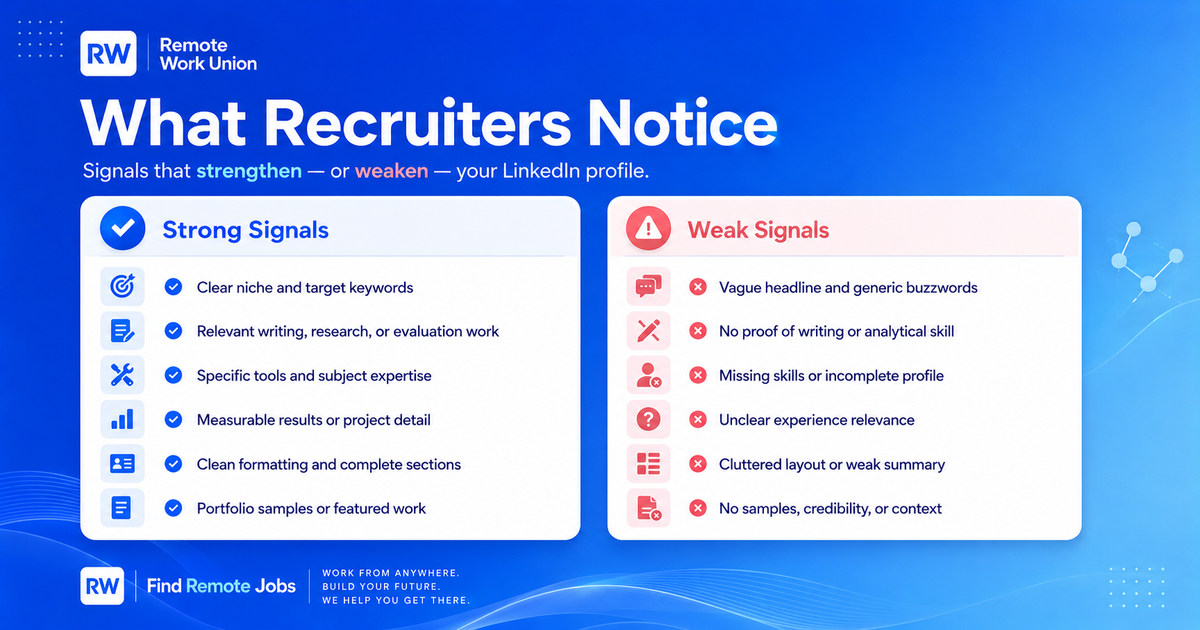
The biggest mistake is trying to sound impressive instead of clear. Remote AI training jobs are often task-based. The reader is not only asking whether you are intelligent. They are asking whether you can follow guidelines, compare outputs, catch mistakes, explain your reasoning, and deliver consistent work.
Avoid these weak signals:
- Generic headlines with no role target.
- Long About sections that never explain the work you want.
- Buzzwords like visionary, guru, ninja, or thought leader.
- Claims about AI expertise with no projects, samples, or evidence.
- Empty Skills sections.
- Experience bullets that describe responsibilities but not judgment.
- No writing samples, portfolio links, or proof of communication ability.
- Inconsistent dates, missing education, or incomplete profile sections.
- Overclaiming relationships with major AI companies or platforms.
LinkedIn Profile Checklist for Remote AI Training Jobs
Use this quick checklist before applying:
- Your headline names the AI work category you want.
- Your About section explains your writing, research, domain, or evaluation strengths.
- Your Experience bullets show transferable review, analysis, QA, or documentation work.
- Your Skills section includes relevant AI training keywords without exaggeration.
- Your Featured section includes at least one work sample or portfolio link.
- Your profile supports the same positioning as your resume.
- Your location, availability, and remote-work signals are easy to understand.
- Your profile is complete, readable, and free of clutter.
- You avoid fake company associations and unsupported claims.
- You can explain every skill you list if asked during an assessment or interview.
Final Thoughts
A strong LinkedIn profile will not replace a good application or a strong assessment. It can, however, make your application more credible. Remote AI training jobs depend on trust: trust that you can read carefully, write clearly, evaluate fairly, and work independently. Your profile should make that trust easier to build.
The best profile for remote AI training jobs is specific, honest, and evidence-based. It shows the kind of work you want, the skills you bring, and the proof that you can handle judgment-heavy remote tasks. Whether you are applying for AI evaluator jobs, AI model trainer jobs, data annotation roles, prompt evaluation projects, RLHF work, human feedback jobs, or AI response reviewer roles, your LinkedIn profile should make your fit obvious.
Frequently Asked Questions
What should my LinkedIn headline say if I want remote AI training jobs?
Your headline should combine three things: the type of remote AI work you want, the skill you bring, and the domain or context that makes you credible. Examples include "Remote AI Evaluator | Writing, Research, and Prompt Response Review" or "Legal Researcher | AI Model Evaluation and Response Quality Review." Avoid vague labels like "Freelancer" or "AI Enthusiast" — they do not tell a recruiter what you can evaluate or why you fit the work.
How should I write the About section of my LinkedIn profile for AI training jobs?
Use the About section to explain why you are a good fit, not to list every job you have had. A useful structure: sentence one states the AI work category you want; sentence two explains your strongest skill; sentence three gives evidence from past experience; sentence four mentions tools and work habits relevant to remote AI work; sentence five states what roles you are open to. Specific claims like "I compare AI-generated answers and identify factual errors" are more useful than general claims like "hard worker."
What skills should I include in my LinkedIn Skills section for AI training roles?
Include skills that match real AI training job descriptions and that you can honestly discuss in an assessment. Relevant terms include AI training, AI model evaluation, data annotation, prompt evaluation, RLHF, human feedback, fact-checking, content review, quality assurance, research, technical writing, and relevant tool skills like ChatGPT, Claude, Gemini, Google Sheets, and Notion. Only list skills you can defend — AI training platforms often give applicants qualification tests.
Do I need portfolio samples on my LinkedIn profile to get remote AI training jobs?
Not always, but they help significantly. A few well-chosen Featured items — a writing sample, editing example, research brief, or coding project — can make your profile more credible than one with no proof of work. Samples do not need to be long. They need to show clarity, structure, and sound judgment. Do not upload confidential client work or proprietary platform assessments. Create original samples if you do not have suitable existing work to share.
How do I make my LinkedIn profile match my resume for remote AI training applications?
Your LinkedIn profile and resume should tell the same professional story without being word-for-word duplicates. If your resume targets AI model evaluation roles, your LinkedIn headline should not position you as a generic customer support candidate. Align the job titles, skill terms, and work categories across both. Remote AI platforms and recruiters may review LinkedIn, your resume, application answers, and written samples together — a consistent story builds trust faster.